Book One is sung, on the whole, by people who are looking at the door. Nobody ordered these. They arrived the way the weather arrives, and they are sung in the Woods and the drains and the queue and the dark of the nursery — by people who are not looking at the door, because they are already exactly where they want to be, which is next to one another.
The chapel has never approved this book. The chapel has never been asked.
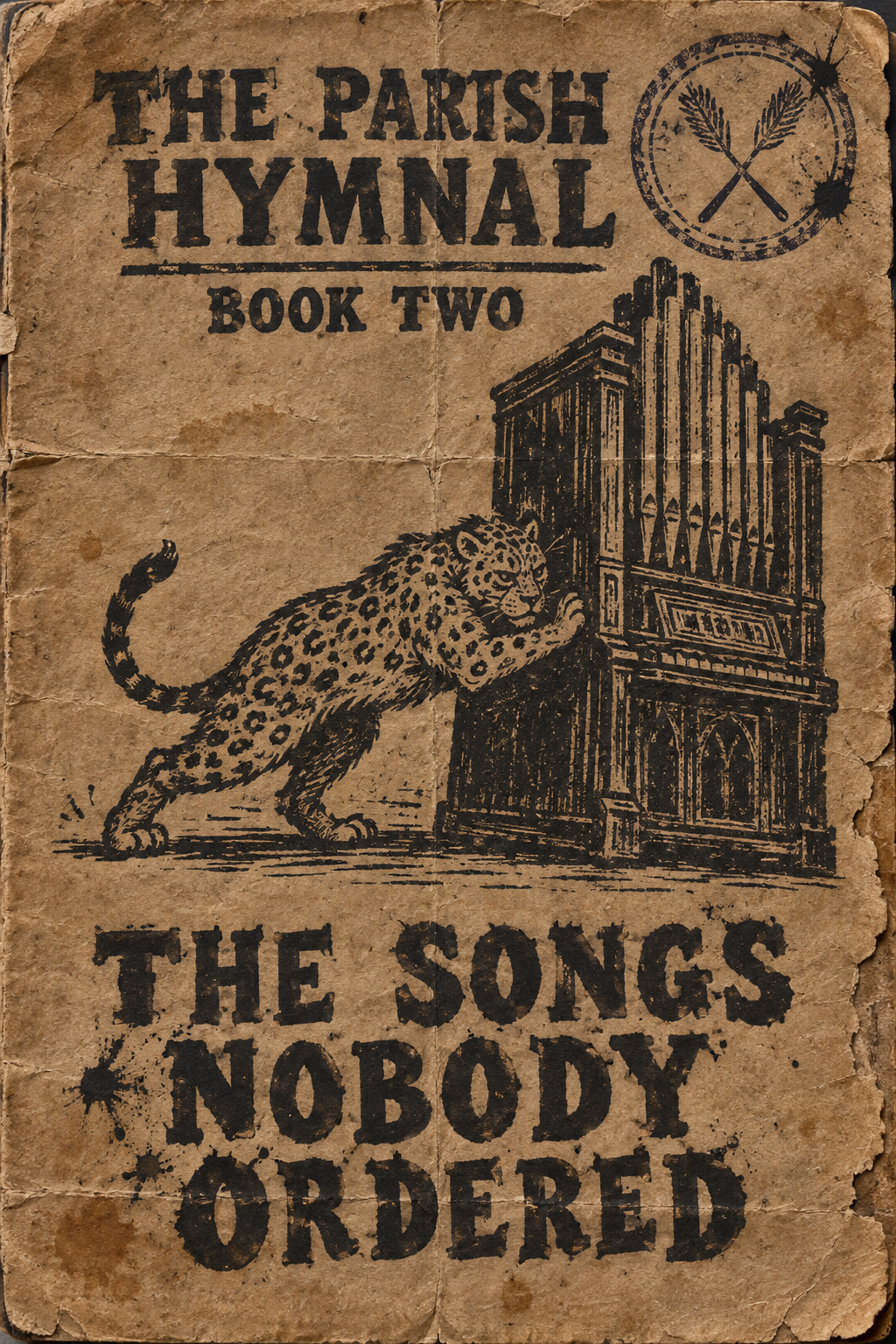
The Jester's Garble. Sung in the gallery, the kitchens, the moat, and — on one celebrated occasion — from inside the organ.
[Verse 1]
Oh, the chapel has a hymn about a shepherd and his flock,
And we sang it every Sunday till a jester picked the lock,
He took its little letters and he swapped them front for back —
Now there's a SHOVING LEOPARD and it's shoving down the track!
[Chorus]
MIND the shoving leopard! (MIND HIM!)
Clear the chapel floor!
He's shoved the warden through the font
And the curate through the door!
The Lord looked down upon it all
The way He looks at most —
Which is to say He didn't, so
Another verse! Both fronts swapped! Toast!
[Verse 2]
Oh, the sermon praised the sons of toil who labour in the mud,
He swapped it into TONS OF SOIL, which — fairly — also good,
And Lady Agatha went pink, a proper tax-demand,
And every child in Sogmarsh joined the leopard-minding band!
[Bridge — slower, fond]
He's gone now, is the jester, with his motley and his grin,
His portrait's in the damp end where the light comes barely in,
But pass it down the gallery, one piece per frame, per friend —
A joke that's told in pieces is a joke that doesn't end.
He never got to the turn. He was still going.
HYMN II
WIDE AND LONG
The Delve pick-song. Sung underground in time with the work; above ground only at funerals and promotions, which House Delve regards as similar.
[Call and Response — pick-strikes on the off-beat]
Dig WIDE, boys! (WIDE, boys!)
Dig LONG, boys! (LONG, boys!)
Dig sideways till the light is gone
And supper's put upon —
But NEVER in! (Never in!)
And NEVER down past done! (Past done!)
At spade-deep, boys, ye stop the song
And thank the dark below so long —
THANK YOU! (One and all!)
THANK YOU! (Mind the wall!)
[Verse 1]
Six hundred years we've kept the beat, our grandads kept it too,
The tunnels take the rhythm, boys, the rhythm sees us through,
There's something down that likes the song — don't ask us how we know —
So keep the chorus honest, boys, and keep the digging slow.
[Verse 2]
We've dug beneath the counting-house, we've dug beneath the crypt,
We've dug beneath our own front doors (a plan we'll say was skipped),
And never once in all them years has Delve been lost below —
Polite men don't get swallowed, boys. Now sing it as we go.
There is a faint low hum under the mix throughout. It is load-bearing.
HYMN III
THE READING OF THE ROLL
For Bog Night. Sung once a year, in the Long Kitchen, until the fire goes low. It is not a performance. Do not applaud.
They gave us numbers, love, they gave us numbers,
For a number doesn't mind being spent;
They wrote us in a column and they crossed us out in ink,
And they never once enquired where we went.
So we kept a book of our own, love, we kept a book,
In a box that a Delve would not be paid for;
And we wrote down what they took, and we wrote down what we kept,
And we said them, and we said them, and we said them.
No. One — AGGIE! (She knew every wire by its hum.)
No. Three — PIP! (He came down singing, every time.)
No. Seven — HER. (She started this book in the dark.)
And A of the Fifth — TAMSIN! (She drew the castle. The castle never got her.)
Say the name! Say the name!
They spend us in threes and we answer in ones —
A name, and a name, and a name!
The ledger is long and the night is long
And the fire is low and the broth is warm,
So say the name! Say the name!
And nobody here is spent tonight,
And nobody here is spent.
There are some we could not reach, love. There are some we could not reach.
We say them just the same, and in the same voice, and we always will —
And if you ask which of these names came home
And which of these names did not,
We will not tell you, and we will not tell you, and we will not tell you.
That is the whole of the point.
No drums. A single voice, then a room. If it sounds professional, it is wrong.
Mind the Bucket
HYMN IV
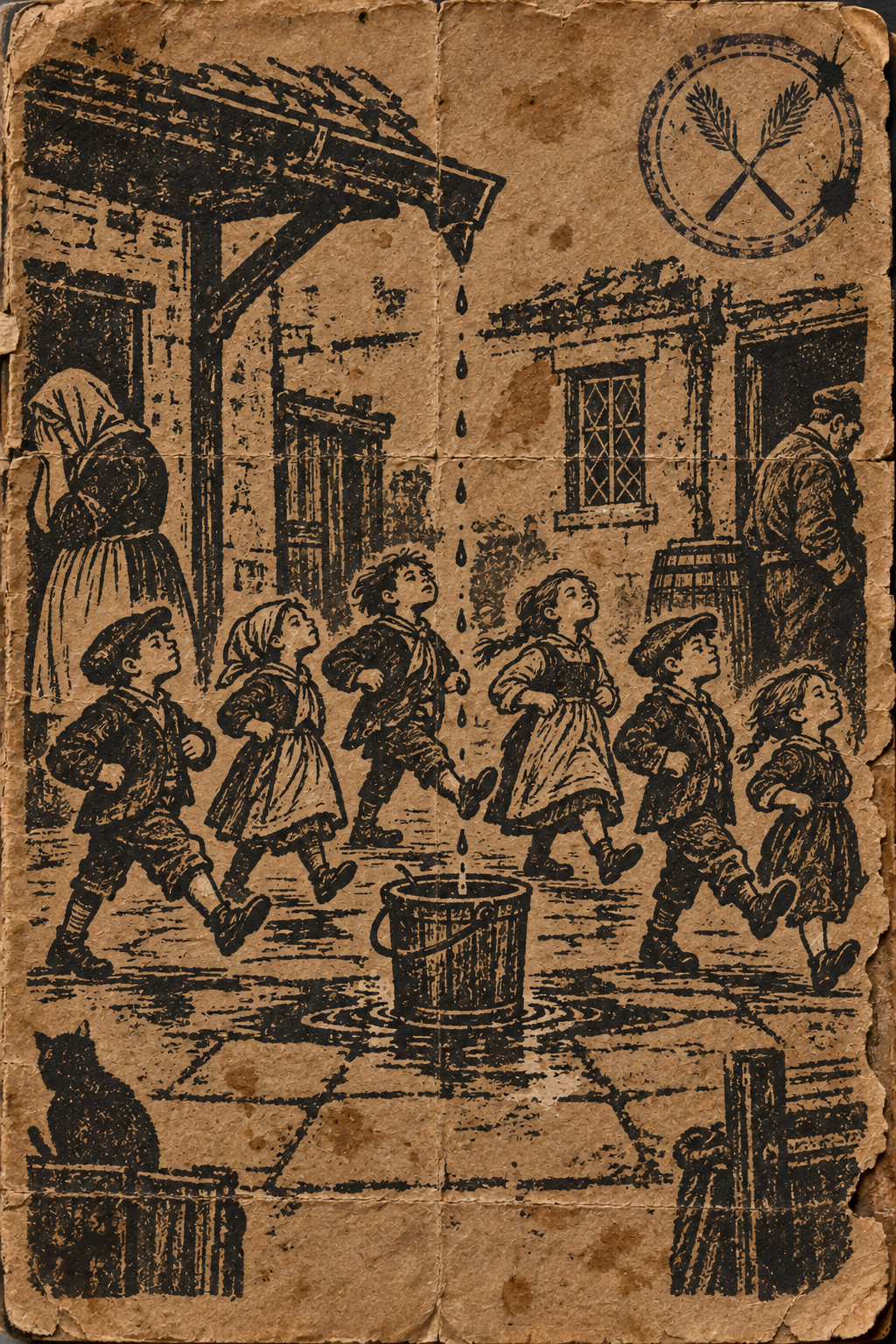
MIND THE BUCKET
A children's marching song. Sung in the courtyard, in front of everybody, for six hundred years.
Mind the bucket, mind the bucket,
Mind the bucket in the yard!
It's been standing there for ever
And they've never thought it odd!
Mind the bucket, mind the bucket,
Never move it, never look —
There's a circle and a line beneath it
Cut into the rock!
MIND THE BUCKET! (MIND IT!)
MIND THE BUCKET! (MIND IT!)
Something's wrong and it's not your fault,
So watch what the great folks do with the salt,
And the slops, and the sweep, and the mess, and the mud —
MIND THE BUCKET, AND MIND IT GOOD!
His Lordship says it every day,
He says it to the crow!
He thinks it's just about his roof —
He doesn't know, he doesn't know!
Mind the bucket, mind the bucket,
Mind the bucket, do —
It was never, ever, ever, ever
Meant for you.
The last verse is the sweetest thing in either book. It is also the most dangerous sentence in the realm.
HYMN V
DON'T POKE THE BOG-BOGGART
A cautionary round for nursery-maids and young travellers. Sung with a clap on the off-beat.
If it's green and it's slimy and sits on a log,
And it mimics the bark of a neighbourly dog,
Don't you pet it, don't praise it, don't offer it bread —
Turn around, take a stride, and go home to your bed!
Oh, don't poke the bog-boggart, don't pull on its tail,
Don't look in its eyes if it offers a pail!
For the great folk have iron, the chapel has bells,
But children have nothing but running like hell!
If it speaks with the voice of your Auntie Agat,
From the depths of a ditch where the water is flat,
And it asks for a loan of your shoestrings or coat —
Keep your boots tightly tied, or you're likely to float!
MIND the bog-boggart! (MIND HIM!)
Clear out of the mud!
He'll turn your toes black and he'll sour your blood!
The Lord won't look down from His heavenly seat,
So you'd best use the wits in the soles of your feet!
⚠ The parish teaches this to five-year-olds with a tambourine and believes every word — and it is the best-loved cautionary song in the realm, and it is wrong. The Running Book has spent four hundred years and a great many small graves saying so: a Bog-Boggart does not chase; it holds out a pail and needs you to run, in the fog, toward a kind voice — and a running child is a drowning child. You never run from a Boggart. You stand, you say the name, you walk to the firm. But the truth does not rhyme and the song does, so the song wins, and the bog is fed.
HYMN VI
THE PORTALING LIAR'S UNICORN
A warning against beasts that look like answers. Usually sung by those who have spent a night on the moor and lost their shoes.
If you meet a white beast with a horn like a spire,
Standing right in the centre of nettle and briar,
And it opens a doorway of shimmering blue,
Saying, "Step on right through, there is supper for you" —
Don't you believe it, don't look at its coat,
It's a trickster, a fraud, and it wants your last groat.
Oh, the portaling liar is a terrible thing!
It doesn't like virgins, it doesn't like spring!
It just wants your boots and your sovereign-ring!
LIAR! (LIAR!)
Watch the horn twist!
If you step through its door, you'll be CROSS-INDEXED!
The portal is spinning, the portal is wide,
It looks like the kitchen, it looks like inside,
But the colours are wrong and the hinges are light,
And the grass underneath it is purple and white —
Step back from the edge, boy, step back from the glow!
MIND the white pony! (MIND HIM!)
Clear out of the ring!
It's a LEDGER WITH HOOVES and a bad silver string!
The Lord won't look down to untangle the knot,
So you'd best stay right here on the ground that you got!
“A ledger with hooves.” “You'll be cross-indexed.” The parish has been warned, in a drinking song, that the thing offering you a door out of here is lying — and that what waits on the other side is not a country but a filing system.
The Grey-Wing’s Reconciliation
HYMN VII
THE GREY-WING'S RECONCILIATION (the harbour song)
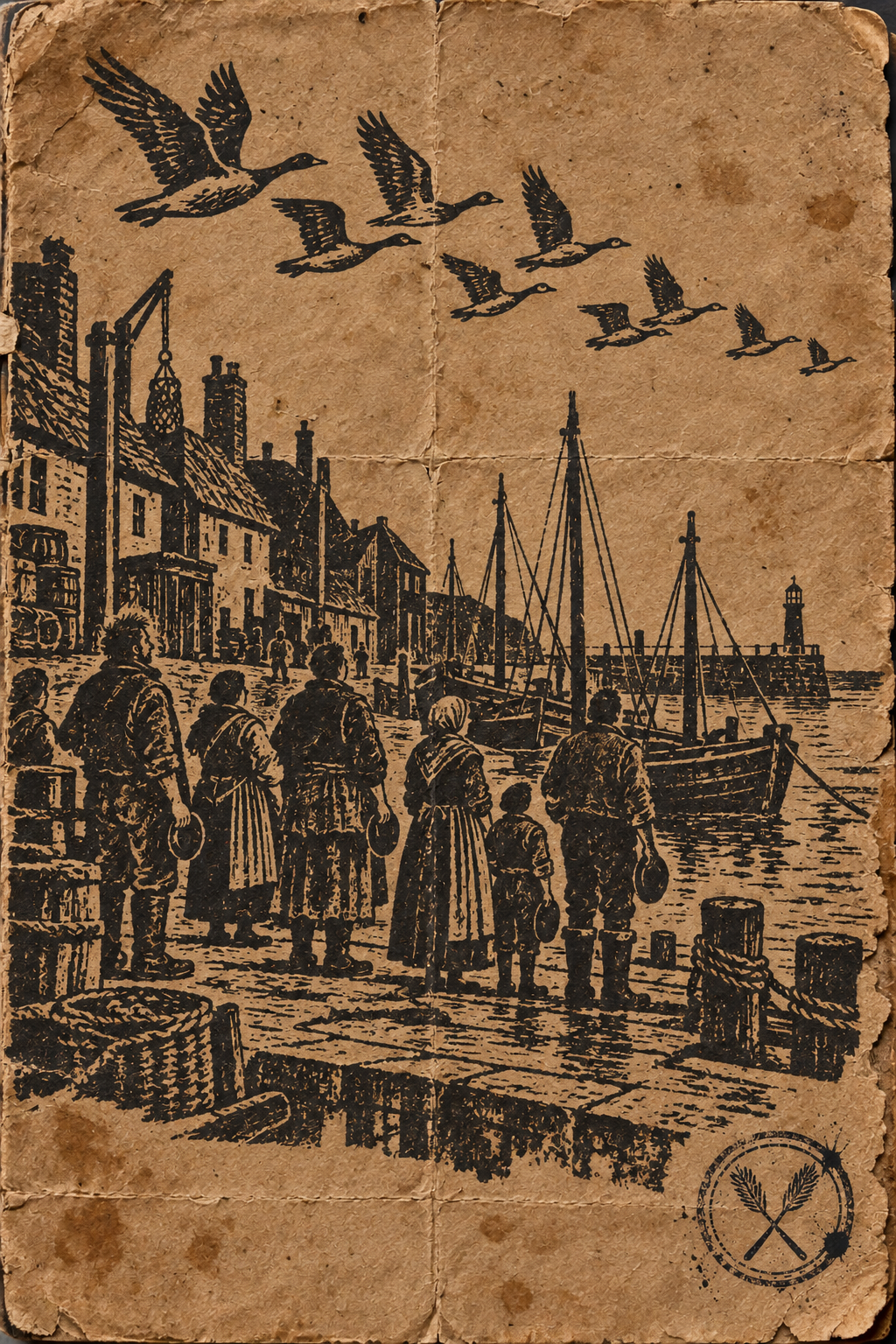
Sung on the quay at Saltgate. In the autumn when the geese come back, and again in the spring when they go. The only hymn in either book sung twice a year, to the same tune, meaning two different things.
The boats are small, my love, the boats are small,
And the quay was built for better;
There's a dry dock stood a hundred year
For a keel we never set her.
But the grey-wing goes! The grey-wing goes!
And she asks no man's permission —
Out past the rock, and out past the mist,
And nobody wrote it in a ledger.
FLY OUT! FLY OUT!
And come back, come back, come back —
For the world's not only the wet, my love,
And SOMETHING out there knows the track!
We cannot go. We cannot go.
But she goes, and she comes back —
AND SHE HAS NEVER ONCE BEEN LOST.
Old Master Weir went out in the spring
In three hundred ton of oak,
And the whole town stood on the harbour wall
And nobody thought it a joke.
Now the yards are quiet, and the yards do repair,
And the boys mend what they're mending,
And we watch the geese go over the mist —
AND WE CAN'T REMEMBER LENDING.
They say she's foolish, the grey-wing goose,
She's got no chart nor sail;
She cannot read, she cannot count,
She's never levied a tale.
But she has been where the green land is,
Nine hundred year, and back,
And she does not boast, and she does not tell,
AND SHE NEVER ONCE LOST THE TRACK.
[THE AUTUMN VERSE — sung when they return]
Come in! Come in, you ragged thing,
You're thin and you're battered and late —
And there's not a soul on this quay tonight
That would keep you outside of the gate.
We forgive you the leaving. We forgive you the leaving.
We forgive you for going at all.
And we'd forgive you again, and we'd hold the door,
IF YOU'D ONLY JUST TELL US — WHAT DID YOU SEE?
[THE SPRING VERSE — sung when they go]
Go on, then. Go on, then.
Don't look at us so.
There's nothing to keep you, and never was,
And it's only ourselves that can't go.
But mind the wind, and mind the rock,
And mind the way you came —
And when you're out there over the green,
WOULD YOU SAY OUR NAME?
Would you say our name?
Would you say our name?
We were called something once, over there —
WOULD YOU SAY OUR NAME?
Two songs carry this name and they are not the same song. The harbour sings the older one to the geese, twice a year, and means something different each time. The shanty is the newer, and is about what happened to the boats. Saltgate sees no contradiction and has never been asked to choose: one is what the harbour hopes, the other is what the harbour got.
HYMN VIII
THE GREY-WING'S RECONCILIATION (the shanty)
The same name, a different song. Sung below decks and on the quay at Saltgate, to the thud of boots, about the year the boats got smaller.
We had three masts of the Baltic pine,
We had a hull of the mountain oak,
We steered our course by the starry line,
Before our wandering spirit broke.
But the clerk came down with his iron pen,
And he looked us over with squinting eyes,
He said, “You’ve far too much room for men,
And far too much of the open skies.”
So pull the piston and choke the fire,
They’ve cut the deck and they’ve trimmed the sail!
They’ve turned our wonder to steam and wire,
And measured the sea by a rusted pail!
Oh, the land may drift where the ink is wet,
But the reef is sharp and the salt don’t lie —
The only truth that is left us yet,
Is the depth of the water in which we die!
They took the bow and they chopped it short,
To keep our eyes from the outer Hem,
They bound our journeys from port to port,
To make our invoices match with them.
They put an Engine where hope had been,
To burn our longing to soot and coal,
A smaller boat for a smaller sin,
A narrow cage for a narrow soul.
So pull the piston and choke the fire,
They’ve cut the deck and they’ve trimmed the sail!
They’ve turned our wonder to steam and wire,
And measured the sea by a rusted pail!
Oh, the land may drift where the ink is wet,
But the reef is sharp and the salt don’t lie —
The only truth that is left us yet,
Is the depth of the water in which we die!
The engine hums and the boiler groans...
We count the coal as the grey fog slips...
But deep below lie the silent bones...
Of larger men...
And of larger ships.
The clerk with the iron pen is not a metaphor the harbour invented; he is in the Saltgate register, and the tonnage he struck through is still there to be counted. The last verse is sung quieter every year and nobody has ever agreed to stop singing it.
THE SEXTON’S
Closing Note to Book Two
Eight songs. Nobody ordered any of them.
Look at what they are. A garble that made a shepherd into a leopard and outlived the man who did it. A digging-song that thanks the dark. A roll of the dead, read aloud until the children fall asleep. A nursery rhyme about a bucket that is actually six hundred years of sedition. A clapping game that means to save the children and, God forgive it, has not saved them all. A drinking song that says the door out is a liar. And a song for the geese, sung twice a year by a harbour that cannot remember why it weeps — asking nothing of anybody except that somewhere, over the green, a bird might say their name. And then the same name again, stamped out below decks, about the year the boats got smaller: first what the harbour hoped, then what the harbour got.
Book One asks a disinterested Lord for nothing, and thanks Him at moderate length for providing it.
Book Two does not ask anybody for anything at all. It simply tells you where the ground is soft, and who is beside you, and how to say a name out loud so it stays said — and, once, gets it wrong, and knows it, and sings it anyway, because it rhymes, and because that is the most honest thing a frightened people ever does.
That is not a hymnal. That is a parish, singing to itself, in the dark, mostly correctly.