Text size
THE FOURTH NURSERY BOOK

THE SOGMARSH NURSERY BOOKS

A note on the use of these books — printed at the front of every edition, by order of the parish, whether anybody reads it or not.

From the nurse, to whoever comes after.

These are the tales we tell the small ones at bedtime. They are set down here because I am tired of being asked to remember them at short notice, and because I will not always be here to be asked.

You will notice they are not the tales they tell in drier countries. In drier countries the wolf is wicked and the fairy is sweet and the moral is that virtue is rewarded. We have tried that here. It does not survive contact with the weather.

Each one has a bit the children shout. Let them shout it. That is not the interruption. That is the tale. A story a child cannot join in with is a story a child is only being told at, and we have quite enough of that from the castle.


You will be asked why our tales end badly, or sideways, or in a damp bedsit with an argument about the sink. Here is your answer, and you may give it to any dry-country visitor who raises an eyebrow.

We do not tell our children that virtue is rewarded. We would be lying, and they would find out, and they would find out from the weather. What we tell them instead is this: the house will leak, the gift will have a clause in it, the wolf will very often be right, and the person who does the worst job in your life will never once be thanked unless you do it.

And then we tell them the other half, which the dry countries have somehow contrived to lose: that none of that is the end of anything. The wolf found the boy. The girl left the broth out. The dish and the spoon are still arguing, twenty years on, in the same small room, together.

A child who is told only that things go well will be broken by the first winter. A child who is told only that things go badly will not bother to try. We tell them both, in the dark, over the drip — and in the morning they get up and go out into a sinking realm and are, on the whole, remarkably decent about it.

They are not cheerful because we lied to them. They are cheerful because we did not, and they decided to be cheerful anyway. That is the only magic in Sogmarsh, and it is entirely home-made.

THE FOURTH NURSERY BOOK

Jobs Nobody Wants (and the People Who Do Them). For the child who has begun to notice that somebody must have done it, and to wonder who.

The first book corrected the beasts of the dry countries. The second set down the beasts of the wet country as they are. The third was about the things that are not there. This fourth book is about the things that are there, and always are, and are done for you every single day by somebody you have quietly been taught not to look at. There is no beast in this book. There are only people. That is the frightening part, and it is the whole of the point. The rule is unchanged: every tale has a bit the children shout. But shout this lot gently, and mean them — because unlike the wolf and the troll, these people are real, and they are out there tonight, doing it, so that you do not have to.

I. THE BOY WHO WENT DOWN THE WELL

I. THE BOY WHO WENT DOWN THE WELL

The first one, and the bravest, and the one they will want again straight away.

Every few years a well needs going down — to clear the fallen thing, or free the stuck bucket, or find out why the water has gone wrong — and the trouble with a well is that it is exactly one child wide.

So it is a child who goes.

There was a boy called Wick, who was the smallest in the parish and minded about it, until the morning the Drudgeford well stopped and every grown-up in three lanes stood round the rim looking at one another, too big, every one of them, to be the slightest use.

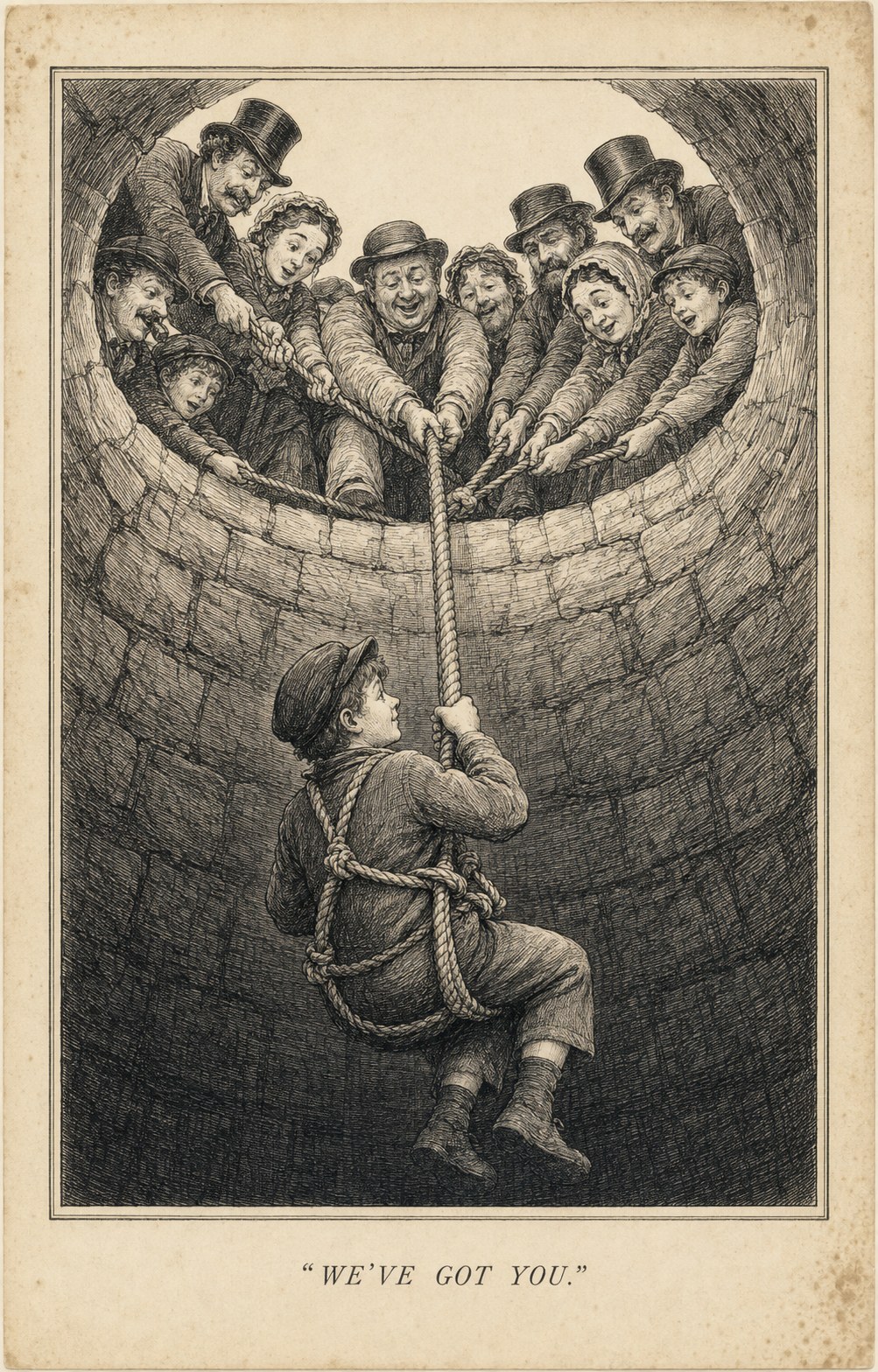
They tied the rope under Wick's arms. And they lowered him down into the cold and the dark and the drip and the green smell, where the daylight became a coin and then a button and then a star, and where he was more alone than a person can be and still hear voices — because he could still hear them, the whole village, leaning over the rim above him, all shouting down advice, all of it different, none of it any help.

(HERE THE CHILDREN SHOUT — first the daft half, all together, over the top of one another: "LEFT A BIT! NO, RIGHT! MIND THE— IS HE ALRIGHT? ASK HIM IF HE'S ALRIGHT!")

And then Wick, far down in the dark, found the trouble — a drowned crock and a great sodden mat of weed — and he cleared it with his cold hands, alone, where nobody could see him do it and nobody could do it for him. And he tugged the rope twice.

And the whole silly shouting village went quiet at once, and took the strain, and brought him up hand over hand, careful as anything, into the light.

(HERE THE CHILDREN SHOUT — the other half, and this half they shout kindly, all together: "WE'VE GOT YOU. WE'VE GOT YOU. WE'VE GOT YOU.")

And that evening the whole parish drank clean water and never once thought about the dark it came out of, or the boy who had been down in it — except Wick's mother, who thought about it, and made no fuss, and gave him the top off the milk.

Moral: Somebody small goes down into the cold and the dark, alone, so that everybody big can have a clean drink and not think about it. The going down is done by one. The pulling up must be done by all of you. Do not be the village that shouts and does not hold the rope.
II. THE CART THAT COMES AT NIGHT

II. THE CART THAT COMES AT NIGHT

The loud one, and the smelly one, and — do not let them tell you otherwise — the one that has saved more of you than the doctor ever will. Hold your nose if you must. But wave.

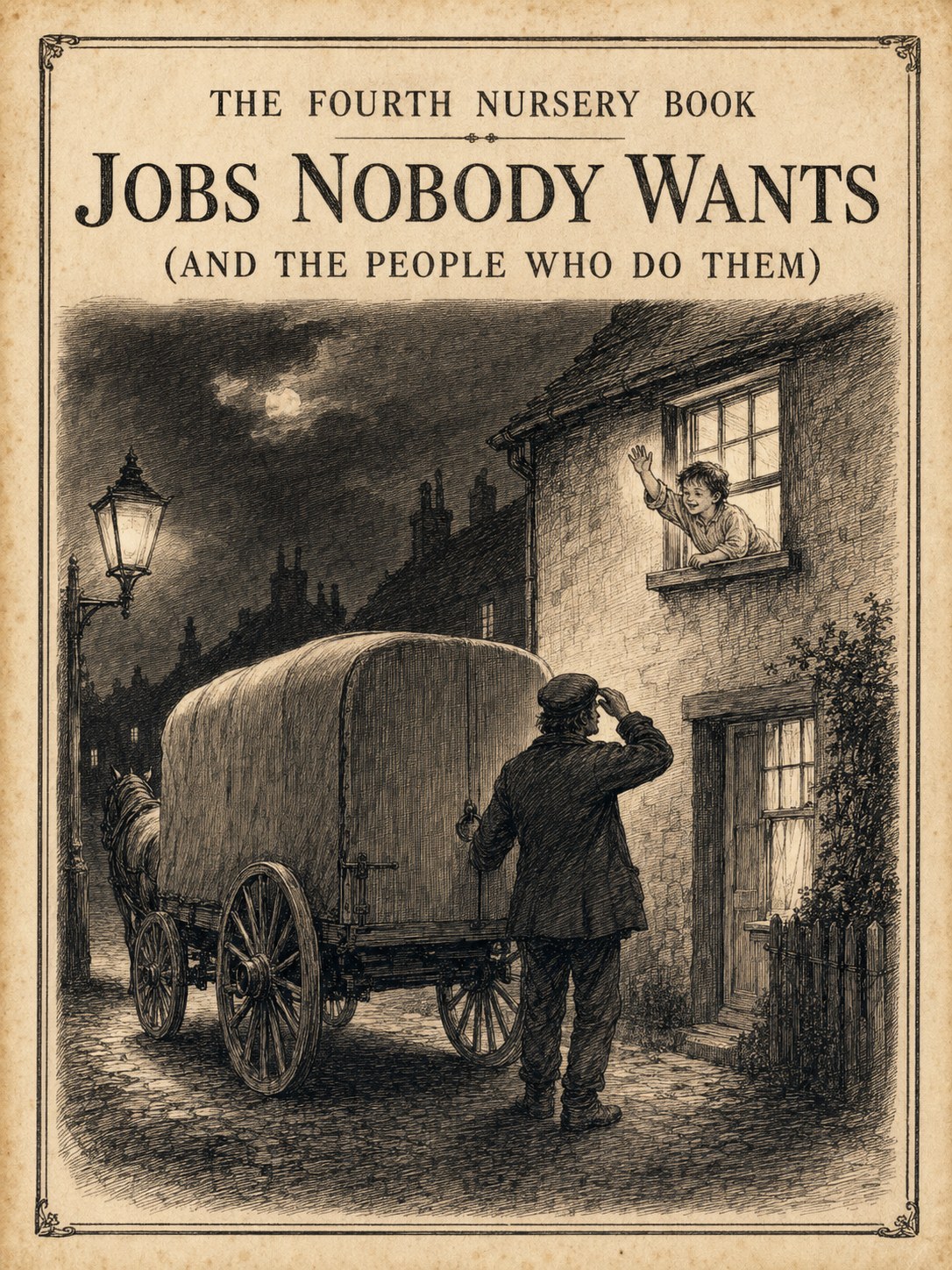
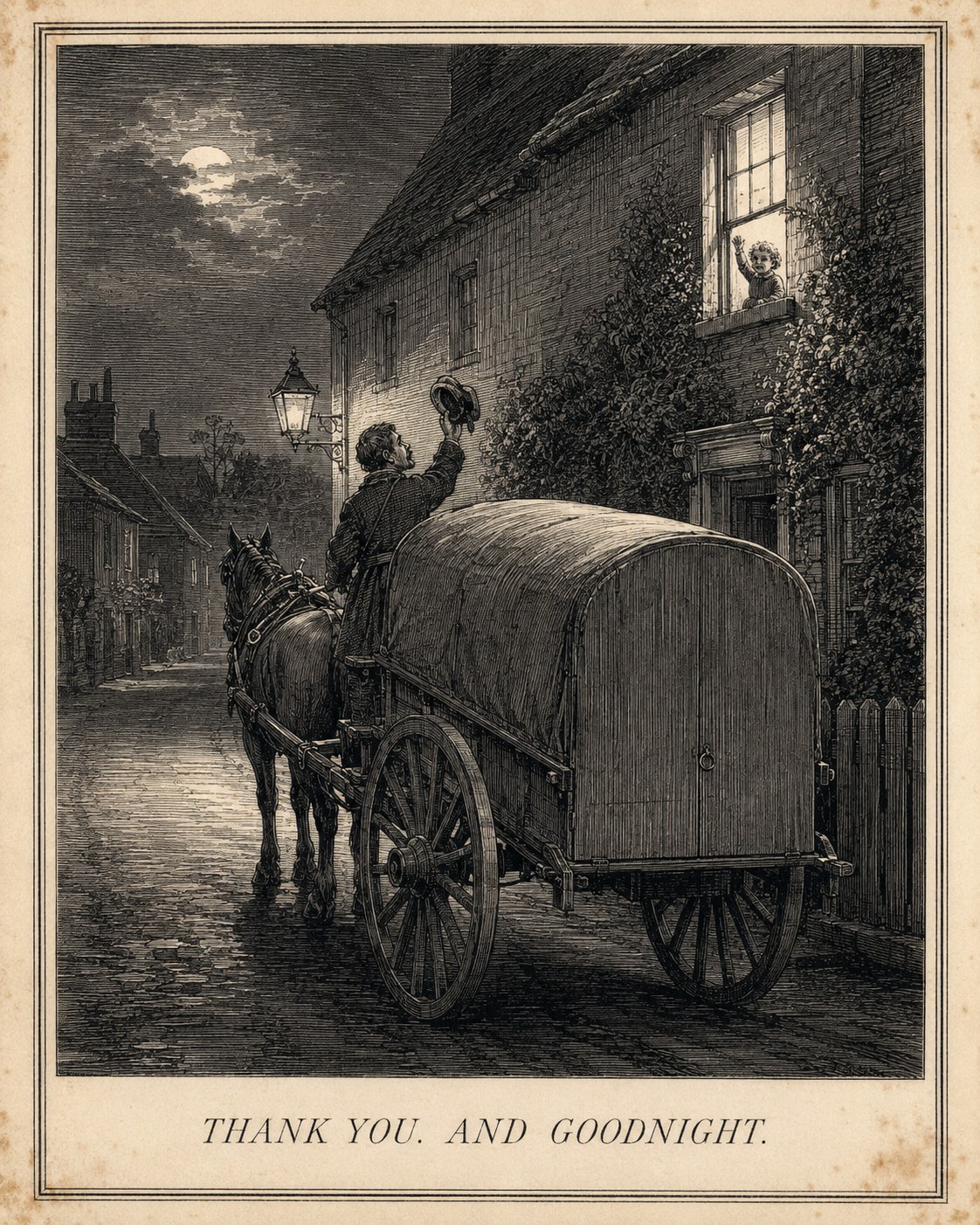
There is a cart that comes down the lanes at night, when you are asleep, and it takes away the one thing the whole parish makes every single day and no one will say the name of, and it is driven by a man they call the gong-farmer, and he has kept more of you alive than any king.

(You may hold your nose now. Go on. He is used to it.)

Because here is the thing they do not put in the almanac: the parishes that laugh at the gong-farmer and will not pay him and turn up their noses as he passes — those are the parishes that get the fever in a hot summer, the low green fever off the standing filth, the one that goes through a hamlet and takes the small ones first.

And the parishes that meet him with a lantern and a civil word and their gate left open — those parishes, year on year on year, do not.

Nobody has ever thanked him properly. How could you? To thank him is to admit what he takes, and no one will say what he takes. So he does the whole of it in the dark, unthanked, on purpose, to spare everyone the embarrassment of being kept alive — which is, if you think about it, about the kindest thing a person can arrange to do.

There was one house, though — the last house on his round, a child at the window who could not sleep — and that child, every single night, when the cart came by, opened the window and called out into the dark:

(HERE THE CHILDREN SHOUT — but gently, out of a window, so as not to wake the house: "THANK YOU! AND GOODNIGHT!")

And the gong-farmer never answered, because his hands were full and his cart was fuller, and the child could never see whether he had heard.

He had heard. He had heard it for eleven years. It was the reason he took that lane last, and slowest, every night, all his working life — so as to be under that window, in the dark, at the one moment in the whole of his day that a person said a kind word to him.

Moral: The fever that did not come to your house this summer sent you no note to say so. Nobody will ever hand you the bad thing that did not happen. But somebody arranged it, in the dark, holding his breath so you needn't hold yours — and you can open the window. It costs you nothing. He has been listening for it longer than you have been alive.


III. HER LADYSHIP

III. HER LADYSHIP

The one they will ask you to tell twice. It is completely disgusting and it is entirely a hero, and both of those are true at once, which is the lesson.

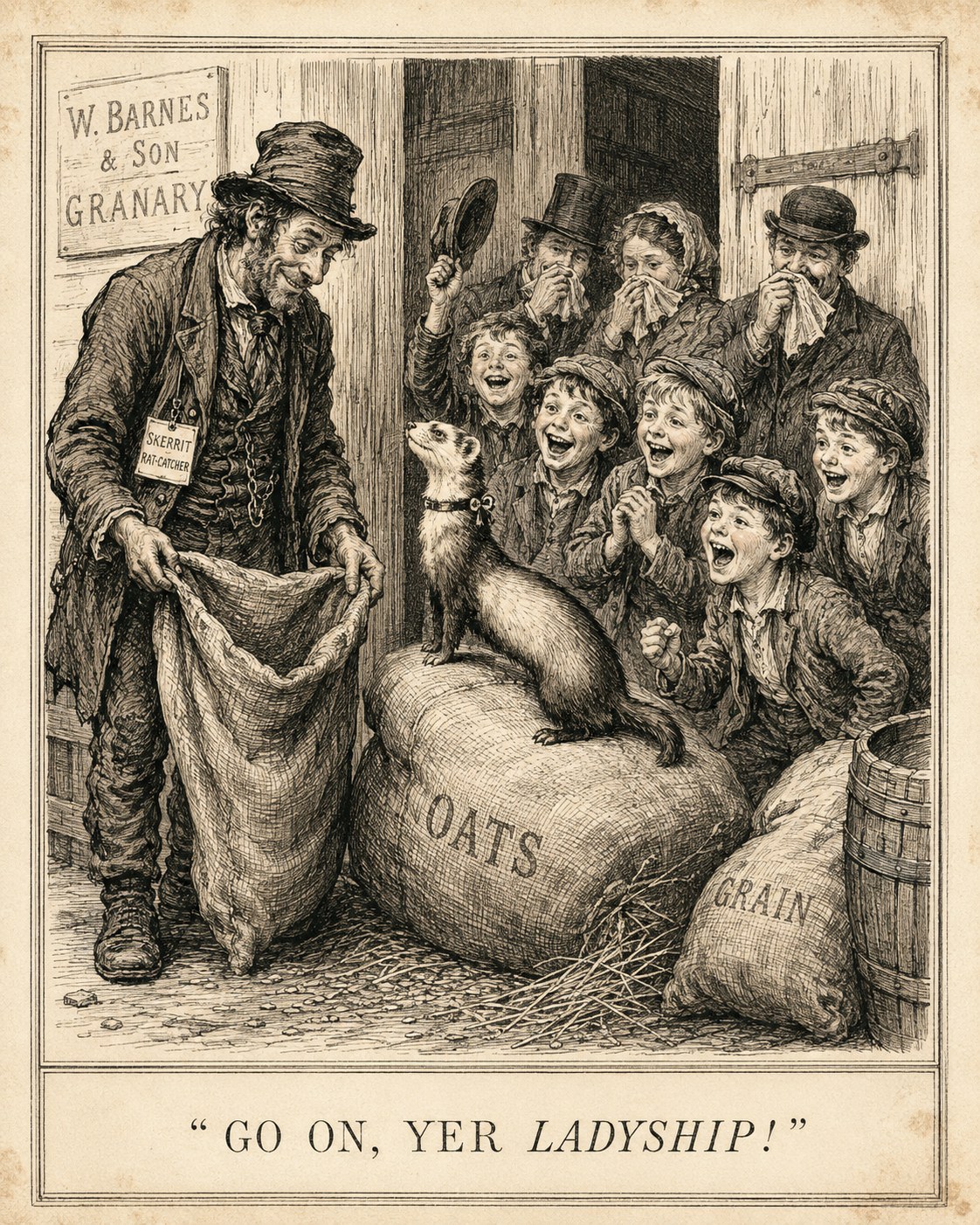
Skerrit the rat-catcher is the most useful man in the parish and nobody will sit next to him at the fair.

He goes where the rats are — down the granary, under the mill-floor, into the wet dark behind the meal-bins — and the rats, you understand, are not a joke. A rat in the seed-corn in a bad year is a family short in the spring. A rat in the well is the fever again. Skerrit stands between the whole parish and a great deal of quiet catastrophe, and for his trouble everyone holds their sleeve to their face when he walks by.

But not the children. Because Skerrit has Her Ladyship.

Her Ladyship is a ferret. She is long and low and the colour of a bad biscuit and she goes down the holes Skerrit cannot, into the black, after the thing that would eat your winter — and she comes back out with the parish saved and an expression of enormous personal satisfaction, and the children of Drudgeford think she is the single greatest celebrity in the realm, greater than the King, whom they have never met and who has never once cleared a granary.

(HERE THE CHILDREN SHOUT, AND THEY LOVE IT, AND THEY MAY DO THE VOICE: "GO ON, YER LADYSHIP! DOWN YOU GO!")

And Her Ladyship goes down, and does the disgusting necessary heroic thing in the dark, and comes back up, and takes the applause of the under-tens as no more than her plain due.

And Skerrit — whom nobody claps — stands behind her holding the sack, and lets her have every bit of it, because a man can go a long way on the reflected glory of his ferret, and it is a good deal more than he gets from anybody with a full grain-store and a clean sleeve.

Moral: Being disgusted is a luxury, and somebody else is paying for it with your dinner. The person you will not sit next to at the fair is the reason there is a fair. Clap the ferret if you cannot manage the man. But know which of the two of them is holding the sack.


IV. THE LAST KINDNESS

IV. THE LAST KINDNESS

The quiet one. There is one in every book, and this is the quietest of all of them. Do not skip it. The children never let you, and they are right not to.

When somebody in this parish dies, somebody has to wash them, and comb them, and dress them clean and straight and decent, so that the family may come in and say goodbye to a person and not to a fright.

And the family cannot do it. Not because they do not love them — because they do. You cannot do that last work for the one you love most; your hands will not, and they should not, and nobody in this realm has ever been asked to.

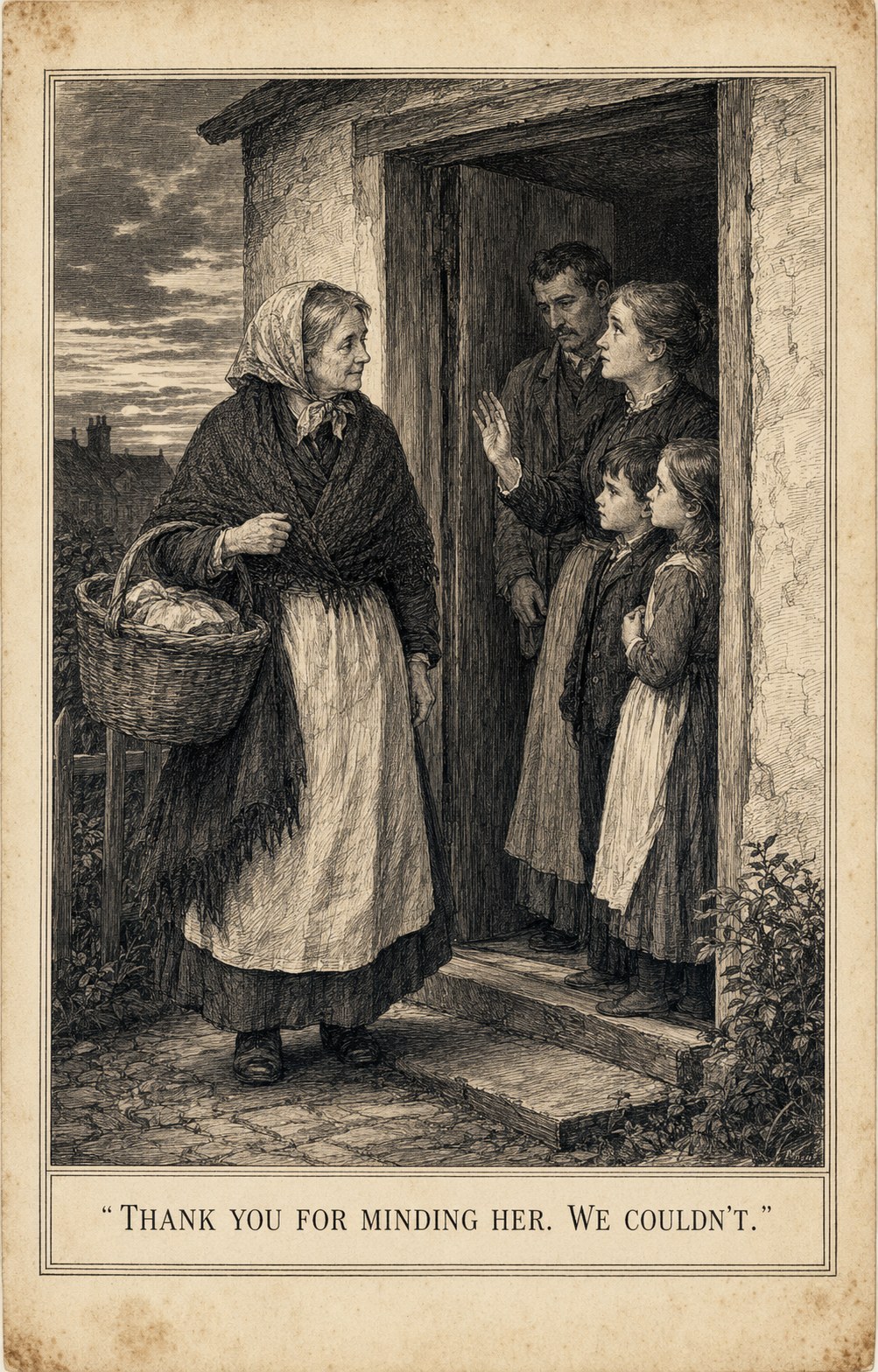
So it is done by Mother Prewitt, who is not kin to anybody, and comes when she is sent for, at any hour, in any weather, and does the last kindness there is — the gentlest, the most careful, the most completely unthanked work in the whole of Sogmarsh — and then goes home, alone, and says nothing to anyone, ever, about any of it.

She is the last person who will ever be kind to your body. She is the first person the parish forgets.

(HERE THE CHILDREN DO NOT SHOUT. THEY GO VERY QUIET, THE WAY THEY DID FOR THE DOOR IN THE HEATHER. LET THEM. AND THEN IT IS YOU WHO SAYS IT FIRST, QUIETLY, AND THEY SAY IT AFTER YOU:)

"THANK YOU FOR MINDING HER. WE COULDN'T."

Mother Prewitt has never once been said that to, in forty years. Not once. The words are said about her, sometimes, in the lane, after — but never to her, because by the time a family can bear to speak she has long gone home.

So we say it here, in the warm, in a nursery book, out loud, where it can do no harm and cost no grief — so that the shape of it is in your mouth. And one day, a long time from now, you may be the one who thinks to turn at the door, before she goes, and say it to her face.

You will be the first in forty years. Do it anyway.

Moral: Somebody does the last kind thing, the one you cannot do yourself, for the person you love most in the world — and then goes home alone and is forgotten by breakfast. Learn her name. Turn at the door. Some thank-yous are forty years overdue and still worth saying.


V. THE KNOCK

V. THE KNOCK

The short one. It is the job nobody in the house wants to hear, and nobody in the parish wants to be, and somebody has to be it, and thank goodness — thank goodness — somebody is.

When the boat is late, and then very late, and then the tide has turned twice and it has not come, there is a knock on a door.

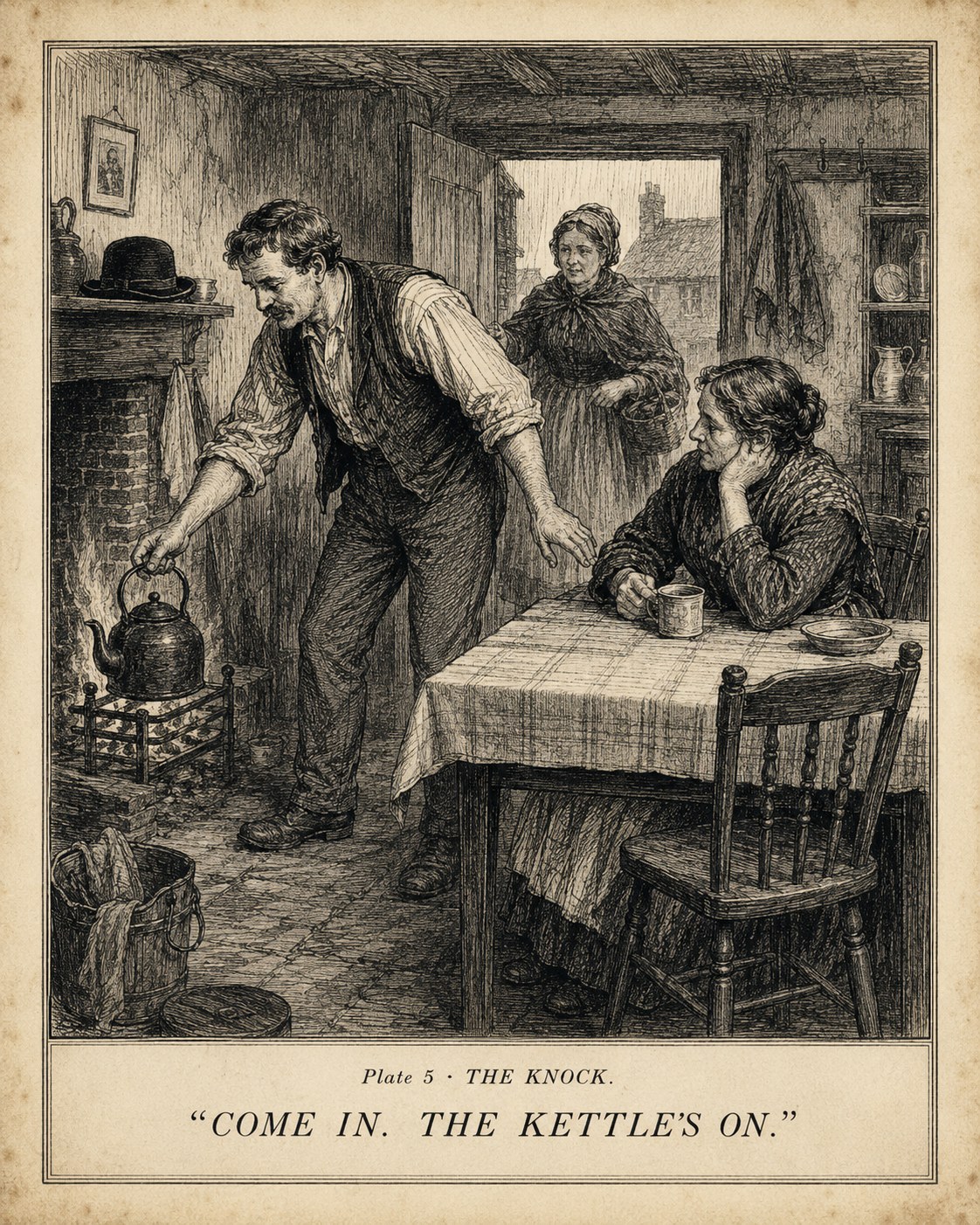
And it is always Hollis who knocks. Not because he is hard. Because he is the opposite — because he is the one who will take his hat off, and say it plainly and slowly and only once, and then not leave; who will come in, and sit down, and put the kettle on in a house that is not his, and stay, and stay, and stay, until a neighbour comes, so that nobody in this realm ever has to hear the worst news in the world and then be left alone in a room with it.

That is the job. It is not the knocking. Anybody can knock. The job is the staying.

(HERE THE CHILDREN SHOUT — and it is the strangest shout in any of the books, because it is the thing you say to the person who has come to tell you, and it is the kindest thing this parish knows how to do: "COME IN. THE KETTLE'S ON.")

Hollis has knocked on more doors than he can count, and carried more worst-mornings than any one man should, and he has never once got used to it, and if he ever did get used to it they would find somebody else, because the day it stops costing him is the day he stops being the right man to do it.

Moral: The worst news in the world still has to be brought by somebody, and you had better pray it is brought by a kind one who will stay. Be the neighbour who comes quickly. And if it is ever you who must knock — take your hat off, say it plain, and put the kettle on.


VI. SAINT SHOVEL'S DAY

VI. SAINT SHOVEL'S DAY

The last one. It ties up the whole book, and the whole shelf, and then you may blow the candle out.

Now. You will have noticed that not one person in this book gets a wage worth the name, or a medal, or a statue, or so much as a proper thank-you — not the boy in the well, not the gong-farmer, not Skerrit, not Mother Prewitt, not Hollis. That is not an accident. That is the realm. Nothing that matters here is paid what it is worth, because nothing that matters here could be.

But there is one day.

Once a year, on Saint Shovel's Day — Saint Shovel being the patron of everyone who clears what the rest of us won't — the whole parish does one horrid job that is not its own.

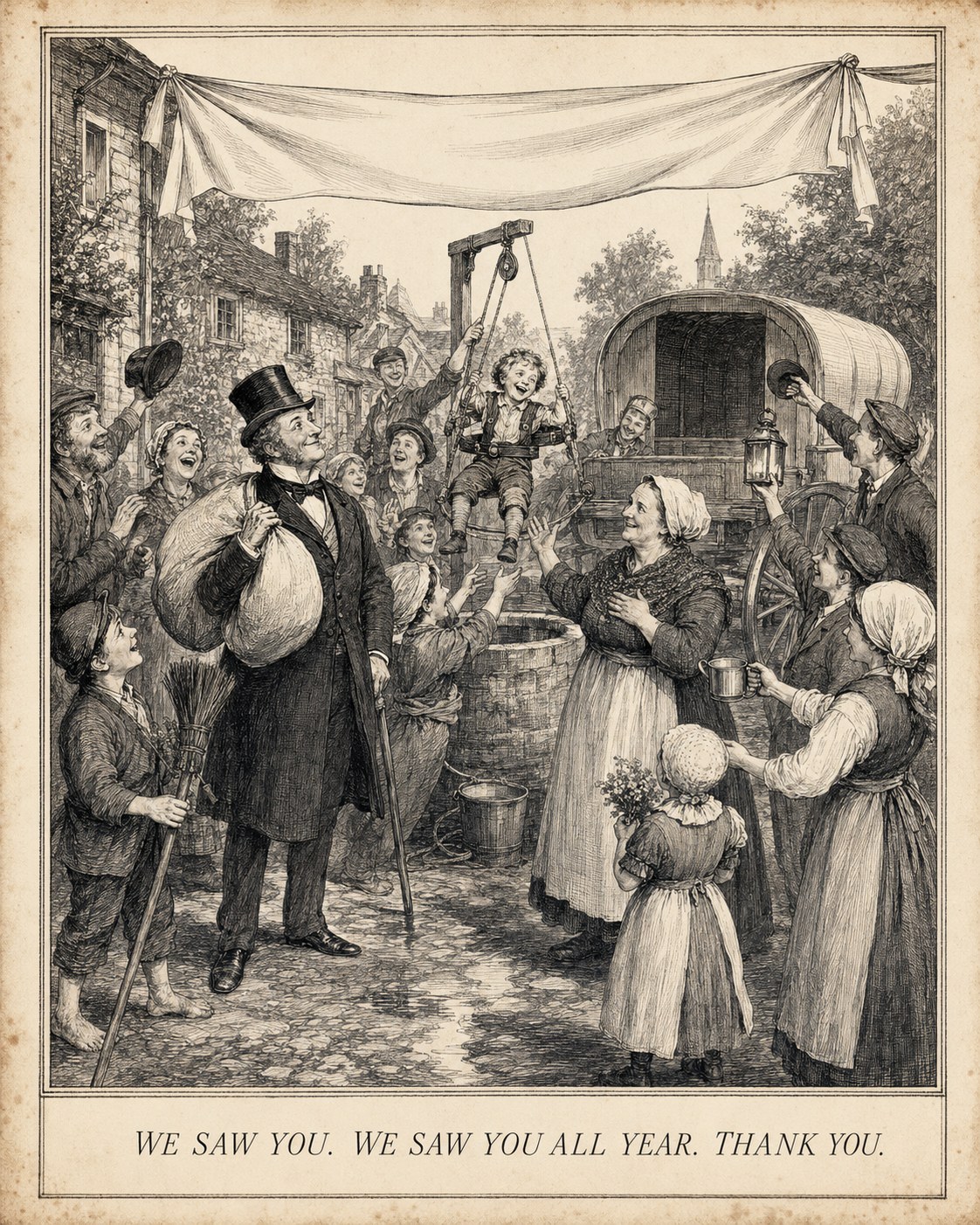
The gentry go down the lanes with the gong-farmer's cart and are sick behind hedges and keep going. The strong young men who will not sit by Skerrit at the fair carry his sacks for him all day and make a great noise about it and are secretly proud. Somebody the family loves goes and sits with Mother Prewitt and helps her wash the linen, so that for one day she is not alone with it. And a child — always a child, it is the custom — is lowered, safe and roped and laughing, just a little way down the clean well, and hauled straight up again, to remember.

And at the end of the day the whole parish stands in the lane and says the thing to all of them at once, the thing none of them ever hears the rest of the year:

(HERE THE CHILDREN SHOUT, AND THE GROWN-UPS SHOUT IT TOO, WHICH IS THE ONLY DAY THEY EVER DO: "WE SAW YOU. WE SAW YOU ALL YEAR. THANK YOU.")

It does not pay them. It does not make the jobs any nicer. The well is still dark on the two-hundred-and- sixty-fourth day as on the first, and the cart still comes in the night, and the knock still falls to Hollis.

But once a year they are seen, out loud, by everyone, on purpose. And it turns out — and this is the last thing the nursery books have to teach you, so listen — that being seen is very nearly enough. Not quite. But very nearly. And in a realm that cannot pay anybody what they are worth, very nearly enough, said out loud, once a year, by everyone, is the whole of what we have got, and it is a great deal more than the dry countries manage, who pay in coin and never look up at all.


Here endeth the Fourth Nursery Book, and the shelf.

Blow the candle out. And when you go out tomorrow into a realm that is sinking, and you pass the person doing the job that nobody wants — the one you were taught not to look at —

look at them.

That is all. That is the whole of it. Look at them, and if you can manage it, say the word. You will very often be the first one who has. Be the first one anyway.


A NOTE FOR THE GROWN-UP READING THIS ALOUD

You were taught, as a child, not to look at these people. You were taught it so gently and so early that you do not remember being taught it at all, and you have very likely passed it on, in the same silent way, without ever deciding to.

This book asks you to stop.

Not to make a fuss. Not to embarrass anybody. The gong-farmer does not want a speech and Mother Prewitt does not want a fuss and Hollis, heaven knows, does not want to be thanked for the thing he brings. What they want — what everyone doing an unthanked, necessary, unlovely job wants, in this realm and in yours — is only to be seen doing it, once, by someone who understands that it is being done for them.

A child who is taught not to see the person who carries away the filth grows into an adult who genuinely believes the water cleans itself. And an adult who believes the water cleans itself is no use to anybody, and is, in the end, a danger — because a realm that cannot see the people holding it up will, sooner or later, stop holding them, and then it will find out, all at once and far too late, exactly what they were holding.

So read them this. Let them shout it gently. And then take them out, tomorrow, and let them see one real one, and say one real word.

It is the whole moral of every book on this shelf, and it fits on a shovel:

Look up. Say the word. Hold the rope.