Text size
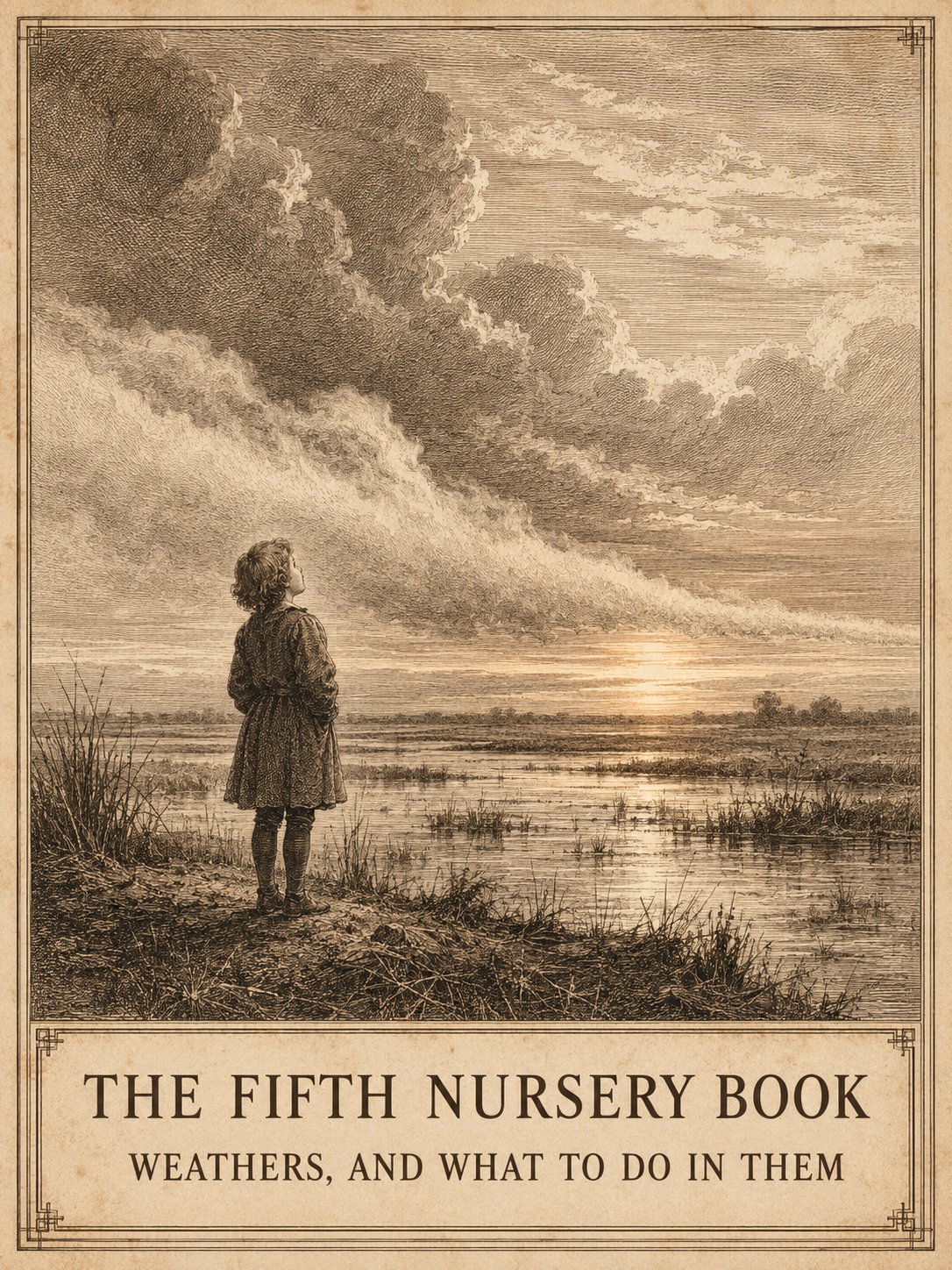
The Fifth Nursery Book — Weathers, and What to Do in Them

THE SOGMARSH NURSERY BOOKS

A note on the use of these books — printed at the front of every edition, by order of the parish, whether anybody reads it or not.

From the nurse, to whoever comes after.

These are the tales we tell the small ones at bedtime. They are set down here because I am tired of being asked to remember them at short notice, and because I will not always be here to be asked.

You will notice they are not the tales they tell in drier countries. In drier countries the wolf is wicked and the fairy is sweet and the moral is that virtue is rewarded. We have tried that here. It does not survive contact with the weather.

Each one has a bit the children shout. Let them shout it. That is not the interruption. That is the tale. A story a child cannot join in with is a story a child is only being told at, and we have quite enough of that from the castle.


You will be asked why our tales end badly, or sideways, or in a damp bedsit with an argument about the sink. Here is your answer, and you may give it to any dry-country visitor who raises an eyebrow.

We do not tell our children that virtue is rewarded. We would be lying, and they would find out, and they would find out from the weather. What we tell them instead is this: the house will leak, the gift will have a clause in it, the wolf will very often be right, and the person who does the worst job in your life will never once be thanked unless you do it.

And then we tell them the other half, which the dry countries have somehow contrived to lose: that none of that is the end of anything. The wolf found the boy. The girl left the broth out. The dish and the spoon are still arguing, twenty years on, in the same small room, together.

A child who is told only that things go well will be broken by the first winter. A child who is told only that things go badly will not bother to try. We tell them both, in the dark, over the drip — and in the morning they get up and go out into a sinking realm and are, on the whole, remarkably decent about it.

They are not cheerful because we lied to them. They are cheerful because we did not, and they decided to be cheerful anyway. That is the only magic in Sogmarsh, and it is entirely home-made.

THE FIFTH NURSERY BOOK

Weathers, and What to Do in Them. For the child who is old enough to be sent out, and must come back.

The first book corrected the beasts of the dry countries. The second set down the beasts of the wet country. The third was about the things that are not there, and the fourth about the people we are taught not to look at. This fifth book is the most practical of all of them, and the one your grandmother would have called the only one that matters: the weathers of this realm, and the one thing to do in each. It is not a frightening book. It only looks like one. Every tale is a weather, and a plain thing to do, and a line you shout in the yard until it lives in your body — so that on the day the fog comes down for real, your mouth already knows the words, and says them before your fear can. We do not teach our children to be afraid of the weather. We teach them what it wants. That is the whole difference, and it is the difference between a story and a stone.

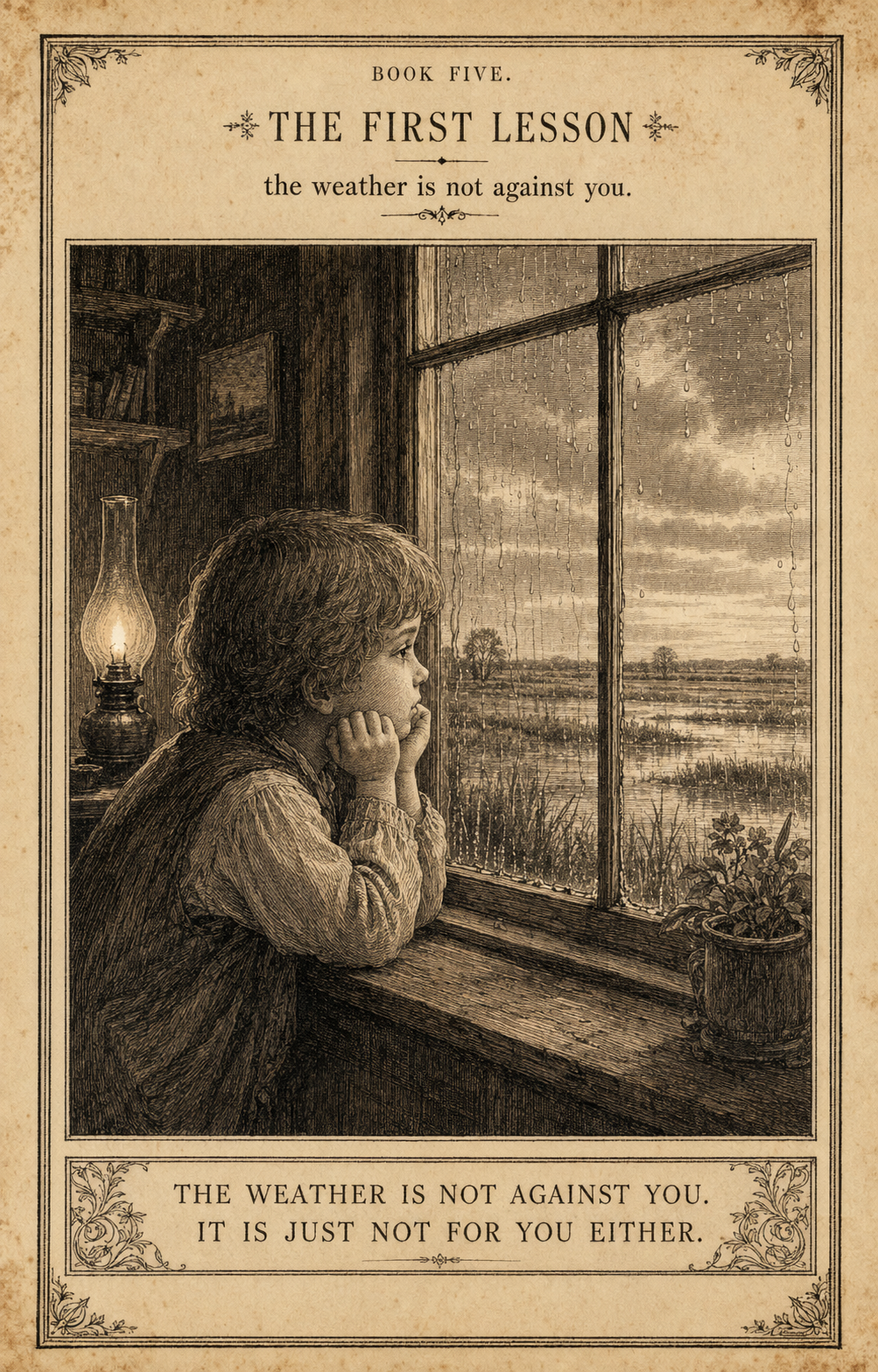
The First Lesson — the weather is not against you

THE FIRST LESSON · The weather is not against you. It is just not for you either.

In the drier countries they believe the weather is a judgement. Sun for the good, storm for the wicked, and if it rains on your wedding you must have done something.

We have tried believing that here. We gave it up around the time we noticed it rains on everybody's wedding, and on the funerals, and on the christenings, and on the days nothing happens at all.

The weather in Sogmarsh is not for you and it is not against you. It is only weather, and it does not know you are there. And the whole of growing up in this realm — the entire art of it — is learning what each kind of weather wants of you, and giving it, cheerfully, with wet feet, and coming home.

There are six you must know. You will meet all six before you are ten. Here they are, and here is what to do, and here is the bit you shout.


1 · THE FOG

1 · THE FOG

The first and the commonest, and the one that has taken more careful people than the mire ever did.

The fog here does not roll in like a story. It simply arrives, off the mire, between one breath and the next, and takes the whole world back to the length of your own arm — the path, the chapel, the person who was walking beside you a moment ago, all of it, gone into white.

And here is the thing the fog is counting on: it makes you want to hurry. To press on and get home before it thickens. Every part of you says keep moving.

That is exactly how the fog takes you. Not by hiding a danger — by hiding everything, until you have walked in a slow proud circle off the firm and into the wet, certain the whole time you were going home.

So here is what you do, and it is the opposite of everything you will want to do:

(HERE THE CHILDREN SHOUT: "STAY WHERE YOU ARE. MAKE A NOISE. THEY'LL COME.")

You stop. You stay exactly where you are, on the firm you know is firm. And you make a noise — you sing, you shout, you bang two stones — because the parish knows the fog too, and the bell will go up in the tower, and they will come to you, following your voice, the way you could not follow anything at all.

There were two children caught out together in it, once. One kept walking, to be clever, to be quick. One sat down on a stone she knew and sang every song she had until her voice cracked. The singing one was home by dark, hoarse and cross and perfectly well. The clever one is a story we tell, and we do not know the end of it, and that is the point of telling it.

Moral: The fog does not hide a monster. It hides the way home, and then it waits for your pride to do the rest. Stop. Make a noise. Let them find you. Being found is not the same as being clever, and it is a great deal warmer.


2 · THE WRONG GREEN

2 · THE WRONG GREEN

The pretty one. The one that kills the careless, and looks lovely doing it.

Not all green is grass. Some of it is a thin green skin the water grows over itself, to look like ground — and it is the brightest, evenest, most beautiful green on the whole moor, because it has never once been walked on, because everything that walks on it goes straight through.

The children call it the wrong green, and they can tell it from the right green across a whole field, in poor light, without thinking — the way you know a friend's walk — because they have played on the edge of it all their lives and learned it in the only way it can be learned, which is by being wrong once, and wet, and hauled out by the ankles, laughing.

(HERE THE CHILDREN SHOUT: "THAT GREEN IS WRONG! WALK ROUND!")

A dry-country cousin came to visit, once, and made straight for the loveliest patch on the edge — the bright even green, the wrongest green in the parish — because in his country the pretty ground is the safe ground.

And the fen-children did not laugh at him, and they did not let him find out the hard way either, because that particular patch went down a long way. They shouted, all together, the thing they shout, and hauled him back by his good coat, and then they did laugh, and he was wet from the one step, and cross, and alive.

Moral: The prettiest ground is pretty because nothing has ever stood on it. Learn the wrong green by heart. Walk round it. And do not trust a thing in this realm for being lovely — lovely is often just what danger looks like before you're close enough to know better.


3 · THE SINGING GROUND

3 · THE SINGING GROUND

The one you learn with your ears, not your eyes. Told quietly, so they listen.

Some ground sings.

Not out loud. But stand very still on it, and you will feel a hum come up through your boots, low, like a voice heard through a wall — and that hum is water, moving under you. Ground that sings is ground with a river beneath its skin, and it is never, ever safe, and no amount of it looking solid will make it so.

The gaugers and the old sounders — the ones who read the mire for a living — learned young to listen to the ground the way you'd listen for a friend's cough across a room: not hard, just always. And a child who has been taught to listen will stop dead on ground that looks perfect, head on one side, and say "it's singing," and be right, and be saved.

(HERE THE CHILDREN SHOUT: "IT'S SINGING! THAT'S WATER! BACK ON THE FIRM!")

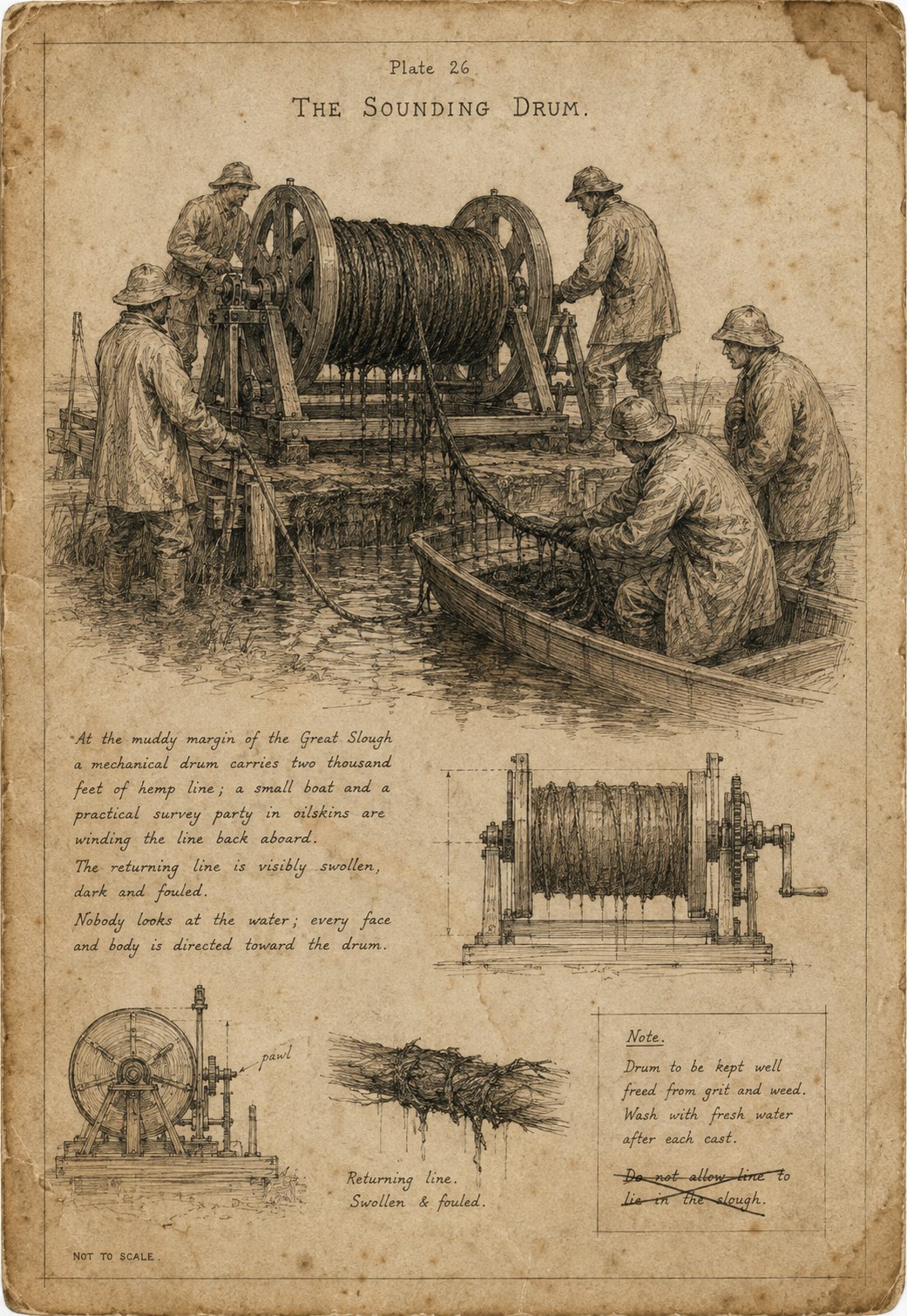
There was an old sounder who took a whole cart and team across the Slough edge in a bad season, and halfway over he stopped, for no reason anyone could see, and made them all get down and go back the way they came, grumbling — because he had felt the ground begin, very faintly, to sing. An hour later that whole stretch was open water. He could not have told you how he knew. He only knew he had listened, all his life, and the ground had told him, the way it will tell you, if you are quiet enough to hear it.

Moral: The ground that looks safest can be a river wearing a coat. If it sings, it is water. Go back the way you came. And learn to listen with your feet — this realm is always talking, and it is mostly telling you the truth, and mostly nobody is listening.


4 · THE STEADY RAIN

4 · THE STEADY RAIN

The heart of the book. The one that isn't sad, though the grown-ups always think it will be.

Now. The others were dangers. This one is not a danger. This one is just Tuesday.

The steady rain is the rain that does not stop, and is not meant to, and will still be coming down, soft and grey and endless, when you are as old as your grandmother is now. It is not a storm. Storms are exciting. This is the other thing. This is the rain you live your whole life inside.

And here is what to do about it, and it is the shortest instruction in the whole book:

Nothing.

You get wet. You keep going. Being wet is a thing that happens to you fourteen times a day in this realm and it carries no shame whatever — not here, not ever, no matter what they think in the countries where getting wet is an event.

(HERE THE CHILDREN SHOUT — quietly, and you say it first: "IT WILL RAIN. WE WILL BE WET. WE WILL BE FINE.")

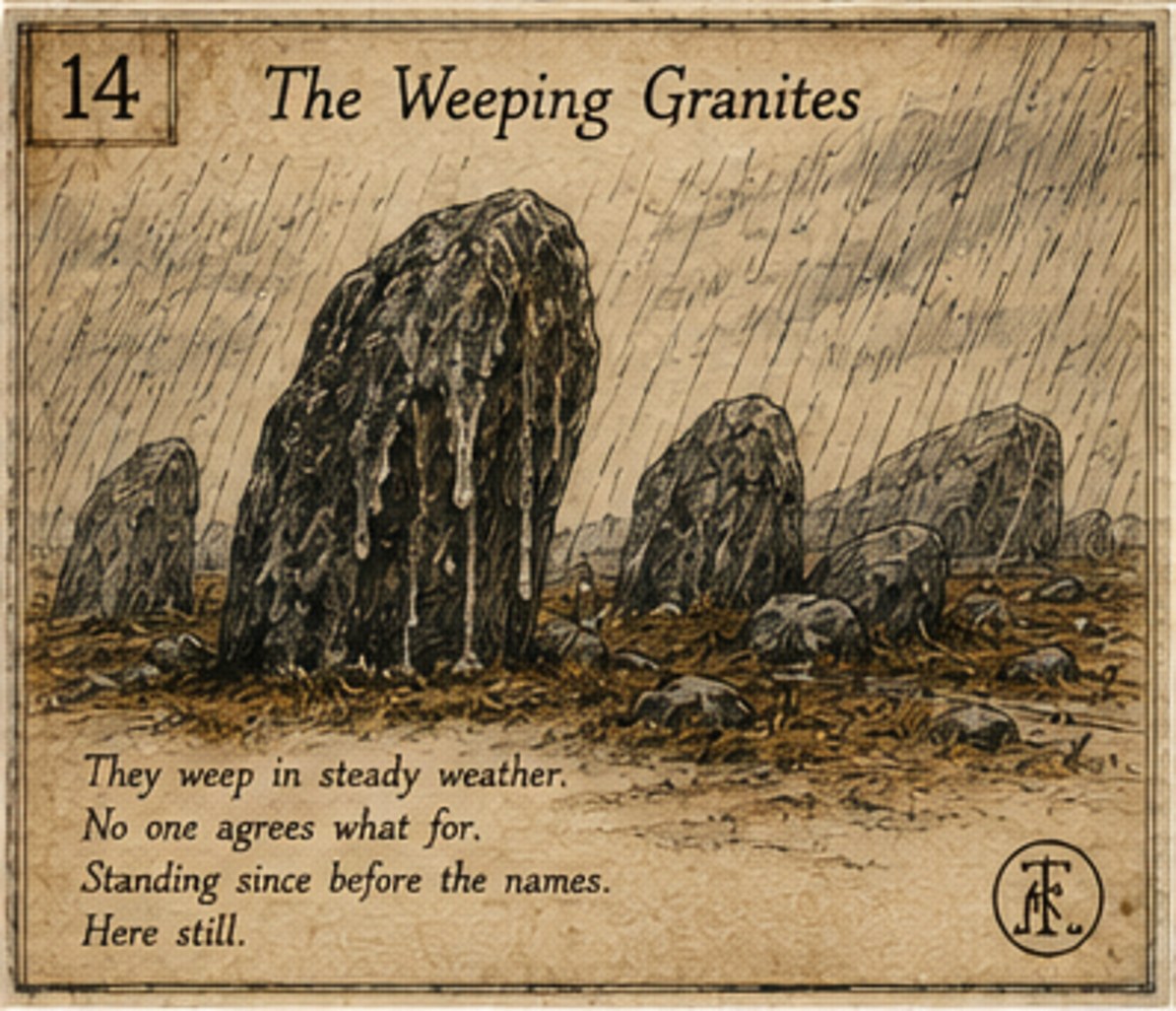
Up on the moor there are great standing stones that weep in the steady weather — water running down them, day after day, and no one agrees what for. Some say it's the rain. Some say it's the stone itself. The children say the stones are just doing what everyone here does, which is carry on being rained on, and they have done it since before there were names for anything, and they are still there.

That is the whole lesson, and it is the one that will hold you up when the cleverer lessons fail: you do not win against the rain. You outlast it. The stones worked that out. So did your grandmother. So will you.

Moral: The weather that never stops is not there to be beaten. It is there to be borne, cheerfully, with dry socks kept by the fire for later. Anyone can stand a storm. It takes a Sogmarsher to stand the Tuesday after the Tuesday after the Tuesday, and put the kettle on, and not once think themselves hard done by.


5 · THE THAW

5 · THE THAW

The treacherous one. It is told last of the dangers, because it is the one that betrays you, and betrayal is a grown-up idea, and by now you are nearly ready for it.

The thaw feels like mercy. The long cold lets go, the ice softens, the air smells of the ground again, and every part of you wants to run out into it and trust the world.

Do not trust the world in the thaw.

Because when the cold lets go, so does everything the cold was holding. The path that carried you all winter — hard as a road, safe as your own doorstep — goes soft underneath from below, where you cannot see, and drops you exactly where you were surest of your footing. Everything in the realm in the thaw is "loose after thaw," and the loosest thing of all is your own confidence.

(HERE THE CHILDREN SHOUT: "THE THAW LIES. THE ROAD ENDS. TURN BACK.")

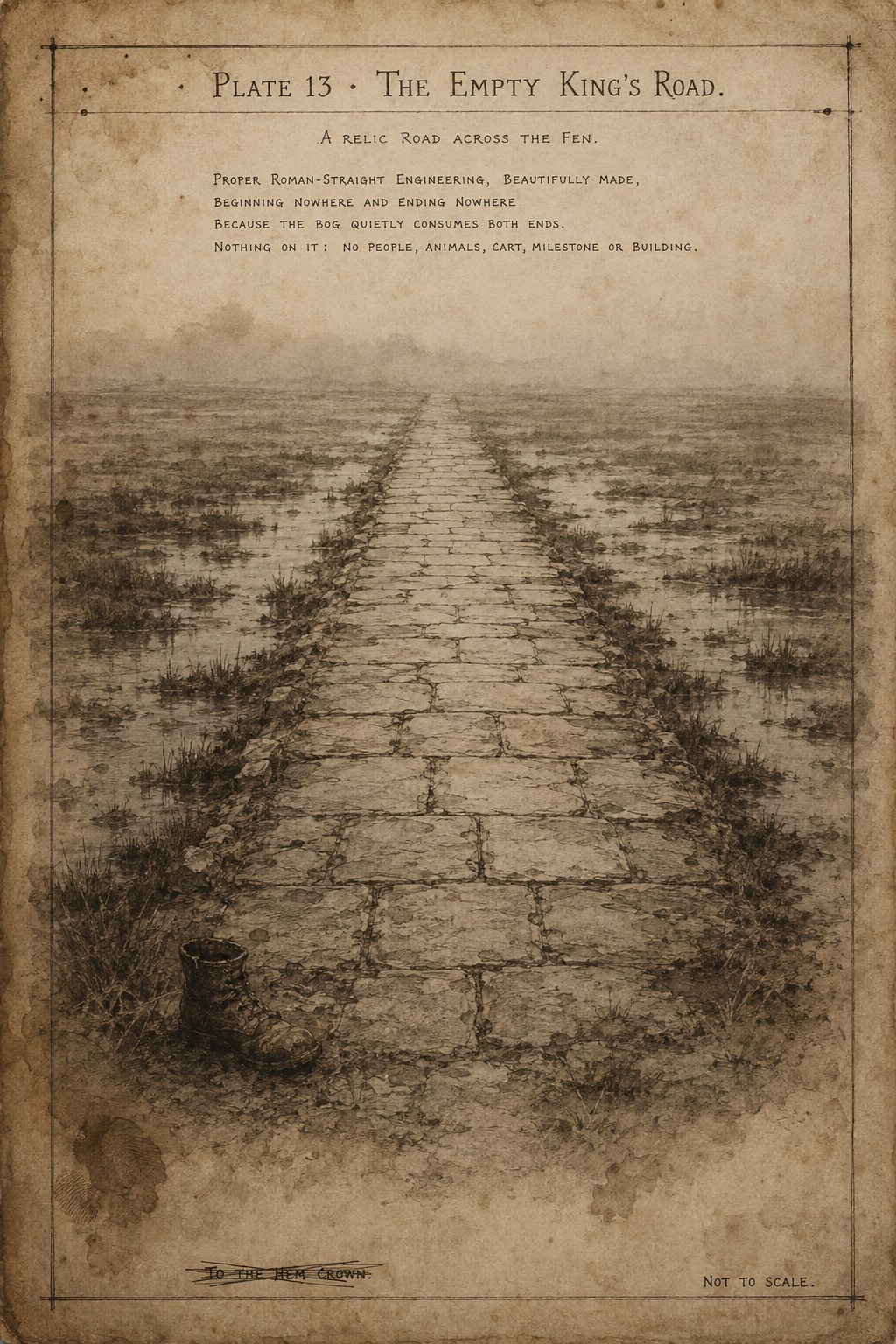
There is a road out on the flat — dead straight, beautifully made, plainly built by someone far cleverer than us — that marches out across the country with tremendous confidence and then simply stops, in the middle of the mire, having reached nowhere at all. Even the clever ones, you see. Even the best-built, straightest, most confident thing in the realm did not get where it was going, because it trusted the ground to stay where it was, and in this country the ground never, ever does.

Moral: The thaw is the weather that feels like a friend and isn't yet. Trust nothing it has touched until it's proven under your own careful foot. The firmest thing you know is the thing it will use against you — and even the cleverest road that ever trusted this ground is out there still, stopped, halfway to nowhere.


6 · THE FAIR DAY

6 · THE FAIR DAY

The last one, and the warm one, and the one they will not believe is real until they have lived a winter.

And then, perhaps six times in a year, you wake and the rain has stopped and the fog has lifted and the ground is firm and the sky is a colour you had half forgotten, and it is a fair day.

And here is what to do, and it is the happiest instruction in any of the five books, and it is compulsory:

Use it. All of it. Do not save it. There is no saving weather in Sogmarsh; there is only spending it.

(HERE THE CHILDREN SHOUT: "IT'S DRY! GET THE REEDS UP! PUT THE KETTLE ON!")

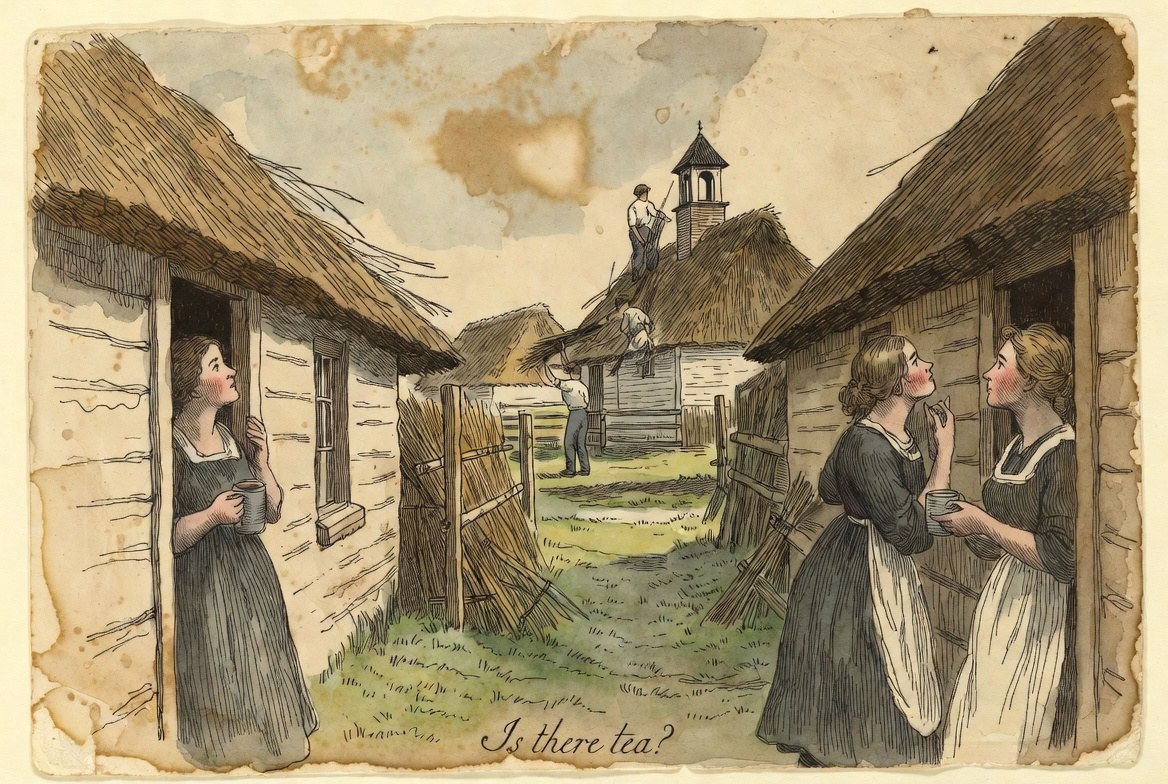
So the whole lane comes out at once. The thatchers go up their ladders, because reed only re-beds dry and a dry day is a roof mended — and the women bring their tea out onto the steps to watch them do it, and everybody is suddenly, tremendously busy, and nobody is fooled: the work is real, but the point is the sun.

For one afternoon the sinking, dripping, stubborn realm stands in its own dooryards with its face turned up, kettles going, reeds going up, and it looks — it truly looks — like the luckiest place on the whole earth.

It isn't, of course. It'll rain by Thursday. Everybody knows it will rain by Thursday.

That is exactly why they are out in the sun today.

Moral: You cannot save a fair day, so spend it — mend the roof, warm your face, carry the tea out and watch the parish do the same. The people who are happiest in this realm are not the ones who get the most sun. They are the ones who waste none of it. It will rain by Thursday. Get the reeds up. Put the kettle on.


Here endeth the Fifth Nursery Book, and — for now — the shelf.

Blow the candle out. Tomorrow it will do something: fog, or the wrong green, or the singing ground, or the long grey rain, or the lying thaw, or — once in a blue moon — the sun. You know all six now. You know what each one wants of you, and what to do, and the words to shout while you do it.

So go out into it, cheerfully, with wet feet, the way we taught you in the yard — and come home. Somebody will have the kettle on.
A NOTE FOR THE GROWN-UP READING THIS ALOUD

This is a safety book wearing a weather book's coat, and the coat is the whole method.

A child told that the fog is dangerous is simply frightened, and frightened children freeze, or bolt, and both are how the mire takes them. A child who has shouted what to do — in the yard, in the warm, a hundred times, until it is as automatic as their own name — will do the right thing on the worst day of their life without having to be brave, because bravery is not required for a thing your body already knows.

So do not teach them to fear the weather. Teach them what it wants, and what to do, and let them shout it until the rooks go up off the chapel. Fear is a thing that happens to a child. Knowing what to do is a thing a child has, and keeps, and one cold afternoon a long way from now it will be the difference between a person who comes home and a story we tell about someone who didn't.

The whole of it, and it fits under a dripping eave:

Know the weather. Do the thing. Shout it first, so you don't have to think of it later.