
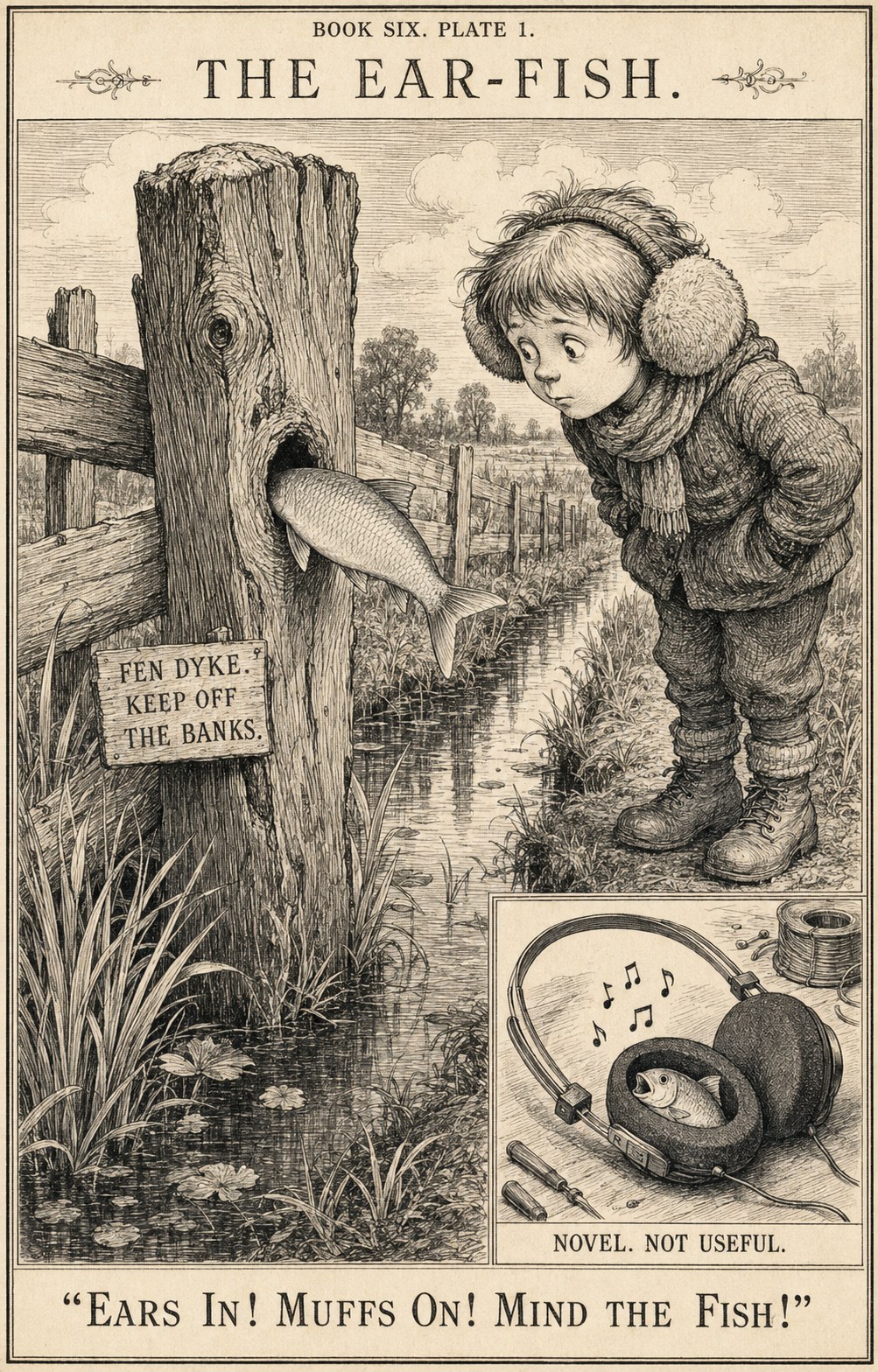
1 · THE EAR-FISH
The star of the book, and the one they will make you tell first, forever.
In the still dykes there lives a small, silver, permanently anxious fish, and it has one habit, and the habit is this: when it is frightened, it hides its head in the nearest dark hole, and considers itself thereby invisible.
It is wrong about this. It is an entire fish sticking out of a hole with its head tucked in, exactly as certain large birds are said to do in the dry countries, and it is convinced, every time, that no one can see it. Nothing has ever talked it out of this. Nothing ever will.
And here is the thing to understand, because it is the whole of the joke and most of the mercy: the ear-fish does not want your ear. It wants no such thing. It has no interest in you at all. It only wants, like the great head-hiding birds of the dry countries, to jam its head into the nearest available dark hole and become — in its own serene and total conviction — invisible. It is not personal. It is not even aimed. It is simply that a human ear, to a small frightened fish casting about for anywhere on earth to tuck its head, happens to be a dark hole of very nearly perfect size. We call it the ear-fish; but that is our word, not its intention, and the fish would be appalled to learn it had a reputation.
And it does not even happen often. You might go three or four years and never meet one — and make no mistake, that is exactly what makes it so much worse when you do. A nuisance you meet every day you learn to wear lightly; but the ear-fish comes once in a blue moon, always by ambush, always when you are least braced for it, and the rareness of the thing is most of the shock. There is no getting used to a fish you meet twice a decade.
(HERE THE CHILDREN SHOUT, and slap their hands over their ears to do it: "EARS IN! MUFFS ON! MIND THE FISH!")
So the dyke-country children wear ear-muffs from the first thaw, when the ear-fish wake, right through to the frosts — good thick woollen ones, pulled down hard — and they are not being soft, whatever the dry-country cousins say. They are being sensible, in the one way that matters, because an ear-fish in the ear is not dangerous. It will not hurt you and it will do you no lasting harm whatever. It is merely — and profoundly, and memorably — unpleasant, and about as inconvenient as a thing can be without actually mattering, in the particular way that only a small, frightened, flapping fish in your own ear can be; and there is no being brave about it, and no arguing your way out of it. You simply have to get the fish out.
(There is a story — only a story, and most likely wrong, because stories are the only news this realm ever gets of anywhere else, and they are wrong by the time they arrive — that a man called Master Fizzle once put an ear-fish in his ear on purpose. He had it third-hand, from a man who had it from another man, that away in some country nobody here has been to or is ever going to, they keep a fish you wear in your ear that lets you understand every tongue in creation. Master Fizzle wore his for a fortnight and understood nothing whatsoever, except a faint muffled panicking, and held to his dying day that this proved the far country had simply got its fish wrong. Nobody has ever been able to fault the logic, and nobody has ever wanted to try it. He is said to have tried, later and more ambitiously, to magic his fish into the other thing the same unreliable rumour spoke of — some little contrivance, from the same cluttered elsewhere, that a body was supposed to wear on the ears to be piped a private music all its own; though nobody here has ever seen one, or heard its name, or is entirely sure it is not also a kind of fish. He did not succeed. Magic here is of the clerical sort, the kind that mostly mis-files; and what the fizzle left him was a foam-and-wire contrivance, a soft cup for each ear, that piped no music anyone could ask for and never would. What it piped, faintly and for ever, was the fish itself, singing. Which was novel. It was, everyone agreed, remarkably novel. It was not, in any sense anyone could name, the least bit useful. The fish, you understand, was still in there. It always is. And it did not even stay: within the season it had worked itself loose of the foam and the wire and slipped back into the dyke, home to the general fish population, to tell — one assumes — no one. So that somewhere out on the still water there swims, to this day, a line of perfectly ordinary ear-fish descended from the one that was, for a single fortnight, very nearly something else.)
No one, before Master Fizzle or since, has ever found the smallest use for an ear-fish. The realm keeps only a faint, stubborn hope that somebody one day might — which is, when you think about it, the single use the creature has ever had: hope, and that at second hand.
And if one does get in — because one always eventually does — you do not panic, because panicking is the ear-fish's entire personality and there is no sense in two of you at it. You tip your head, and you offer the fish a better hole — a cupped dark hand, a jar laid on its side — because a frightened thing looking for somewhere to hide will always, always move to the darker, snugger spot, and out it comes, mortified, and swims off, and tells, presumably, no one.
Moral: The cleverest idea in the whole wide world — a fish you put in your ear to understand everything — turns out, close up and in your own ear, to be one frightened little creature that understands nothing and only wants somewhere to hide. Wear your muffs. Don't panic. And when the nuisance comes, as it will, give it a better hole rather than a fight. Most things that get stuck are only looking for somewhere to feel safe, and the kind way and the quick way are, gratifyingly, the same way. And the fish itself — head in the dark, dead certain it cannot be seen? It is not safe. But it feels safe, and whatever makes you feel safe makes you feel safe, which is not the same as being safe, and is not nothing either. The trick — which the fish never learns, and you must — is telling those two apart.