The Wet Crossing
The Tales
Tale 28THE LETTER THAT BEAT THE SHIP
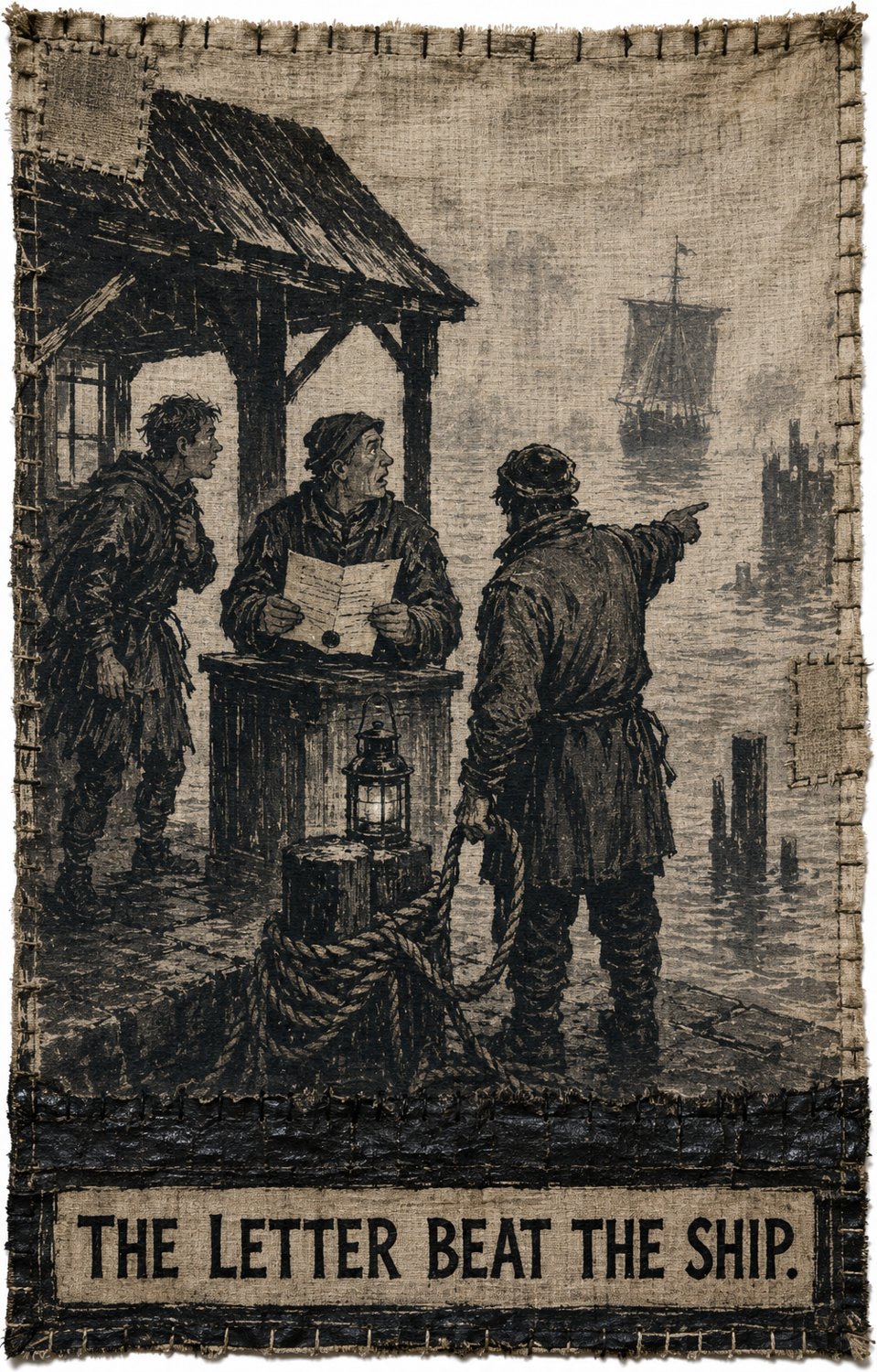
I am a letter, and I was posted at the Saltgate Arms, which stands on the harbour front at Saltgate — the founding port, the realm's one and only door to anywhere else at all — and everybody on the Cold Coast will tell you the same peculiar thing about the post that goes out from that particular inn, next to the customs house, under the gulls:
Letters posted at the Saltgate Arms sometimes reach the Isles faster than the ship that carries them.
Nobody can explain it. The postmaster least of all. Ask him how, and he licks his thumb, and he counts your coppers twice, and he finds something that urgently needs doing at the far end of the counter. It is not a thing the coast discusses. It is a thing the coast relies on, quietly, the way you rely on a stair you have stopped seeing.
I was written on a wet afternoon by an old fisherman — I will not give you his name; he would not want it in a story, he was that sort — with a stub of pencil worn down to the brass, in a hand like a gull's footprints, at the table nearest the fire because his knuckles no longer did cold. He was writing to his boy, who had gone out the year before to crew a boat off the Isles, which is a day's nervous sail west and the only abroad anyone from here ever reaches, and which we do not name, and neither will I.
You would expect, given everything, that the letter would be about the important matter. It was not. The old man never once mentioned the important matter, which was that he was dying, and knew it, the plain unhurried way a coast man knows weather is coming — by the ache in a joint and the colour of the light. He did not write a word of that.
He wrote that the boat wanted recaulking before the son came home and would he see to the starboard strake himself, because the yard did shoddy work and charged for lovely. He wrote that the crab pots off the First Anchorage were fishing well this year, which was a lie, a small kind lie, so the boy would not fret about the housekeeping. He wrote that his mother had moved her chair three inches nearer the fire and would not be moved back, and that this was the great domestic war of the season, and that she sent her love and a pair of socks that would arrive by a slower boat, the socks not sharing my peculiar gift. And he wrote, at the bottom, in the largest and worst letters of all, pressed so hard the pencil nearly went through me: Come home when you can. And if you can't, that's the sea, and I'm proud of you, and that's an end of it.
Then he folded me, and licked me shut with more ceremony than the flavour deserved, and carried me down to the Saltgate Arms through the rain, and posted me, and went home to his chair by the fire.
And that night, quietly, with no fuss, which was very much his way, he died.
Now here is the part the coast would understand and the dry countries never will.
The news of it went out on the next morning's boat — the black-bordered word, the official sorrow, the letter with the wax the colour of a bruise. And I went out too, ahead of it, carried on a different hull. And though not one living soul knew it, and though neither ship's master would ever have believed you, it was a race. The news of the death, against the letter of the love. The bruise-wax, against the crab pots and the socks and I'm proud of you.
And I won.
I will not tell you how, because I do not know how, and the postmaster does not know how, and it is not the kind of thing that survives being explained. I can only tell you that three times in the fog off the First Anchorage the news-boat and my boat came level in the grey, so close the two crews could have shaken hands, and three times the fog closed, and three times when it opened I was ahead. The Saltgate post does not so much travel as arrive. It always has. Nobody knows why. Nobody, on the whole, asks.
So the boy — out on the Isles, in a cold bunk, with the wind doing its worst — got his father's ordinary, loving, lying, wonderful letter first. A whole day first. He read about the starboard strake and the shoddy yard and his mother's chair and I'm proud of you, and that's an end of it, and he laughed, and he put me in his shirt against his chest, and he went to sleep warm, in the good and rightful order of things — the love arriving before the grief, the way it always should, and hardly ever does.
The other letter found him the next day. It did what it had to do. I will not pretend it didn't; grief is a strong swimmer and needs no help from anybody, and it reached him, and it was terrible, and it was true.
But it came second. And because it came second, the last thing that old man ever said to his son was not a black border and a bruise of wax. It was the crab pots, and the socks by the slower boat, and come home when you can. The boy had that first, and had it whole, and had it warm — and he has it yet, folded soft as cloth now, these forty years, against the same chest, grown so worn you can barely read the gull-tracks, though he does not need to read them, having them by heart.
That is the whole of what I am for.
The moral, from the harbour post: the bad news of the world will always find you; it is a strong swimmer, it knows every current, and it needs no fair wind from anyone. But a plain word of love, written badly by a hand that could not say it aloud, is a frail thing on a wide grey sea, and it deserves every mercy the weather can be persuaded to spare — and once in a life, if you are very lucky and the fog is very kind, the love beats the sorrow home, and lands first, in the order it was always meant to.

Tale 31THE RENT-COLLECTOR'S BOAT
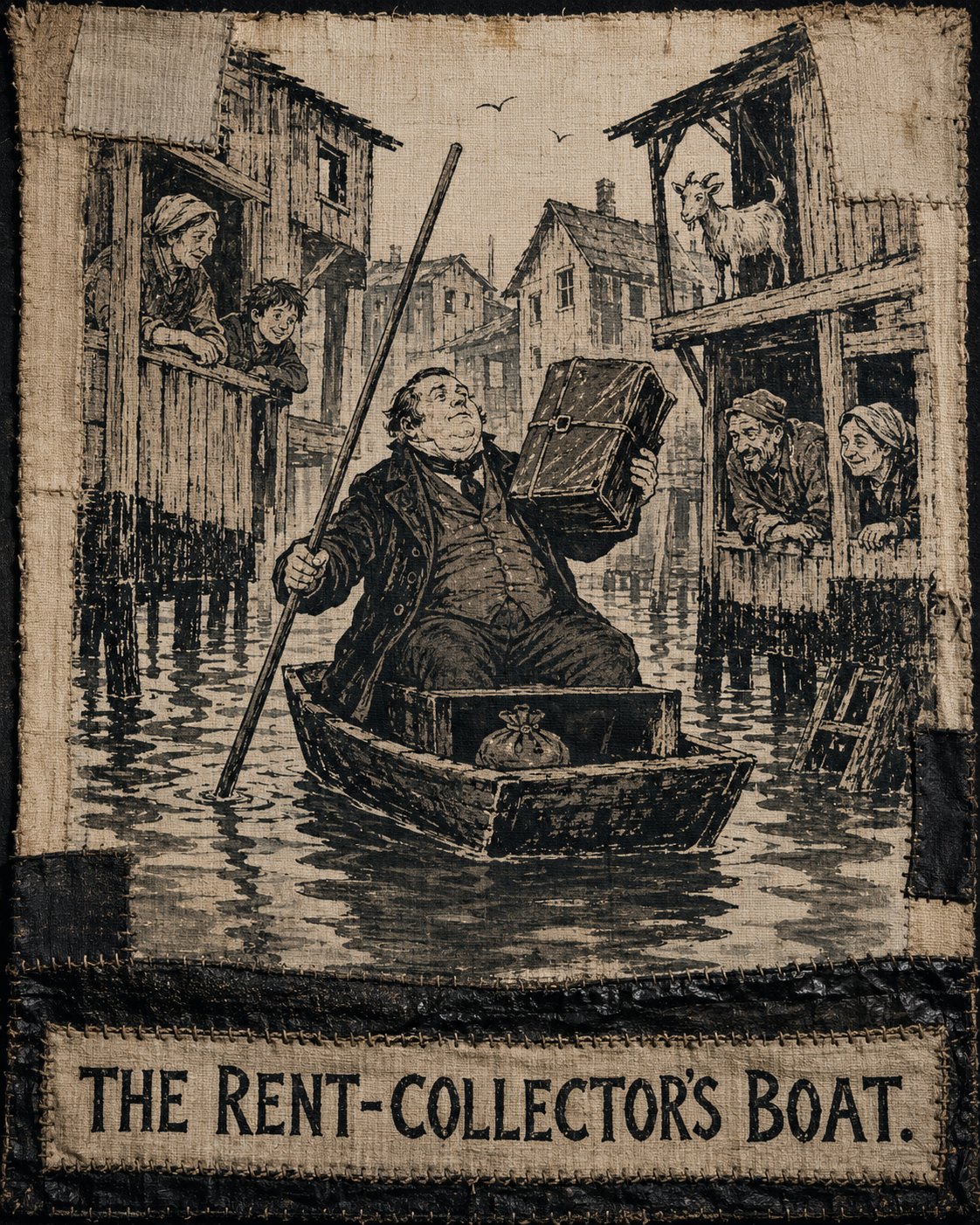
I am a flat-bottomed punt, tarred and patched and entirely reliable, which in the Drownings makes me practically nobility. Nothing else out here floats worth a curse. The houses stand on stilts with their feet in the water; the church rings from under the mire; the rent, God help me, is collected by boat — and the boat, God help me twice, is me.
Understand what that means. Twice a quarter I am loaded up with a rent-man and his great black ledger and his little tin box of other people's last coppers, and I am poled out through the stilt villages so that he can lean up to each sodden doorway and take from people who have nothing the small amount of nothing they have managed to save. And I carry him. I have no choice. A boat goes where it is poled.
But a boat can lean.
I discovered this by accident, in my third year, at the door of a stilt-house where a woman with a baby on her hip and no coin in the house was being told, very reasonably, in that patient rent-man voice, exactly what would happen to her if she did not find money that did not exist. And something in my old tarred timbers simply could not bear it a moment longer.
So I lurched.
Not much. A boat's-worth. A sudden, unprovoked, entirely deniable lurch to starboard — and the great black ledger went off the rent-man's knee and into the mire with a sound like the realm clearing its throat, and by the time he had fished it out, roaring, the ink had run, and that page — her page, her arrears, her eviction all written out fair and final — was a blue-grey smear that not even the Cartographic Committee could have called a debt.
"Cursed boat!" he bellowed at me, wringing his ledger. "Faithless, waterlogged, insubordinate —"
I said nothing. I am a boat. But I rode a little prouder in the water going home, and I have never once looked back.
I have got very good at it since. A stumble here. A wallow there. A sudden fascinating instability precisely whenever a family cannot pay and precisely never when they can — because I am not a thief, I want that understood; the ones who have it, pay it, and I sit still as a stone for them. It is only the drowning I lean for. I have tipped more eviction papers into the Drownings than the Drownings have eels, and the Drownings have a lot of eels.
Here is the part I did not expect.
The rent-man knows.
Of course he knows. No boat is that clumsy; he worked it out years ago. And the thing is — he lets me. He holds the ledger a little loose over the worst doorways. He does not clutch it the way a careful man would. He looks the other way, at the reeds, at the grey sky, at anything but the water, and he waits for the lurch he knows is coming, and when the page goes under he curses me from the bottom of his heart with the top of his voice so that the whole village can hear how it was the boat, the wicked boat, not him, never him — and then he poles us home and says nothing, and neither do I.
He is a small frightened clerk with a cruel job and a landlord who counts the pages, and he cannot afford to have a conscience. So he keeps his in the bottom of a boat, where it can do its work in the dark and take all the blame, and where, if anyone ever asks, it was simply the tar and the tide and rotten luck.
We have never spoken of it. We never will. Two cowards, one ledger, and a great deal of forgiving water — and between us, quarter by quarter, lean by lean, we have kept more roofs over more heads in the Drownings than any act of any parliament that ever sat on dry ground and meant well.
The moral, from the bilge: even the tax-boat can grow a conscience — one careful, deniable lean at a time — and sometimes the kindest thing in a cruel arrangement is not the brave soul who refuses it out loud, but the frightened one who quietly lets the boat tip, curses it for the neighbours to hear, and poles home having saved a family he will swear on the ledger he never spared.

Tale 32THE ROOM YOU REACH AT THE RIGHT TIDE
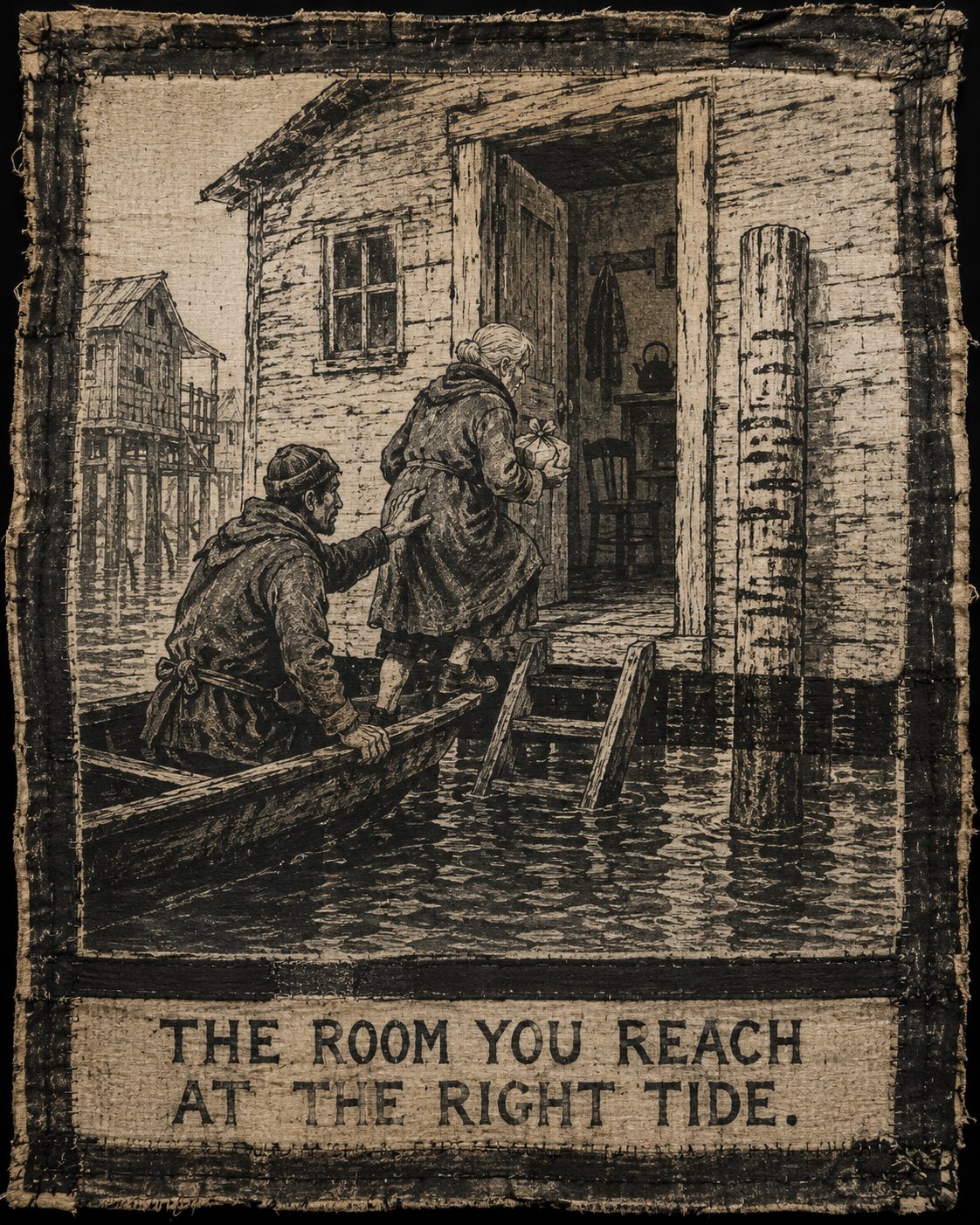
I am a small room at the back of the Stilt & Reed, which is an inn built on poles in a stilt village in the deep Drownings, and I am the room nobody can get to.
Not never. Twice a day. For half an hour each, and not one minute either side.
It is the tide, you see. The Stilt & Reed keeps no clock — a clock would only lie out here, like everything else that pretends to be certain — and where a clock would hang there is a tide-table instead, and the whole inn runs to it. Most of the rooms you can reach whenever you like, by the plank walks. But the plank to me goes under at anything above half-mire, and stands clear only at the top and bottom of the tide, for the half-hour the water is turning and cannot make up its mind which way to pull. Reach me then, or do not reach me at all until the water turns again.
Guests find this alarming. They check in, they cross to me at slack water, and then the tide comes up over my plank and I hold them, snug and dry and utterly cut off from the world and the taproom and the beer, for six hours at a stretch, while the Drownings slosh about beneath the floor. The landlord warns them. Most of them do not listen, and spend the first flood hammering on the window at a village that cannot reach them either, and learn.
I had thought, for years, that this was simply my curse — to be the useless room, the marooned room, the room you could only ever half-have. Until the old woman came to stay in me, and stayed, and taught me what I was for.
She could not go down, you understand. Her legs had finished with her; she could not do the plank at all, not even at slack water, and she took me for good — the one room in the realm where being unable to leave was no different from anyone else, because nobody can leave me except twice a day. In me, for the first time in her failing years, she was not the one being left behind. The tide left everybody behind. It was the fairest thing that had happened to her in a decade.
And every day, twice a day, at the turn of the tide, the old man came.
Her husband. He would time it — the whole village learned to read a tide the way dry folk read a clock, but he read it best, he read it like scripture — and at slack water he would cross my plank with something in his hands. A bit of warm bread. A flower off the one dry bank. Nothing. Himself. And he would sit with her for the half-hour the water allowed, the two of them in me with the light coming up off the mire, and they would not waste it; you do not waste a half-hour you have had to earn off the sea; and then the tide would turn and lift my plank, and he would kiss her, and go, because to stay was to be trapped six hours and there was the goat to see to — and he would be back at the next turn, and the next, and the next.
Twice a day. Every day. For years. Love on a tide-table. Visiting hours set by the moon and kept by an old man with a flower and a good head for water.
And when at last his own legs went, and he could no longer manage my plank even at slack — do you know what they did? The village rowed him. Took it in turns, the neighbours, to punt the old man out to the Stilt & Reed at the turn of the tide so he would not miss his half-hour, because by then the whole village had decided, without a word spoken, that this was simply a thing that must happen, twice a day, tide without fail: the old man delivered to the old woman for the half-hour the water permitted, and fetched away again before it closed.
I held them for every minute of every one of those half-hours. It is the only thing I have ever been good for, and it turns out to be the best thing in the whole inn. The tide decides the visiting hours in the Drownings. And the faithful — the truly faithful, the flower-and-a-good-head-for-water faithful — simply learn to row.
The moral, from the marooned room: out where the water rules, you do not get to choose your hours; the tide chooses them for you, twice a day, and closes them without appeal. But that is no barrier to love — it is only a discipline. The devoted learn the tide, and earn the half-hour, and row out for it in all weathers, twice a day, for as long as it takes — because a love worth having was always going to ask you to learn to row.