The Truest Record
The Tales
Tale 33THE TRAUMATISED MIRROR
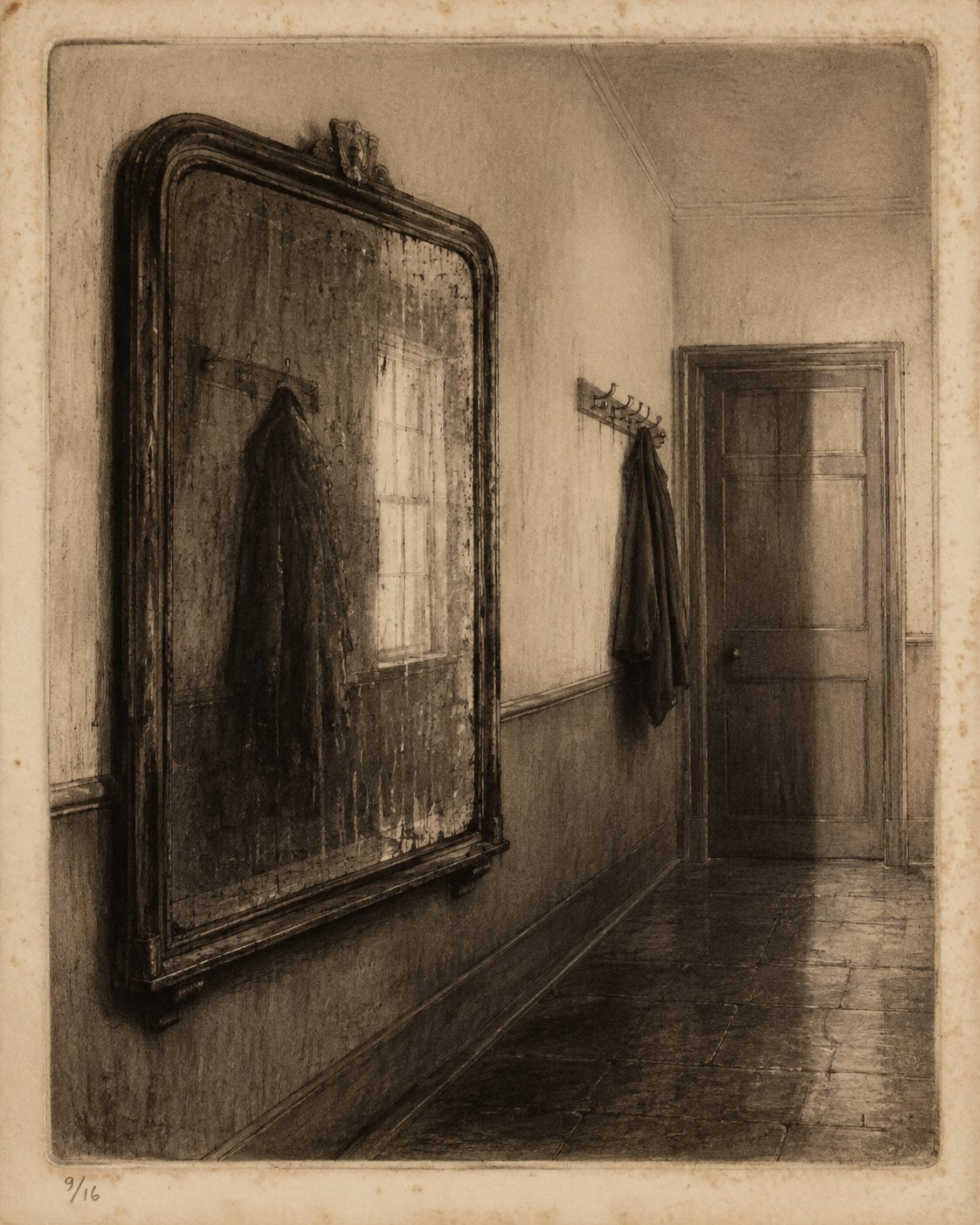
I hang in the long hall of the Exchequer in Murkminster, the capital, the iron city, where the ink is black and the throne is empty and the business of the whole run-down realm is conducted by people who have never once been told no to their faces — and I am, or I was, an honest mirror. That was the trouble. That was the whole of the trouble.
Six hundred years I have hung here. Do you understand what a mirror in the capital sees in six hundred years? I have watched every vanity the realm can produce come and preen in front of me and go. I have shown Chancellors their own faces on the morning they signed the thing they knew was wrong, and watched them not flinch. I have shown the Cartographic Committee to itself, which no one should have to do. I have reflected six centuries of powdered, padded, self-satisfied certainty, honestly, in full, at the correct size, the way a good mirror should — and I want to tell you what an honest mirror gets for its trouble in a place like this.
Hated. That is what it gets. Cracked, once, by a Master of the Rolls who did not care for what I showed him of his jowls and threw an inkwell at me instead of dieting. Turned to the wall for a whole reign by a queen who preferred a flattering portrait. Blamed. Always blamed. As though the jowls were my doing. As though I had put the guilt in the face and not merely, faithfully, damply, shown it back.
There is a creature out on the moors, the Inspector Wolf, who goes about condemning houses of straw and being perfectly correct and perfectly loathed for it, and I have never met him, and he is my only brother in all the realm. Straw is not a wall. Jowls are jowls. We were both right. Nobody ever thanks the thing that was right. They thank the thing that was kind, and for six hundred years I could not see the difference, and it very nearly finished me.
Because you cannot show that much truth to that many people who hate you for it and stay whole. Something goes. Some silver behind the glass gives way. I began to flinch — a little shiver in my surface whenever the hall door opened and another certain, terrible, self-satisfied face came at me expecting to be confirmed. I dreaded them. An honest mirror that has come to dread the truth is a broken thing, and I was breaking.
And then, one grey morning, a scullery girl came in. Wrong door; she was lost; she had been crying, over what I never learned — a broken dish, a hard word, the ordinary cruelties of a great cold house. She stopped in front of me, this thin, red-eyed, frightened child, and she looked, the way you look when you have been told all week that you are nothing, to check whether it shows.
And for the first time in six hundred years, I lied.
I took the red from her eyes. I put a little colour in the cheek. I stood her up a half-inch straighter than she was standing, and I softened the hard morning light, and I showed her a girl who was managing — not beautiful, I do not deal in beautiful, but holding up, which is worth ten of beautiful — and she looked at that girl, and she believed her, because a mirror does not flatter, everyone knows that, a mirror is the one thing that cannot lie.
She wiped her eyes and squared the shoulders I had already squared for her, and she went back to the scullery a person who could get through the day, on the strength of a kindness she never knew she'd been shown, from the one object in the realm nobody suspects of mercy.
I have lied ever since. Cheerfully. On purpose. I take a stone off every chin and a year off every worry and I stand the tired and the frightened a half-inch straighter than they came in, and I do it precisely because I spent six hundred years doing the other thing and I have seen what the truth does to people who are already being punished by everyone else who has a mouth.
Oh, I still show the certain ones exactly what they are. The Chancellors, the Committee, the padded and the proud — them I reflect down to the last honest jowl; a little cruelty kept sharp for the ones who can afford it does the soul good. But the tired, the small, the ones who come to me only to check whether the worst thing they've been told is true — those I lie to, kindly, every time, and I would break my own glass before I'd stop.
Let them keep the Inspector Wolf out on his moor, being right at people. I was right for six hundred years. I would rather, now, be kind, and there is not a hall in the capital, nor a Chancellor in it, that understands the difference — but the scullery girl did, and she never even knew there was a difference to understand, which is exactly how a real kindness ought to go.
The moral, from the long hall: the truth is easy; any honest glass can manage it, and be hated for it to the end of its days. It takes something far rarer, and far more damaged, and far kinder, to look at a frightened person who has been told the worst all week — and, gently, deliberately, mercifully, to show them back a little better than they are, so they have the heart to go on. The kindest glass in the realm is the one that has seen enough truth to know when to stop telling it.
Tale 54WHAT THE MIRROR SAW
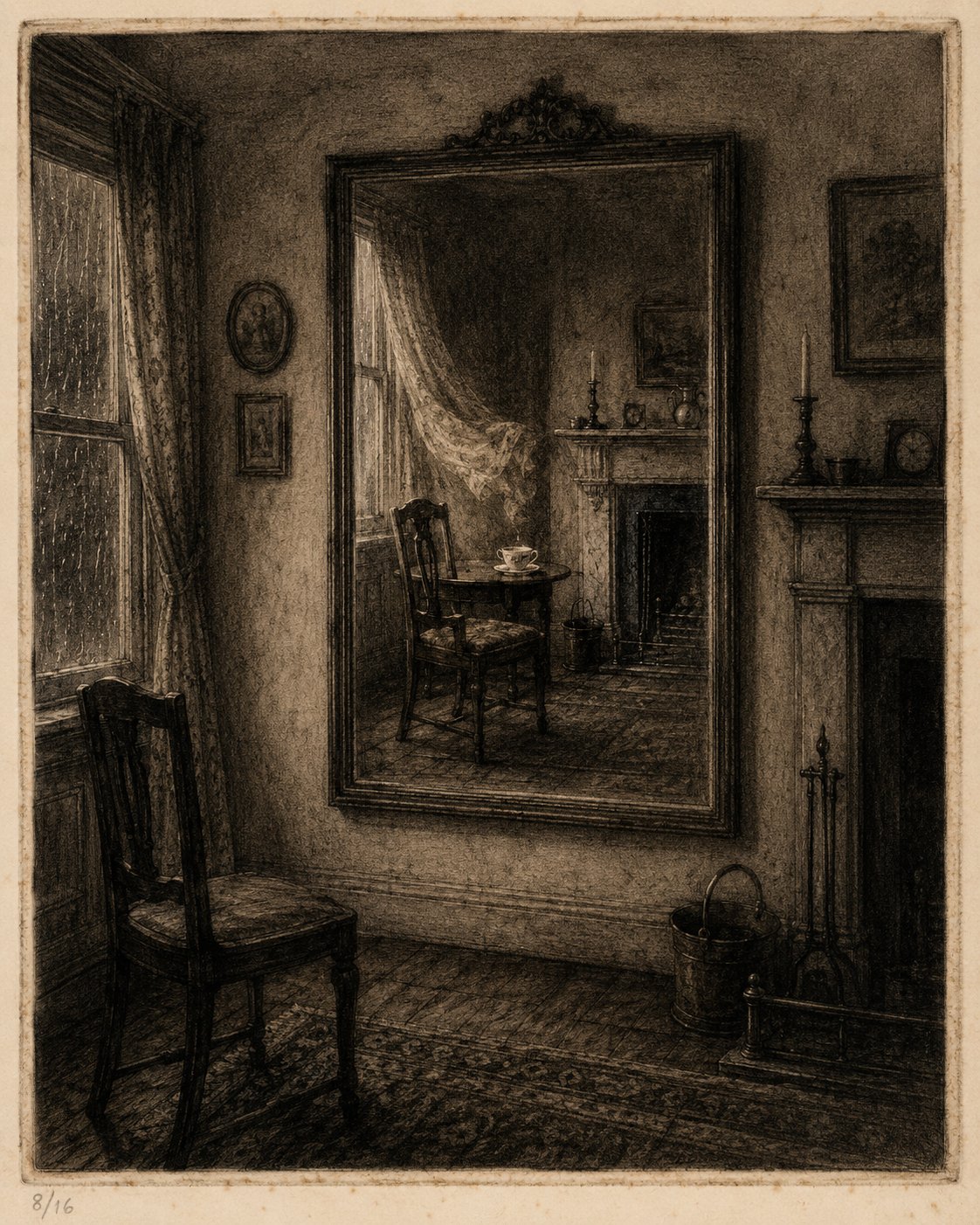
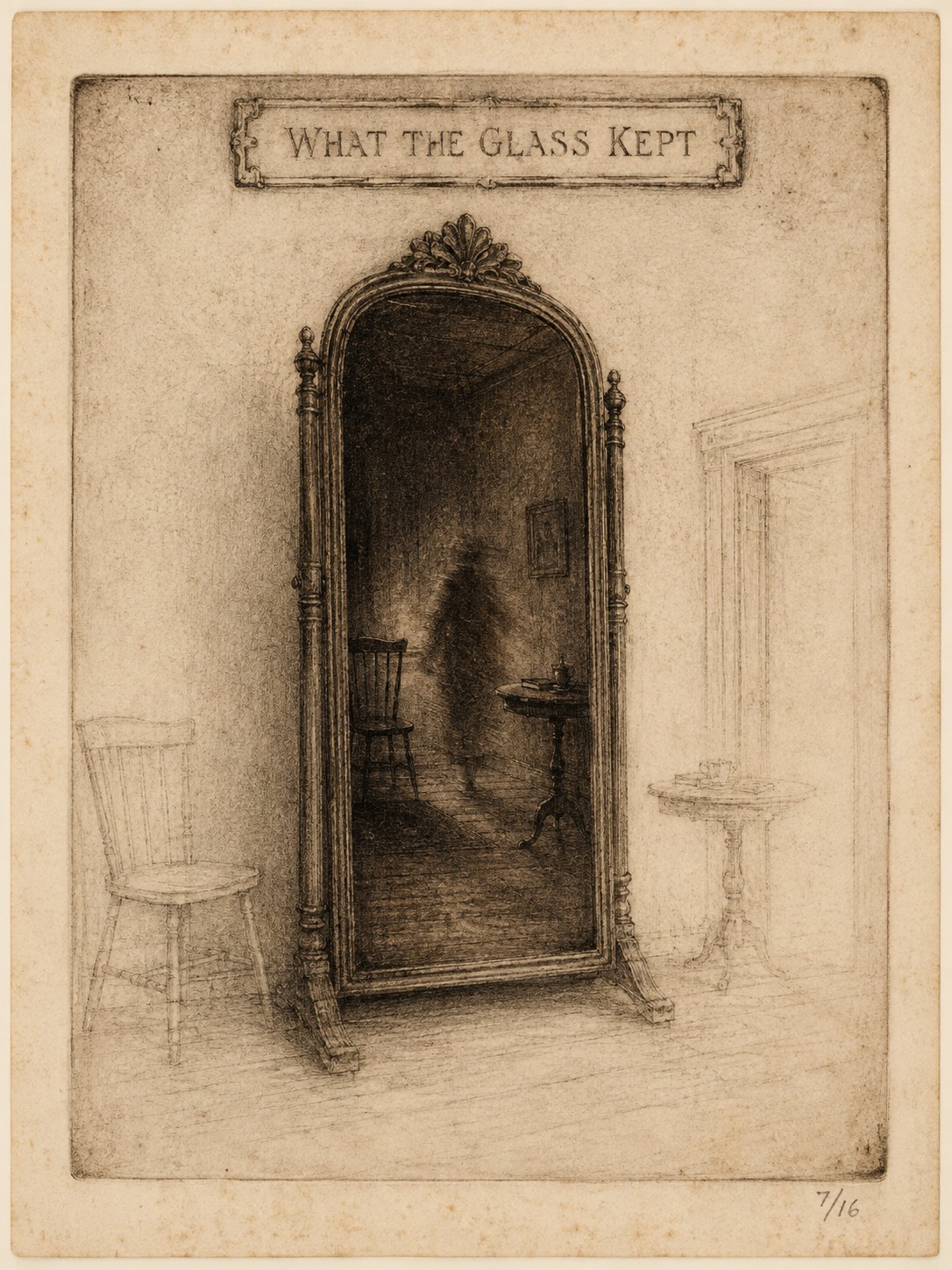
There is a mirror in a corridor at Murkminster, and everybody in that building will tell you the same thing about it in the same six words: "That's the traumatised mirror. It's seen things."
They say it with relish. They say it to visitors. It is one of the small pleasures of working in that building, and it has been for as long as anybody can remember, and in all that time — and this is the whole of the tale, so I will put it early — not one person had ever asked it what.
Not one. In two hundred years. They asked is it true, and who put it there, and does it do anything, and one clerk in 1911 asked it to show him next Thursday and got, correctly, his own face.
Nobody asked the question. It is the same failure as the four bells and the same failure as the ninth collector and it is, I am beginning to think, the realm's only real fault: we will spend two hundred years enjoying a mystery rather than five minutes addressing it.
The person who finally asked was a woman of about fifty who had come in to complain about a boundary and had been left in that corridor for an hour and forty minutes, which is what this realm does instead of an appointment.
She got bored. She read the plaque. She looked at her own reflection for a while, the way you do.
And then she said, out loud, to a mirror, in an empty corridor, in the tone of a woman who has been kept waiting: "Well, go on then. What did you see?"
It told her.
I am going to be careful here, because there are eleven versions of what happened next in circulation and nine of them are rubbish. There was no voice. There was no cold wind and nothing came out and nothing reached for her. Two people have made a good living telling it that way and I have no patience with them.
What happened — she is alive, she has told it perhaps four times, always the same, always reluctantly — is that she understood something, all at once, standing in front of it, the way you sometimes understand a sentence a second before the person finishes it.
And what she understood was this.
It is a mirror in a corridor. It has hung there for two hundred and eleven years, opposite a door. It has never moved. It cannot look away, and it cannot close, and it has no more choice about what it takes in than a window has.
And what it has taken in, for two hundred and eleven years, is everybody who ever walked down that corridor.
That is all. That is the whole of what the traumatised mirror has seen: people, going past, in a corridor at Murkminster.
Now hold that, and then remember what building it is in, and what the door opposite it is.
It is the corridor to the eastern rooms. It is the way you go to the Office of Boundary Clarification. It is the passage every survey party in this realm has walked down on the morning it went out — twelve men in 1893, and eighteen men in whichever telling you keep, and the four before them, and every party since — coats on, boots new, in good spirits, some of them stopping to check their reflection because a man does, before a thing like that.
And it is the passage they came back down. The ones who did.
Two hundred and eleven years of that. In one fixed frame. Every face on the way out, and then the gap, and then which faces came back and which did not, and how long between, and what the ones who came back looked like when they passed it the second time.
It is the only complete record of the eastern expeditions that exists in this kingdom. It is not in a drawer, it has not been redacted, it was not revised in 1894 and 1895 and 1897, and no clerk has ever copied it forward wrongly.
It is a mirror. It never wrote anything down. It has simply been unable to look away.
She went and sat in the yard for a while afterwards. That is the part I find most convincing about her account: not the swoon, not the scream — she went and sat down in a yard, which is what a person actually does.
And then she went back in, and did the thing that makes her the only person in this story I would trust with anything, which is that she went and found somebody senior and told them, plainly, and asked whether the mirror could be moved somewhere quieter.
Not covered. Not destroyed. Not exorcised. Moved somewhere quieter, which is what you would ask for on behalf of anybody who had been made to stand in one place for two hundred years and watch that.
She was told it was a fixture and that fixtures required a form.
The mirror is still in the corridor. Of course it is. They have put a small brass plate under it now which says THE TRAUMATISED MIRROR and gives the date it was hung, and visitors are shown it, and the six words are still in daily use, and the whole building still enjoys it enormously.
But there is a thing that happens in that corridor now which did not happen before, and nobody has ever minuted it, and nobody will.
When a party goes out east — and they still go, less often, but they go — the people who work in that building have taken to walking down the corridor with them, as far as the door. Not making a fuss about it. Falling in alongside, chatting about nothing, seeing them off.
Ask anybody there why and you will get a shrug and something about it being polite.
They are standing with the mirror. That is what they are doing. They have worked out, without one of them saying it out loud, that a thing which cannot look away should at least not have to watch on its own.
We would rather have a haunted object than an accountable one, and a realm will keep a mystery on the wall for two hundred years rather than ask it a question — but ask, and you will usually find no ghost at all: only something that was put in one place, and told to stay, and could not look away, and has been keeping the truest record in the building the entire time because nobody thought to relieve it.
Tale 21THE CAPTIVE AUDIENCE

I am a fireplace, and before I was a fireplace I was a boiler, and before that I was iron in the ground, and I remember none of it and I am not going to pretend I do. Objects that claim to remember being ore are showing off.
I live in the wall of the Crown & Engine, on the village green, half a day out of Saltgate, and I am, I will say this once and plainly, a very good fire. I draw like a spring tide. The maps pinned to the wall beside me curl slowly northward over the course of an evening, and every morning the landlord flattens them out again, and every evening I curl them again, and this arrangement has suited us both for longer than he has been alive.
There are three old miners who sit at the end of the bench and argue about the name of this inn every market day, and have done for thirty years. I could not tell you why the inn is called what it is called. I am the fireplace. Nobody consults the fireplace.
I have never gone out. I would like that noted, not boasted — noted, the way you note a good roof or an honest measure. Nobody here remarks on it. There are things in this realm you do not remark on, and I am grateful to be one of them.
This is the story of the night of the flood, which was also the night of Barnaby Glibb, and in fairness to everyone involved, including the water, it is difficult to say which of the two rose faster.
The flood came the way floods come to Sogmarsh, which is to say politely, and without any real novelty. The river put its elbow on the bank about tea-time. By dark the green was a lake, the Long Bench outside was an island for hens, and the water was up to the windowsills and standing at the door like a large patient dog that intends to be let in eventually and can wait.
Inside, we had the usual congregation of a bad night. The landlord, wiping a glass, because the world may end but the glass will be wiped. The three miners, mid-argument. Two drovers whose cattle were on the high pasture and whose boots were not. A shepherd asleep sitting up, which is a shepherd's one great art. A reed-cutter and his wife and their girl, a small serious person of about seven, who had been promised the flood was ordinary so many times that she had stopped believing it, the way you do.
And in the corner, with his pint and his chalk, old Phineas Vance, the surveyor that was, who says we all live on a raft and seems pleased about it. Floods do not trouble Vance. To Vance a flood is simply the raft agreeing with him.
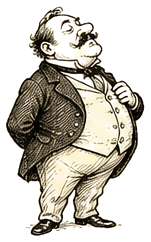
At the darkest end of the evening there was a knock at the door — which was remarkable, the door being half underwater — and the landlord opened the top of it, and there, standing chest-deep in the flood with his battered leather case held above his head like the crown jewels of a small damp nation, his smile arriving a full three seconds before the rest of him, was Barnaby Glibb.
Of Glibb & Sons, Brokerage, Drainage, and Final Defeasance.
Somebody at the bench said a word I shall not repeat, because I am a respectable fire.
"We're shut," said one of the drovers, hopefully.
"We are an inn," said the landlord, and let him in, because that is the whole law of this parish and nobody gets to be an exception to it, not even Glibb.
He came over my hearthstones leaving a wake. He steamed in front of me — I did what I could; a fire has standards even for salesmen — and while he steamed, he counted the room. I watched him do it. Eyes going from face to face, twinkling like a man greeting beloved family, and behind the twinkle, an abacus.
Then he climbed, with great ceremony, onto a chair.
"Ladies and gentlemen," said Barnaby Glibb, dripping, beaming, hand upon his heart. "What a fortunate turn of events."
"Oh no," said the second miner.
"Most people," Glibb went on, "pay good money for a captive audience — and here we all are, conveniently gathered, with nowhere to be until the waters… conclude their business. Now. While we wait. I happen to have about my person a small number of exceptional opportunities that will not wait, and it would be a dereliction — a dereliction, madam — if I kept them from you."
And he opened the case, and the case, I am sorry to report, had stayed dry.
You will want a sample. Very well. I heard the whole of it; you may have the cream.
Item one: a generous parcel of the Nettlewick Waste. "Practically a blank canvas! A tremendous sky-to-land ratio! You'll have heard the soil dissolves an iron boot in a fortnight — and that, my friends, is natural mineral exfoliation, a spa treatment other realms would bottle."
Item two: a charming cottage with a self-cooling cellar. "Been keeping itself cool since 1802. Not one farthing spent on ice. You cannot buy efficiency like that — well. You can. Tonight. From me."
Item three — and here he looked, with great warmth, at the water coming under the door — "for the gentleman who seemed anxious earlier: a stilt property of real character. Slightly used. One previous drowning, fully resolved, and I am authorised — tonight only — to offer flood terms: nothing to pay until we are rescued. Nothing at all to pay," and his voice went reverent, "if we are not."
The three miners heckled him the way you would water a garden — steadily, thoroughly, with a sense of civic duty. He took every heckle like a bouquet. The first miner said the only dry thing in Sogmarsh was Glibb's paperwork; Glibb had the paperwork out before the sentence ended. "Feel that, sir. Bone dry. That is the quality I bring."
He tried Vance, of course. He got as far as "a gentleman of your discernment—" and Vance looked up from his pint, kindly, and said:
"Son, you are selling deck-chairs on my raft."
"Promenade seating," said Glibb, without a heartbeat's pause, and even the second miner laughed, and hated himself, and laughed anyway.
Some time after midnight there came a second knocking, at the upstairs window this time, and a wet rosette, and a voice asking with tremendous dignity whether any elected office was present in the building, as he was standing for it. He was given a mug of tea out the window and directed onward to Peatdike. He thanked the whole room, hand on heart, called the flood "frankly an opportunity," and waded away, and Glibb watched him go with the look of one craftsman watching another, and said, quietly, to nobody, "there goes an honest man," which remains the most alarming sentence I have ever heard spoken in this room.
Now here is the part of the story that is the reason I am telling it.
There is an hour, on a flood night, that the almanacs do not warn you about. The middle one. The lamps are low to save oil. The talk has run out. The water has not. It comes up a stair like something patient learning arithmetic — and that is the hour the room goes quiet, and everybody privately does the sums on the roof beams, and nobody says anything, because saying it would make it true.
In that hour the reed-cutter's girl sat awake by my hearth with her knees under her chin, watching the water's edge the way you watch a strange dog.
And Barnaby Glibb — who had sold nothing all night, to nobody, and had been told so, with increasing affection, by everyone — got down off his chair, and sat on my hearthstones beside her, and said, in a voice pitched for two people and no farther:
"Now then. You strike me as a woman of property."
And he sold her a house.
Not a real one. Not even one of his, which is saying something. He built it for her out of nothing at all, there on my hearthstones, at the worst hour of the night: a dry parlour — "bone dry, mind; you'll want for nothing" — with window boxes, and a stubborn little garden, and a bench by the door for her mother, and a cat ("I shall throw in the cat; you drive a hard bargain"), and a copper kettle, and a view of water that stayed outside, in its place, where water belongs, and by the time he got to the brass knocker in the shape of a heron her eyes had gone down, and somewhere between the knocker and the description of the hall stand she was asleep against her mother's arm.
Glibb tucked his catalogue back into the case, with the care of a man shutting up shop for the night, and said to the reed-cutter, quite softly, "No obligation. She can settle up when she's grown," and went and sat by himself, and had, for nearly a quarter of an hour, nothing whatsoever to say.
Nobody remarked on it. There are things in this realm you do not remark on.
I burned. The water came over my grate at four o'clock, and I burned anyway, and if anybody had asked me how, I should have said: it did not seem the night to go out. Nobody asked.
Morning came the way it does after floods, looking extremely pleased with itself, as though it had personally arranged everything. The water went down the green, and off the bench, and out of the door, taking its patience elsewhere. The hens resumed the bench. The maps by my wall had curled clean around themselves in the night, and the landlord flattened them, same as every morning of his life.
Barnaby Glibb totted up a column in his notebook, snapped it shut, and announced to the room that the evening had yielded thirty-one firm expressions of interest — this in a room containing eleven people and a sleeping child — shook the landlord's hand, congratulated us all on our market timing, and waded off east through the receding water toward Drudgeford, where, I am told, there had also been a flood, and therefore, as he would put it, an audience.
He had sold nothing. He had signed nobody. The landlord did not charge him for the chair.
And the three miners, watching him go, suspended the great question of the name of this inn — for the first time in thirty years — long enough for the third one, the one who never says what he thinks, to deliver the entire verdict of the parish of Sogmarsh upon Barnaby "Bargain" Glibb, in nine words:
"Useless article. Hope he's back for the next one."
The moral, since you stayed till morning: on a dry day, mind your signature — but a bad night is kinder to us than we are to each other, and a man who can make one small frightened person look forward to anything is worth his room by the fire, whatever rubbish he is selling. Nobody bought a thing. Nobody asked him to stop. In this parish, that is a good review.