The Survey That Won't Hold Still
The Tales
Tale 53THE OFFICE OF MARSH COMMUNICATIONS
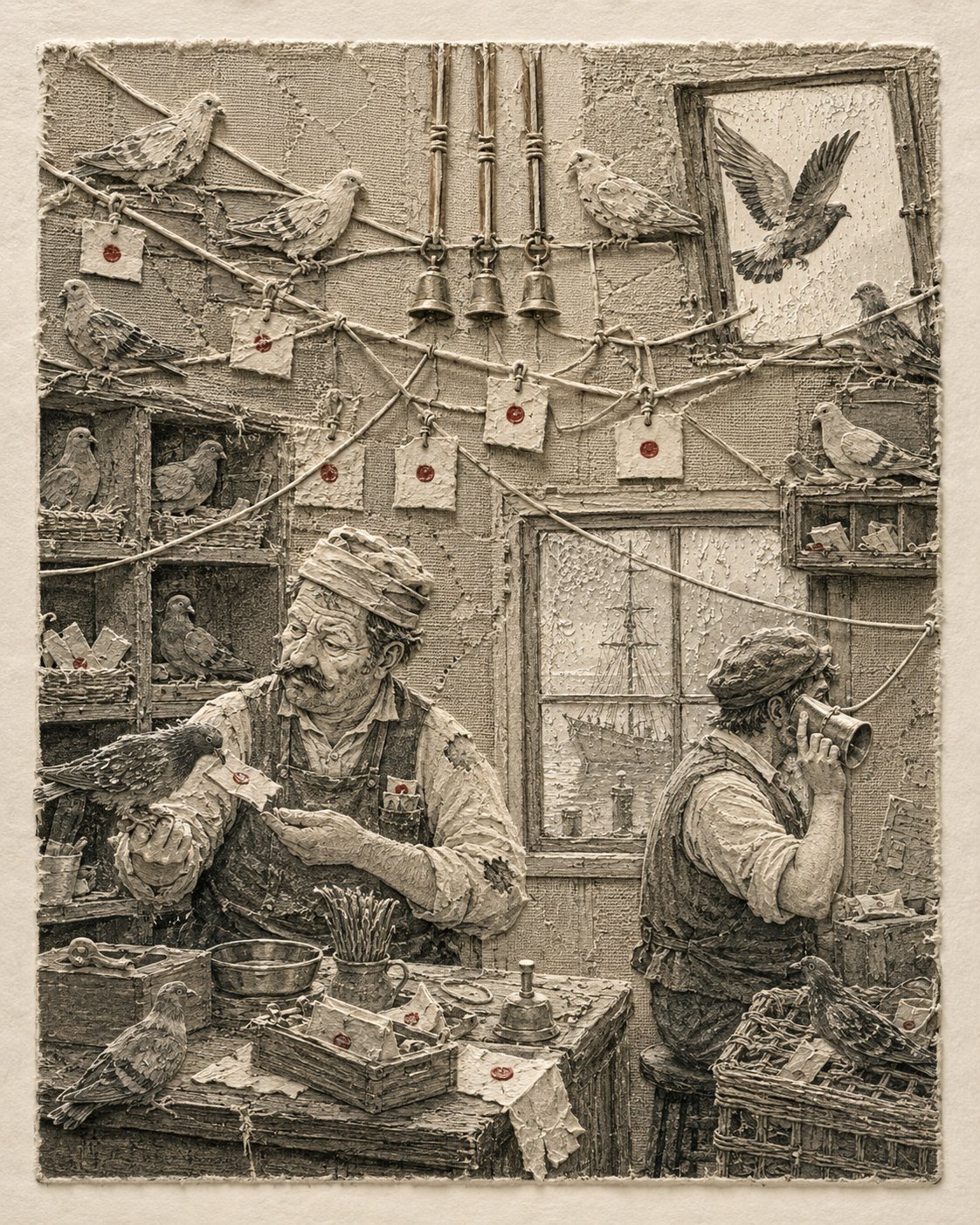
The notice on the door of the Office of Marsh Communications at Murkminster reads, in full:
It has read that since 1902. It is one of the four or five great documents of this realm and it is on a door in a corridor and most people who pass it laugh, which is correct, and go away, which is the part this tale is about — because one woman did not go away, and what she found is the best account anybody has of how this kingdom actually works.
Her name was Bel Harrow and she needed Form 9.
Not for anything dramatic. Her brother had drowned in the Drownings — properly drowned, no mystery, a boat and a bad night — and the parish needed the death notified to three places, and two of the three would take a letter, and the third required Form 9 of the Office of Marsh Communications, which is the office that carries word between the flooded parishes and everywhere else, and which is closed, and whose enquiries go to itself.
She was thirty-four and she was tired and she had buried a brother and she wanted one piece of paper.
She was in that building eleven days.
Day one. She read the notice. She laughed — she is very clear that she laughed, and that it was a real laugh — and then she knocked, because a person has to try the door.
Nobody answered. She tried the handle. It was not locked. There was nobody in the room. There was a desk, and a chair, and a stove that was cold, and a shelf of forms, and no Form 9.
Day two. She went to the Chancery, who told her the Office of Marsh Communications was not their office and that they could not issue its forms, which is true and is not obstruction; a Chancery clerk issuing another office's form is how a realm ends up with two Form 9s and no way of telling them apart, and this realm has enough of that.
Day three. She was sent to the Toll Bench, who sent her to the Exchequer, who were kind, and gave her tea, and explained that the Office of Marsh Communications had been reorganised in 1902, and that the reorganisation had never been completed, and that as far as anyone could establish it had been reorganised into itself.
"Then somebody works there," said Bel Harrow.
"Somebody must," agreed the Exchequer man, "because the forms get printed."
That is the sentence that turned it from an errand into an expedition, and I think anybody would have felt it: the forms get printed.
Somewhere in this city there is a press, and a print order, and a person who signs it, and a budget it comes out of. The Office of Marsh Communications is closed, and has been for a hundred and twenty-one years, and it is still ordering its own stationery.
So Bel Harrow, who had come for a piece of paper about her brother, stopped asking for Form 9 and started following the money, which is the only reliable way to find anybody in Murkminster.
Days four to nine are the corridor, and I will compress them, because the tale is famous for being long and I have never thought that its being long was the joke.
She found the print order. She found the printer, who has printed Form 9 for thirty years, four hundred a year, and has never once been asked for a receipt because the invoice goes to a department that pays it without querying, on the grounds that it is small and has always been paid.
She followed the invoice. It goes to the Office of Establishments, who confirmed — after two days, and with great courtesy, and by consulting a book that had to be fetched — that the Office of Marsh Communications has, on the establishment, one post: a Clerk, Grade Two.
"And who holds it?"
They looked. It took an hour. The post is held. It has been held continuously since 1902. It draws no wage, because the wage line was struck in the reorganisation and never restored, and the post has therefore never been formally vacant and never formally filled, and nobody has been able to do anything about it for a hundred and twenty-one years because doing anything about it would require the office to apply, and the office is closed, and enquiries go to itself.
Day ten she went back to the corridor and sat down on the floor opposite the door, because she had run out of other places to be, and she waited.
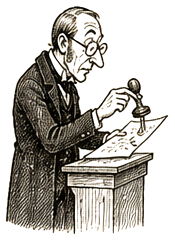
Day eleven, at about four in the afternoon, an elderly man came down the corridor with a key and a string bag, and let himself into the Office of Marsh Communications, and lit the stove.
His name was Mr Pightle. He was seventy-six. He had held the post since 1971.
He was not a mystery. He was not a ghost, and he was not mad, and he was not hiding. He came in twice a week, on a Tuesday and a Friday, at four, for an hour and a half — a fact which about nine people in that building knew perfectly well and which nobody had thought to tell Bel Harrow, because nobody had ever asked them the question in a form they recognised. She had been asking where is the office. The office is behind that door. She had never once asked when.
He was appalled to hear she had been eleven days. He made her tea on the stove. He asked about her brother, properly, and let her talk, and did not hurry her, and then he opened a drawer and took out Form 9, of which there are, by his own count, something over eleven thousand in that room, and filled it in for her himself because his hand is better, and stamped it, and gave it to her, and it took four minutes.
He had held the post, without pay, for fifty-two years, because his predecessor had asked him to and because — he said this quite matter-of-factly, stirring the tea — "somebody has to be here when they come about a drowning. They always come about a drowning. That's the whole of what this office is for."
The notice is still on the door. Bel Harrow asked him about it, at the end, and he said the only funny thing he said in the whole of that hour, and he did not mean it to be:
"Oh, I've applied to have it changed. Twice." He blew on his tea. "Enquiries go to this office, you see. So it comes back to me, and I'm not authorised to approve it, because the post that approves it was struck in '02. I keep the applications." He nodded at a drawer. "There's forty-one."
Some doors in this realm say CLOSED and are not, and the whole difference between a bureaucracy and a kindness is that somebody has quietly kept coming in, unpaid, on a Tuesday and a Friday, for fifty-two years, in case anybody comes about a drowning. Do not read the notice. Knock at four.
Tale 56SIDEWAYS, OUT OF COURTESY
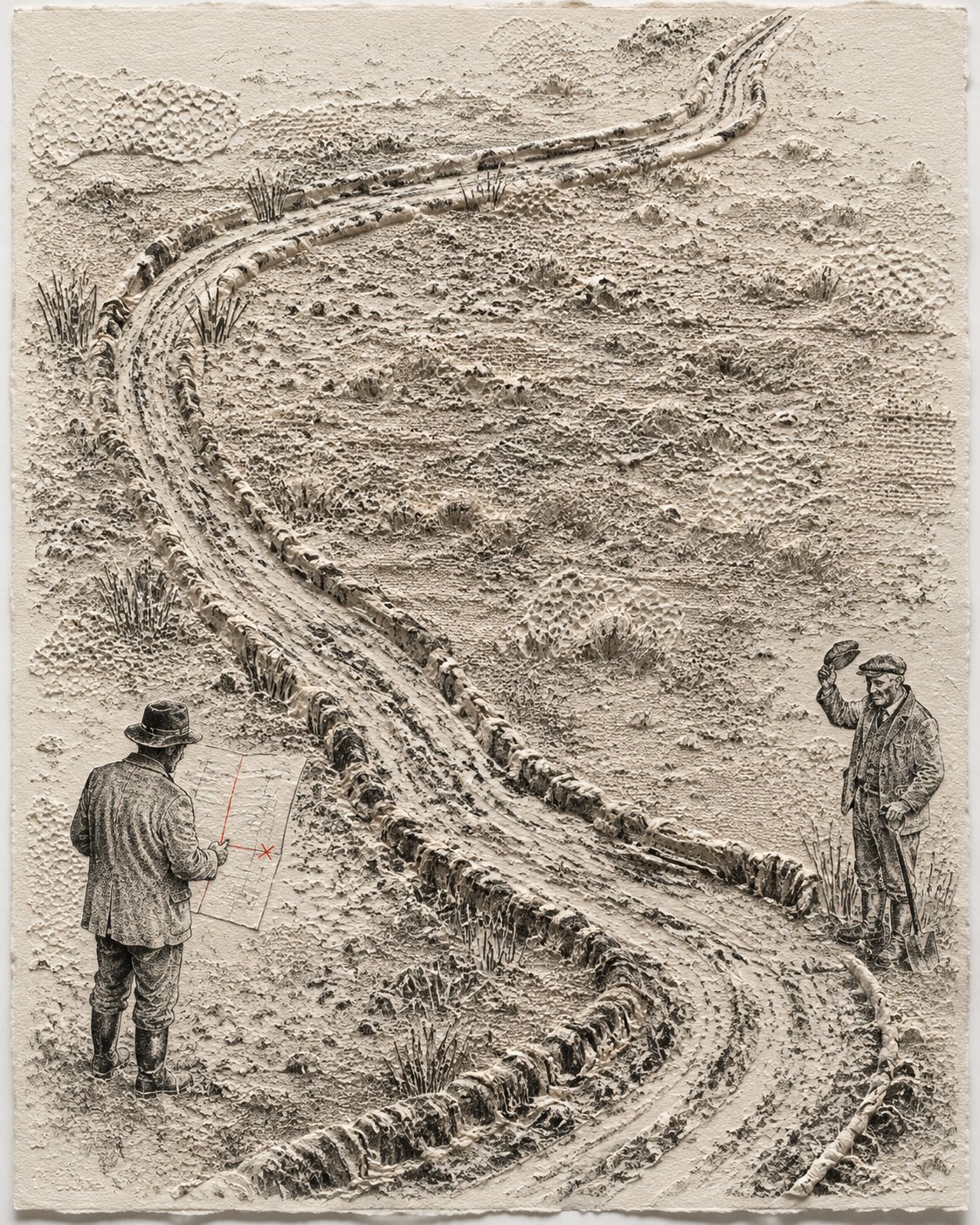
House Delve digs sideways.
Every soul in this realm knows it and nobody outside it can be got to believe it, and the misunderstanding that follows is so reliable that the Delves have a word for the visitor it happens to. They call him a Straight, and they say it the way you might say a nephew — with affection, and a certain weariness, and an eye on the furniture.
The most celebrated Straight was a mining engineer of two-and-twenty, brought up from a dry country at considerable expense to advise on efficiency, and I have the whole of his week from three people who were there and who agree about everything except the pie.
He arrived at the Delve workings on a Monday and did the sums on the Tuesday, and the sums are not in dispute. They were correct then and they are correct now, and if you put them to any engineer alive he will tell you the same thing:
The Delves are digging the longest possible route to everything.
Their workings go out sideways from the shaft in great patient curves, and where a seam lies below them they do not go down to it; they go along, and around, and come at it from the far side, and the distance they walk in a working life is, by his figures, something over six hundred miles more than the job requires.
He put this to them on the Tuesday evening, in the long room, with the figures written out.
And they were delighted. That is the part he could not account for at the time and told for the rest of his life. They were not offended and they were not ashamed; they passed the paper down the table and several of them whistled and old Nan Delve said it was the most beautiful piece of arithmetic she had ever had read at her, and they gave him more pie.
Then they carried on digging sideways.
He tried again on the Wednesday, more slowly, in case it was the accent.
And a man called Tam Delve — pick-man, about forty, patient as a wall — put his cup down and gave him the answer, which the Straight wrote in his notebook that night and underlined twice with the pen going through the paper:
"We know, lad. It's manners."
The Straight said that manners were all very well but that six hundred miles was six hundred miles.
"Aye," said Tam. "And?"
"And it's inefficient."
"Aye," said Tam, comfortably. "It is that."
Here is what he was four days working out, and I set it out here in the plain order because the Delves themselves will not, holding that a thing you have to be told is a thing you have not understood.
Down is where the water is.
That is the whole of it. That is the entire foundation of Delve manners and every rule that comes off it. In a realm made of bog, a working that goes down goes wet, and a wet working is not merely a nuisance — the water in this country does not stay where you find it. It moves. Take the bottom out of a seam and you have not only flooded your own gallery; you have given the water somewhere new to be, and it will go there, and it will go on going there, into somebody's else's workings, or somebody's well, or somebody's cellar, next week or next year or in forty years when you are dead and it is not your name on it any more.
You cannot see whose. That is the point. You cannot see whose, and so you go round.
The Delves have therefore arrived, over six hundred years underground, at a code of manners in which going down is not dangerous — they are not frightened of it, they will go down in an emergency and be back up by tea — but rude. Straightforwardly, socially rude, in the way that reaching across a table is rude. It is a thing you do not do in front of people because of what it does to the person you cannot see.
And out of that comes the whole of their etiquette, which is elaborate, and which they take entirely seriously, and which is why the pick-song has the line it has.
"Never in, never down past done."
The Straight had been hearing it sung all week and had taken it for a work rhythm, which it is. It is also the law, and it means: never go into another's working, and never go below the level of what is already finished. Both halves are courtesies to somebody you have not met.
A Delve does not sink a new shaft without walking the ground above it first and knocking at every door within earshot — not to ask permission, which nobody would grant or refuse, but to say where they will be digging. It takes a morning and it has no legal force whatever and not one Delve in six hundred years has skipped it.
A Delve who breaks into water shouts. Immediately, at the top of the lungs, before anything else, including before getting out — the word is WET and it goes up the gallery and out of the shaft and across the top and it is the only occasion on which a Delve will shout at all.
And a Delve does not say the word below at a table. This is the one the Straight fell over twice. There is a set of polite substitutions — the lower, the far side, the long way — and they are used without any solemnity, in the way you might avoid a subject at a christening. He asked, on the Thursday, what the taboo was.
Nan Delve told him there was no taboo, and that they simply did not care to discuss the plumbing at meals, and everybody laughed, and the Straight understood that he had been given the true answer and a joke at the same time and that the Delves regarded these as the same thing.
He went home on the Saturday and wrote a report which is, by the standards of such reports, remarkable — because it recommended no change whatever.
It is four pages long. Three of them are the arithmetic, which is unaltered; he never withdrew a figure. The fourth is one paragraph, and it is the paragraph that got him laughed at in his own profession for some years and quoted with approval in this one ever since:
The girl of eight is the best part and I have it from two of them.
He had asked her — on the Friday, having given up on the grown ones — why not just go straight down, and she had taken his cup and a jug and poured water on the table, and let him watch it run, and said:
"That's your gallery. Where's it gone?"
He said it had gone to the edge.
"Whose edge?"
And he opened his mouth and had no answer, and she nodded at him the way an eight-year-old does when a grown man has finally caught up, and mopped the table with her sleeve, and said the thing that is on the wall of the long room now because somebody wrote it there afterwards in chalk and nobody has washed it off:
The Delves still dig sideways. They still walk their six hundred extra miles. They still knock on doors to tell people where they will be, and they still will not say below at a table, and every few years another Straight comes up with another set of correct figures and gets the pie and the whistling and the same reply.
"We know, lad. It's manners."
Efficiency is a measurement taken from one place at one time, and courtesy is what a trade develops when it has spent six hundred years learning that the person its shortcuts will drown has not been born yet — so if you are ever shown a route that is plainly the long way round, ask what it goes around, before you improve it.
Tale 69THE SURVEYOR WHOSE PROOF CAUGHT FIRE
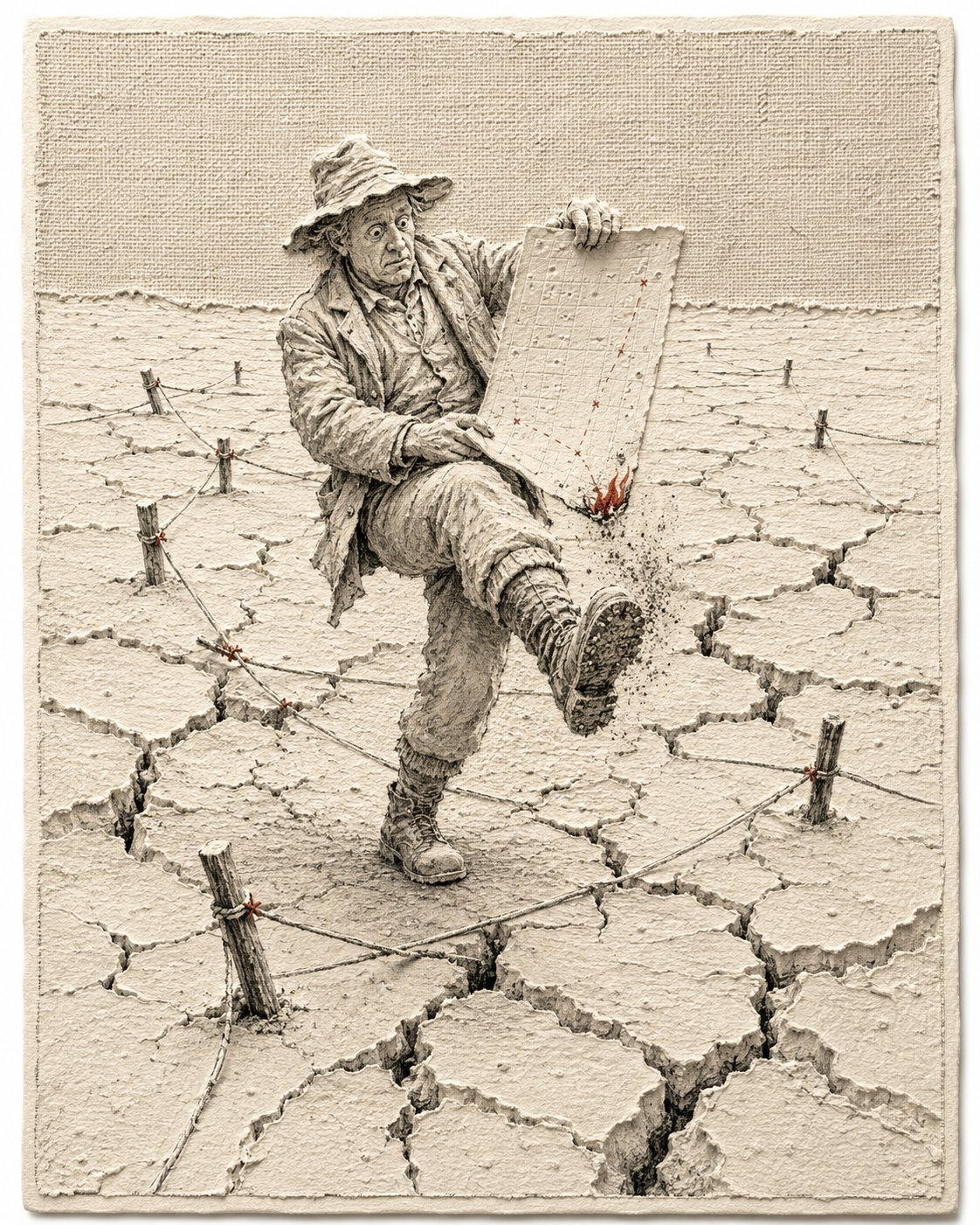
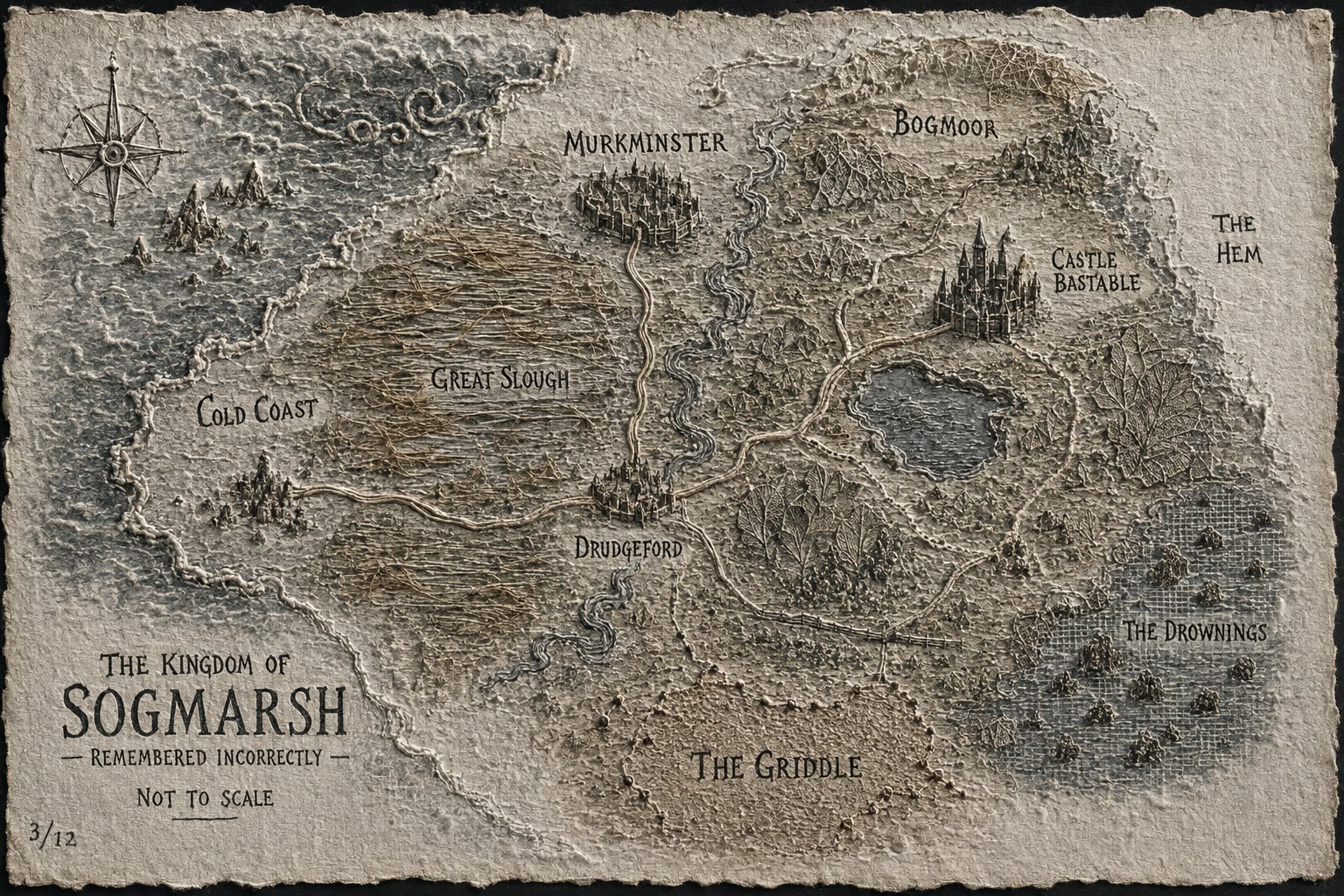
There is a place in the far south that the whole realm calls the Griddle, where the ground is dry — which, in Sogmarsh, is very nearly an accusation — and cracks like an old plate left too near the fire, and grows nothing, and now and then goes suddenly, viciously hot for no reason anybody can give. The people on its edge believe that Someone, up there, has left a burning-glass trained on that one spot of the map. There are three versions of who is holding it, and we need not go into them here, because this is not their story. This is the story of the one man who did not believe in any of them.
His name was Endacott, and he was the finest surveyor the Grand Cartographic Revision Committee ever ruined.
Endacott held, as an article of faith he would not have dignified with the word faith, that everything has a plain cause, and it is a decent man's work to find it and write it down. He had explained the singing culverts of Peatdike (water, moving, under a hollow stone). He had proved the Crooked Compass staircase a mere trick of worn treads and a sloping floor. He had reduced a full dozen of the realm's better hauntings to damp, draught, and arithmetic, and he had done it kindly, because to Endacott a mystery was not a wonder to be guarded but a frightened thing to be let down gently into the ordinary. He loved the moment a marvel went dull in his hands. He thought it the truest mercy his trade could offer.
The Committee's trouble was this: a realm may not, in its own returns, keep a place it cannot account for. Who owned the Griddle was hopeless — it had been contested since before the ledgers — but the cause of the heat was a question, and a question has an answer, and an answer can be filed. They gave Endacott a mule, a season, and their blessing, and sent him south to end it.
He went past the Fat Mile — that thin green seam on the wet edge where the heat and the water meet and the one good ground in the realm grows, and the pickers are brown as nuts and call it the food basket of the world — and then he went up, onto the Griddle proper, where almost nobody goes. And there he measured, alone, for a season.
And he found it.
Nobody remembers this part, because there is no paper by which to remember it, so you will have to take it from me: he found it, and he had it cold. The dry wind that falls off the high country and arrives with the wet already wrung out of it. The pale, hard stone that sheds every drop of water and hurls the sun's heat straight back up. The way a hot gust and a bright bare floor together make the shimmer, and the ticking, and the sudden murderous hikes. He had figures. He had it exactly. It was the happiest season of his life — he had run down the realm's one true mystery and made it ordinary, which was the whole of his joy — and one bright afternoon he sat on the cracked ground and wrote it up, a fair copy, page upon page, meaning to carry it home to Murkminster and read it aloud to the Committee and put the legend in the ground forever.
And a hike came.
The air went to water. The ground ticked and opened. And his papers — the proof, the whole rational account, the entire season's work — caught, all at once, and went up in a single breath, and were black flakes rising past his face before he could so much as get his coat across them.
He saved nothing.
He stood there on the baking ground with the ash of his own handwriting going up into the shimmer, and he understood the joke, and it was not a kind one. The one place whose plain cause he had nailed was the one place that would not permit the cause to be written down.
Now — and here is where he was undone — the rationalist in him was, for about one minute, delighted. Of course it burned. That is the proof. The heat is precisely what I measured; the fire is the confirmation; I have not lost my account, I have had it witnessed, by combustion, in the field. For that one minute it held him up like a plank across a ditch.
Then he saw that he could never say it. A man cannot stand before the Committee and report: I had the answer, and it burned, and the burning was the answer. That is not a return. That is a ghost story with figures in it. The Committee deals in paper. He had no paper. And a surveyor with no paper is, when you come down to it, exactly as empty-handed as a parish that believes in a glass.
So he went home.
The Griddle stayed as legendary as it had ever been. And the people on its edge, hearing that a Committee man had come and gone and his papers had burned, only nodded — they are not gloaters, down there — and said the thing they always say, which closes every question the Griddle has ever raised: closed in favour of the glass.
Endacott never doubted his figures. Not once, to the end of his life. But he had nothing in his hand, and he discovered — slowly, over years, at his desk in the Surveyor's Quarter, filing other men's certainties — that a conviction you cannot produce on paper is not, in the end, to be told apart from a faith. He believed in the dry wind and the pale stone precisely the way the Griddle folk believe in the burning-glass: completely, warmly, and without a single shred of evidence to his name. He, who had spent his whole life turning wonders into arithmetic, had been turned by one afternoon into a man of belief — and he could no longer tell, and this was the thing that quietly hollowed him out, whether his certainty was any better than theirs, or merely louder.
When young surveyors asked him about the Griddle — and they did, it being the Committee's oldest embarrassment — he would say only, "It is the wind and the stone," in a flat voice, and they would write it down, and it would mean nothing, because he could not show them, and a truth you cannot show is just a story holding its chin up. He never went back. He could not have borne to be right again somewhere it would not stick.
And the Griddle, which eats explanations the way it eats rope and water and hope, simply took him in among its stock, and had a new tale to tell in the dry evenings, and tells it yet: the surveyor who came to end the mystery, and proved it, and watched his proof burn, and went home a believer — which is the one thing the Griddle makes of everybody in the end, whichever god they came in with.
Moral: The realm does not keep its mysteries by hiding the answers. It keeps them by letting one honest man find the answer, and then taking his paper — so that he goes home as certain as a priest and as empty-handed as a fool, and can no longer tell you, or himself, which of the two he has become. A proof you cannot produce is a prayer. Carry which you like — only be honest about which one it is.