The Struck and the Spent
The Tales
Tale 38THE ERASER-IN-CHIEF
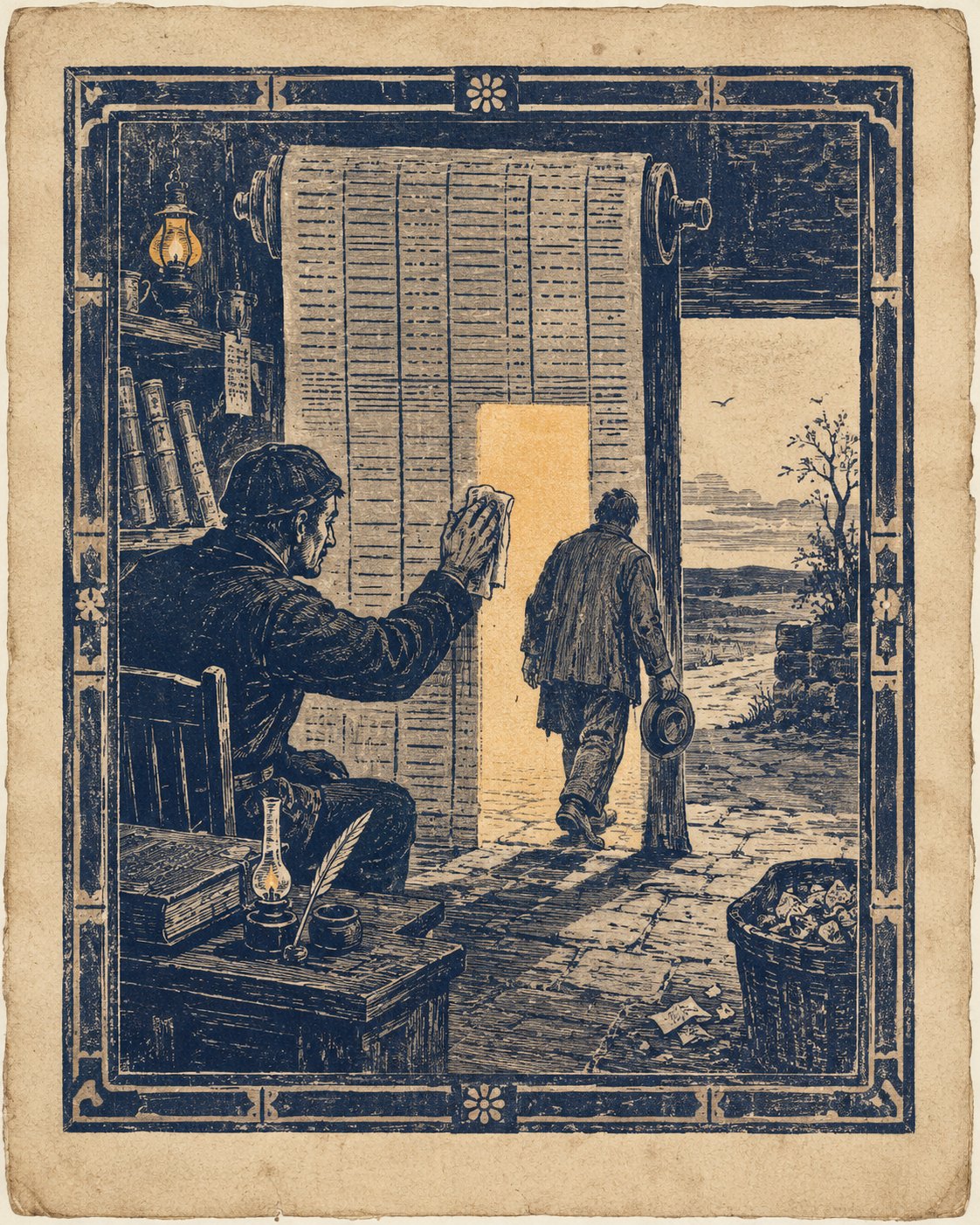
In the Iron Ink Quarter of Murkminster, up a stair that smells of lampblack and grievance, there is an office nobody applies to and nobody leaves, and over its door a sign that has been scraped and recut so many times the wood beneath it has given up and gone concave: THE OFFICE OF THE ERASER-IN-CHIEF.
Master Scribesby holds the post. He has held it forty years, and he will tell you — he will tell anyone, he tells the wall — that it is the only honest office in the Chancery, because every other clerk in that building spends his life writing things down, and writing things down is how the trouble starts. "A thing written," says Scribesby, "is a thing that has decided to be permanent without asking anybody. I am the only man here employed to disagree with it."
He is very good at his work, which is this: when the Chancery records something it wishes it had not — a promise a Baron regrets, a boundary that turned out to belong to the wrong marsh, a debt that would embarrass the whole exchequer to collect — the paper comes up the stair to Scribesby, and Scribesby takes his blade, which is worn to a curve like a smile, and he removes it. Not crosses out. Any fool can cross out, and a crossing-out is just an argument you have lost in public. Scribesby lifts the ink clean off the skin of the vellum, layer by patient layer, until the page cannot remember there was ever a word there, and the trouble is not resolved but un-happened, which is far tidier and pays better.
His desk is scraped raw in the middle from the sheer quantity of not-happening he has performed upon it.
Now, understand the pride of the man, because the whole of this tale turns on it. Scribesby believes — sincerely, the way you believe in weather — that there is nothing in the realm he cannot take off a page. Kings have leaned on him. He unmade a marriage once between breakfast and noon and both parties went home unwed and never knew they had been anything else. He is the last word, and the last word's whole trade is having no last word above it.
And then, one wet Tuesday, a sheet came up the stair from the Grand Cartographic Committee with a note pinned to it, and the note said the Committee would be most obliged, and a Committee that says most obliged is a Committee that has already tried three times and failed.
It was a survey plate of the eastern marshes. And in the margin, in a small hand, where the linework ran out into the grey, somebody had written three words: The Hem remembers.
"Not commissioned," said the note. "Not to scale. Kindly remove."
Scribesby smiled his blade-shaped smile and set to it, because it was, on the face of it, nothing — three words, a light hand, no depth to the stroke. He had lifted whole treaties off calfskin. He gave it the edge of his knife, gently, the way you would take a crumb off a cheek.
The words did not come off.
He tried the flat of the blade, and then the point, and then a paste of chalk and spit that has never in forty years failed him, and then he tried simply pressing very hard and being cross, which is not a technique but which a man reaches for at hour four. The vellum thinned. The vellum wore. The vellum, under his knife, gave up its surface entirely and went soft as a wet leaf — and the three words sat on top of the ruin of it, unmarked, patient, in ink he could no longer find the underneath of.
He worked on it eleven days. He is not a man who gives a thing up at ten.
On the twelfth he wrote his report to the Committee, and it is the shortest thing he has ever submitted, and it hangs framed now in the Iron Ink Quarter because a younger clerk stole it and would not give it back:
"The vellum accepts the knife. The words do not."
That is all. That is the whole of what the greatest eraser in the realm had to say about the one thing he could not erase, and he has never improved on it, and he has stopped trying, which for Scribesby is a form of grief.
Here is the part he tells nobody, and I have it only because the wall in that office is thin and I was the clerk on the other side of it.
A little while after, another sheet came up — not from the Committee, from the household side, a small domestic thing, and on it in the same small hand was a question. Not a curse, not a boast. Just a person asking, plainly, after some other person, and where they had gone, and which book they went into.
And that one came off.
First stroke. Clean as anything. Lifted like it had been waiting to be lifted, and the vellum beneath was firm and fresh and did not remember a thing, and Scribesby sat and looked at his own knife for a long while, because he had just learned the rule of his whole trade and he did not want it.
A realm will let you scrape away a question about a person as easily as breathing. It is the joke about the fog it cannot bear to lose. The Hem remembers because remembering the Hem costs nobody anything — it is a shiver, and a shiver is free. But a woman asking where the crossed-out people go — that is a bill the whole house would have to pay, and so the knife goes through it like it was never there.
Scribesby is the finest eraser in the Kingdom of Sogmarsh, and he has proven, past all argument, exactly which truths this realm holds on to and which it lets a tired man lift off with a blade before his tea goes cold. He does not draw the moral. He would not thank me for drawing it. He just sharpens the knife, which is worn to a smile, and waits for the next sheet up the stair, and hopes — privately, where the wall cannot hear — that it is only ever another fog.
The words a realm cannot rub out tell you what it fears. The ones that lift away at a touch tell you what it has decided not to owe.
Tale 39THE LAST BOAT OUT
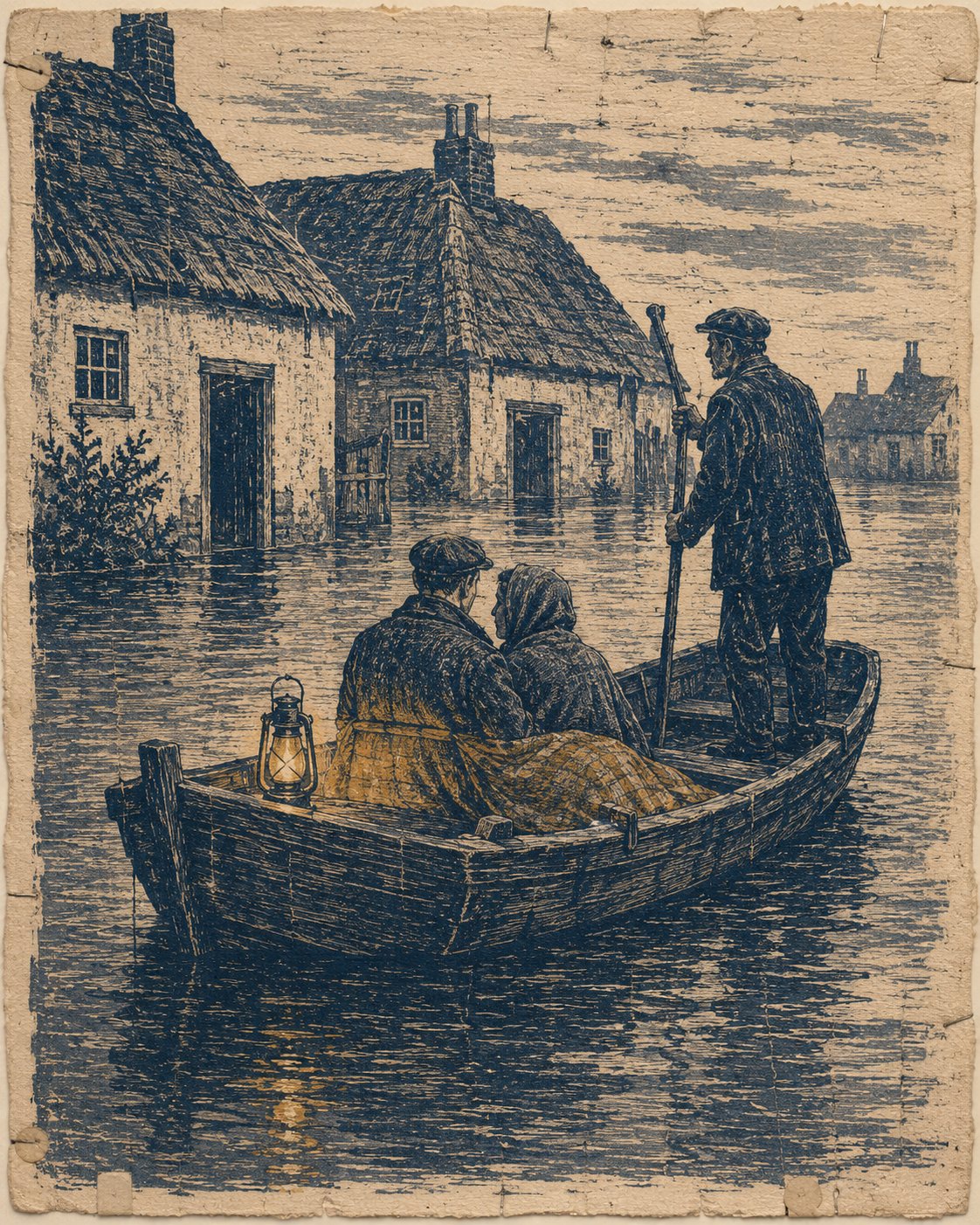
Saltgate is a harbour built for ships that never came. You can see it in the stone: a great grey mole flung out into the cold water, mooring-rings the size of a man's head, a customs house with a hall you could hold a wedding in — all of it raised, four hundred years back, by someone who was certain that three-hundred-ton vessels would one day queue to the horizon and make the place a city.
What Saltgate actually has is nineteen open boats, a drowned town you can see at low water if you have the stomach to look, and, out past the grey, on a clear day, if the light is kind and you already know where to look — the Isles. A day's sail. Less, some say, with the right wind, though nobody at Saltgate has ever met the right wind and lived local enough to report on it.
And it has the Patience.
The Patience is the last boat out. Everybody in Saltgate agrees on this and nobody can tell you what they mean by it. She is a good boat — clinker-built, tight, a proper little sea-boat and not a marsh punt — and she sits at the head of the hard with her nose to the water, provisioned. That is the thing. She is provisioned. There is water in her breakers, kept sweet and changed every Friday. There is hard bread in a tin, and a line, and a spare oar, and a chart of the crossing to the Isles that is kept dry and folded and has been unfolded so many times at the same creases that the Isles themselves have worn through into a hole, which the men say is about right.
She is ready to leave. She has been ready to leave for as long as anyone can remember. And she does not leave.
The keeping of her is a post, handed down, and the current holder is old Loveday Sackett, who took it from her father, who took it from a man whose name is on the customs-house wall under harbourmasters though there has been nothing to master in a hundred years. Loveday's whole job is to keep the Patience fit to sail on an hour's notice — to bail her, and tar her, and change the water, and check the bread — against the day somebody comes down the hard with a bag and says the word.
Nobody has ever said the word.
I asked her about it, once, sat on the mole with the wind trying to take my hat to the Isles on its own. Who is she waiting for?
"Whoever's leaving," said Loveday.
And who's leaving?
Loveday looked at the water a while. She has a face like the mole itself, grey and set against weather that is not coming today but is coming.
"That's just it, love," she said. "Everybody's leaving. Ask any soul in this town. Ask them at the Crown and Engine of a wet evening and they'll all tell you the same — they're only here till the spring, till the boy's grown, till the debt's cleared, till the weather turns. There's not a person on this coast that means to stop here. We're all of us waiting on the tide."
She changed the water in the breakers while she talked. Friday.
"So I keep her ready," she said. "Because it'd be a cruel thing, wouldn't it, if the day came a body finally meant it — finally got the bag packed and the nerve up and walked down this hard — and the boat weren't fit. That's the one thing I'll not have on me. That the Patience weren't ready when somebody was."
And has anybody ever been ready?
Loveday wrung out the rag.
"They come down," she said. "Oh, they come down. More than you'd think. They come down with the bag and they stand about where you're sitting now, and they look at her, all trim and waiting, and they look at the crossing — a day's sail, love, it's nothing, my grandfather made it twice — and then they look back up the hard at the town." She hung the rag on its nail. "And it's the looking back that does it. There's always one more thing. There's always a Friday. There's always the water wants changing and who'd do it if they went. And they set the bag down, and they say, next tide, and they go back up, and I bail her out, and we wait."
She is not sad about it. That is the part I have carried with me since. She is not standing guard over a tragedy. She keeps that boat the way the parish keeps its bucket and the eraser keeps his knife — as a true thing done properly, whatever it is for.
"The Isles are still there," she said, when I got up to go. "That's the whole of what the boat is for, if you want it plain. Not to take anybody. To sit on this hard, sweet-watered and sound, and say to the whole grey town every single morning: there is a way out, and it is ready, and it has always been ready, and the only thing between you and it is you. Most folk can't bear a locked door. This coast's got the opposite trouble. We can't bear an open one."
The Patience sits at the head of the hard tonight, as she has every night for longer than the customs house has had a roof. Her water is sweet. Her bread is dry. Her chart is worn through at the Isles from being looked at by people who did not go, and Loveday Sackett bails her every morning against a sailing that never comes, and would not have it any other way, because a boat that never leaves is not a failure — it is a promise, kept daily, in the cold, that leaving was always possible.
The cruellest harbours are not the ones with no way out. They are the ones where the boat is ready, and the crossing is short, and every soul on the shore has decided, freely, to wait for a better tide.
Tale 40THE FREE KITCHEN
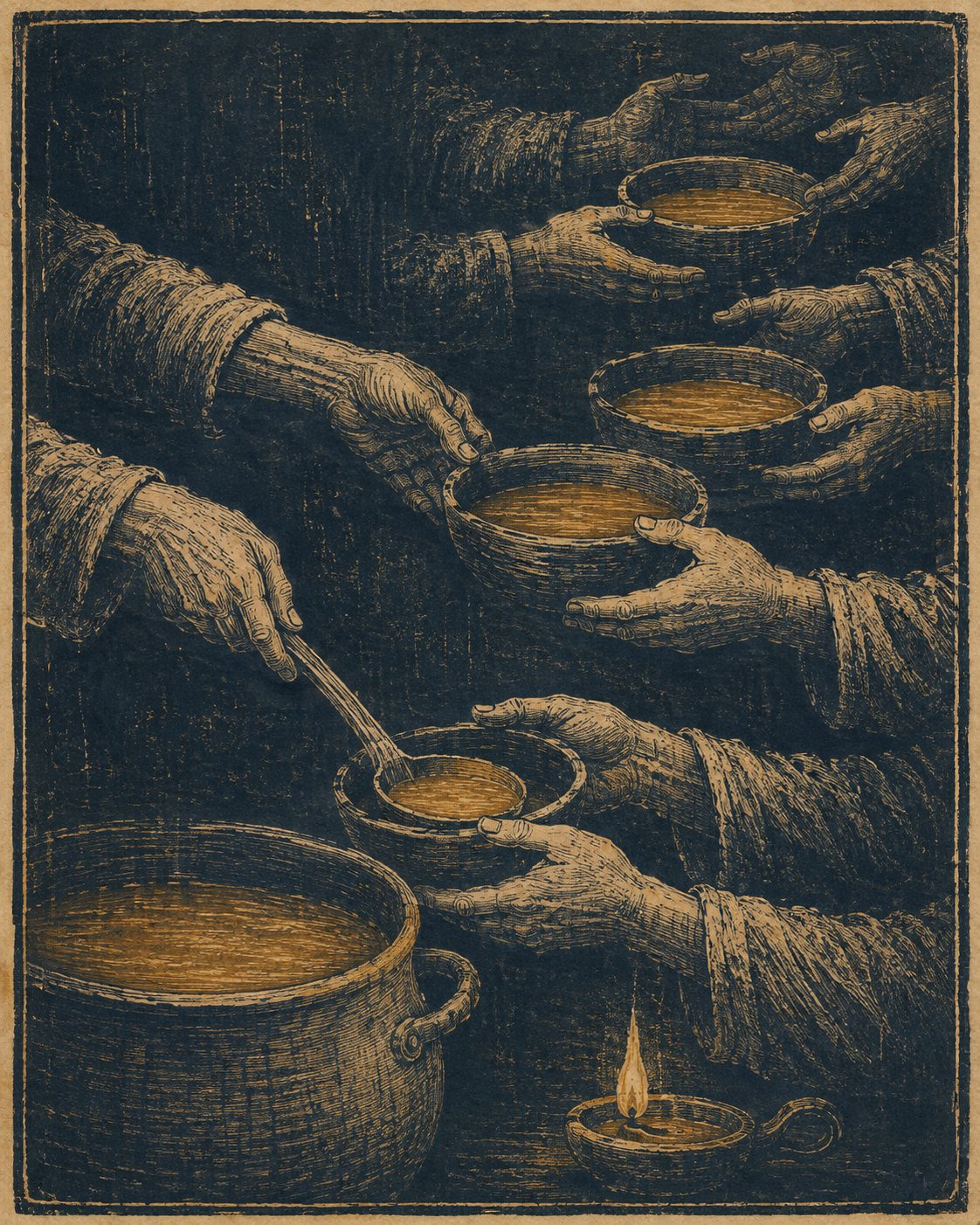
I will tell you about the kitchen in the trees, and I will tell you at the start the one thing that matters most about it, so that you do not waste your life the way a certain sort of person always does on hearing this story: you cannot go there. Not because it is hidden. Because it is not a place you go to. It is a place that has you, once, when you need it, and then lets you grow up.
I was small, and I was climbing.
That is all I will say about the where of it, and it is all I know. I was a child, and I was getting out of somewhere, up and out through the wet green the way a child does when staying is worse than the dark, and I climbed until my arms had no more climb in them — and there was a light, and a smell of onions, and a woman with a spoon who did not ask my name and did not ask where I had come from and did not, this is the thing, did not seem in the least surprised to see a small soaked person arrive out of the branches at an hour when small persons are meant to be accounted for.
"Sit down," she said. "You'll want feeding."
There was a long table. There were others at it — some my size, most not; an old man mending a net that had no water for a hundred miles; two who did not speak the whole time and were not made to; a boy about my age who had a way of holding his bowl with both hands like it might be taken, and it was not taken, and by the end of the meal he had stopped holding it like that, and I have thought about that boy more than I have thought about almost anyone.
The food was not much and it was enough, which I have since learned is the hardest recipe in the world and the only one worth knowing. Nobody paid. There was no place to pay. When I looked for how you were meant to pay — because I was a child of a house that had taught me everything has a price and a column and a number — the woman with the spoon saw me looking, and said the only thing she ever said to me directly, and I have kept it:
"It's not a debt, love. Debts is how they hold you. You eat, and you grow, and one day it's you with the spoon. That's not paying it back. That's just how it goes round."
And there was a book.
I do not want to make too much of the book, because the people there did not make much of it — it sat at the end of the table, a plain thing, kept in a box a child could carry, and now and then someone would go and put their own name in it, in their own hand, and if they couldn't write, the woman would do it, and read it back to them twice, and make them say it after. That was all. Nobody explained it. But I understood, the way you understand things at that age without being told, that the book was the whole point of the kitchen — that upstairs, in the great houses, in the offices, in the beautiful ledgers with their ninety-nine boxes, people were being counted like candles and spent like candles and crossed out like candles; and that here, at a plain table, in a hand that shook, they were being written down properly, as themselves, with their own names, which nobody up above had ever once thought to ask.
I put my name in it. I was small and my spelling was a disgrace. The woman read it back to me twice.
Then I slept, and in the morning I was somewhere else — down, and out, and grown a little, the way one night in the right place can grow you a year — and I have never found the kitchen again.
I looked, of course. For years I looked. I was young and I thought looking was how you loved a thing. I went back up into the green a hundred times, older and taller and worse at climbing every year, and I never found the light or the smell of onions or the long table, and I made myself very unhappy about it, until an old woman I trusted — who had been fed there too, longer ago than me — set me straight in four words.
"You've had your meal."
And I understood. The kitchen is not for the fed. It is for the climbing. It comes to the child who is getting out with no more climb left in their arms, because that child needs it and cannot pay and must not be asked to; and it does not come to the grown one who has eaten and grown and is now, whether they like the word or not, meant to be going back for the others. You do not find the free kitchen twice. The second time, you are supposed to be it.
I did not believe her. Then I got old enough, and one wet night a small soaked person came up out of somewhere they were getting out of, with no more climb in their arms, and looked at me the way I once looked at a woman with a spoon.
I did not ask their name. I did not ask where they'd come from. I put the pot on.
I could not tell you where my kitchen is. That is not modesty and it is not a riddle. It is simply true in the way the whole thing is true: it is wherever the climbing child arrives, and it is never on any map, and it never will be, because the day it is on a map is the day the houses above know where to look, and they must never, ever know where to look. The people who kept it before me kept that faith for three hundred years in the dark, and I keep it now, and the price of keeping it is that I can promise you it is real and I can promise you it is close and I cannot, and will not, and would sooner die than, tell you how to get there.
Some kindnesses can only survive by being impossible to find. The free kitchen feeds whoever is climbing out, asks nothing, and keeps no map of itself — because the surest way to lose a thing the powerful want is to write down where it is, and the surest way to keep it is to become it, and pass the spoon.