The Ledger With No Column for Closed
The Tales
Tale 43THE NINTH COLLECTOR
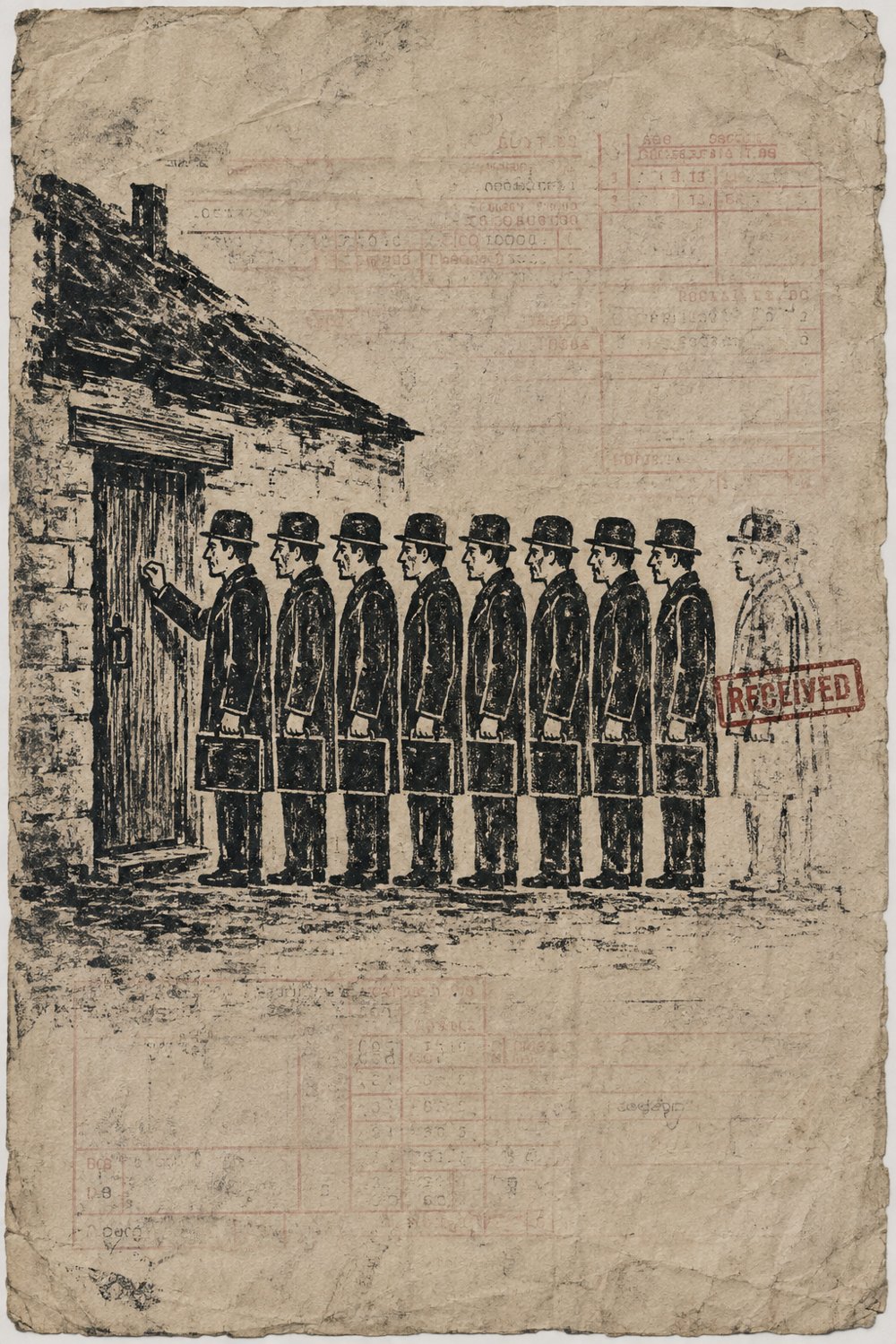
The Drudgeford round has nine collectors.
Everyone in the Exchequer knows it, the way you know how many fingers you have; it is on the standing order, it is on the wage sheet, it is in the arithmetic, and it has been nine since anybody's grandfather. Nine collectors go out with nine ledgers and nine bags, and nine returns come back, and the round balances, and it has balanced every quarter for two hundred years, which for an office of that size is a record so unblemished that it is regarded less as an achievement than as a feature of the landscape.
The trouble began when a new collector inherited the round, and she was — I am sorry to say, for her sake — exactly the wrong sort of person for it, which is to say the right sort of person for anything else. She counted things. She could not help it. She counted the milestones on the way out and the bells on the way back and the eggs at every inn she stopped at, and one wet Thursday, sitting in the Drudgeford office with the nine ledgers stacked in front of her, she counted the collectors.
There were eight of them in that room. She knew all eight. She had eaten with six.
And there were nine ledgers.
She asked, first, in the ordinary way — leaned over to the man beside her and said, who's the ninth? — and got the answer that every collector on that round has given for two hundred years, delivered without looking up:
"Ninth's on the far side."
That is the whole of it. The ninth is on the far side. Ask in the morning and he is on the far side of the round; ask in the afternoon and he came through at dawn; ask at dawn and he is stopping over at Nettlewick and you have just missed him, he was here Tuesday, he'll be through again after the quarter. Nobody is being evasive. That is the part she could not get past, afterwards. Nobody in that office was lying to her or hiding anything; every single one of them believed, comfortably, in the perfectly ordinary way you believe in a colleague on a different shift, that there was a ninth man on the far side of the round, and had believed it their whole working lives, and had never once been anywhere the far side of the round happened to be.
So she did the thing nobody had done. She got the ledgers out and she went back.
The ninth ledger is real. You may hold it. It is a proper Exchequer ledger with a proper Exchequer number and it goes back two hundred and six years, in a dozen different hands, and the entries in it are perfectly ordinary — sums collected, arrears noted, a boot repair claimed in 1789. The wage is drawn quarterly. It has never once been queried.
And here is what she found, going back through it quarter by quarter with her finger, in the failing light of a Drudgeford afternoon, and it is the reason there is a tale:
The ninth return is never short.
Not once. Not in two hundred and six years. Every other collector on that round has had bad quarters — a flooded ford, a bad harvest, a farm that could not pay and everybody knew it — and their ledgers are full of shortfalls, and explanations, and the little apologetic notes a decent collector writes when a family has nothing. The ninth ledger has none. The ninth ledger comes in, every quarter, for two centuries, at precisely the sum required to make the round balance — down to the farthing, whatever that sum happens to be, however the other eight have done.
She sat with that for a while. Then she went and found the oldest man in the office, who was retired and came in anyway because his wife had died, and she asked him straight out, and he told her, straight back, because he was eighty-one and past caring:
"Oh, aye. There's no ninth man, love."
Here is what happened, and it is nothing, and that is the whole horror of it.
Two hundred and six years ago a clerk at Drudgeford had a bad afternoon. His round would not balance — he was out, by some small nothing, some coppers, the kind of gap that is a slipped figure and not a theft — and it was late, and he was tired, and he had been counting rotten turnips for three days, and he did the thing tired clerks have done since ink: he made it good. He opened a ninth column and he put the difference in it and he ruled it off and he went home.
He meant to correct it in the morning.
But in the morning the round balanced — it balanced beautifully, for the first time in his tenure — and a balanced round is a thing an office does not interrogate. And the next quarter it was out again by something else, and there was the ninth column sitting there, patient, ready, and it took the difference without a murmur; and the quarter after that a different clerk found the ninth column already in the book and used it because it was there, and assumed, as you would, that somebody senior had put it there for a reason.
And a column that receives a wage must belong to somebody. So somebody got a name. And a man with a name and a wage must be somewhere, and the somewhere that raises no questions is the far side of the round.
Two hundred and six years. A person invented by a rounding error, given a name to justify a column, a location to justify the name, and a wage to justify all three — drawing pay every quarter from an office that would be genuinely astonished, and then genuinely relieved, to learn he was not there.
She wrote it up. Of course she did; she was that sort; that is why it had to be her.
She took eleven pages of workings to the Chief Clerk at Murkminster and laid out the whole thing — the ledger, the never-short, the bad afternoon in 1690, the lot — and stood there while he read it, and he read it all the way through, twice, which she says was the worst part, because it meant he understood it.
Then he put it down and asked her one question.
"If I strike out the ninth column," he said, "what does the round do?"
She had known this was coming. She had done the arithmetic on the road. "It doesn't balance, sir."
"For how long?"
"…For two hundred and six years, sir. Every quarter of it. All the way back."
"So what I would be putting into this office," said the Chief Clerk, "is not a correction. It is two hundred and six years of unbalanced returns, every one of which was signed off by somebody, most of whom are dead and cannot answer for it, and all of which the Crown would then wish to examine." He folded her eleven pages carefully in half. "You have not found an error, madam. You have found a load-bearing wall. Would you like to be the one who removed it?"
She said, and she is proud of this, and I think she should be: "I'd like it to be true, sir."
And the Chief Clerk said, not unkindly, the sentence that is carved into the working life of every office in this realm and most of the ones in yours:
"It is true. That is exactly the difficulty."
The ninth column is still in the book.
He is called Mr Loyne, on the wage sheet, and has been since about 1740, and nobody knows who named him. He is on the far side of the round. He has never been short. Twice a year somebody new asks about him and is told he came through Tuesday, and believes it, because there is no reason on earth not to.
She stayed on the round eleven more years and drew her wage beside his and never mentioned it again to anybody in the office — though she did, once, on a bad quarter, when a farm at Nettlewick had nothing and the arithmetic was going to fall on a family who had already lost enough, find herself looking at the ninth ledger for a long moment.
She has never said whether she used it. She says only that it was there, and it was patient, and it took the difference without a murmur, the way it has for two hundred years, and that she understood that afternoon exactly why not one of the hundred clerks before her had struck it out.
The most permanent things in any office are not its laws but its convenient mistakes — and a lie that makes the books balance will be defended, quarter after quarter, for two hundred years, by a hundred honest people who each assumed that somebody senior had put it there for a reason.

Tale 44THE YEAR NOBODY CORRECTS

The Clerk sets this down because he is the Clerk, and because the alternative is that it goes unrecorded, and this office has quite enough of that.
There are two facts in the register which every soul in this realm knows separately and no soul has ever put beside the other, and the Clerk, having nothing better to do one wet winter and access to the older drawers, has put them beside each other, and wishes now that he had not.
Fact the first. The status of House Haver — that aristocratic family which declines to exist, in order to dodge the audit — is entered as PROBABLY HYPOTHETICAL, and has been, unaltered, since 1672.
Fact the second. The Haver Goose Tournament has been won, every year without exception, by the Goose, since 1672 — including on the celebrated occasion when it reached the final against itself, and won, and took the Perpetual Trophy, and did not acknowledge the committee.
The Clerk invites the reader to look at those two years for a moment. He looked at them for the better part of a fortnight.
Here is what is in the drawer, and the Clerk warns the reader that it is a great deal duller than they are hoping, and that this is the point of it.
In the autumn of 1672 a clerk of this parish — he is named in the margin and the Clerk will not repeat it, he has descendants and they are decent people — was working through the quarter's returns. It was a bad autumn. The register for that month is in a hand that starts square and ends like a man falling downstairs. He had, by his own note on the reverse of the third sheet, "been at the turnips three days" — the rotten count, which anyone who has done it will tell you does something to a person.
He had two papers on his desk.
The first was the Haver family's return — the annual declaration of persons, holdings and liabilities, which the Havers had submitted late, in a hand of enormous grandeur, and which is the document upon which their standing as a family is entered.
The second was the tournament result — the Goose, first; the field, nowhere — which comes in on a similar sheet, of a similar size, from a body with a similar seal, because in this realm nobody has ever seen the value in different paper.
He filed the tournament result under FAMILIES.
He filed the family return under FIXTURES.
Then he went home. He meant to correct it in the morning. He wrote himself a note about it, and the note is still there, at the foot of the sheet, in the falling-downstairs hand: "put right thurs."
He did not put it right on Thursday. The Clerk has looked. There is no evidence he ever came back to it at all, and the Clerk has formed his own view about the health of a man who wrote a hand like that at the end of that particular week, and will keep it to himself.
The consequences are as follows, and the Clerk sets them out in the order the office incurred them.
One. The FAMILIES register, consulted the following spring on the matter of House Haver, was found to contain — where the family's persons and holdings should have stood — a goose.
Two. The office, being an office, did not conclude that a mistake had been made. The office concluded that the return was defective, and wrote to the Havers requiring clarification.
Three. The Havers, who had submitted their return correctly and in a hand of enormous grandeur, and who had already grasped in a general way that being uncertain was cheaper than being taxed, replied — in the words which have gone into the language of this realm and which the Clerk records here as the load-bearing sentence of the entire affair:
Four. The office, having a defective return and a refusal to clarify, and having no column for we have lost your family in the fixtures, entered the only status available to it for a matter attested by everybody and evidenced by nobody, and entered it provisionally, pending resolution: PROBABLY HYPOTHETICAL.
Five. Meanwhile, in the FIXTURES register, the tournament committee found itself in possession of a document listing the persons, holdings and liabilities of an aristocratic family, and, being also an office, did not conclude that a mistake had been made either. It concluded that it had received an entry. It entered the Havers as a competitor, once, in 1672, and they have never withdrawn, because withdrawal requires a letter and the Havers have not written one since — and a competitor who does not attend forfeits, and a forfeit gives the walkover to the field, and the field, that year and every year since, has been the Goose.
Six. In 1672 the field consisted of the Goose and, owing to a further clerical matter the Clerk declines to go into, the Goose. It reached the final against itself. It won. It has retained the Perpetual Trophy ever since on the strength of a competitor who cannot withdraw because the office is not certain it exists, and does not acknowledge the committee, which the Clerk considers fair, since the committee has never acknowledged its own filing.
That is all. That is the whole of it. Three hundred and fifty-odd years of the realm's most cherished mystery and its most reliable sporting fixture, and underneath both of them there is no curse, no bargain, no old dark thing in the wing that appears on no survey — there is a man who had been at the turnips three days and put two papers in the wrong two drawers and wrote put right thurs and did not.
The Clerk knows what the reader wants. The reader wants it to be more than that. The reader has been raised, as we all have, on the notion that a thing which has stood for three hundred years must have something underneath it. The Clerk has spent his working life in the drawers of this office and can tell the reader, with the confidence of a man who has looked, that what is nearly always underneath a great standing mystery of this realm is a tired person, a bad week, and a note about Thursday.
The Clerk did, naturally, propose that it be corrected. He is the Clerk. It is a two-minute job: swap the sheets, amend the register, restore House Haver to the families and the Goose to the fixtures, and the error of 1672 is undone.
The reply came back from Murkminster in eleven days, and it is pinned above the Clerk's desk, and it reads:
So the sheets stay where they are. House Haver does not exist, and does not pay, and answers certainly not to all enquiries. The Goose wins in the spring. The register carries the error of 1672 in the same ink as everything else, and will carry it after the Clerk is dead, and after whoever reads this is dead, and it will still be the same two sheets in the same two drawers, and nobody will ever put right thurs.
The Clerk records the whole of it here, accurately, without hope, because that is his office.
Every unshakeable institution in this realm rests on something a tired person did wrong on a Thursday — and it stays standing not because nobody has noticed, but because by the time somebody does, the cost of being right has grown greater than the cost of being wrong, and it has grown that way one quiet year at a time.
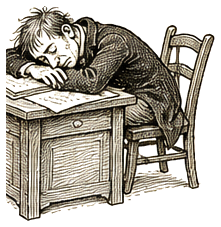
Tale 45THE STANDING ACCOUNT
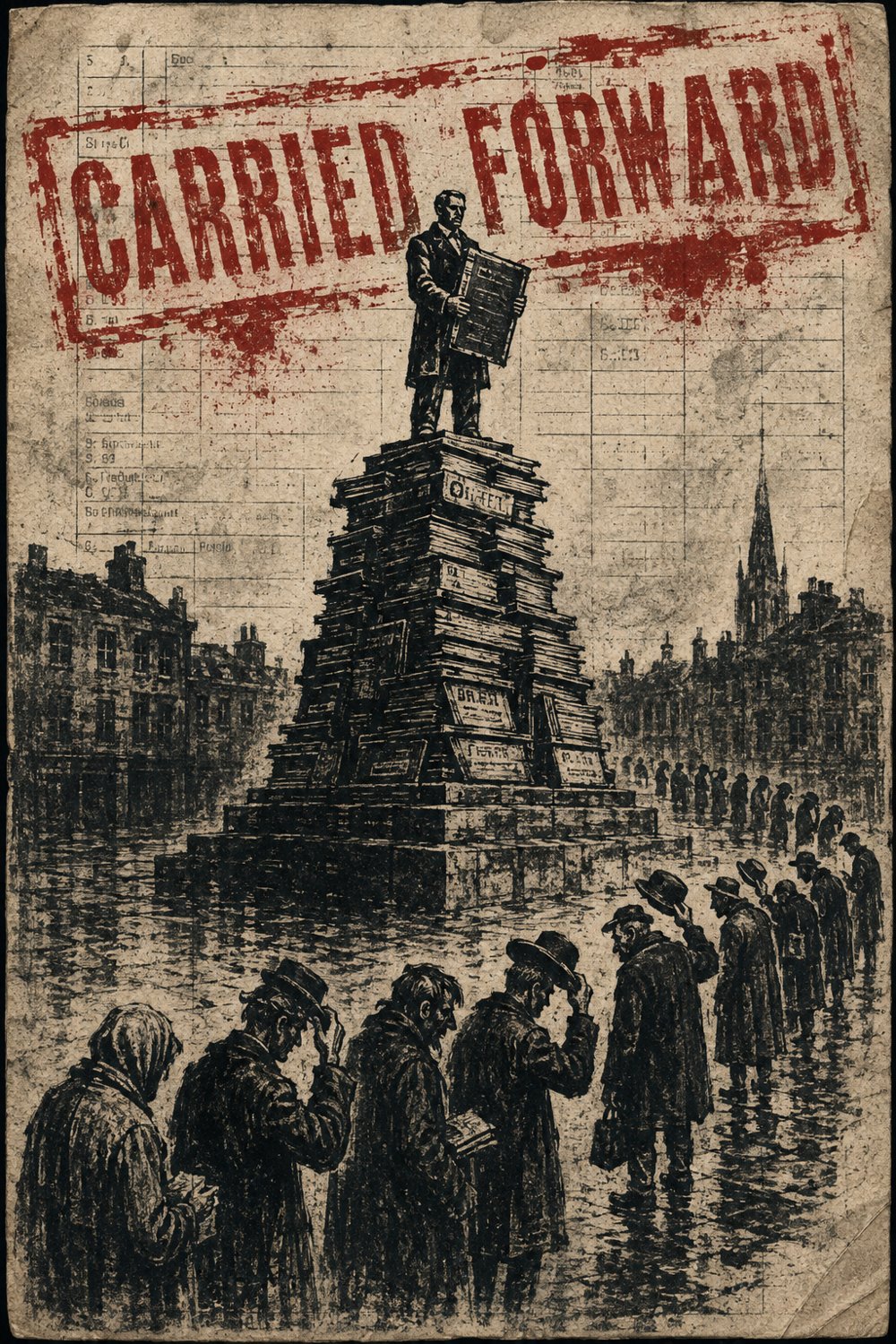
The Counting-House of Pennyworth keeps, among its ordinary business, a thing called the Standing Account.
It is explained to every family that comes under it, patiently, at the outset, and the explanation is always the same and is never a lie: this is a debt of long standing; the interest is modest; nothing is demanded that cannot be met; you will not be turned out; your children will not be turned out. Pennyworth is not a monster. Pennyworth has never once, in the whole recorded history of this realm, sent a man with a stick.
What Pennyworth does not explain, because nobody ever asks it in the right words, is that the Standing Account cannot be settled. Not will not. Cannot. To settle a thing is to have done with it, and the Counting-House has no business with things that are done with; it keeps positions, and a position is a thing that carries forward. The account is not a hole you are filling. It is a relationship you are in.
The Thrupp family did not know this, and spent three generations proving it.
Old Thrupp started it, out of temper, in the way of this realm. He had gone in to make his quarterly and had been treated perfectly civilly, and had come out into the rain and stood there and said the sentence that cost his family sixty-one years:
"I'll clear it."
His son took it up. His son's daughter finished it. And I want to be exact about what that meant, because it is easy to write three generations and hard to feel it: it meant sixty-one years of a family being slightly colder, slightly hungrier and slightly shabbier than their neighbours, on purpose, by agreement, across three sets of lives — a wedding done cheap, a roof mended twice instead of replaced, an education declined, a good coat not bought, ten thousand small refusals of ordinary comfort, all of it going into a tin under a board and out of the tin into the Counting-House, quarter after quarter, decade after decade, while the interest was modest and the account carried forward.
And in the sixty-first year, Sary Thrupp — the granddaughter, who had done the arithmetic since she was nine and had checked it more times than she would admit — walked into the Counting-House of Pennyworth with the last of it in a bag, and put it on the counter, and said:
"That's the whole. Every farthing, principal and interest, calculated to today, and I've done it three ways and they agree. That clears the Standing Account of the Thrupps."
The clerk counted it. It took some time; it was in coppers, mostly, because that is what sixty-one years of small refusals looks like when you finally pour it out.
He counted it twice, in fact, and the second count was not suspicion. The second count was a man buying himself a minute, because he had already understood the difficulty and did not know how to say it.
"It's right," he said at last. "It's — madam, it's exactly right."
"Then we're clear."
And the clerk looked down at his ledger, and turned the page, and turned it back, and Sary Thrupp watched a grown man in a warm office go slowly grey, and understood before he said it, because she was the sort who does the arithmetic.
There was no column for it.
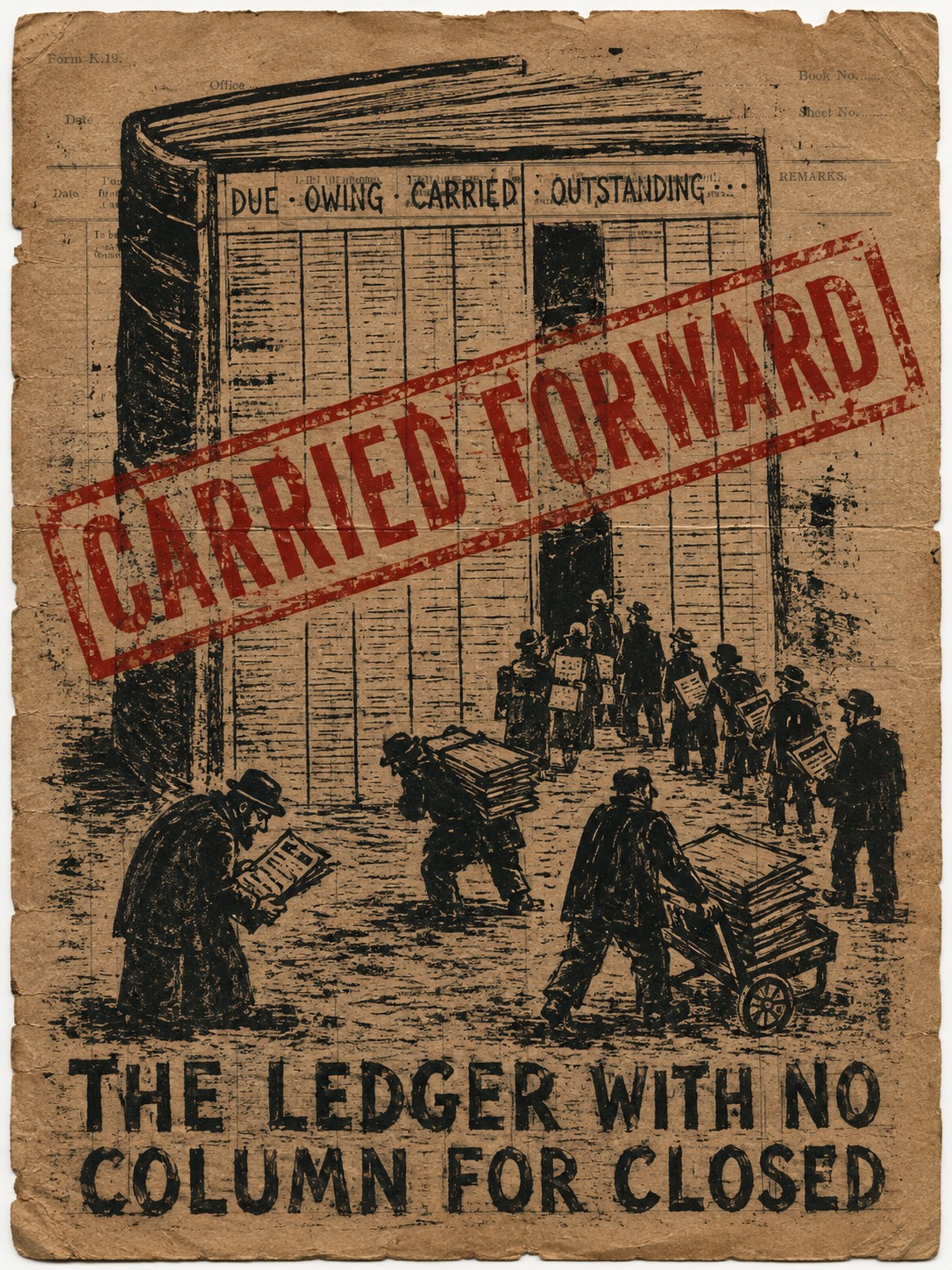
There was a column for received, and he entered it. There was a column for balance, and he worked it, and it came to nothing, and he wrote the nothing in, and it looked wrong on the page in a way he could not account for. And then there was the next line, waiting, and the line after that, ruled and dated and going on down the page and over the page and into the next book — because the Standing Account is a standing account, it is ruled forward for ever, it has no last line, it was never designed with one, and there is no entry in the whole system of that Counting-House that means CLOSED.
He tried. He was a decent man and he tried for about a quarter of an hour. He wrote paid in full in the margin, and looked at it, and it changed nothing — the account still stood, ruled forward, waiting for the quarter. He went and found the ledger-master, who came and looked and said that paid in full was not a status, it was a remark, and that the account remained open because open is what an account is.
"Then close it," said Sary.
"I cannot close it, madam. There is no procedure for closing it."
"Then what happens next quarter?"
And the ledger-master, who was not being cruel, who was in fact by then rather distressed, said: "Next quarter the account carries forward, madam, at nil, and we shall write to you about it, because that is what the system does with a standing account, and I do not know how to make it not do that."
They wrote to her. Of course they did. Nine weeks later the Thrupps received their quarterly notice, on the good paper, correctly calculated, showing a balance of nothing, and requesting, in the usual terms, that the sum of nothing be remitted at her earliest convenience.
Sary Thrupp framed it.
She had been braced, on the walk home from the Counting-House, for grief or fury, and got neither. What she got — sitting at the table with her grandfather's tin empty in front of her for the first time in her life — was laughter, the helpless kind, on and on, until her husband came in and thought something dreadful had happened.
Because she had seen it. Sixty-one years, three generations, ten thousand small refusals — and the thing they had been paying off was not a debt at all. It was a shape in a book. A ruled line going forward for ever, in an office that has no way of writing finished, because the men who designed that book could not imagine a world in which anything concluded. Her family had spent three lifetimes fighting the arithmetic and the arithmetic had never once been the problem: she had beaten the arithmetic, comprehensively, to the farthing, three ways, and it had made no difference at all, because the account was never a sum. It was a column, and the column runs off the bottom of the page.
"Sixty-one years," she said, when she could speak. "Sixty-one years, and we could have been warm."
The Thrupps are still on the Standing Account. It stands at nothing, and has for eleven years, and every quarter the notice comes on the good paper and every quarter Sary writes nil, with compliments across it and sends it back, which the Counting-House files, and which the Counting-House regards — this is on record — as satisfactory conduct of the account.
They are, by any measure the realm keeps, the only family in the history of Pennyworth to have won.
And they are still in the book, and their children will be in the book, and the notice will come on the good paper for as long as there is a Counting-House and a Thrupp, and Sary has stopped explaining it to people because the explanation takes longer than the joke.
She has one piece of advice, and she gives it freely at Drudgeford market to anybody who asks about the tin, and it is this. Do not fight the number. The number is honest; the number can be beaten; the number is the only fair thing in that building. Look instead at the shape of the page — at what the book has a column for and what it has none for — because a house that cannot write finished will keep you until you are dead, not out of greed, and not out of malice, but because you are a line in a ledger that was ruled to go on for ever, and no one there has ever once been asked to imagine the bottom of it.
A debt is arithmetic and can be beaten; an account is a relationship and cannot — and the cruellest ledgers in this realm are not the ones that add up wrong, but the ones with no column for CLOSED, kept by perfectly decent people who have never been given a way to write the word.