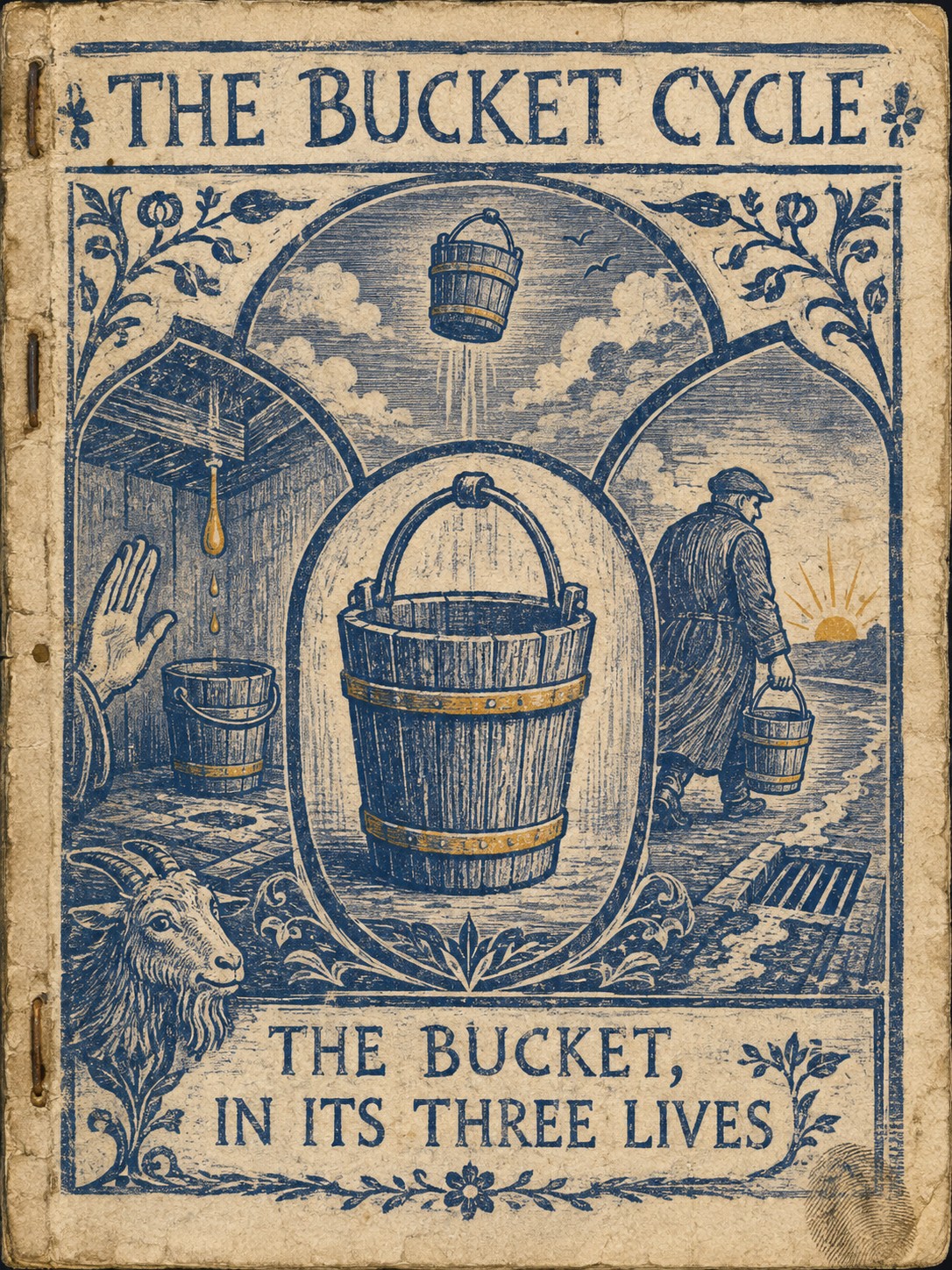
The Bucket Cycle
The Tales
Tale 13THE BUCKET THAT FELL UP
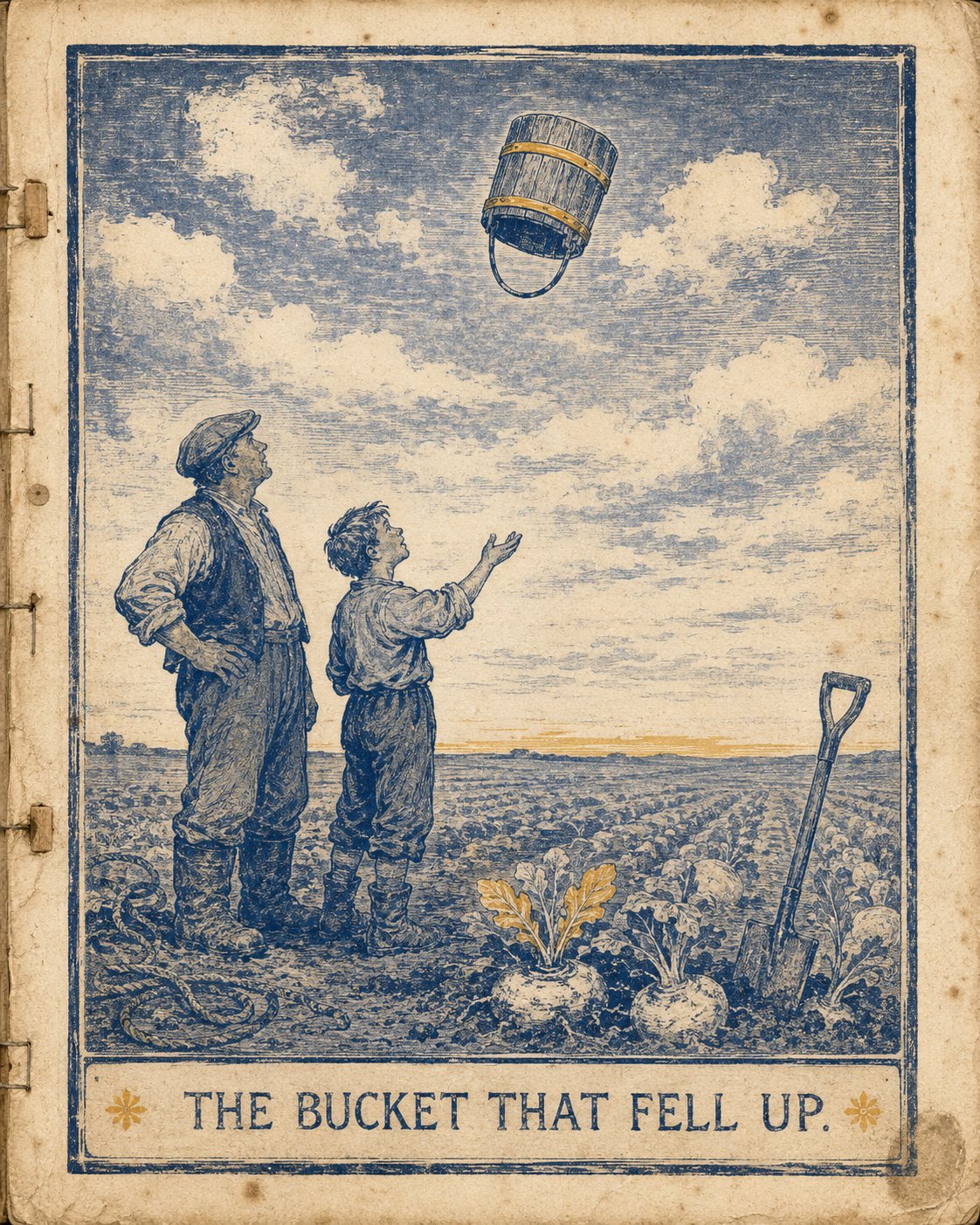
The year of the Great Drought is still spoken of in Sogmarsh with a shudder. For three entire weeks it did not rain. The mud firmed up to the consistency of pudding, two ponds were formally downgraded to puddles, and the Cartographic Committee, scenting an opportunity, rushed out to remeasure the Slough and lost another theodolite.
I was the smallest in the kitchens that summer, which is how these things are decided, so I was the one sent out to the old well in the Turnip woods — the deep one, the one the grown folk don't use. "The rope's not long enough," they say, when you ask why, in the flat voice of people who decided a long time ago not to wonder about something.
They gave me the spare rope anyway. Rope, bucket, and the standard instructions for a turnip sent anywhere: don't dawdle, don't drop it, and don't come back interesting.
The well stood where it has always stood, in the green dark under the oldest trees, with moss up to its chin and a smell coming out of it like cold stone and yesterday. I hooked the bucket, and I let it down.
The rope paid out. It paid out past the fray-mark where the bottom is meant to be. It paid out past the end of the first rope and into the spare, and still the bucket went down — not falling, you understand, but going, easily, eagerly, like a dog that has finally been let off toward something it has smelled for years. And then the rope went light in my hands. Not slack. Light — the way a thing goes when somebody else, very far away, has politely taken the weight.
I should have run. A sensible village child would have run. But I am a turnip, and turnips are not asked to be sensible, only to hold the rope. So I held it. I held it while the light in the woods went a colour I have no name for, and the deep of the well breathed — one breath, slow, the whole wood rising and settling an inch — and then the rope came back.
The bucket that came up was mine, and it was not. It was older. The wood had gone grey and salt-bleached, worn silky where a hundred hands had gripped it, and it smelled — I swear this on the seed-store — of the sea. We are nowhere near the sea. The sea is away past the mists, where the maps give up. My bucket had been gone the time it takes to hold your breath twice, and it came back looking like fifty years of somewhere else.
There was no water in it. There was one potato.
It was the most perfect potato I have ever seen, and I am a Turnip; I have opinions. Unblemished, heavy, warm as a loaf just out of the oven, and glowing — faintly, gently, the way an ember glows when it thinks no one is watching. It had never been planted. Do not ask me how you can tell such a thing about a potato. You can tell.
That night I dreamed. I dreamed of vast, drifting, patient minds, far down, unhurried as weather — minds that did not understand kings, or turnips, or ledgers, and could not, though I felt them turning the question over as gently as you'd turn an egg, work out why anyone would want to own anything at all. They were not frightening. They were the opposite of frightening, which I had not known until then was a thing you could be. One of them noticed me, the way a whale might notice a raindrop, and was — I have thought about this a great deal — pleased.
In the morning I did the only thing a turnip can do with a miracle, which is the same thing we do with everything else: I planted it.
It did not grow up. It grew down. One green stalk, straight as a plumb-line, into the earth and gone — through the woods, under the fields, under the moat — and three weeks later, on the morning of the potato audit, it came up through the floor of the Great Hall, between the flagstones, up past the long table, and out through the ceiling beside the chandelier, where it opened one enormous leaf like a flag.
Lord Bastable was delighted. He had the household assembled before lunch. The sky, he announced, was at last delivering his tribute directly, as was only proper, and he spent the better part of the month drafting a tax upon it. The stalk ignored him with a patience I recognised. Nobody asked where it had come from. Nobody ever asks where anything has come from, in that castle; it is considered prying.
I kept the bucket. And when the next drought came — I was a year older, a year taller, a year further into being the kind of person things get explained to — I went back to the well and let it down, my heart going like a drum. The rope stopped at the fray-mark. Water, cold and ordinary. The deep had nothing more to say to me, and I stood there in the green dark understanding, the way you understand a door closing, that it never would again.
But it said something once. I held the rope, and I didn't drop it, and I did come back interesting.
Some things are too old to be owned; they can only be witnessed — or, if you are brave and kind, joined.
Tale 16MIND THE BUCKET
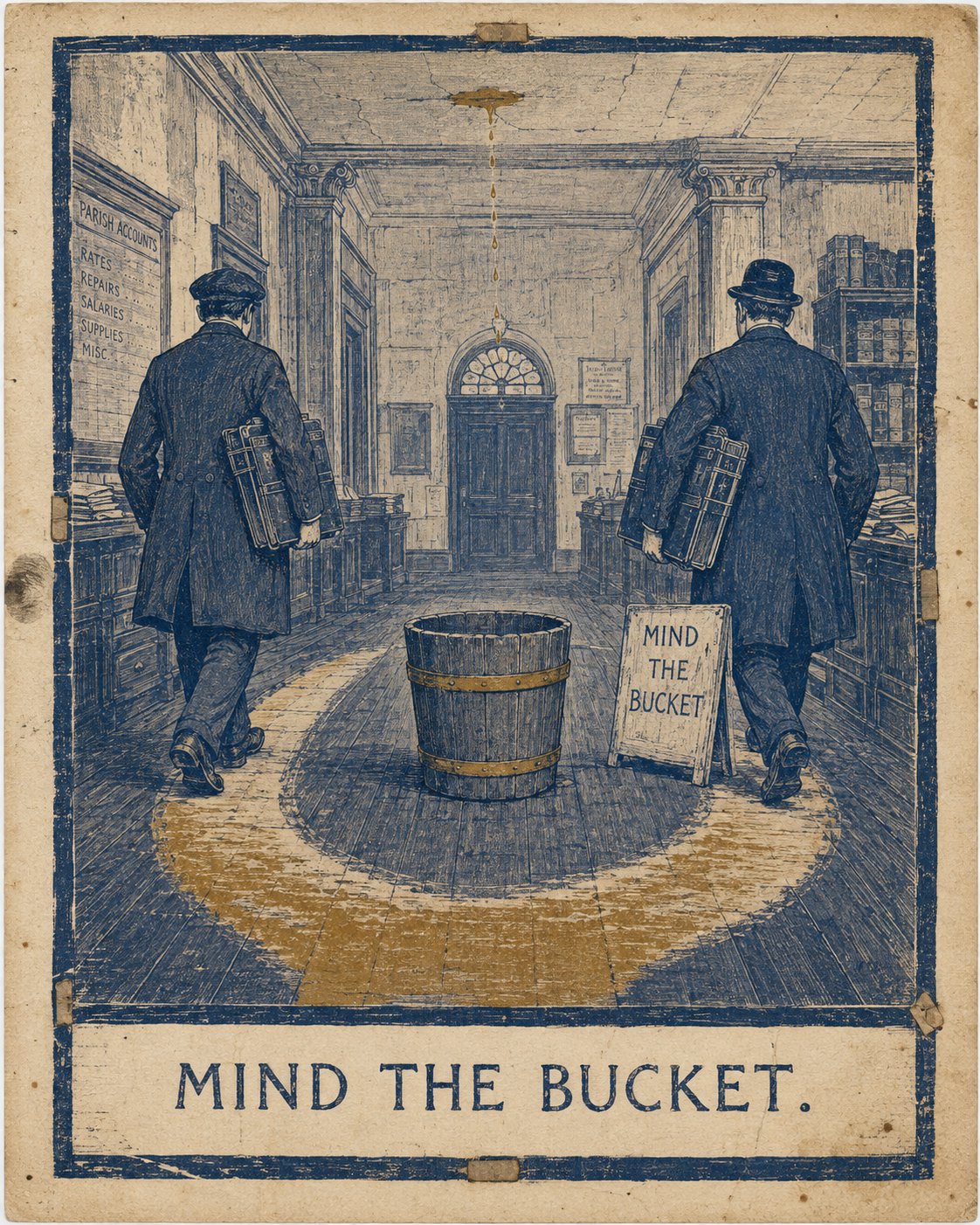
I am a zinc pail, and I stand in the courtyard of Castle Bastable, and I have not moved in six hundred years.
Let us deal with the indignities first, since they are what you came for. I have been rained in. I have been snowed in. I have been used as a spittoon by three generations of footmen, as a helmet by a boy on a dare, and, in the winter of 1802, as a place for a butler to be extravagantly unwell after the New Year — an incident for which the household blamed the dog, and for which the dog, to its eternal credit, never once tried to explain itself. I have held drips from the leaking roof, and I have held a frog, and for eleven years I held a small tree that was doing its best.
Nobody has ever emptied me on purpose. They step around me. They have always stepped around me. And every day of his life, Lord Percival Bastable the Twenty-Seventh comes out into this courtyard, sees me, and says — to whoever is passing, to the pigeon, to nobody — "Mind the bucket."
He thinks it is his joke. He thinks it is about the roof.
Now let me tell you what I am.
Cut into the flagstone beneath me, worn so smooth by six centuries of boots that you would need to lie down in the wet to find it, there is a mark. A circle, with a line beneath it. It is the oldest sign the turnips have, and it was cut there before this family arrived, and it means: something is wrong here, and it is not your fault, and if you want to live in this house, watch what it does with its own mess.
I am not a bucket. I am a warning. I have been standing in the middle of their courtyard, in front of their eyes, for six hundred years, and not one of them has ever asked why nobody moves me.
Which is the joke, and the joke is on them, and I have had six hundred years to enjoy it.
Her number was Sixty-One. That is not her name; I will come to her name.
She was small, and quick, and had the particular hollow-cheeked cheerfulness of a person who has learned to be useful very young, and in the spring of that year she was sent — because she fit, because she always fit, because fitting is what the small ones are spent on — down into the drains to recover a ring that Lady Bastable had dropped, and did not much want, and had already replaced.
I watched her go past me on her way to it. She touched my rim with two fingers as she went. They all do. I have felt six hundred years of small hands touch me on the way to something they were not coming back from, and I have never once been able to say a word, and that is the whole of what it is to be a sign instead of a mouth.
But she had read me. That is the thing. She had been taught, in a turf hall eleven minutes from that gate, what the mark beneath me means, and she had looked at that drain with my line in her head — watch what the house does with its own mess — and she had noticed, as no Bastable in six centuries has ever noticed, that the drains of Castle Bastable do not run out.
They run down. And what goes down does not come back, and no one has ever wondered where it goes, and somewhere below the down there is a hum you can feel in your teeth.
So she did not go into the drain to fetch the ring.
She went into the drain, and she left her boots at the lip of it — set neat and side by side, the way you do when you mean them to be found — and she went sideways, along the old dry course that the turnips have known about for four generations and have never once written down, and she came up in the Woods, in the green dark, eleven minutes from the gate, and somebody was waiting for her with a blanket, because somebody is always waiting.
The boots were found. Of course they were found; that was the point of the boots.
There was a great deal of concern in the Great Hall that evening, and Lady Bastable said it was too awful, and meant it, for nearly a minute. Lord Percival stood in this courtyard with his hands behind his back and looked genuinely stricken, and said that something really ought to be done about those drains, and then he saw me, and brightened, and said to the pigeon:
"Mind the bucket."
And went in to his dinner.
The steward drew one line through the number Sixty-One, and the column was tidy, and from that moment on she was the safest person in the realm — because there is nothing in Sogmarsh so thoroughly unwatched as a name that has already been crossed out.
She is forty now. She mends nets. She has two children who have never been inside those walls and never will be, and she is, I am told, extremely rude about the quality of modern drowning, which she considers sloppy work by people who have not thought it through.
Her name is Tamsin. Not the one who drew the castle — that Tamsin was her grandmother, and where do you suppose the girl learned to look at a thing properly? They put her name in the ledger in the turf hall, in the dry, and once a year they read it out loud by the fire with all the others, the kept ones and the lost ones alike, in exactly the same voice.
So I stand here. I hold the rain, and the spit, and the frog, and the occasional regrettable butler. I am the most disgusting object in a castle with real competition for the title, and I would not swap my post for the throne in the Great Hall.
Because every so often a small one comes across this courtyard with their whole life about to be spent on a ring nobody wants, and they touch my rim with two fingers on the way past — and some of them have been taught what I am.
I cannot speak. I have never been able to speak. But I can stand here, exactly here, for six hundred years, until the one person who needs me happens to look down.
The most important thing in the house is the thing nobody has ever thought worth moving.
Tale 48THE BUCKET-WARDEN
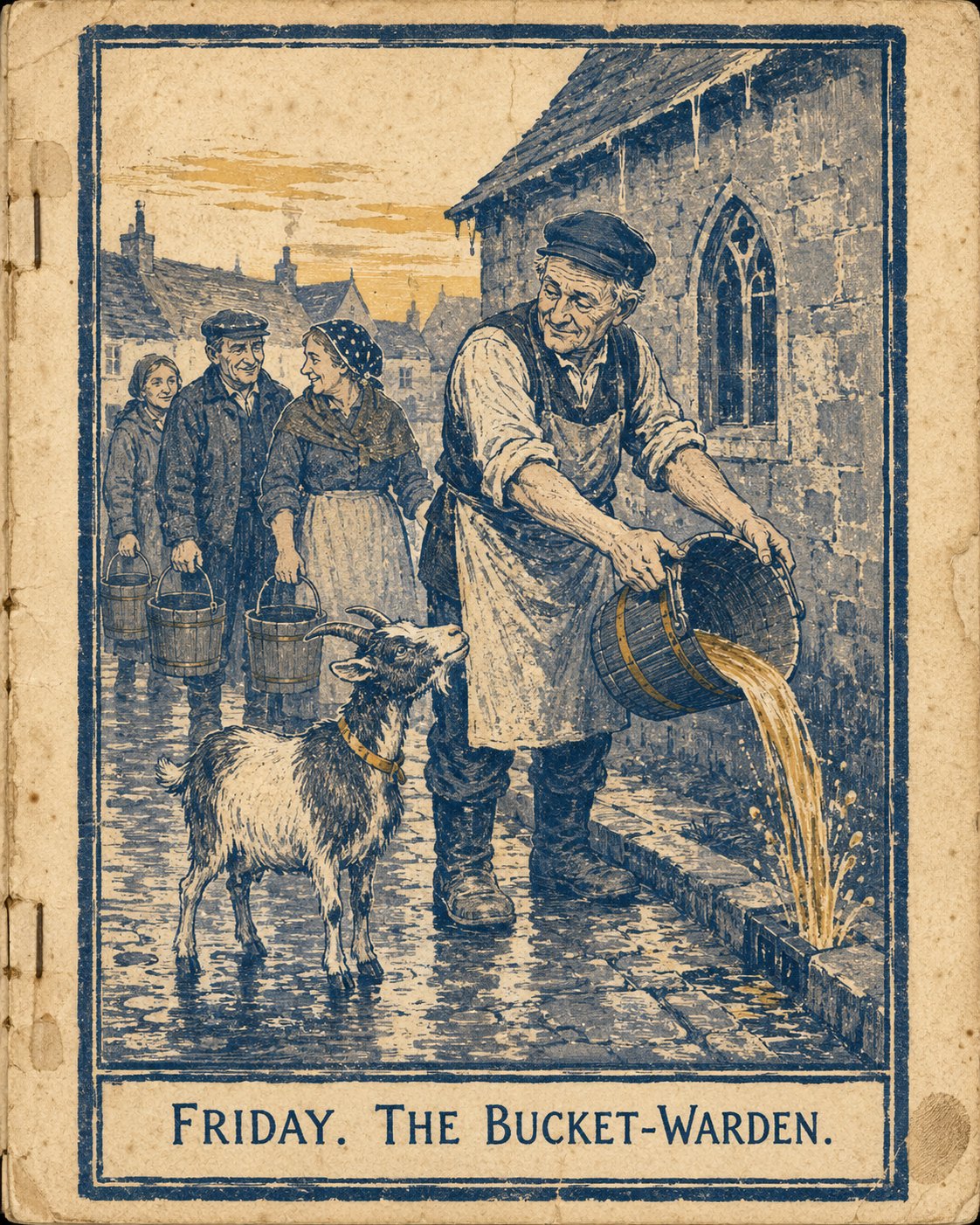
The elected offices of a Sogmarsh parish are these: Fen-Reeve, Pound-Keeper, Hedge-Viewer, Ale-Conner, the Toll Bench, the pitch wardens, and Bucket-Warden. There is no wage attached to any of them. There is, in most cases, a liability. The realm's four verbs of power are inherited, purchased, recorded and collected — nothing that matters is elected, which is precisely why the parish is permitted to elect anything at all.
Of the seven, Bucket-Warden is the joke office. Everyone knows it. The Fen-Reeve at least gets shouted at about drainage; the Ale-Conner gets to taste things. The Bucket-Warden's duty, as recorded, is "to have regard to the parish bucket" — the one under the worst of the chapel leak, that stands there and drips and is emptied by whoever notices — and the office has for three hundred years been used as the parish's way of gently telling somebody they are ridiculous.
Which is how, in a wet October, it came to Nolly Dellow.
Nolly was nineteen, and earnest, and had said at the vestry — out loud, in front of everybody — that he thought the parish ought to organise itself better, which is the single most laughable sentence available to a young man in this realm. He was elected Bucket-Warden by acclamation before he had finished sitting down. The whole vestry enjoyed it enormously. Somebody proposed a chain of office and somebody else produced one, which was a bucket handle on a bit of string, and Nolly wore it home.
He wore it, in fact, for eleven years, and by the end of the eleven years the parish had stopped laughing, and by the end of the twenty they had put his name on the chapel wall.
He began with the bucket, because that was the office.
And the first thing he found, on going and looking at it properly — which nobody had done in living memory, because it was the bucket, it was scenery — was that the parish bucket had a slow split in the base, and had had for some while, and that the reason the chapel floor by the north pew was going soft was not the leak. The leak went in the bucket. The bucket went in the floor.
He mended it. Sixpence of his own money and an afternoon. The floor dried out over the winter and the churchwardens, who had been quietly budgeting for a new floor at a cost that would have taken the parish four years, discovered that they were not going to need one, and asked how, and were told: the Bucket-Warden mended the bucket.
That was the first time anybody had said the words seriously since 1690.
Now, having mended the parish bucket, Nolly Dellow did the thing that made him. He asked the question that was, strictly, none of his business, and which nobody had asked in three hundred years because the office was a joke and jokes do not ask questions:
"How many buckets has this parish got?"
Nobody knew. So he counted them. It took him a winter, going door to door in the wet with a bit of chalk, and what he found is the whole of this tale and is the reason the office is what it is today.
There were, in that parish, in that October: forty-one buckets. Eleven of them were split. Four households had none at all — which in a realm where the leak is permanent means four households were sleeping under a drip and mopping, in the dark, every night, and had said nothing to anybody because there is nothing more private than the exact shape of what you cannot afford. Nine households had two or more and had never once thought about it. And the chapel had, in its cellar, under some sacking, nineteen buckets from a long-forgotten harvest supper, which had been under that sacking since before Nolly was born.
He redistributed them in a fortnight. Not by charity — he never once used the word, and he was very careful about that, because he had grasped the thing about pride that most people do not. He went to the nine two-bucket households and told them the parish was short, and asked them to lend to the parish, and every one of them lent, gladly, because being asked to help is an entirely different transaction from being given something. Then he issued to the four. And he chalked a number on the bottom of every bucket in the parish, and wrote the numbers in a book, and that book still exists.
Nobody in that parish has slept under a drip since. It cost nothing. It took one winter and a bit of chalk, and it had been available to anybody, at any time, for three hundred years.
Here is what it grew into, and I will be brief, because the tale's point is already made and the parish does not care for a fuss.
Once you have a man who knows where every bucket in the parish is, you have — without anyone deciding it — a man who knows which roofs leak. And a man who knows which roofs leak knows which households are struggling, and knows it before they say so, which in a proud realm is the only useful time to know it. The Bucket-Warden's book is, by its second decade, the most accurate record of hardship in the district, and it was compiled entirely by counting an object nobody is ashamed to own.
The parish worked out what it had somewhere around the seventh year. There was no meeting. Things arrived at the Dellow door instead — a spare hundredweight of peat, a coat outgrown, a half sack — with no message beyond "you'll know where that wants to go." And he did know. And it went. And the household that received it never learned who had sent it, and the household that sent it never learned who had received it, and the only person in the parish who held both halves was a man in a bucket-handle chain who had been elected as a joke.
They still call it the least office in the parish. They say it with their chins up now, which is a different thing entirely, and the current Warden — the fourth since Nolly — is elected by acclamation in the old way, with the old laughter, and takes it as gravely as a coronation, because everybody in that vestry knows exactly what they are handing over and it is not funny at all.
Nolly Dellow died at sixty-one, of a chest, in the ordinary way. He is on the chapel wall — not among the benefactors, who paid for the roof, but on the small plain stone below them, which the parish put up itself and which reads, in full:
The office nobody wants is the office nobody watches, and the office nobody watches is the only one left where a person may quietly do the whole job — so if you would change a parish, do not stand for Fen-Reeve. Ask how many buckets it has, and then go and count them.