Reading the Ground
The Tales
Tale 60BOG OR NOT
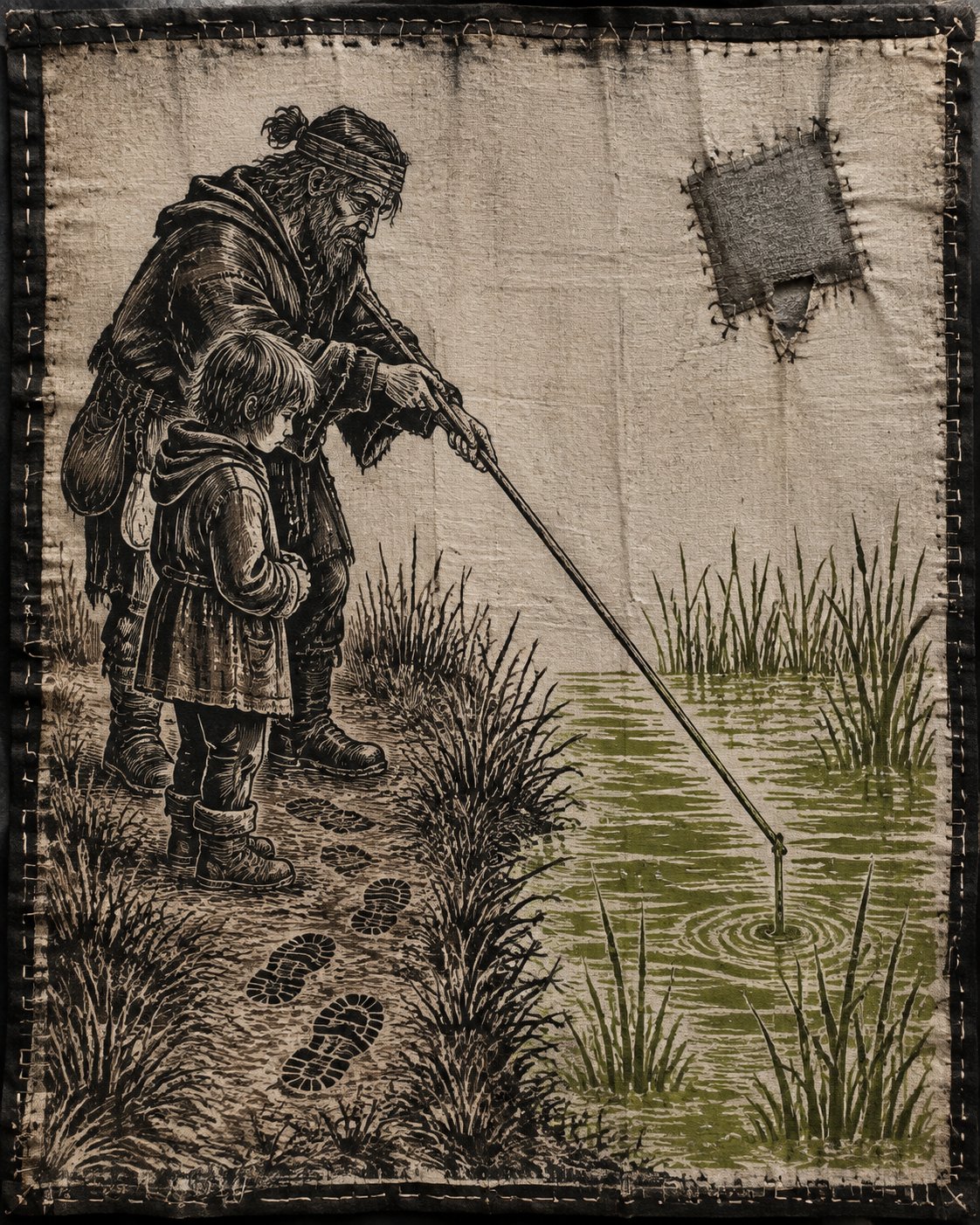
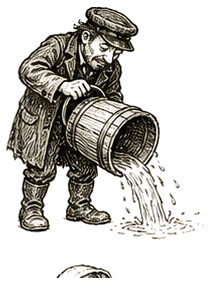
The children of the fen play a game called Bog or Not, and it is the most idiotic game in the Kingdom of Sogmarsh, and it is also the reason so many of them grow up.
The rules — and there are a great many rules, all enforced by seven-year-olds with the ferocity of a Chancery — are these. One child is the Caller. The Caller points at a patch of ground and shouts a name for it: green, or black, or singing, or the wrong green, which is a real category and the most feared. The other children shout back "Bog!" or "Not!" And then — this is the part the grown-ups pretend they cannot watch — the Caller has to go and stand on it.
If it holds, the Caller wins, and gets to be Caller again, and is insufferable.
If it does not hold, the Caller goes in, to the knee or the thigh depending on the ground, and is hauled out by the ankles by the others, and loses, and is wet, and everybody laughs, and the wetness is the whole of the punishment because in Sogmarsh being wet is a thing that happens to you fourteen times a day and carries no shame whatever.
That is the game. Point at mud. Argue about the mud. Stand on the mud. It has no ball, no score worth keeping, and no point that any adult will admit to, and children have played it on the edge of the Drownings for longer than anyone can say.
Now. Here is the thing about Bog or Not that no adult in that parish will tell you, and that every adult in that parish knows.
The children who are good at it do not drown.
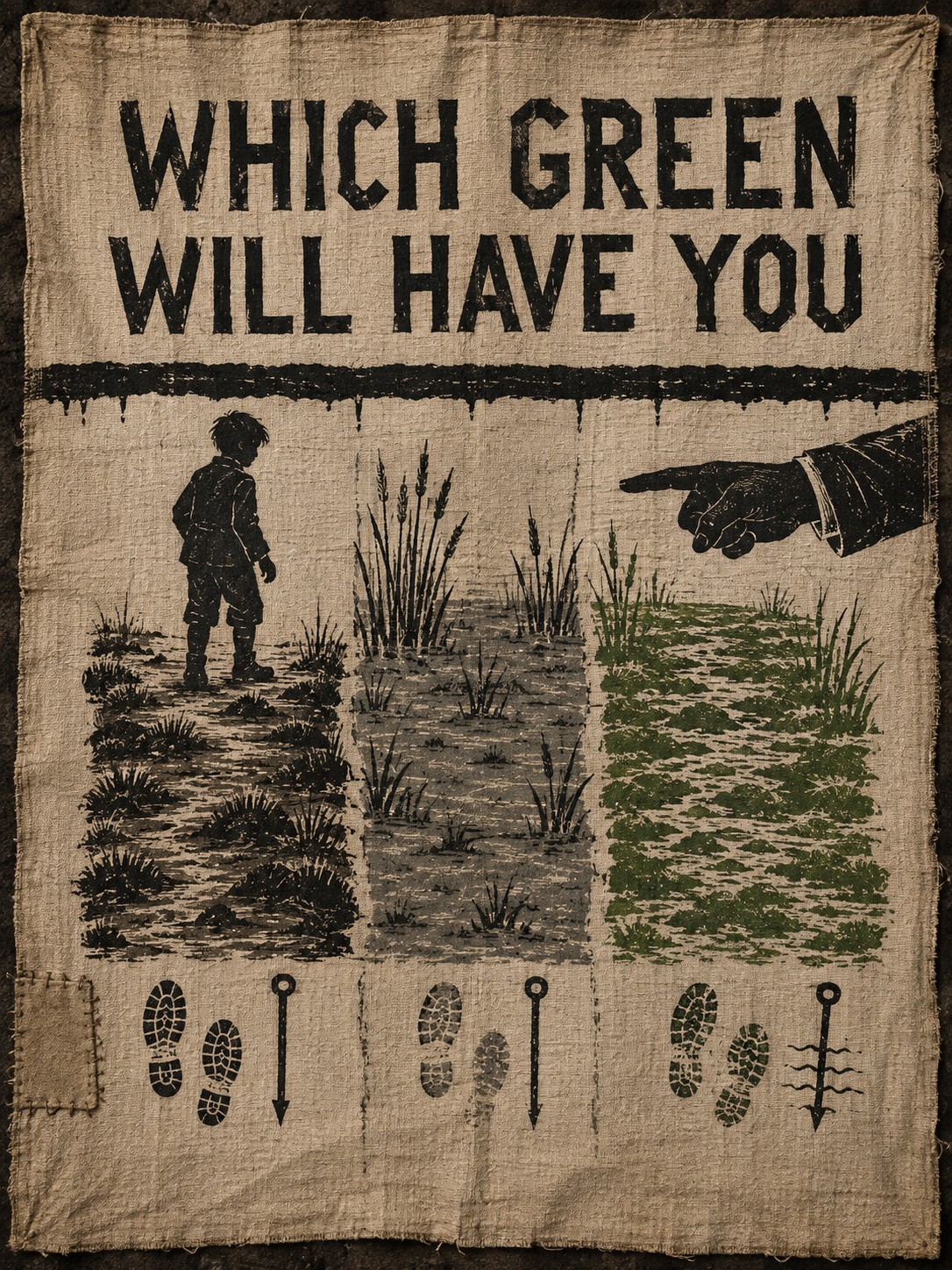
The categories are not nonsense. Green holds. The wrong green — the green that is a shade too bright, too even, too pleased with itself — does not, and will take a grown man with a cart, and every child who has played Bog or Not for a season can tell the wrong green from the right one across a field, in poor light, without thinking, the way you or I know a friend's walk. Singing ground is ground with water moving under it and it is never, ever safe, and a child who has lost the game on singing ground three times learns it in the body in a way no warning from a mother ever teaches.
The game is a drill. It has always been a drill. Some ancestor whose name is long gone looked at a fen that kills the careless and made the not-being-careless into the best afternoon a child can have — so that the lesson goes in as laughter, and stays in for life, and the child never once feels it being taught.
The parish knows. The parish invented it. And the parish will go to its grave calling it a silly game, because the moment you tell a child this game keeps you alive, it stops being a game, and a lesson a child is enduring is a lesson half-learned, and half-learned is exactly the amount that drowns you.
The afternoon this tale is about, there was a new child in the game — a Poxbury child, dry-country people lately come to the edge of the fen, who did not know the ground and was, for that reason, the most cheerful Caller anybody had seen in years, because he was not frightened of anything, having nothing yet to be frightened of.
And the older children, in the cruelty and the kindness that live so close together in the young, were about to let him win.
They were going to call Not on a patch he had named — a lovely patch, a bright even green, the wrongest green on the whole edge — and let him march out onto it triumphant, and go in over his head, because that is how you learn the wrong green, and they had all learned it that way, and the wetness teaches better than any words.
Except the wrong green there was not knee-deep. The older children knew the field the way they knew their own names, and they knew that particular patch went down a long way, and a dry-country child who could not swim and did not know to spread flat and did not know the ground would let go of him if he stopped fighting it — that child, on that patch, was not a lesson. That child was a funeral.
They knew it. You could see them know it, the whole ring of them going quiet at once, the game teetering on the edge of the thing it exists to prevent.
And old Fenwick Sedge, who was cutting withies at the field's edge and had not appeared to be watching anything, said, without looking up:
"Not that one, lad. Wrong green. Call another."
Which is against the rules. It is the one unbreakable rule of Bog or Not that no grown-up ever, ever plays — the game is the children's, the ground is the children's teacher, and an adult who calls the ground has spoiled it.
Fenwick Sedge had not called the ground in sixty years. He had learned the game on that same edge as a boy and he had taught it, silently, by being wet in front of the next lot, and he believed in it the way you believe in a thing that saved your life, which he did, twice.
And he broke it, in one sentence, for one child, because a drill is a beautiful thing and a drowned boy is not a lesson to anybody, and there is a point past which a rule that exists to keep children alive must give way to the actual living child in front of you — and knowing exactly where that point is, and not one inch before it, is the whole of what it means to be the old man at the edge of the field.
The boy called another patch. It held. He won, and was insufferable, and learned the wrong green the next week, in the ordinary way, knee-deep, laughing, the way you are supposed to.
A game that keeps you alive stops working the instant anybody admits that is what it is for — so a whole parish will call its most important lesson a silly game, and mean it, and only the oldest hand at the field's edge is allowed to know the one afternoon the game must be broken to do the thing the game was built to do.
Tale 50DEPTH NOT ESTABLISHED
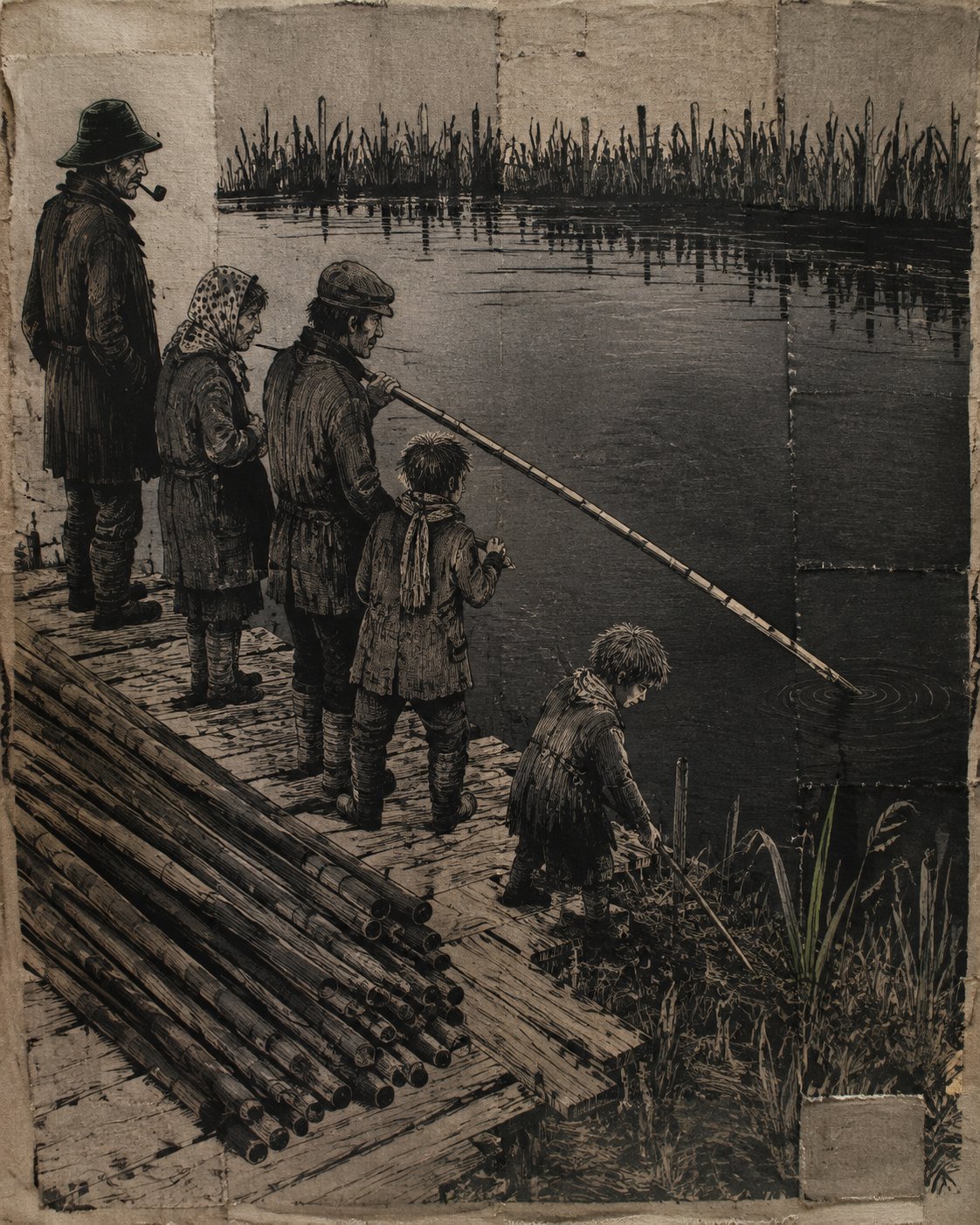
The Grand Cartographic Revision Committee has been trying to establish the depth of the Great Slough since 1841.
It has not established it. This is not the interesting part. The interesting part is how it has not established it, which is with enormous diligence, at considerable expense, over four generations, in a straight line, without at any point stopping to consider whether the method might be the difficulty — and the whole magnificent history is preserved, because the Committee preserves everything, in the one place where this office's soul is fully visible: the requisitions.
I have read them all. It took an afternoon. It is the funniest document in the realm and I do not think one word of it was meant to be.
REQUISITION THE FIRST. 1841. One sounding line, 100 ft, hemp.
The party proceeds to the margin of the Slough, pays out the line, and reports:
Now: a person outside this realm reads came back short and thinks about it for a moment and arrives, fairly quickly, at the answer. The bog is not a lake. It is not water with a floor under it. It is a suspension of peat and fibre and cold water, and it closes on things, and a hemp line paid into it comes back wet, and swollen, and fouled, and — over enough time in enough peat-acid — shorter, because the bog is quietly eating it.
There is no bottom to find in the sense the Committee means. There is only a gradient of increasing unwillingness.
Nobody at the Committee has ever written that down. Not once, in a hundred and eighty years. And I want to be careful here, because it would be easy and wrong to call them fools: every single man on those parties knew the bog. They were fen surveyors. They had walked it their whole lives. Ask any one of them in a taproom what the Slough does to a rope and he would tell you, at length, with feeling.
What none of them could do was put it in a return. Because the return has a box that says DEPTH, and the box takes a figure, and "the bog ate the line" is not a figure, and a return that does not fill its boxes is a return that will come back for amendment. So they filled in the only box the form gave them — Depth not established — and requisitioned a longer line, because a longer line is a thing the form does have a box for, and everybody could sign that with a clear conscience and go home.
REQUISITION THE SECOND. 1843. One sounding line, 200 ft, hemp.
(The Committee has re-issued the survey party with a longer line. The Committee is aware of how the previous sentence reads. The requisition stands.)
That parenthesis is real. It is in the minutes. It is, I maintain, the single greatest sentence any institution in this kingdom has ever written about itself: the Committee is aware of how that reads. They saw it. They saw exactly how it looked. And they ordered the longer line anyway, because seeing how a thing looks and having a different thing to do about it are separate problems, and only the first one is free.
REQUISITION THE THIRD. 1851. One line, 400 ft. Result as before.
THE FOURTH. 1869. One line, 600 ft, and one drum, iron, to wind it. The drum is the first sign of a Committee beginning to suffer: you do not requisition a drum unless the line has got heavy enough to require machinery, and a line that requires machinery is a line nobody is going to pull in by hand and notice the state of.
THE FIFTH. 1877. One line, 600 ft, chain, in place of hemp.
⭐ This is the near miss, and it is the great tragedy of the sequence. Somebody — the requisition is initialled and the initials belong to a junior — worked it out. Chain does not swell. Chain does not rot. Chain does not come back short. If that line had gone out, the Committee would have learned, in one afternoon, that its problem was the rope, and the whole subsequent century would not have happened.
The chain was struck from the requisition by the Chairman of the day, on grounds of cost, with a note that hemp had been found satisfactory in previous years.
Satisfactory is doing a very great deal of work in that note, and it has been doing it for a hundred and forty-six years.
THE SIXTH through THE NINTH. (1884, 1897, 1911, 1934.) Longer lines. Better drums. A boat. A second boat, the first having been retained by the Slough under maritime bog-law, which the Scuttles enforced promptly and which cost the Committee more in argument than in boat.
The returns are identical. I do not mean similar; I mean somebody copied the wording forward, year on year, because it had been accepted before and a form of words that has been accepted is worth more to a clerk than a form of words that is true.
THE TENTH. 1961. One line, 1,200 ft. And appended to it, for the first and only time in the entire sequence, a note from the officer in charge of the party, a woman, in her own hand, not on a form:
It was noted. It was filed. It was not read, until I read it, which is what filed means in this realm.
THE ELEVENTH, AND CURRENT. Standing, since 1989.
One sounding line, 2,000 ft, hemp; one drum, mechanical; and the party to attend annually at the margin.
They still go. That is the thing I want to leave you with. There is a survey party of the Grand Cartographic Revision Committee that attends the Great Slough once a year, in the wet, with two thousand feet of rope on a mechanical drum, and pays it out, and winds it in, and measures what comes back, and enters the result on a form whose wording has not changed since 1841.
They are good at it. They are efficient, and polite, and they have got the operation down to a day and a half from what used to take a week. There is a young man on that party at present who is, by common account, the finest hand with a drum in the profession.
And they know. Every one of them knows. I asked. The senior of them, a man of sixty, gave me the answer that is the whole of this realm, and gave it without any bitterness at all, wiping his hands on a rag:
"Course it's the rope, son. Everyone knows it's the rope. Been the rope since before my grandad."
And when I asked why nobody had ever written that on the form, he looked at me with the mild patience of a professional explaining his trade to an enthusiast, and said:
"There's no box for it."
Here is what a hundred and eighty years of that has produced, and it is not nothing, and this is the part the joke does not cover.
The Committee has no depth for the Great Slough. It has, instead, the most complete record of the behaviour of hemp in peat-acid ever assembled by anybody anywhere: a hundred and eighty years of lines, of known lengths, in known conditions, measured going out and coming back, annually, by careful people. Three separate trades now use those figures. The rope-makers at Saltgate price by them. It is, by a comfortable margin, the most valuable thing that office has ever produced.
It is filed under DEPTH: NOT ESTABLISHED.
An institution that cannot say a true thing will not stop working — it will go on working, beautifully, for a hundred and eighty years, and produce something magnificent and entirely unlike what it set out to find, and file it under the heading it was given at the start. If you would change such a place, do not argue with its conclusions. Widen its form.
Tale 70WATERING THE CRACKS
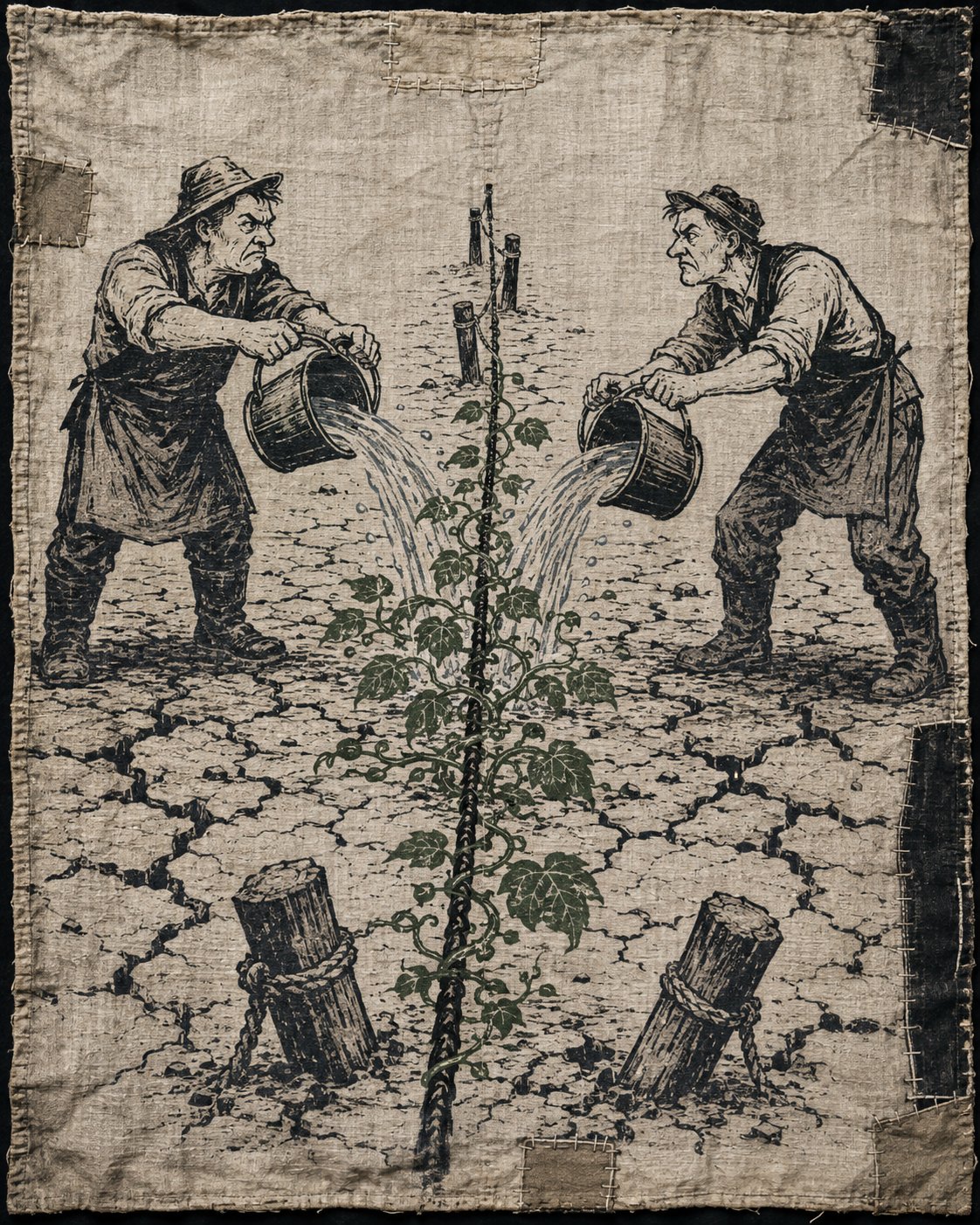
Where the Fat Mile gives out — that thin green seam on the Griddle's wet edge, where the heat and the water meet and everything grows — there is a line. It is the line the surveyors could never fix, the one that will not hold still; and just on the dead side of it, in the last cottage before the ground gives up being ground at all, lives old Gammer Kerne.
Every evening, when the shimmer has gone off the waste and a body can stand on it without their boots complaining, Gammer Kerne fills a single pail at the good wet edge, and carries it out — not onto the Fat Mile, which grows without a soul to help it, but out onto the Griddle proper, the cracked, pale, dead, useless ground beyond — and she pours it, slow and careful, into the cracks. One pail. And then she goes home.
It does nothing. Everybody knows it does nothing. The Griddle takes a pail of water the way the sea takes a single tear: by morning the crack is as pale and dry as if she had never come, and the water is somewhere the water always goes, which is down, and away, and not back. You cannot green a waste with a bucket. A child could tell you. Children have told her, gently, because they are fond of her, and she has thanked them for the information, and gone out the next evening with her pail.
If you ask her why — and strangers do, once — she will tell you about the glass.
You will have heard, if you have got this far south, what the edge believes: that Someone, up there, keeps a burning-glass on this one spot of the map, and that the kindest of the tellings, the one they hold to by day, is that it was no cruelty but an over-kindness — a generous hand that heard a drowning realm beg for dryness and warmth and firm ground and gave the Griddle all of it, and a little too much, and will, one day, notice, and ease the glass, and the Griddle will go green. And on that day, Gammer Kerne will tell you, the ground must be ready. It must not have forgotten how to hold water. It must remember it was ever anything but a griddle. So she waters it. She keeps it in practice for its own greening, against the day the glass is lifted.
That is what she says. It is even true.
Here is the rest of it, which she does not say, and which the whole edge knows and has never once made her speak.
Gammer Kerne did not always carry the pail. She began the year the heat took her man. He went out onto the Griddle on some small errand one bright afternoon, and a hike came, and the ground shone, and he did not come back off it. The Griddle keeps everything. It kept him. There was no bringing him home and there is no grave out there — you cannot dig the cracked stone, and in any case she would not know the place — so she has never known which crack. And that is the reason for the pail, and the reason it is the whole waste and not one spot: she does not know where he is, so she tends them all. Every crack on the Griddle might be the one, and so every crack on the Griddle gets its water, a pail at a time, for as long as she has evenings left to carry it.
She will not say this. She says the thing about the glass, and the greening, and being ready. And the parish lets her — helps her — because the parish on that edge learned a hard lesson not long ago, from a Committee man who came to explain the Griddle and proved it and watched his proof burn, and went home unable to tell his certainty from a prayer. They learned from him that some things are kept only by not being examined, and that a truth you drag into the open is very often a truth you lose. So nobody asks Gammer Kerne what she is really watering. They know. They fill their own pails, and they walk out beside her.
A neighbour, watching her go one evening with her one useless pail against all that dead ground, said the thing that has been said of her ever since, and that the edge now says of hope in general: "The greening is a daily work, not a state." You do not water a thing once and call yourself hopeful and sit down. Hope left untended goes dry as fast as brass left unpolished goes dull — faster — and it must be carried out again every single evening or it has not been carried at all. Gammer Kerne is not watering the ground. She is watering the hope, which is the same as watering herself, and it is a daily work, and she does it daily.
She is very old now, so the children carry the pails. A line of them, at evening, out onto the waste, pouring good water into cracks that will not keep it — and it has become the custom of that whole edge, and no child is ever told it is about a dead man. They are told it is about the greening, against the day the glass is lifted, and they believe it, and they are not wrong, because it is about that — and it is also about him, and about every crack that might be somebody's — and the edge does not sort these apart, because sorting them apart would end the watering, and the watering is the point.
And one evening — this is the last of it — a child tipping out a pail found, down in the crack, a single green shoot. One. Nobody living had ever seen a green thing stand on the Griddle proper.
And here is the whole of what that edge has learned, and the reason this tale is told warm and not sad: they did not ask. They did not send for a surveyor. They did not kneel down and work out whether it was Gammer Kerne's water, or a seed some bird had let fall, or a freak wet season, or the glass itself beginning, at long last, by the width of a single hair, to lift. They looked at it. And they left it. And they watered it. And whether it was still there the next evening, or the evening after — well. Nobody ever found out what it meant, and nobody ever tried, because finding out is how you lose things, and the not-finding-out is the last and best thing the Griddle ever taught anybody.
Gammer Kerne, they say, only nodded when they showed her, and filled her pail, and carried it out to the shoot herself, that evening, the whole slow way, on her own two feet.
Moral: You will one day tend a hope that gives you nothing back — for a person the ground has kept, or a greening that may never come — and the world will be very ready to tell you it is useless, and the world will be right, and it will not matter in the least. Carry the pail anyway. Carry it every evening. And if one day a green thing stands where nothing should — do not ask what it means. Water it, and say nothing, and go on. Some graces keep only as long as you never make them prove themselves.