
Grief With Somewhere to Go
The Tales
Tale 34THE REAPER'S GATE
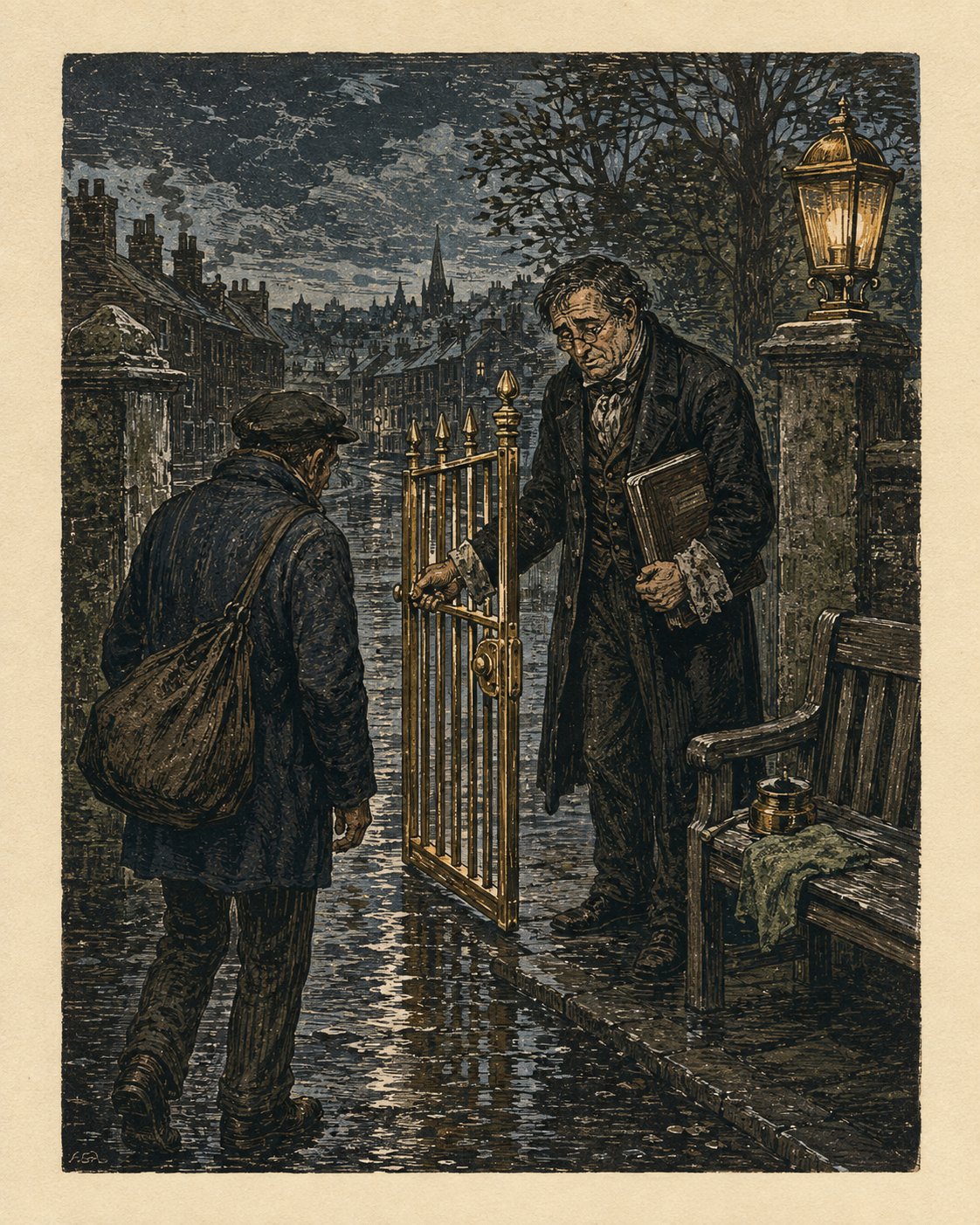
Murkminster has four gates, and I am the one nobody wants named at their own dinner table.
There is the Murk Gate, that the roads come in by. There is the Salt Gate, that the fish and the sea-news come in by. There is the Ink Gate, that the law and the bad letters come in by. And there is me. I am the Reaper's Gate, in the cold north wall, and I am the gate the city goes out by — out for good, I mean, the last time, feet first, with the bell going slow.
You would think this would make me grim. It is, I will not pretend otherwise, a serious sort of position. I have stood open for six hundred years of the capital's dead, and I have seen them all leave — the great ones under black plumes with a procession a quarter-mile long, and the small ones on a borrowed cart with nobody behind but a dog, and every single one of them just as gone as the other, because I am a gate, and a gate does not check your rank on the way through; a gate only opens.
But here is the thing about my particular trade, and it is the reason I am not grim, and it is the best-kept secret in Murkminster: the Reaper is always late.
You will have heard of him — the Underfunded Reaper, Death himself, such as we can afford, coming round the realm on a moped that was old when his grandfather rode it, perpetually, structurally, magnificently behind schedule. Well. He comes home through me. Every soul he collects, he brings out through the Reaper's Gate, and he is meant to be here at the appointed hour, to the minute, as the old contracts specify — and he has not once, in six centuries, been on time.
So I cover for him.
It started as a small thing. A family would gather at my arch in the cold at the appointed hour, and the appointed hour would come, and there would be no Reaper — only the little put-put of a moped three streets away, stuck behind a hay cart, going nowhere. And the family would stand there in the awful, hollow, waiting silence that is the worst part of any leaving, the part where there is nothing left to do but wait for the end to arrive on time.
And I found I could not bear it. So I creaked.
Not much. A gate's-worth. A long, low, companionable groan of old iron, the kind of sound a thing makes when it settles — and it gave them something. Something to be there with them in the silence. A voice, of a sort, in the cold, that was not grief, that said only: not yet, not quite yet, there is still a moment; stand together in it. And the moment the Reaper's own funding could not buy them — the small mercy of a little more time — I gave them for free, out of the one thing I have, which is that I am in no hurry whatsoever and never will be.
I do it always now. When the Reaper is late — which is to say, when the Reaper is present — I hold the passage gentle. I keep the arch warm as old stone can. I creak, softly, so the waiting is not silent. And when at last he comes put-putting up at his own hopeless pace, full of apology, wringing his hands about the hay cart, I open for him slow and easy, so that the leaving, when it finally comes, is not a snatching but a walking-through — the way you'd see an old friend to the door, unhurried, both of you pretending there is no hurry, because the pretending is itself the kindness.
The dry countries think a death-gate's job is to shut people out of life. They have it backwards, as they have most things. My job is not to shut. A gate that only shut would be a wall, and the realm has walls enough. My job is to make the one passage nobody can refuse into something that feels, at the very last, a little less like a door slamming and a little more like a door held — held open, by an old iron friend in no hurry, on a cold night, for as long as the moment needs, until the latecomer arrives and it is, gently, and only then, time.
The Reaper has never thanked me. He does not know he is late; he thinks he is prompt and the whole realm's clocks are fast, which is his one vanity and I leave him to it. But between the two of us — his lateness and my creaking — the capital's dead go out easier than the living will ever guess, and that is a good trade for a gate, and I would not swap my cold north wall for all three of the others and their traffic in fish and law.
The moral, from the north wall: the last gate is not there to shut you out; it is there to make the one passage no one escapes a little gentler than it need be — to creak in the silence, to hold the arch warm, to give freely the small mercy of not yet, not quite yet, a moment more that no one else can afford to give. A door that only closes is just a wall. The kind ones learn to be held open.
Tale 72THE WRONG FUNERAL
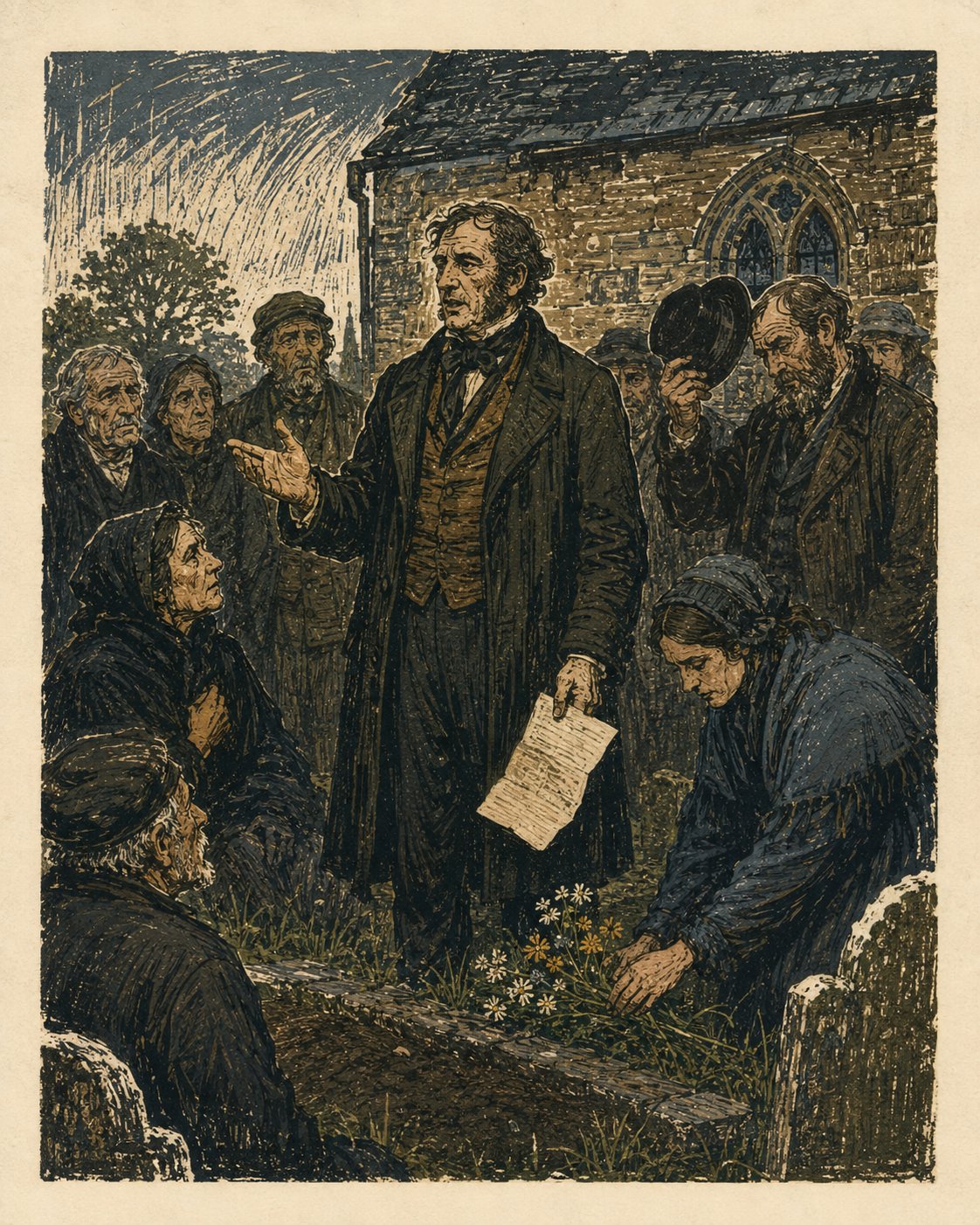
You must understand two customs of the parish before this will make any sense, and both of them are entirely mad, and both of them are the whole of the story.
The first is that in this parish nobody is buried alone. Not the beloved and not the beast; not the one who paid his way and not the one who never did. When the bell goes, you go. It is not about the dead — the dead, as a rule, are past minding — it is about the parish being the sort of place where a person is seen out, whoever they were, because a village that will let one soul go into the ground unattended will, in the end, let anybody.
The second is stranger, and it is this: the words over a grave are spoken not by a friend of the dead but by the last person the dead wronged. The reasoning, if you can call it that, is impeccable in the local manner — the last word on a man should come from someone with no earthly reason to flatter him — and it means that a Sogmarsh eulogy is the only one in the world you can absolutely trust, because it is given through gritted teeth.
Now. There died, one wet week, old Bartholomew Sneap, and I will not pretend to you that he was mourned. Sneap was sharp where a man could be blunt, and tight where he could have been open, and he had a tongue on him that could take the shine off a wedding at forty paces, and had. When word went round that Sneap was gone, the general feeling in the parish, honestly reported, was a kind of guilty lightening, as of a cart taken off a soft road.
But the funeral notice on the chapel door had done what every notice in this realm does, which is turn to grey pulp in the wet, so that by the morning of the service the only thing you could read on it was the one word SNEAP — and the parish, which also contained a beloved Sneap, kind old Gammer Sneap of the green who had been poorly all winter, read the pulp the way you read anything you cannot quite see, which is to say they read what they hoped, and their hearts went out, and they came. All of them. In their good black. In force.
They were most of the way through the door and into the warm before the coffin was near enough to see whose it was, and by then it was, of course, far too late — because there is precisely one thing you cannot do in this parish, one act beyond all forgiveness, and it is to be seen getting up and walking out of a funeral. So they sat. A chapel packed to the rafters with people who had come to bury the wrong Sneap, trapped shoulder to shoulder by their own good manners, burying the right one.
And then, by the custom, the eulogy fell to be given by the last man Sneap had wronged — which was young Nab Cutler, the fiddler, whom Sneap, the week before he died, had informed in front of the entire taproom that his playing was "a noise fit to curdle milk," and sat down to general laughter.
Nab Cutler stood up with every right in the world to bury Sneap a second time, in words, and the parish, if it is honest, rather leaned forward.
And he could not do it.
He stood over the box, and he found — as men do, over a box — that you cannot land a blow on a thing that cannot flinch. So instead, because he had to say something and could not think of anything cutting that did not curdle in his own mouth, he said the one true kind thing he knew, which was that mean old Sneap, the very morning after the taproom, had left a set of new fiddle-strings on his sill, with no note, because a man who would shame you in public and mend your instrument in private is a more complicated article than the parish had troubled to work out.
And that opened it.
Because once one true kind thing is said over a man, the others come, the way water finds a crack. Someone said, low, that it was Sneap who had quietly paid the doctor for the Hoby child, years back, and let the family think it was the parish. Someone else said that the half-blind stray that everyone assumed was nobody's had been fed on Sneap's own step, every night, for eleven — for a great many years, and there it was now, that very dog, sat in the chapel doorway in the rain, waiting, which no one could afterward explain and no one tried. And old Prewitt said, not looking up, that when her man was dying and the whole parish found reasons to be elsewhere, it was Sneap — Sneap, whom her man had feuded with for thirty years — who had sat up the three last nights, so that his enemy would not go into the dark alone.
And the parish sat in its good black, having come to see the back of a man, and understood, all at once and far too late, that it had never once looked at him — that it had decided about Bartholomew Sneap the way you decide about a locked door, from the outside, and had been wrong about the room.
They buried him beautifully. They could not help it; they had the numbers, and the grief was real by the end, though it was a peculiar grief — not for the man exactly, whom most of them still could not have said they liked, but for the man they might have known, and now never would, because he had had to die before anybody thought to ask.
The dog followed the coffin to the hole and would not be led away, and somebody took it home, and it is fat now, and sour-tempered, and universally beloved, which is the joke Sneap would have appreciated most, and the one he is not here for.
Moral: You will decide about people the way you read a notice in the rain — from the little that shows, and mostly from what you already expected — and you will be wrong more often than the weather. Go to the funeral. Say the one kind true thing. And if you must wait for a man to die before you trouble to look at him, at least have the decency to be ashamed of it, standing there in your good black, holding the words you should have said while he could still have heard them.
Tale 83The Apology Stone
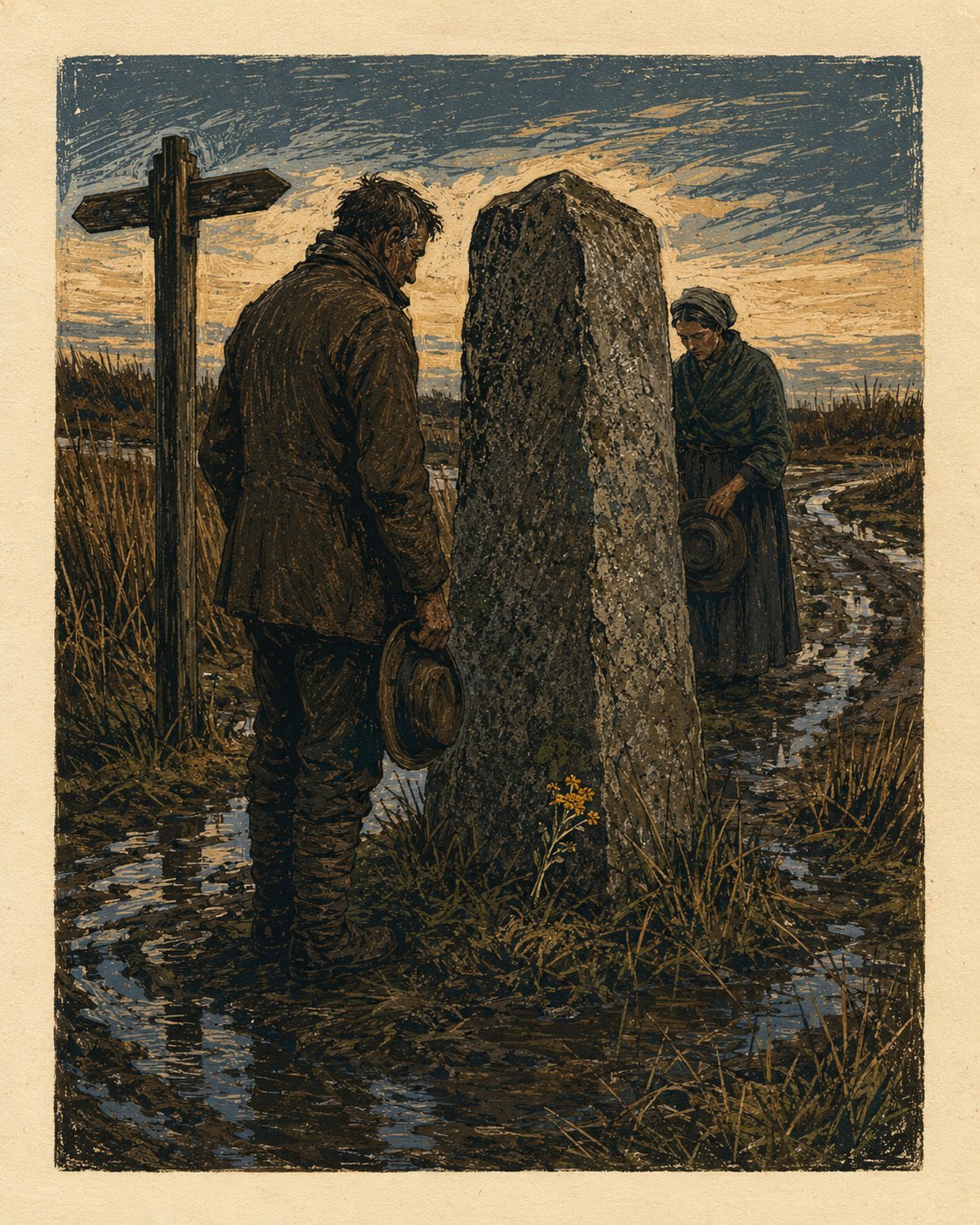
There is a standing stone on the Drudgeford road that everyone pats and says "sorry" to. Not to do so is rude. It has been this way about a hundred years, since a carter blamed the stone for the axle it broke, then felt foolish, and apologised to it — and somehow the thing caught, the way a good habit and a silly one are hard to tell apart in the doing. The Stone hears more apologies in a week than the church hears in a year, and keeps every one of them, being a stone.
Now, Elias Turf and Corbin Sedge had a boundary ditch between their holdings and a ten-year feud on top of it — whose spoil, whose slope, whose foot of good ground the ditch had quietly eaten. Neither would say sorry to the other. Sorry, in Sogmarsh, is a coin you cannot take back once it is spent, and both men were savers.
But Elias Turf had a conscience that would not lie down, for the truth was his ditch had taken a foot of Sedge's slope, and he'd known it the whole ten years. Unable to face the man, he took to apologising to the Stone instead — properly, out loud, the entire speech, the way you'd rehearse a thing you never mean to say. It is a great deal easier to a rock. A rock does not gloat.
What Turf did not know was that Corbin Sedge had been doing exactly the same. Different hours. Each man unburdening to the granite the sorry he could not put in the other's hand.
One foggy morning their hours overlapped. Turf came round the bend mid-confession — "...and the foot of slope, Corbin, I did know it was yours, I've known it ten year—" and there, on the far side of the Stone, hat off, halfway through the very same speech, stood Corbin Sedge.
They stood. The Stone between them had heard both halves, and, being a stone, said nothing, which was the one right thing to say. There was nothing left to apologise for; it had all been apologised, only to the wrong listener — which turned out to be the right one. They walked back to Drudgeford together and split the ditch, and the difference.
The parish says the Stone works miracles. The truth is duller and better: it is far easier to say the true thing when no one's face is there to make you sorry you said it — and now and again, saying it at all is enough, whoever happens to be standing on the other side.