Gliding on Blue Smoke
The Tales
Tale 35DEATH'S LIFE IN SOGMARSH
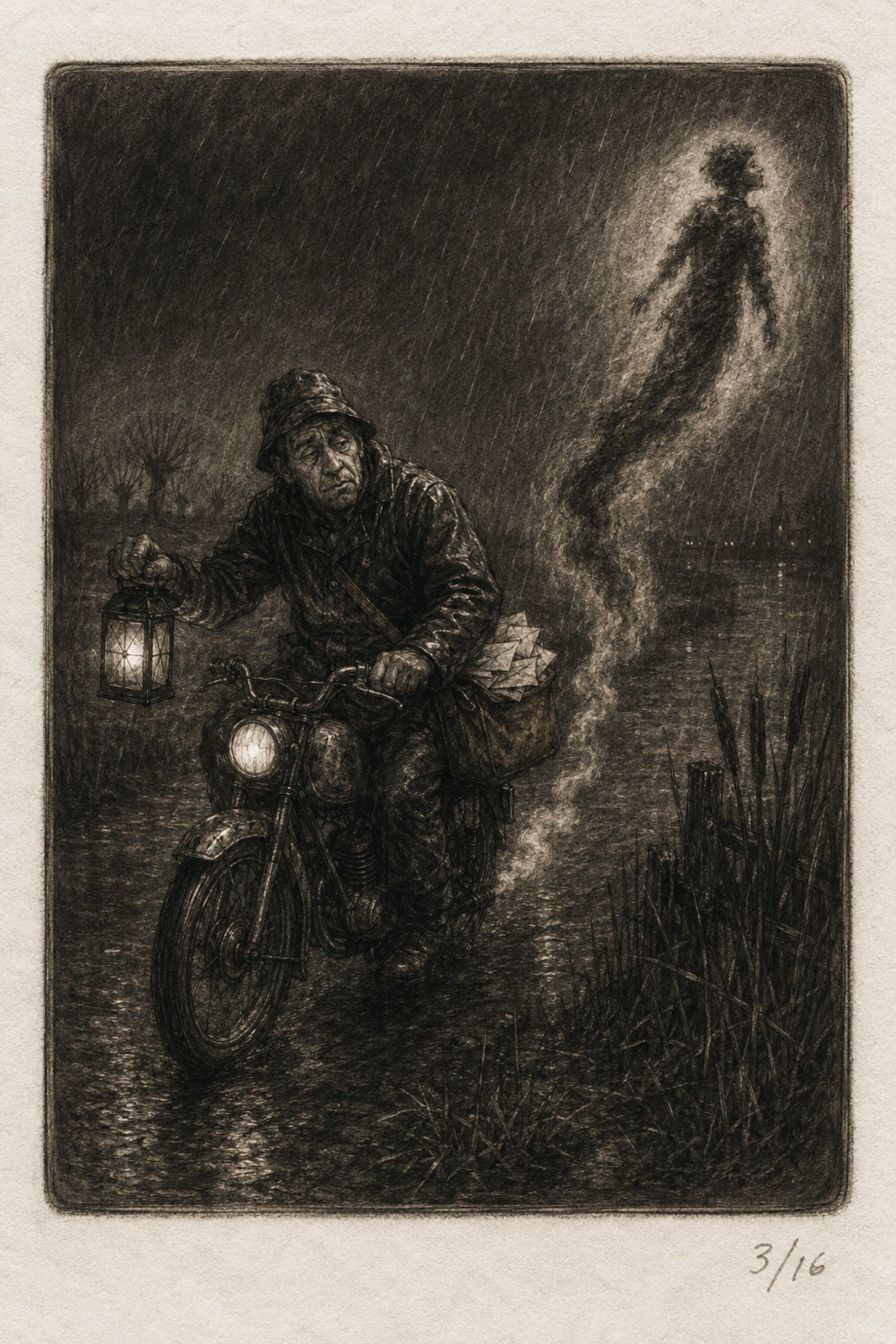
The pre-printed slips from the Sog & District Reaping Authority always went out late, and everyone was kind enough to blame the moped, or the mud. The truth was simpler. Everywhere else in the cosmos, dying is clean administration: a line drawn, a tally marked, a cold slot slid open to take the receipt. But Sogmarsh does not look to the sky for its laws. It looks down — and something down there holds the realm so tightly that nobody here has the decency to actually leave.
So the realm does not get the majestic, unyielding End of All Things. It gets a splinter of him: a tired, thin fragment of a vast cold thing, pressed into the shape of a man in a damp wool coat, handed the keys to a sputtering moped, and told to manage three full counties on a pittance.
And oh, he was so dreadfully, profoundly overwhelmed.
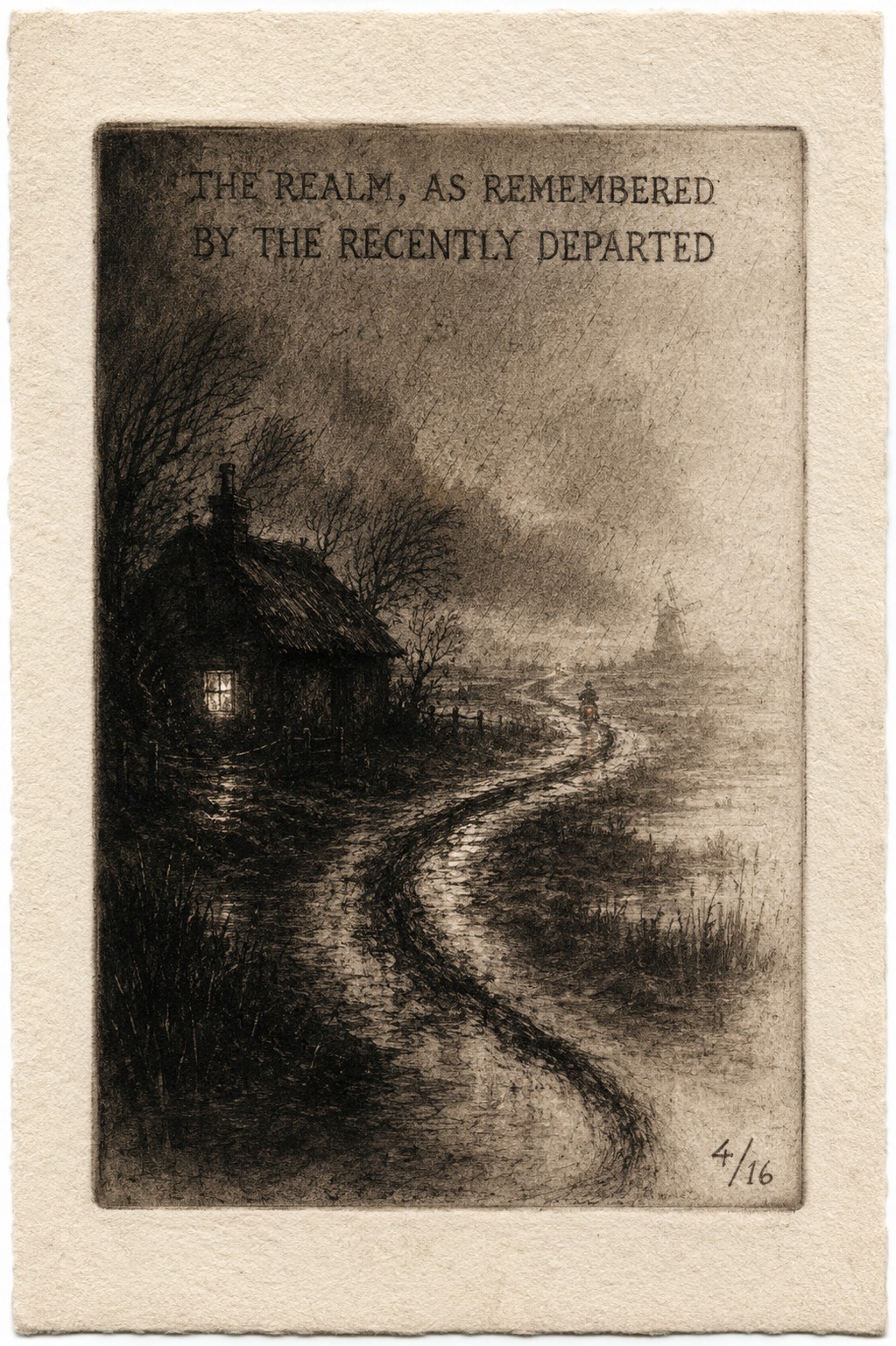
The moped coughed, blew a wet bubble into a puddle by the gatehouse, and died with a pathetic ping. I adjusted the strap of my satchel. Inside were forty-two urgent collection slips, all of them turning slightly green from the humidity.
Every other territory made sense. You died in Murkminster, you left; simple. But the moment I crossed the Hem the air grew thick with unfinished business, and nobody had the decency to go. My scythe, which had downscaled itself into a rather blunt pair of pocket hedge-clippers to fit the local reality, clattered against my belt. Being only a sliver of Death meant I got headaches now. True Death did not have sinuses.
I walked into the Great Hall. Lord Percival Bastable XXVII was draped across a chaise longue that appeared to be quietly growing a fifth leg, holding forth — to the room at large, or to the bucket, or to a pigeon that had wandered in; it was hard to say.
"Ah," he drawled, at the empty air a yard to my left. "The civil servant of the sepulchre. The bloodless bureaucrat of the final ledger. Do you have a form to authorise that ghastly noise outside, or must I fine you three sacks of King Edwards?"
He could not see me. They never can. He had simply felt the temperature drop and addressed it, out of lordly habit, with his very best material — wasted, as ever, on a man quipping at his own furniture. Only the portraits knew me: one cracked old Mutter dowager tracked me the length of the gallery with her painted eyes and muttered something uncharitable about my coat.
"Mind the bucket," Bastable told the chandelier.
I always do. I stepped neatly around the zinc pail and left him explaining the concept of leverage to the pigeon.
Down the spiral stairs, past the portraits that hissed when my coat brushed their frames, into the cool dark of Mortlake's register office. The undertaker did not flinch; he never does. He slid a cup of lukewarm chicory tea across the table and patted the heavy leather book.
"Late again," he said, not unkindly.
"It's backing up," I said, sinking into the chair. "I caught a butcher from the village on Thursday. He's sitting on his own roof, arguing with a magpie about his grandfather's clock. I can't clear the file until the magpie concedes, and the magpie is being backed by the Church of the Blessed Loaf."
"Ah, the Loafians," Mortlake nodded, ticking a name off his list. "They've rolled three more souls into 'Compound Grace' this morning. Mr. Pennyworth is furious — he wanted those names for the potato audit."
"They treat the afterlife like a competitive ledger," I said, rubbing my temples. "The Pennyworths want the numbers, the Church wants the loaves, the Turnips keep a separate book out of spite, and Old Mother Stilton has a Wensleydale in the back that remembers the actual date of creation and won't let me near the shelf."
"She's protective of the dairy," Mortlake agreed. "Did you bring the slip for Sefton?"
I pulled a crumpled pink paper from my pocket.
"I'm three weeks late for him," I admitted. "Is he —?"
"Oh, he's fine," Mortlake smiled. "The free kitchen in the Woods made his mutton broth last night. He said it tasted of wet straw, but he cried anyway. He's ready. He's down by the well, waiting for the moped."
"You do good work," he added softly, as I pocketed the paper. "The great systems fail us out here — the King's highway ends in the fog, and the laws of Murkminster don't care about the mud. But you always turn up eventually. Even on a moped."
"I have to," I said. "If I don't keep the diary, they just pile up until the castle pops like an over-ripe cheese."
Out in the courtyard the moped waited — and I will say this for the wretched machine: out here, where it mattered, it was beautiful.
Old Sefton sat on an upturned potato crate by the well, a small bundle tied with string in his lap. He had spent eighty-odd years in this valley, which is to say eighty-odd years crawling — hauling himself and a sinking bog-pony through mud that swallows carts and fences and the occasional tax man. He had never once, in all that time, seen a thing cross the mire without being eaten by it.
He looked at the moped the way other men look at cathedrals.
"Is that the chariot, then?" he asked.
And here is the thing the clean parts of the cosmos will never understand: he was right. To me it is a sad 50cc nothing — three kicks and a cough of blue smoke. To him, to all of them, it is the single most graceful, advanced, impossible thing he will ever see: a machine that glides, unsinking, needing no beast and no oars and no straining porters, regal as a swan over still water. The one true marvel of his whole sodden life — and it had come, at last, for him.
"It is," I said. "Hop on the back, Sefton. Hold onto your hat."
It started on the third kick, with a puff of blue smoke and a small metallic cough like a curse in an ancient dialect. We rolled out through the collapsing gates — past Lord Bastable, still explaining leverage to the pigeon, who never saw us go — and out across the surface of the mud, floating, the way nothing in Sogmarsh floats. Behind us the thrum below began to fade. The air thinned. The fog parted.
For a few miles, until the highway, the numbers would look exactly like people again. And for a little while, I would not have to think about the potatoes at all.
Tale 36THE DINNER THAT WAS NEVER BROUGHT UP
I am a tray.
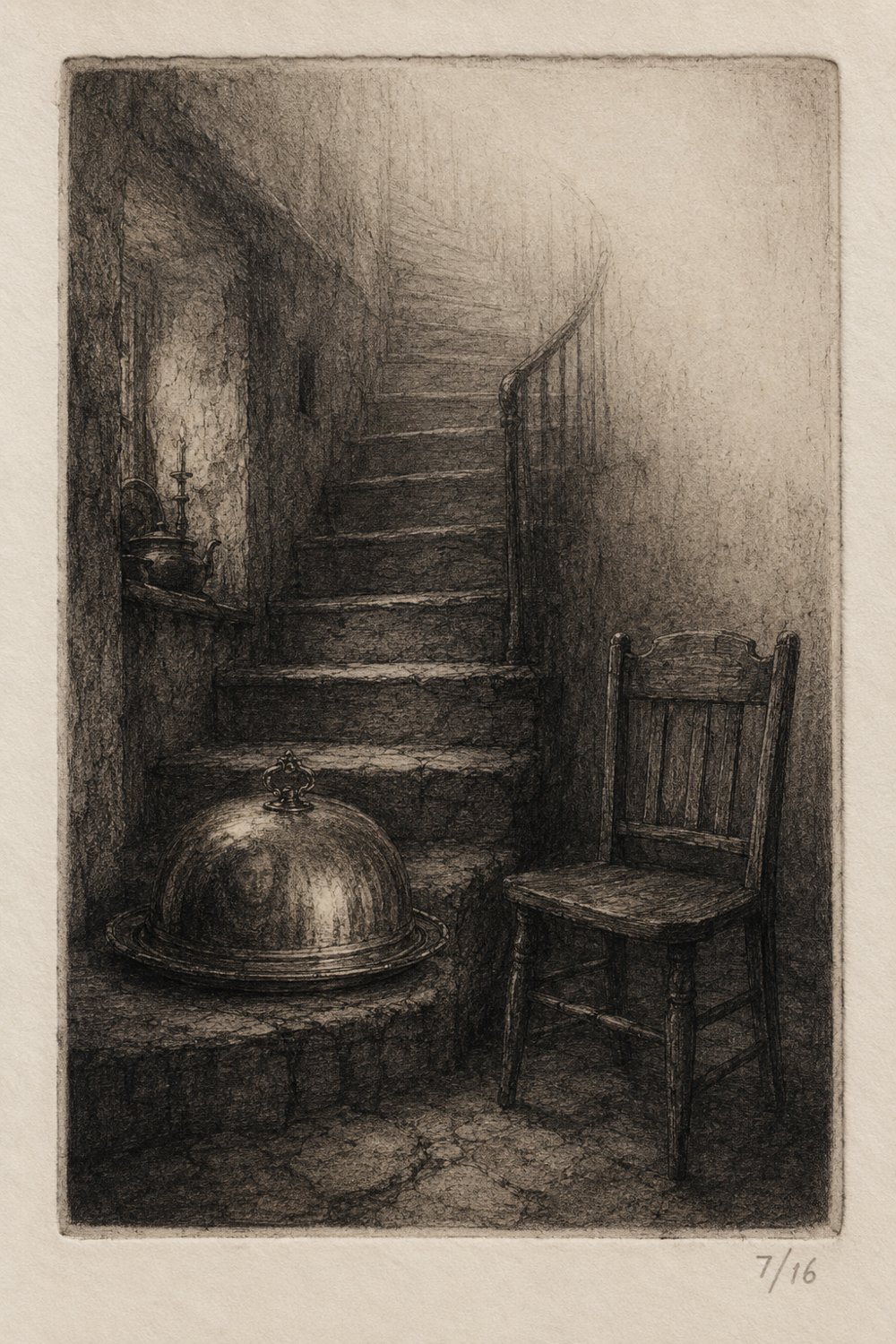
Ash wood, warped, and so heavy with two hundred years of Castle Bastable's grease that I have stopped being furniture and become, more or less, geology. For all that time I have rested exactly twelve steps below the parlour floor, on the cold stone lip of the cellar stair, held up by the trembling thumbs of a man named Sozzle who is, at every single moment, just about to climb.
I have never seen the parlour. I know it only as a rumour of warmer air leaking down the stairwell, and as a sound: the small, patient creak of a chair that will not be moved.
Let me tell you what I carry, since no one else will look.
There is a bowl of mutton broth. It was, once. It has since grown a thick grey pelt of mould so deep and so hairy that it breathes — rising and falling, gently, with the damp of the cellar, like a sleeping thing that would rather not be disturbed. Beside it sits a dish of cold pease pudding, which over the centuries has calcified into a single sulphurous brick; you could build a wall with it, if you had no neighbours you liked. And there is a tankard of ale, long since fermented down into a black, volatile tar that bubbles to itself in the dark and, now and again, swallows a stray petrified cellar-beetle whole, with a small, satisfied gloop.
The mould, I should say, is now load-bearing. It is the only thing holding the pewter spoon up; beneath it the wood of me has rotted to lace, and were it not for an enterprising blue-green crust spanning the gap, the spoon would have dropped into King Tiddles' drains around the reign of the third bad Bastable.
By every law the cook ever swore by, this dinner should be cold. Stone cold. Cold as the stair, cold as the grave, cold as a Pennyworth handshake.
It is not.
Deep in the centre of the mutton bowl, under the breathing pelt, under the grease, under two hundred winters of stagnant cellar air, there is a small stubborn knot of warmth. It has no business being there. It defies every sensible thing. And I have had a long time, balanced here in the dark, to work out why it persists — and it is not physics.
It is that Sozzle is still holding me.
Not idly. Not asleep, whatever the upstairs gossips say. He holds me the way a man holds the last thing that matters: with his whole trembling weight tipped forward toward the climb he means to make, because somewhere up those twelve steps there is a woman, and the winter was coming, and he wanted — he wanted, fiercely, with everything a careful man has instead of words — for her to have one hot meal before the cold set in.
Her name is upstairs. I have never seen her. But I have heard her, all this time: the creak of the chair she will not move. They tell me — the beetles tell me, the draughts tell me — that her slippers have worn two shallow, perfect dips into the parlour floorboards, just there, by the head of the stair, where she sits and listens. She could move the chair. She could turn it to the fire. She does not. Because to move the chair would be to face the stair, and to face the stair would be to see that it is empty, and to see that it is empty would be to know — and knowing is the one dinner she will not be served.
So she waits at the top with her two worn dips in the floor, and he waits at the bottom with his trembling thumbs, and I wait in between with my breathing broth, and none of us, you understand, can finish.
The night does not quite end. The chair does not quite still. The last bell — there is a bell, I am told, that a butler rings when the day is truly done — does not quite ring. And I do not quite go cold. Forever, and forever, and one more forever after that.
I have had two hundred years to consider my position, and I have reached a conclusion, which I offer to you free of charge, since I am a tray and have no other use left:
It is a terrible thing to be permanent, and better by far to be finished — but if you must wait forever, wait as Sozzle waits: holding something warm for somebody else.
Tale 37MY FIRST DAY DEAD

I died on a Tuesday, in my sleep, which I am reliably informed is the polite way to go about it. I was a turnip-weaver by trade in Lowmoss, out in the turnip country of the Bogmoor — and no, before you ask, I never did work out what a turnip-weaver weaves; nobody in the village could tell me either, and I had forty years to enquire. I went to bed a craftsman of uncertain craft, and I woke up dead, which is a great deal like waking up early: cold, faintly surprised, and quite sure someone somewhere has made a clerical error.
The first thing I learned about death in Sogmarsh is that it does not, in any meaningful sense, start.
I had the slip. Everyone gets the slip — a pink pre-printed thing from the Sog & District Reaping Authority, delivered (in my case) by a damp moth that had clearly read it first.
I was packed. I was ground-floor. I was, if anything, early.
The moped was not.
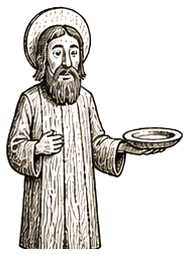
So I waited, as you do, and I learned the second thing about death in Sogmarsh, which is that it is overwhelmingly administrative. I was to report to one Mr. Mortlake, a cheerful undertaker who keeps the register in the crypt and who, on seeing me, sighed the particular sigh of a man whose in-tray has just gained another sheet. He gave me a number. He gave me a cup of lukewarm chicory tea. And he directed me to the queue — which is kept, he explained, by Saint Tarry, the patron of the about-to-be-served, and which has the remarkable property of never, ever moving, while remaining at all times just about to.
I shall spare you most of it. But I will mention the indignities, because no one warns you.
You still shed earwax. Phantom earwax — a faint, glowing grey dust that a ghost produces precisely as a living man does, and which gathers, slowly and luminously, in the corner behind the wardrobe where no broom will ever reach it, as a monument to the fact that death frees you from absolutely none of your body's stupider habits. I had imagined a great many things about the hereafter. I had not imagined dusting.
I went, as is the custom, to my own funeral. The free kitchen in the Woods sent up the mutton broth; the mourners agreed it tasted of wet straw and ate it anyway, weeping. I sat at the back, as a soul should, and I did not correct the eulogy, though the eulogy was extremely generous about my turnip-weaving and implied a level of skill that I, the turnip-weaver, had never once witnessed. This is the etiquette. You let them embroider. They earned it.
And all the while, I felt the third thing — the thing nobody will say out loud.
Everywhere else in the world, I am told, the dead simply leave. A line is drawn, a slot slides open, off you pop. But here, the nearer you are to the castle, the more the leaving jams. The queue thickens. The slot sticks. The air grows crowded with people who, by every right, should have gone on years and years ago, and who instead linger about the place complaining of the damp and attending dinners. Something holds us. Nobody can say what. We do not discuss it, the way you do not discuss a draught when there is no window to blame.
I confess my first day dead was shaping up to be a disappointment. Cold tea, an unmoving queue, eternal dusting, and a moped that may or may not arrive before the next reign.
And then I came out to the gate to wait for it anyway — and there, sitting in the mud as though no time at all had passed, with his tail going like a flag in a gale, was my dog.
He had been dead thirty years. I buried him myself, under the willow, and cried in a way a grown turnip-weaver is not supposed to. And he had spent those thirty years — I have since been told, by a kind scullery-ghost named Edith who showed me where to stand — chewing through the paperwork. Gnawing, patiently, illegally, through three decades of the lower circles' red tape: every form, every transfer, every stamped and triplicate refusal, reduced to spit and confetti, all so that he could get back up to the gate and be sitting in exactly the right spot when his man finally came through it.
He did not care about the queue. He did not care about Saint Tarry or the slot or the moped or the embroidered eulogy. He had one piece of unfinished business, and it was me, and he had simply waited.
I sat down beside him in the mud. There was, of course, no chair — there is never a chair — but I found I did not especially mind.
The afterlife, it turns out, is mostly administrative. But the company more than makes up for the lack of a chair.