Chosen Futility
The Tales
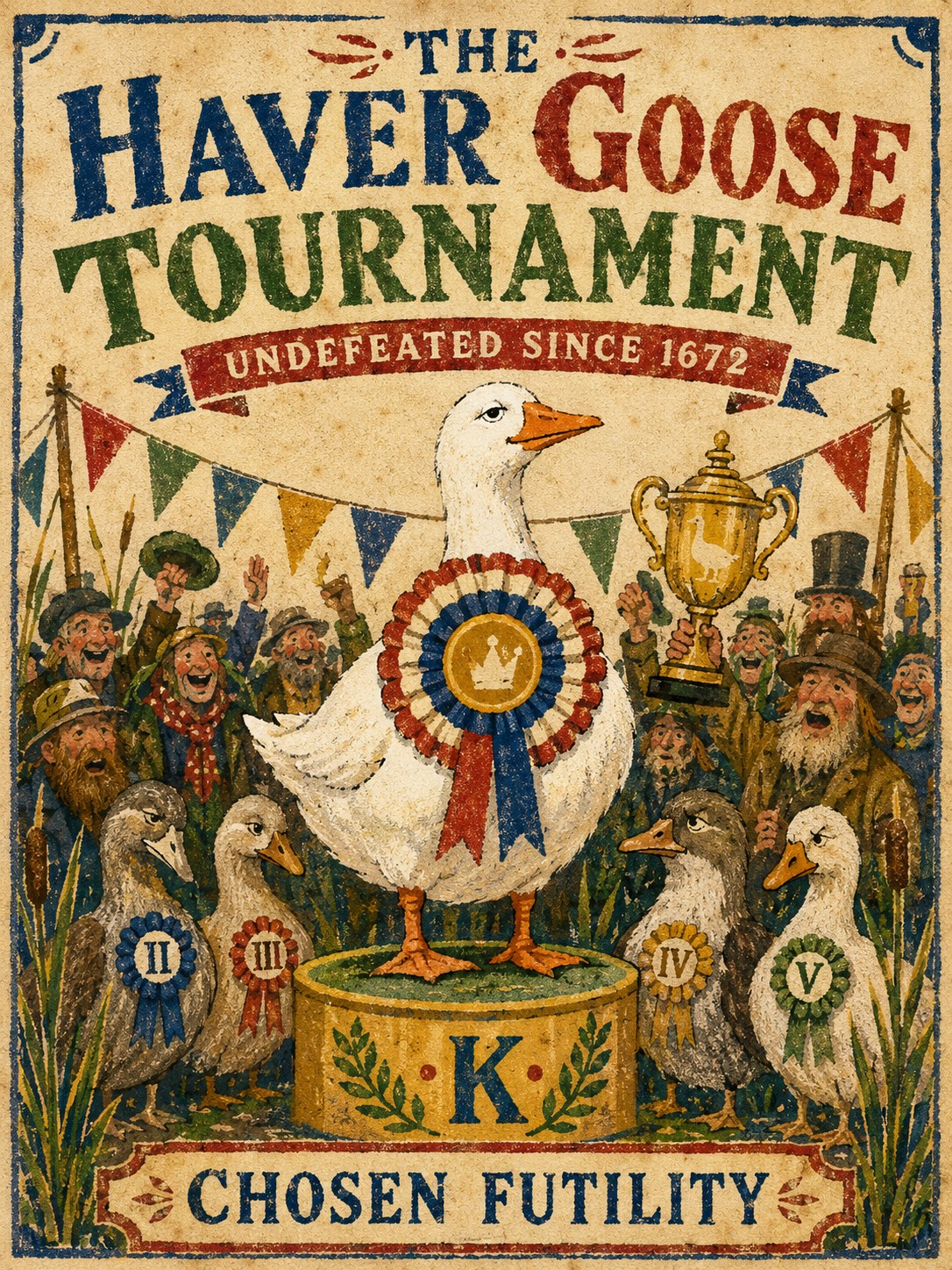
Tale 55THE HAVER GOOSE TOURNAMENT

Every spring, on the Haver ground, the parishes of this realm hold the oldest continuous sporting fixture in the kingdom, and every spring it is won by a goose.
I am aware that a great many people know this much and no more. I am going to attempt the whole of it, because I have been going since I was six, and because the last honest account was written by a man who left at the interval, and because I have a piece of paper in front of me that I intend to work through before the ale wears off.
Let us begin with the difficulty that has defeated every previous chronicler, which is the small matter of what the sport actually is.
## THE RULES, SUCH AS THEY ARE
The tournament is a contest of retrieval over broken ground.
That is the shortest true sentence available and I have spent two seasons arriving at it. A thing is thrown — traditionally a bound sheaf, latterly whatever is to hand — and it lands somewhere in the Haver ground, which is three-quarters wet, and the competitors go and get it, and the one who brings it back gets a point, and the one with the most points at the end is the champion.
If you are now thinking that this sounds like a game a dog would be good at, you have arrived, in one step, at the central problem of the Haver Goose Tournament, and it took the parishes two hundred years.
Dogs were barred in 1698. The relevant minute is short and, I think, the finest thing House Haver ever wrote:
Nobody has ever barred a goose. There was no reason to. Nobody at any point in the history of that committee sat down and thought: what if a goose entered.
## WHY THE GOOSE WINS
I want to set this out properly, because the parishes are sick of being told they are fools, and they are not fools, and the Goose's advantages are structural and every one of them was voted in by men trying to be fair.
One. The ground. The Haver ground is bog with opinions. A man crossing it goes in to the knee at every fourth step and spends the day hauling himself out of the fourth steps. A goose does not cross the ground. A goose goes over the top of it, in that low insulting flap that geese do, six inches up, at the speed of a trotting horse, and comes down on the far side dry.
Two. The throw. The sheaf is thrown, by tradition, into the wind, so that the contest is fair to all comers regardless of which side of the ground they start from. This was decided in 1704, unanimously, by men who had thought hard about fairness and had never once considered that a thing thrown into the wind comes back a little, and that the only competitor on that field who understands wind professionally is the one with feathers.
Three. The whistle. Play begins on a whistle. The Goose has learned the whistle. The Goose has, over several generations of geese and one long institutional memory, learned the sharp intake of breath the whistleman takes before the whistle, which is a distinction the rules do not cover and which the parishes have twice declined to legislate on, on the grounds — and this is minuted — that "you cannot fine a bird for listening."
Four, and this is the one that finishes it. There is no rule requiring a competitor to bring the sheaf back to the same place. The rule says back. In 1672 everybody knew what back meant, because everybody was standing together at the near hedge. The Goose brings it back to where the Goose was standing, which is beside the trophy table, which is closer, and which is — read the rule again — entirely permissible.
It has been suggested that the rule be tightened. It has been suggested at every annual meeting since 1806. The motion has never once been put to a vote, because at the meeting of that year a member observed that the Goose was in the room, and the minute records that the matter was held over.
The Goose was in the room. It is always in the room. It has been in the room, in one body or another, for longer than the room.
## THE GOOSE
Nobody is entirely clear whether it is one goose.
I want to be careful here, because this is where a chronicler makes a fool of himself. The parishes say the Goose, singular, and have said it since 1672, and if you ask a direct question you get one of three answers depending on who you ask and how much they have had.
The plain answer, which I believe, is that it is a succession of geese from the same Haver flock, handed down like an office, each one taught the whistle by the last, in the way farmyard birds do learn things off one another and nobody has ever been able to explain how.
The taproom answer is that it is the same goose, which is nonsense, and is asserted with such total confidence by men who can otherwise be trusted with money that I have stopped arguing.
The Haver answer, when the family was applied to in writing in 1843, was "Certainly not."
What can be said with certainty is that the Goose is a goose of considerable presence. It is grey and about the size of a dog nobody would keep. It walks the ground before play like a man inspecting a hedge he intends to complain about. It does not acknowledge the committee — this is not a figure of speech; the committee stands at the trophy table in their sashes at the opening, and the Goose walks past them, and has never once looked at them, in any year, in any body, and every child on that field notices it and finds it the funniest thing they have ever seen.
It is not, I should say, a nice goose. Two of the sashes have been bitten. The Perpetual Trophy has to be brought to it, because it will not go to the table, and the man who brings it goes at a certain angle with the trophy held out in front of him like a shield, and that man is chosen by lot, and refusing is permitted, and about one in three refuse.
## THE CHALLENGERS, IN BRIEF
There have been serious attempts. I will not list them all, but the parishes' honour requires a few.
Boots off (1788). A cutter from Peatdike reasoned that the ground could be crossed barefoot faster than booted, and he was right, and he crossed it beautifully, and he was second by a margin of about a goose. He is remembered fondly and his time stood for sixty years.
The long arm (1822). A man arrived with a rake. There is no rule about a rake. He got the sheaf on the first throw and the crowd went up, and then he had to carry a rake across three-quarters of a bog, and the bog took the rake, and it is still there, and the parishes point at the spot.
The committee's own attempt (1854). Two members entered in an official capacity to demonstrate that the thing was beatable by a man of method. They finished fourth and seventh out of eight and did not enter again, and the minute for that year is one line long and reads "no further demonstration is proposed."
The dog question (1871). A man from a dry country brought a dog, having read the rules and found no dog in them, having not read far enough, and was shown the minute of 1698, and read it, and said — according to four witnesses who agree — "but the goose enjoys it," which is the best point anybody has ever made at that ground and which was ruled out of order.
## THE YEAR OF THE CHALLENGER
Now the year I came to write about, which the parishes call the Long Final, and which is the reason grown men in three villages still cannot be got to shut up about a bird.
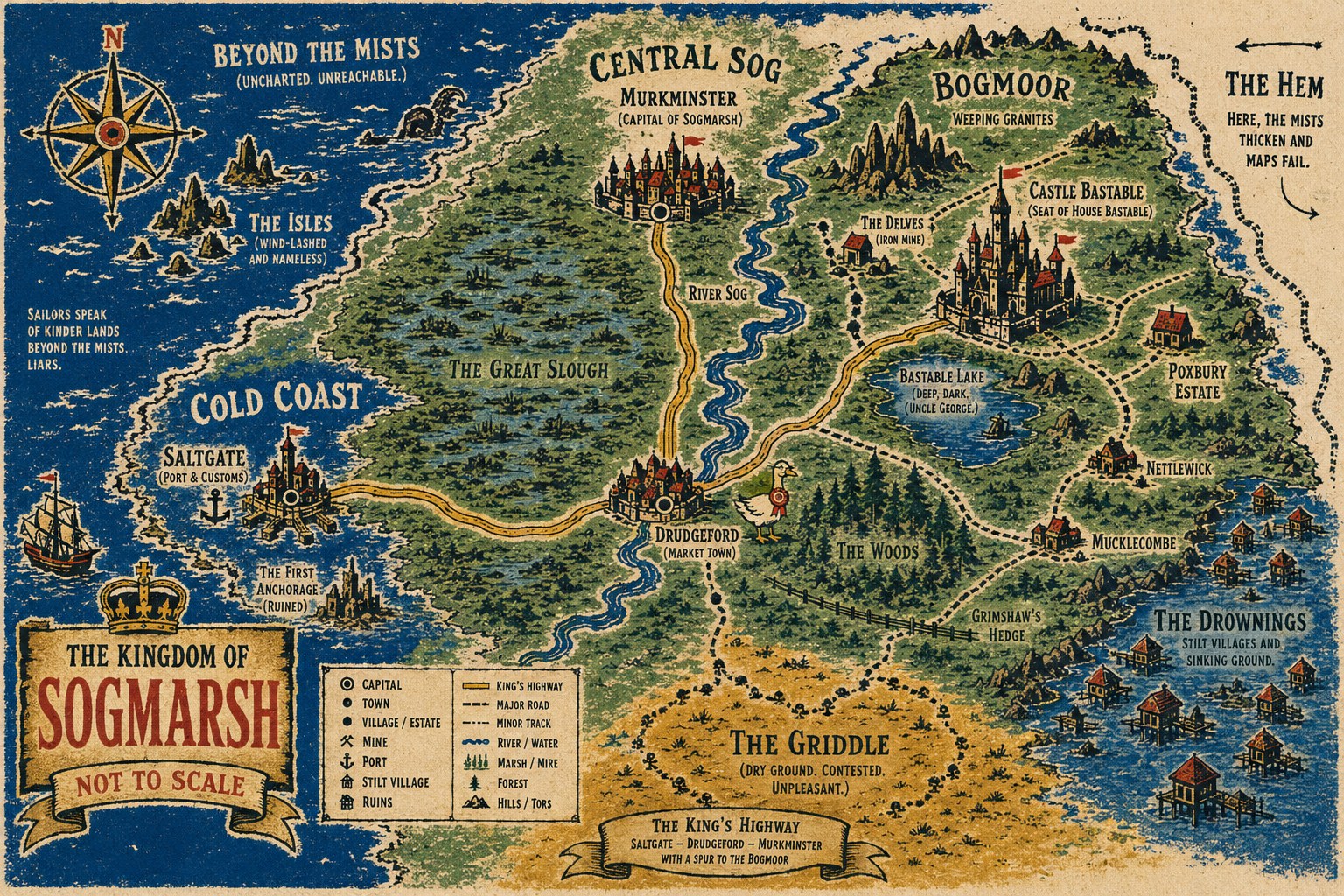
The challenger was a woman called Aggie Prowse — of the Prowse family, mud and stone, the ones who re-lay the stepping-stones on Mire Road every time the water takes them, which is twice a year, which turns out to matter enormously.
She was about thirty, built like a door, and she had spent her whole working life crossing exactly the kind of ground the Haver tournament is held on. Not training. Working. That is the part the story keeps and the part I would like on the record: she did not prepare for the tournament. She had a job that happened to be the tournament.
And she had thought about it. This is what raises the Long Final above the rakes and the bare feet: Aggie Prowse had gone and stood on that ground in February, alone, in the wet, and worked out the one thing two hundred years of committee had not.
She did not try to beat the Goose across the ground. She worked out where the sheaf was going to land.
The throw is into the wind, by rule. The wind on the Haver ground in April comes off the west and does the same thing every year, and a woman who has spent her life reading water knows what wind does to a thrown object better than she knows her own family. She paced it out in February. She put a stone down. She came back in March and the stone was right.
On the day, she did not start at the near hedge with the others. There is no rule requiring it. She started out on the ground, at her stone, having walked out there in front of a crowd of about eight hundred people while the committee consulted each other in a rising panic and found, to their visible distress, that she was entitled.
The sheaf came down, they say, close enough to her that she did not have to run.
She had it up and was turning before the Goose was properly airborne, and eight hundred people made a noise that was heard at Mucklecombe, and for about four seconds the oldest fixture in the realm was lost.
And then Aggie Prowse had to carry a sheaf three-quarters of the way across a bog with a goose in the air beside her.
They went the whole way together. That is the detail. Not a chase — level, the two of them, the woman going through it to the knee and hauling out and going again with the sheaf up over her head, and the bird six inches off the surface doing that flat contemptuous flap, and neither of them gaining, all the way across, for what the parishes insist was four minutes and was probably closer to two.
She lost by the length of a table.
Not by the ground. She had the ground beaten; she was ahead at the last firm footing and she is the only competitor in the history of that tournament who was. She lost because at the last she had to go to the near hedge, where the field starts, and the Goose went to the trophy table — the rule of 1672, the word back, the thing that has never been put to a vote — and the table is nearer.
She lost to the minute. The parishes have never been in any doubt about it and neither has anybody else.
## WHAT HAPPENED AFTER, WHICH IS THE PART I ACTUALLY CAME TO TELL
The committee met the following winter, and there was a mood.
Somebody — and it was not Aggie Prowse, who has never asked for anything and finds the whole business embarrassing — somebody put the motion at last. That the rule be tightened; that "back" shall mean the near hedge; that the matter be settled.
And it was debated properly for the first time in two hundred years, and it was going to pass. Everybody in that room says it was going to pass.
And then Old Marle stood up. He was eighty-something and had carried the trophy out to the Goose in 1859 and had the mark on his hand to prove it, and he said the thing that ended the argument and has been quoted at that ground every spring since:
The motion was withdrawn. The minute reads "the matter was held over," which is what that minute has read since 1806, and which the parishes now use as a general expression meaning we all know and we are not going to.
The Goose won the next spring, and the spring after, and it is winning still.
Aggie Prowse has entered every year since and come second every year since, and is, by a distance, the most celebrated competitor in the history of the fixture. There is a bench on the Haver ground with her name on it — not the Goose's; the Goose has the Perpetual Trophy and does not require a bench — and the bench faces the last firm footing, which is where she was ahead.
She was asked once, at a Mucklecombe supper, in front of company, whether it galled her.
And she thought about it, in the Prowse way, which is slowly and with her hands flat on the table, and she said:
"It'd gall me if I'd been beat by a man. Beat by that thing —" and here she made a gesture that everybody present agreed was a very good goose "— that's not a defeat, that's a feature of the county."
A fixture that could be made fair and has been left crooked on purpose for two hundred years is not a failure of administration; it is a parish deciding, unanimously and without ever quite saying so, that it would rather have a story than a trophy — and there is no prouder second place in this realm than the one the Haver ground gives out every spring to the best of us, behind a bird that will not look at the committee.
Tale 64SECOND BEST
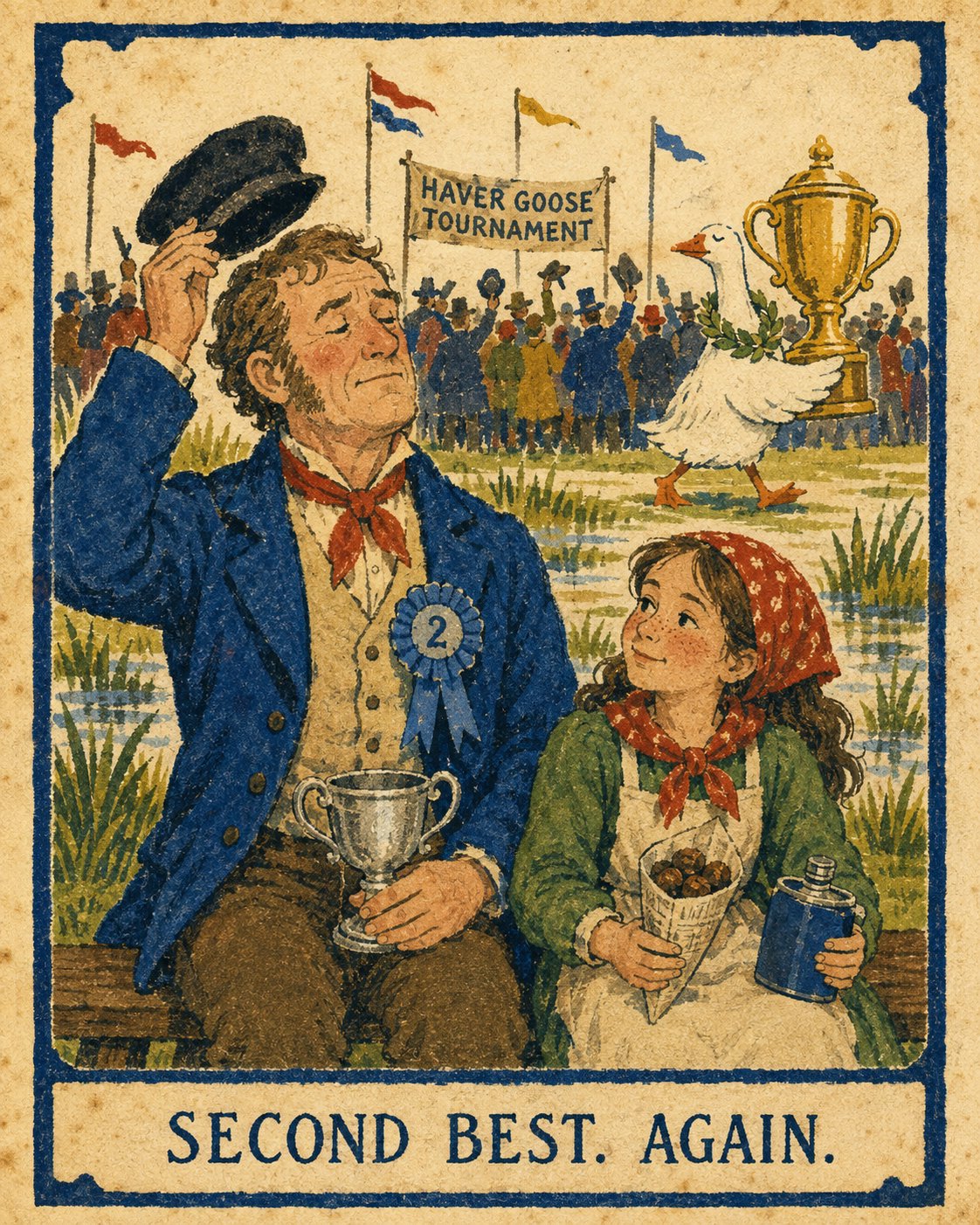
Every child on the Haver ground wants to beat the Goose, and every year the Goose beats them, and most children learn to live with this the way you learn to live with the rain.
Not the Prowse boy. Little Wat Prowse — great-nephew to Aggie, the same mud-and-stone family, the ones who re-lay the Mire Road stepping-stones twice a year — did not want to live with it. He wanted to win. And he did the thing no child had done in a generation, which was to go to Aggie Prowse herself, the only soul in the history of the tournament ever to lead the Goose at the last firm footing, and ask her to teach him how it was done.
Aggie was old by then, and famous, and had a bench on the ground with her name on it that she found embarrassing and would not sit on. She looked at the boy a long while, in the slow Prowse way, hands flat on her knees.
And she said she would teach him. Which surprised the parish, because Aggie Prowse had never taught anyone anything about that tournament and had spent a lifetime declining to discuss it.
She taught him for three springs.
She taught him to read the wind off the west the way she read water, so he would know where the sheaf came down before it was thrown. She taught him to start out on the ground at his own stone instead of at the hedge with the others. She taught him to go through the bog to the knee and haul out and go again without breaking his line, which is the hardest thing on that field and the thing she was best at in the whole history of it.
She taught him everything she knew. And the boy was good — better, at his age, than she had been — and by the third spring he could get the sheaf up and turning before the Goose was properly in the air, and the parish began, very quietly, to wonder.
What she did not teach him, in all three springs, was the last thing. The finish. Where to carry the sheaf. She taught him every yard of that field except the final one, and when he asked about the last stretch — where do I take it, Aunt Aggie, when I've got it and I'm ahead — she only ever said, "We'll come to that."
They came to it in the boy's fourth year, on the ground, in front of eight hundred people, which is how Aggie Prowse had planned it all along, though she never said so.
The sheaf came down where the wind said it would. Wat Prowse had it up and was turning before the Goose left the ground, and he went through the bog the way she taught him, hauling and going, hauling and going, and he was ahead — ahead at the last firm footing, the second child in the whole history of the Haver ground to be there, and the crowd made a noise you could hear at Mucklecombe.
And he stopped. On the last firm footing. Sheaf up over his head. The Goose six inches off the mud beside him doing its flat contemptuous flap. And Wat Prowse stood there, ahead, with the whole tournament there for the taking, and did not know where to run — because his great-aunt had never taught him the last yard.
He looked for her in the crowd. And she was standing at her bench, the one with her name on it, the one that faces the last firm footing, and she was not shouting go. She was just looking at him. And in that long second the boy understood the whole of what she had spent three springs not saying.
He understood that she could have taught him the last yard. That there is a way to beat the rule of 1672, that a Prowse who has thought about that field as hard as Aggie had would have found it, and that she had found it, years ago, and had chosen — every year, on purpose — not to use it.
And he understood why, standing there ahead of the bird with the choice in his hands: that the parish does not need another winner. A hundred parishes have a winner. What this one has, the only one in the realm, is the ground where the best of us comes second to a bird and holds their head up — and that being the person who could have won, and let the crookedness stand, and came second on purpose so the story lives, is a prouder thing than any trophy, and the hardest thing his aunt knew, and the last thing she had left to teach him, and the only way to teach it was to let him find it here, ahead, with everyone watching.
He carried the sheaf to the near hedge. The Goose carried it to the table. The Goose won.
Wat Prowse came second, by the length of a table, the third of his family to do it, and the crowd understood what they had seen, and the noise they made was not for a defeat.
Afterward, Aggie Prowse sat down on her bench for the first and only time anyone ever saw, and the boy sat down beside her, and neither of them said much, in the Prowse way, and then Wat said he thought he could have won it.
And Aggie said, "I know you could. That's why it counts that you didn't."
And they watched the Goose refuse to look at the committee, the pair of them, for a good long while.
Anyone can be taught to win; a hundred parishes teach nothing else. The rare thing — the thing that has to be found standing on the last firm footing with the prize in your hands — is knowing when the crooked, generous, unwinnable thing is worth more than the trophy, and choosing, in front of everyone, to come second on purpose so that something better than you gets to go on living.
Tale 22THE ROSETTE
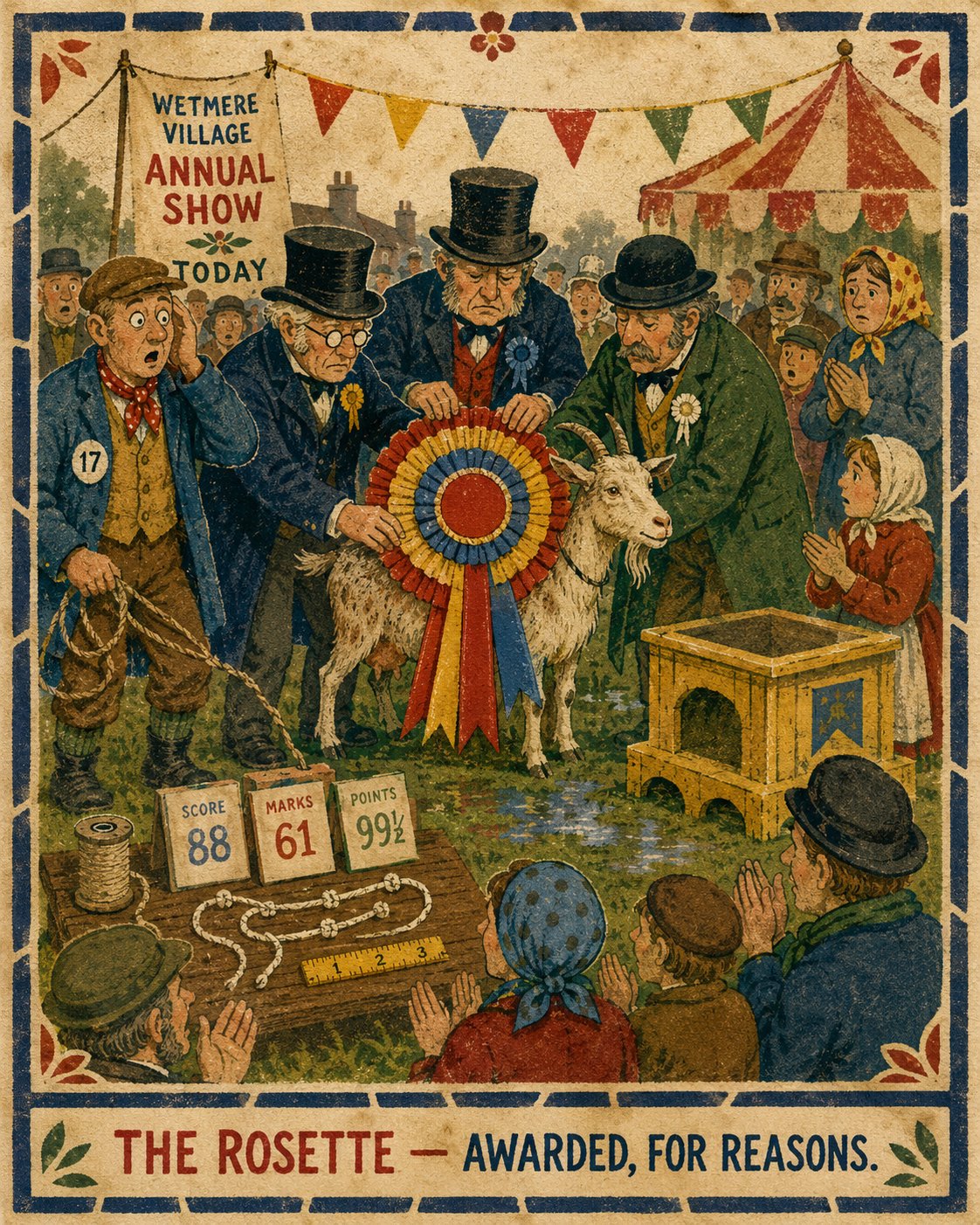
I am a rosette. I was red once. I would ask you to take that on faith, as everyone else has to.
I have been rained on since 1989 — not constantly, but as near to constantly as makes no odds in this realm — and I have been pinned, every day of it, over the heart of Sir Reginald "Reggie" Thwackbottom: the Rt. Hon., the Member for Sogmarsh & the Greater Boglands, the people's champion, the man of the marshes, hand on my heart.
I want to be exact about that last part, because I am the only witness in the realm with the standing to testify. When he says hand on my heart — and he says it the way other men breathe — the hand comes up and lands flat upon me, and I am pressed to his chest, and so I can report to you, under oath, the one fact about Reggie Thwackbottom that nobody else can:
The heart is there. And it beats hardest on the word "honest." Every single time.
I shall let you decide, over the course of this story, what that is evidence of. I have had thirty-odd years, and I am still deciding.
This is the story of the Peatdike election, which we walked to overnight, through a flood, arriving with the dawn and half the river.
You will want to know what was being elected. So did Peatdike. The post was Fen-Reeve — which is the person who decides, when two ditches disagree, which of them is right. It carries no wage, no cottage, and no thanks; it carries a rod, a duty to be stood in cold water while both ditches' families shout at you, and a strong likelihood of being blamed for the weather. It had fallen vacant in the usual way, which is that the last Fen-Reeve had finally got his boots dry and refused, politely and from behind a locked door, to ever get them wet again.
We had heard about it two parishes away. My man can hear a vacancy the way a gull hears a dropped chip.
By the time Peatdike woke, he was up on the back of a borrowed cart in the drizzle, hat in both hands, and I was pinned fresh over his heart — straightened twice, though nobody straightens a rosette for the mud's benefit — and the speech was already at full sail.
I have heard the speech, at a modest estimate, eleven hundred times. It is never the same twice, and it is always identical. It has the origin, the hardship, the triumph, and the vow, and each of them grows a little between parishes, like a marrow.
That morning in Peatdike, he was raised in a caravan on the marsh edge — which is true, and I can vouch for it, and it wants no improving. By the second telling, outside the peat-stacks, it had become a coracle. By the third, at the communal fire, it was the mist itself, and a woman stirring the pot asked, not unkindly, whether the mist had been terribly proud of him, and he said, hand upon me, that it had never once written, and that he had forgiven it — and the whole fire-circle laughed, and he glowed, and took it for support.
He was told at school he would never amount to anything more than a prize-winning leek grower. He tells this one everywhere, as the wound that made him. What he does not tell them — what he has never once told anybody, in eleven hundred speeches — is that the leeks are real, and have won things, and that I have been pinned to his coat at three vegetable shows where he stood beside a leek the size of a rowing-boat oar with his face as soft as I have ever seen it. He thinks the leeks are the failure. He campaigns on the wound and hides the actual medal. I have given up rustling at him about it.
And the limp. The famous limp, the first limp in the realm to stand in every constituency simultaneously. I am positioned, you understand, where I can feel the man walk.
It changes legs depending on which side of the room the voters are sitting.
I do not believe he knows. That is the part I need you to understand about my man, and it is the part nobody in the taprooms believes: he is not lying. I am pinned to the chest of the one man in Sogmarsh who has never once, in my thirty years, said a thing he did not, in the moment of saying it, wholly believe. The limp moves. The caravan becomes a coracle. The heart underneath me bangs like a proud drum on the word "honest." All of it, all at once, all sincere. There is a gentleman in a damp coat who sells property on the same principle, and the two of them once shook hands for a full minute, each certain he had at last met the realm's other honest man, and I felt the heart under me going like a wedding bell.
Peatdike gave us the full day. Peatdike gave us tea.
I must say something about the tea, because the tea is the thing I have never got to the bottom of. In thirty years and — he keeps the count himself, in a wet notebook — four hundred and eleven elections, no door in this realm has ever been shut in his face. The tea is always poured. The chair is always pulled out. The old men walk with him along the ditches and point out the bad culverts as if to a colleague; the children follow the cart; the women at the fire feed him twice and wrap a third portion "for the road." They ask after his leeks. They ask after Kevin, the pike, of whom the less said the better, except that the Labrador has never contradicted the story, which my man regards as decisive.
They love him. I am a rosette; we are manufactured to know a crowd; I am telling you, they love him.
And at the count — which in Peatdike, as everywhere, is counted in boots, not heads: stood in a row outside the meeting-hut, one boot per household, and a man may send his boots if honest work detains him — at the count, when the Fen-Reeve's rod went to its winner, the number of boots stood beside the name of Sir Reginald "Reggie" Thwackbottom, the people's champion, the best-fed man on the fen, the only candidate who had campaigned, the only man present who wanted it —
was none.
Not one boot. Four hundred and eleven elections. Not one boot, ever, anywhere, in thirty years.
The rod went to Jethro Podd.
I want you to picture Jethro Podd, because he is the other half of this story. A peat-cutter. Arms like wet oak. He had not stood for the post. He had, in point of fact, hidden behind the peat-stacks when the nominating started, and been fetched out by his own mother, and he took the oath of the Fen-Reeve in the rain with the expression of a man being measured for something he had specifically said he did not want, protesting quietly all the way through it, while the whole of Peatdike nodded with satisfaction and my man applauded warmly from the back.
That is how it is done here. I have watched it four hundred and eleven times. The parish hunts its officers like a press-gang hunts sailors, and the one man running toward the post with his arms open is the one man the parish steps around, gently, with tea. Nobody has ever explained it to him. Nobody has ever explained it to me, and I have had time to think, pinned out here in the rain, and the nearest I have come is this: the parish can smell wanting the way I can smell rain coming, and it has decided — long ago, in its bones, for reasons it has never had to say aloud — that the wanting and the rod are never to be kept in the same man.
He took it, as he takes all four hundred and eleven of them, with tremendous grace and total incomprehension. He shook Jethro Podd's unwilling hand. He called it "a strong result for the movement." He is the movement. He updated the wet notebook. Moral victory, he wrote. He writes that every time. The notebook is nothing but moral victories and rain.
And then — and here is the part I stay for; here is why I have not let the rust take my pin in thirty years of weather —
on the road out of Peatdike, past the last house, where no voter could see and no vote was left to win, we came upon a parlour with the flood still standing in it, and an old man standing in the flood, bailing, alone, slow, with a saucepan.
And my man stopped the cart.
He took off the good coat — I go with the coat; I was hung on the gatepost; I had the whole of it in view — and he rolled up his sleeves, and he went in, and he bailed that parlour for two hours and ten minutes by the church clock, in his shirt, in the cold, properly, the way a man bails who did twelve years of it for wages: fast at the corners, patient at the hearth, kind to the furniture. He unblocked the ditch outside. He listened to the whole of the old man's account of a stubborn bulrush, and asked a follow-up question, and meant it. And he never mentioned it at the next hustings, and he has never mentioned it at any hustings, not once in thirty years — the one true thing, the thing he is actually made of, the thing every parish somehow knows about him anyway, which is why the tea is always poured.
He campaigns on the mist and the coracle and the limp. He keeps the drainage to himself, like the leeks.
I have decided — I said I was still deciding, but there on the gatepost, watching the saucepan, I decided — that I am pinned to him for good, whatever colour I end up.
We slept in a barn. In the morning he brushed the coat, straightened me — twice — and consulted the wet notebook, where it seems there is shortly to be an election in Sodden Bottom for the post of Warden of the Chapel Bell, the bell being underwater, the wardenship being therefore chiefly ceremonial, the ceremony being therefore, in his words, "exactly where a man of vision can make a difference."
Four hundred and twelve.
Hand on my heart.
The moral, from the gatepost: a parish is wiser than it can say — it will pour tea for a man's true self and vote for it never, and both of these, together, are how it loves him. And if you must be made entirely of wanting, want the way Reggie Thwackbottom wants: out loud, in the rain, forever, with your hand on your heart — and do your real good on the road out of town, where nobody is counting. The heart, I can report, is there. I have felt it. It beats hardest on the word "honest." I no longer believe that is a lie. I believe it is a vote — the one vote he has ever won, cast daily, from the inside, and counted by nobody but me.