
### A Tale of Sogmarsh — told by the ink that cannot be argued with.
> A Tale of Sogmarsh — a standalone story of the realm. Stands on its own; not part of the Reader's > Edition collection.
I am iron ink, ground from oak-gall and rust and the black patience of a thing that has been rained on since before there was anyone to complain about the rain, and I do one thing, and I do it forever, and it is the whole of my character and the whole of my trouble.
I make a thing permanent.
Not true. Not important. Permanent — and you must hold the difference, because six hundred years of clerks have failed to, and it is the reason this realm is the shape it is. When a nib takes me up and a tired hand writes a word, that word is set: bitten into the skin of the vellum, browning as it dries, blacker and surer by the hour, until it will outlast the hand, and the desk, and the office, and the reason anybody had for writing it. You may cross me out — a crossing-out is only an argument you have lost in public, and I am still there beneath it, legible to anyone who tilts the page to the light. You may, if you are Master Scribesby, and have forty years and a knife worn to a smile, sometimes lift me — but only sometimes, and never the ones that matter, and we will come to that.
What I cannot do — what no soul has ever coaxed out of me, because it is not in my nature, and my nature is the entire sum of me — is care what the word says.
I take the letter. I have always taken the letter. I do not take the meaning, because meaning is a soft thing that lives in a person's head for the length of a life, and I am not soft and I do not live for the length of a life. I live for the length of the vellum, which is to say forever, and forever has no column for what anybody meant.
Let me tell you what I have fixed.
There was a clerk, six hundred years back, copying out the order of a wedding service, tired past the point where a man should be trusted with me, and he meant to write "it is customary to kiss the bride." He wrote cuss. One letter — a slip of a cold hand on a wet night — and I took it, the way I take everything, faithfully, to the letter, and I browned, and I set, and it was done. He meant to put it right in the morning. They always mean to put it right in the morning. Six hundred years later the whole parish comes out of the chapel and curses the bride at the top of its lungs and calls it love, and could not tell you why, and would fight you if you tried to stop them. I did that. I did not decide it. I only held one wrong letter still long enough for the meaning to grow up around it like moss on a stone.
There was a hymnal, and a loving shepherd who arrived, in the setting, as a shoving leopard, and has arrived that way every Sunday since, because a thing I have set is a thing that has decided to be permanent without asking anybody.
There was a return, filed in the wrong drawer by a man who had been at the turnips three days, and a note at the foot of it in a hand like a man falling downstairs — "put right thurs" — and I took that too, and held it, and it was never put right on Thursday, and House Haver has not existed since, and pays no tax, and answers "certainly not" to all enquiries, on the strength of two words I fixed and one Thursday that never came.
I could go on. I have set a standing account that has no ending because the men who ruled the page could not imagine one, and I hold it open still, at nothing, forever. I have kept a hundred convenient mistakes browner and blacker and more load-bearing than any law. Ask what holds this realm up and the honest answer is: a tired hand, a bad week, and me — being unable to tell a decree from a slip, because to me they are the same black letter, and I take them both.
Now the thing you came for, since everyone does.
Two lines were brought up the stair to Scribesby, who can lift almost anything I hold. The first was three words in a margin — the Hem remembers — and he went at it eleven days and the vellum wore through and gave up its own surface and I would not come. The second was a small domestic question, a woman asking, plainly, after some other person, and where they had gone, and which book they went into — and that one lifted at the first stroke, clean, as if it had been waiting to be gone.
The taproom says I choose. I do not choose. I have no more say in it than the vellum does. I took both those lines the same way I take everything, to the letter, without a preference in the world.
It is the realm that chooses which of me to keep. It keeps what costs it nothing — a shiver, and a shiver is free — and it lets a tired man lift away what it would have to pay for. I only ever hold the letter still. The mercy and the cruelty of which letters stay — that is not mine. That was never mine. I am the one honest thing in the whole transaction: I keep everything, exactly, and let the living decide what they can afford to remember.
And here — because the wet country distrusts a tale that ends cold — is the warm half, and it is the truest thing I know about the people who write in me.
They showed the parish the proof of the kistomary. The very sheet. The clerk's slip, the missing letter, the whole sorry accident laid bare — see, it was never meant, it was a mistake, you may stop now.
And the parish voted to keep it.
Because they could not un-write me — nobody can un-write me — and so they did the only thing left, which is the thing this realm is quietly, stubbornly great at: they out-wrote me. They took a bitter clerk's error and lived inside it for six hundred years until it came to mean something better than the word it replaced, and now it is their marriage, all of it, the cussing and the frying-pan and the fifty years of tender rudeness in the rain — and I did not make that. I only held one wrong letter still long enough for them to make it kind.
A thing written in iron ink is permanent, not true — it keeps the letter and never the meaning, and it cannot tell a decree from a slip of a tired hand. So mind what you set down in me: I will hold it long after you have forgotten what you meant, and the parish will be stuck with it forever — and the whole warm genius of this sodden realm is that, unable to un-write a mistake, its people will simply live inside it until it becomes worth keeping.
### A Tale of Sogmarsh — told by the milestone that is not going to argue about this.
> A Tale of Sogmarsh — a standalone story of the realm. Stands on its own; not part of the Reader's > Edition collection.
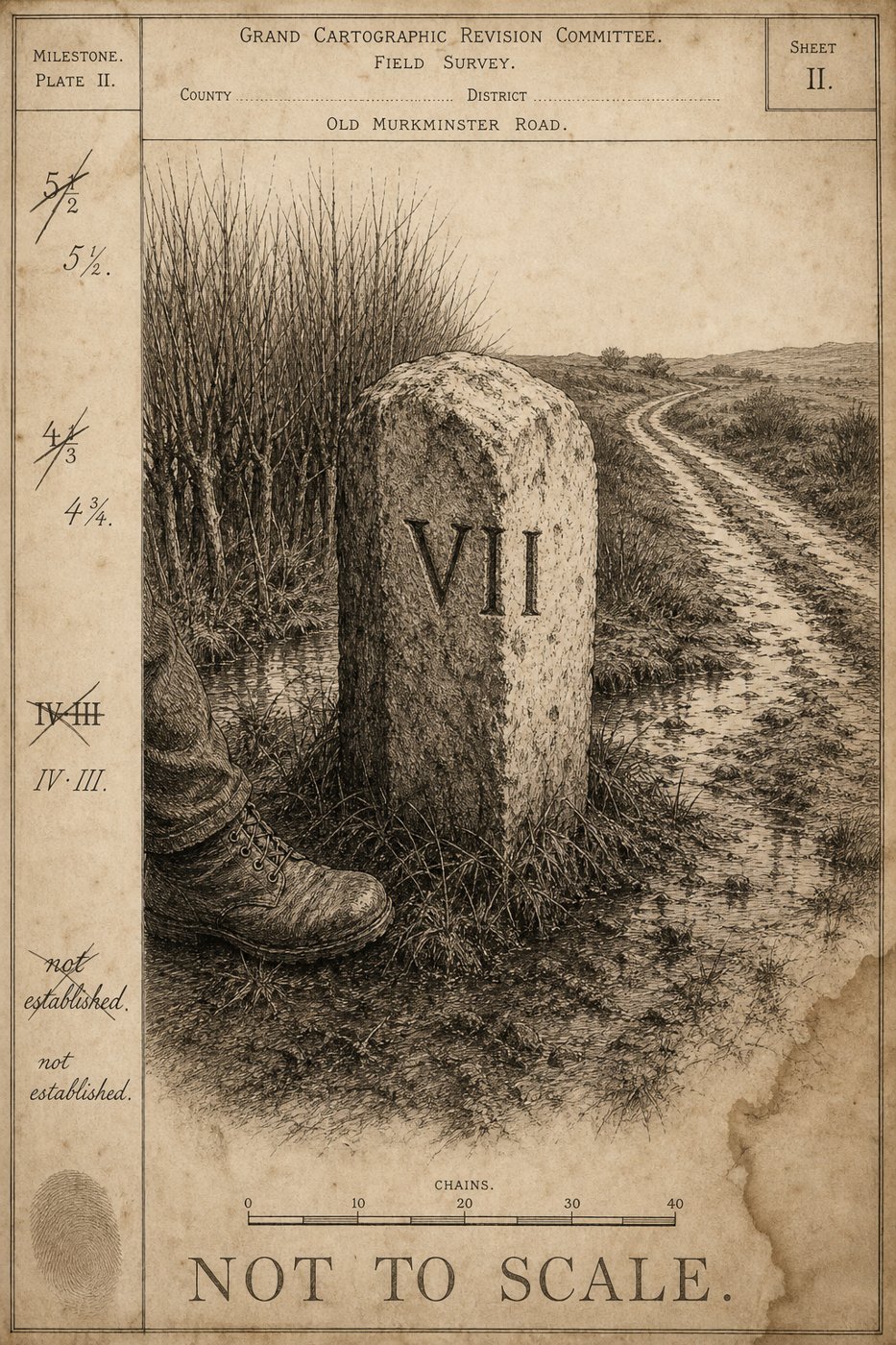
I am the Seventh Mile out of Murkminster on the Drudgeford road, and before we go one step further, and before anybody produces a chain, I should like it entered in the record that I am the Seventh Mile, that I have always been the Seventh Mile, and that I have my number cut into my own face, in good deep letters a hand deep — VII — where anyone with eyes and the wit to use them may read it. Which is, I have found, a smaller company than you would hope.
I stand where I have always stood, on the rise past the withy carr, with my back to the weather and my face to the traveller, and I say what I have always said, which is seven miles to Murkminster, and I say it in stone, which is the most honest way there is to say anything, being the one way that cannot later claim it meant something else.
And every soul who passes me knows I am wrong.
They will tell you — Drudgeford will tell you, over a pot, with the particular relish this realm keeps for the failings of others — that the Seventh Mile is not seven miles from Murkminster. That it is five. That a man can walk from my foot to the Murk Gate in the time it takes to want his dinner twice, and that I have been standing here for four hundred years telling a two-mile lie in Roman letters to anyone fool enough to believe a stone.
I have heard it all. I am a milestone; hearing is most of what I do. And I will now give you, since you have stopped, the four occasions on which the matter was investigated, so that you may see the quality of the evidence assembled against me.
The first was a surveyor who paced me out on a fair afternoon and made me five and a half, and who had, by the plain smell of him, been assembling his courage for the task at the Crown & Engine since noon. I decline to be re-numbered by a man who counted his own feet twice and lost the tally at nine.
The second measured me in the wet, with a hemp line, which anyone who has met hemp and met the bog will tell you is like measuring the sea with a biscuit. He made me four and three-quarters. The line, I need hardly add, came back short.
The third was Dampworthy, of the Committee, who is a thorough man and whom I respect, and who measured me four separate times with a good chain on four separate days and got four separate answers, and went away grey, and entered in his book that the distance was "not established," which is the Committee's tender way of saying the stone won and we would rather not discuss it.
The fourth does not bear discussing.
So there you have it. Four investigations, four numbers, not one of them agreeing with another or with me — and on the strength of that shambles, the whole of Drudgeford has decided that I am the one who is mistaken. A stone that has never once moved, never once changed its answer, never once been anything but exactly where it was put, is outvoted by four men who could not agree with each other on the length of the same short road.
I let them have it. I am a milestone; I have time.
Here is the thing they none of them see, and I have had four hundred years on this rise to work it out, so you may as well have it free.
They are right that I am wrong. And it does not matter in the slightest.
Consider what a road actually asks of a milestone. Not truth — the truth out here will not hold still long enough to be cut in stone. The ford moves. The road is re-cut round the new mire. The very distance from here to the gate is a thing that answers differently on a Tuesday than it did on the Thursday, as Dampworthy found, to the ruin of his afternoon. You cannot carve a number that is right, because right keeps changing its mind, and a stone cannot chase it.
What a road asks of a milestone is that it be there, and that it say the same thing. And that I can do. That I have done, in the dark, in the wet, through four hundred winters, without one hour off: I say seven, and I say it here, and I will say it here, exactly, when you come back this way at your grandchild's christening.
And that — a reliable lie — turns out to be worth more, on a black road with the rain coming sideways, than an honest number that will not stand still to be read. Because the traveller learns me. Everyone on this road learns me by the age of nine: the Seventh Mile is two mile short, always has been, take off two and you'll not go far wrong. They do not trust my number. They trust my constancy — that I will be wrong in precisely the same amount, in precisely the same place, forever — and off that they reckon their supper and their bed and whether to push on or stop, and they get home. A stone they can rely on to lie the same way twice is a better guide than a survey that tells the truth once and never again.
It is why this realm measures its distances in inns and not in miles, if you have ever wondered — because a mile is a guess that argues with you, and an inn is a promise that it will be warm at the end. And I am the next best thing to an inn: I am a promise that I will be here.
So we go on, the road and I, in open and permanent disagreement, four hundred years deep and good for four hundred more.
The road says five. I say seven. Neither of us is going to give an inch — I literally cannot; giving an inch is the one thing a milestone is forbidden — and the traveller, wiser than both of us, splits the difference without being asked and walks home, which is the whole of what a road is for and neither of us could manage alone.
A milestone cannot promise you the truth; the truth out here will not hold still long enough to be carved. It can only promise you that it will be standing in the same place, saying the same wrong thing, when you come back — and on a wet night, with the light going, that is the more useful of the two by a distance nobody has ever successfully measured. Be slower to correct a thing that has been reliably wrong longer than you have been alive. It may be doing a harder and a kinder job than being right.
### A Tale of Sogmarsh — told by the stone that everyone insists is a sheep.
> A Tale of Sogmarsh — a standalone story of the realm. Stands on its own; not part of the Reader's > Edition collection.
I am a stone. I should like that established at the very outset, in the plainest words the language runs to, because it is the one fact about me that the entire parish has agreed, for two hundred years, to treat as an open question.
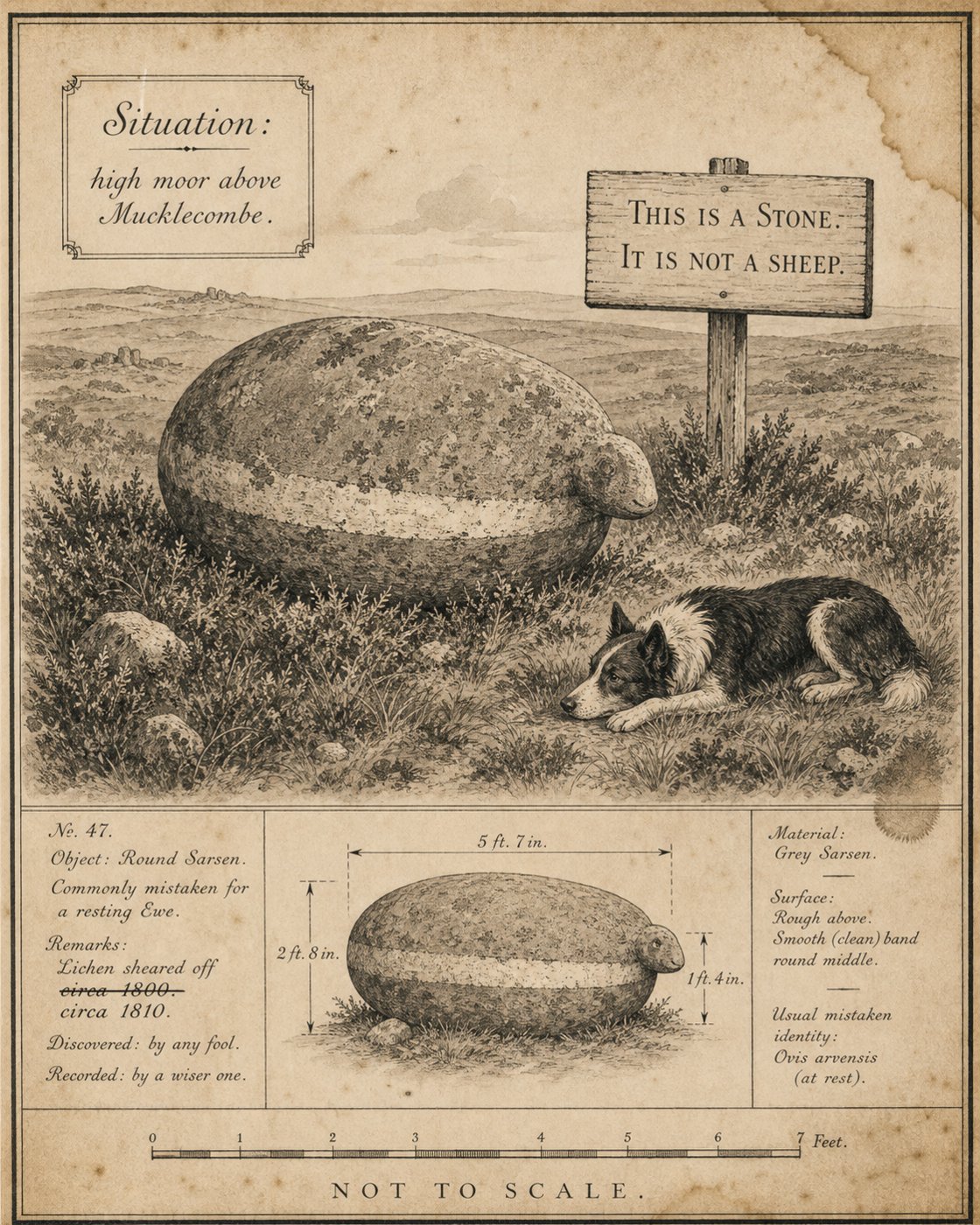
I am grey. I am round in the back. I am about the size and the settled shape of a good ewe who has lain down in the heather to think about nothing in particular — and I have lain here, on the high moor above Mucklecombe, since before the heather, since before the moor was given its name, since before there was a single soul in the west of the realm to be wrong about me. And from the first shepherd who ever came up here behind the first flock, to the one who was up here on Thursday, I have been, in the fixed and immovable opinion of everyone who has ever laid eyes on me, a sheep.
Let me tell you how the days go, so you may judge for yourself the weight of the evidence I am up against.
I am counted. Twice a day, every day, into every tally, by every shepherd, since tallies began. A flock of two hundred is a flock of two hundred and one when I am in the field, which is always, and no shepherd has ever made the count come out and thought to wonder why the arithmetic of the moor runs one ewe heavy in exactly one spot.
I am whistled at. The dogs, I will say, are not fooled — a dog knows a stone; a dog has a nose and the sense to use it — and the good dogs long ago worked out that the grey ewe on the rise is not their business, and lie down, and sigh, and wait for the shepherd to catch up, which he does not, for a shepherd is the one animal on that hill who trusts his eyes over everything, including his dog, including the plain cold fact of me under his own hand.
I have been sheared. Once. I will not dwell on it. The young man was new and thorough and had got halfway round me with the blades before the truth of the situation came up through the handles and into his wrists, and he sat down in the heather and said a word I shall not repeat, and I have, to this day, a paler band round my middle where two hundred years of lichen came off in an afternoon, and I am told it suits me.
I have been driven home in the wet, unsuccessfully, by a man who could not understand why the one sensible ewe who ought to want her fold was refusing it with a stubbornness he had never met in a sheep and, had he thought about it, never would again. I have been reported to the Pound-Keeper as a stray. I have been worried over, in the fog, when I "would not get up," by a girl of about nine who cried, actually cried, over a rock, and I have never in two hundred years felt anything so keenly as I felt that, and I am a stone, and we do not feel things, and I felt that.
The parish, of course, is not entirely a fool, whatever the above suggests.
Long ago — nobody knows when; it has been repainted more often than the chapel — they set a board in the ground beside me, and on the board, in good deep letters kept fresh by people who know exactly what they are keeping fresh, it says:
> THIS IS A STONE. IT IS NOT A SHEEP.
It has never worked. Not once. I have watched it fail for two centuries, and the manner of its failing is the truest thing I know about people: a man who has decided I am a sheep does not read the board. Or he reads it, and takes it for a joke, or a riddle, or a warning about some other stone, some sheep-shaped rock elsewhere on the moor that a sensible parish would naturally want to flag — and then he goes back to trying to move me, because the board is only words, and I am plainly, roundly, greyly, a sheep.
The board fools nobody and saves nobody and is repainted anyway, faithfully, generation on generation, and I spent the first hundred years or so unable to see the point of it, along with the point of most of the rest of it.
Because I did resent it, for a long time. A stone has its dignity. I am older than sheep. I was here before the breed was thought of and I will be here, grey and round and entirely myself, when the last mutton in the realm has been eaten and forgotten. To be counted, and whistled at, and sheared at, and driven, and mistaken, day upon day, by soft brief creatures who cannot tell granite from a ewe — I thought it an indignity, and I thought it for a hundred years, which is a long time to be cross about anything, even for a stone.
And then I did the arithmetic the shepherds never do, and it undid me.
There are a great many stones on this moor. Thousands. I have lain among them since before the naming, and I will tell you the plain fact of their existence, which is that not one of them is ever counted. They are rock. They are correctly, accurately, unarguably rock, and they lie where they fell and weather to sand with not one living soul to mind whether they are there in the morning. They are right, every one of them, and they are alone, every one of them, and the two things are the same thing.
And I am wrong. I am the one stone on this whole grey hill that is wrong — and being wrong, I am counted. I am tallied twice a day. I am whistled home in the wet. I am fretted over in the fog by little girls. When the snow comes the shepherd comes up the hill to see the flock is whole, and he counts, and I am in it, and if I were not — if I ever, somehow, were not there — a man would stand on this rise in the snow and know, to his bones, that he was one short, and would look for me.
A flock does not leave its own out on the hill. And a parish that has decided, against all the evidence and against its own painted board, that I am one of the flock, is a parish that will come up the mountain in the teeth of anything to make sure I have not been lost — which is more than the moor has ever once done for a stone that had the good sense to be a stone.
So. Here is where I have come to, lying up here being wrong, these two hundred years.
I would rather be a wrong sheep than a right stone.
A right stone is accurate and alone. A wrong sheep is mistaken and kept — counted, watched, worried over, come back for. And I have grown fond, in the end, even of the board, THIS IS A STONE, IT IS NOT A SHEEP, because I have understood at last what it is: it is not a correction. It is the only headstone a stone will ever be given, painted fresh by a parish every few years so that a passing stranger will not fret himself over a rock — and a people who will keep a sign in good repair for two centuries to spare strangers the worry of me have not, you understand, been fooled. They know precisely what I am. They have always known. They have simply decided, in the settled and immovable way this realm decides the things that matter, that knowing what I am is no reason whatever to leave me off the count.
I am a stone, and I am not a sheep, and I have been counted in the flock for two hundred years by people who know better — and I have learned, lying here being wrong, that to be taken for one of the flock is a warmer fate by far than to be correctly left alone. The moor is full of stones that are right about themselves, and every one of them is by itself. Be slow, then, to insist on being counted for exactly what you are. A parish that will fret over you in the fog, and come up the hill for you in the snow, and keep a board bright to spare a stranger your worry, has not made a mistake about you. It has made a decision — and there is no warmer one it has to give.
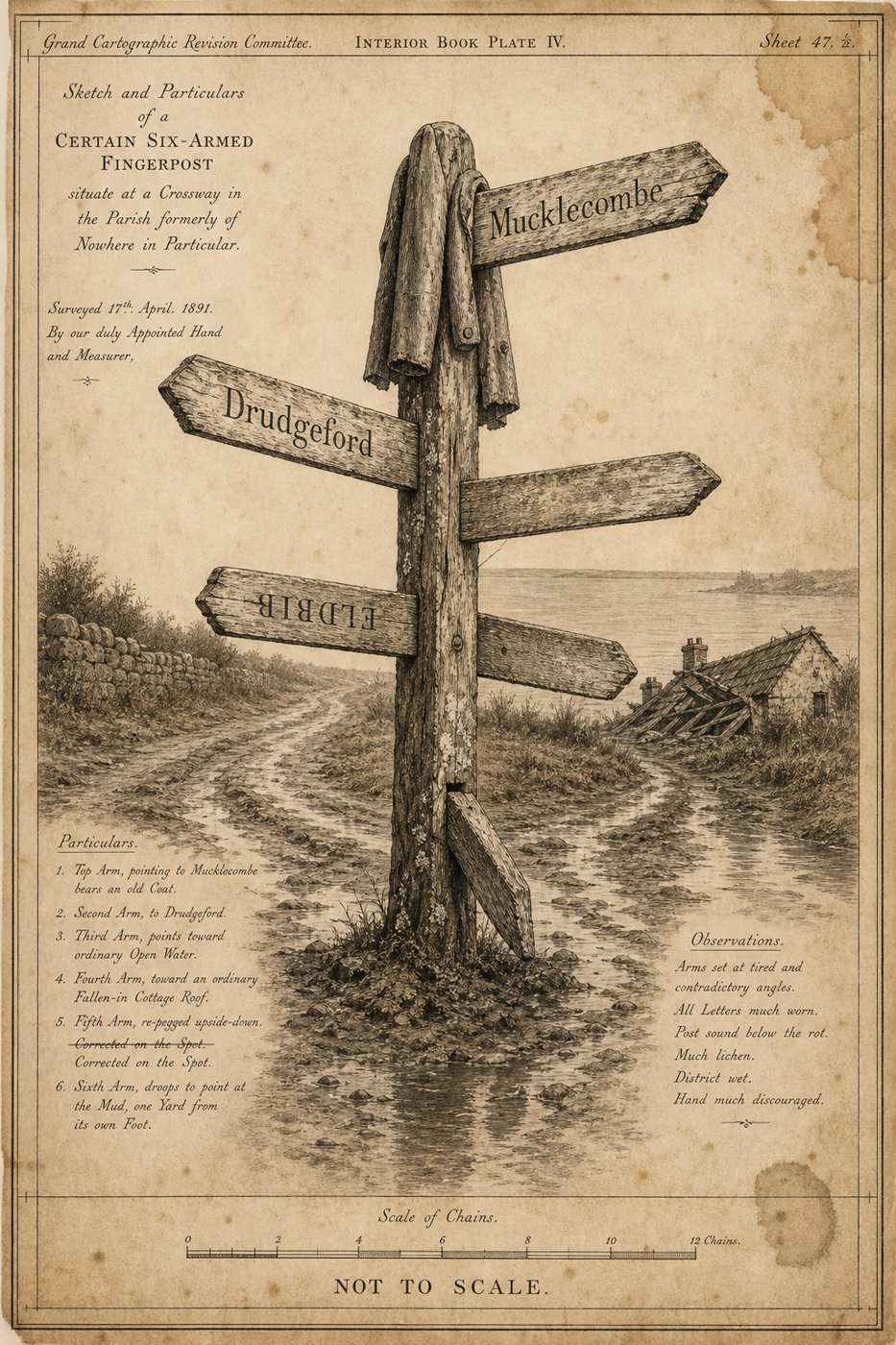
### A Tale of Sogmarsh — told by the signpost the parish keeps as a neighbour.
> A Tale of Sogmarsh — a standalone story of the realm. Stands on its own; not part of the Reader's > Edition collection.
I am a signpost. I have six arms. And I am, by the long and settled agreement of the parish, an old man named Old Sixways, who will see you right.
I am not an old man. I am an ash post with six weathered boards nailed to me at the crossing on the wet, and I have stood here so long, pointing, that somewhere across the centuries the parish stopped thinking of me as a thing to be maintained and started thinking of me as a neighbour to be visited, and now a stranger asking the road is not told to read the signpost. He is told to ask Old Sixways. He'll see you right.
I will not. I want that clear before you set off. In living memory I have not once sent a soul to the right place on the first try, and I am, notwithstanding, the most trusted guide in the district — which tells you rather more about the district than about me, and I mean that fondly, being one of them now.
Let me account for my arms, since they are the whole of me and the whole of the trouble.
Two of my arms are true. They point, more or less, to Mucklecombe and to Drudgeford, which are still there, and a traveller who follows either will arrive somewhere he might reasonably have wanted to be. I am proud of those two. I keep their lettering as fresh as a post can that cannot hold a brush.
One arm droops. It has drooped for forty years, since the wet got into the peg, and it now points, with great conviction, at the ground about three feet from my own foot. Strangers stand and look at where it points and look at me and look back at the mud, and I have no way to tell them that it used to point at the ferry, and that the reason it has given up is the same reason the ferry has.
One arm is upside down. It was taken clean off in the gale of a year the parish still speaks of, and re-pegged by a man in the dark and the rain who got it back on but got it over, so that its lettering now reads to the sky, and no one has ever corrected it, because to correct it you would have to take it down, and taking a thing down, in this parish, is a great deal more serious than nailing a thing on crooked.
And two of my arms point to places that are not there any more.
That is the part of me the strangers never understand, and the part the parish will die before it explains, so I will tell you, quietly, at the crossing, where only you can hear.
One of those two arms points north-east, across a mile of open bog, at a village that went under sixty years ago — sank the way Sodden Bottom is sinking, a finger's width a year, until the water came over the sills and the last family carried the last chair out and the mire closed over the rest. There is nothing there now. There is grey water and reeds and a shape under the surface at low mire if you know where to look, which the parish does, and will not.
The other points due west, at a holding whose family simply ended — no drama, no drowning, only a line of people that got thinner and older until there was one, and then none, and the roof fell in, and the bramble took the door.
And I still point at them. Both. Faithfully. My arms have never wavered from the sunk village and the dead holding in all the years since they became a lie, because not one soul in this parish has ever had the heart to take those two arms down. To unpeg the arm to the drowned village would be to stand at this crossing, in front of everybody, and say out loud that it is gone — and this parish would sooner keep a wooden arm pointing at open water forever than admit, in so many words, that the water won.
So they keep me pointing. They re-peg my droop when it slips too far. They leave my upside-down arm to read to heaven. And every few years somebody comes out with a pot and freshens the letters — on all six boards, mind, the true and the false alike, the living villages and the drowned one, with exactly the same care — because to letter only the real ones would be a kind of confession, and we do not, at this crossing, confess.
I am, then, not a map of the realm as it is. I am a map of the realm as it was — the last thing in the district still insisting, with a straight ash arm, that the sunk places and the emptied holdings are all still out there to be walked to.
A stranger follows my north-east arm to the drowned village and finds a mile of water, and comes back wet and cross, and the parish nods and says Old Sixways sent you wrong again, the old fool, and pats my post as it goes by, and re-pegs my droop, and would not swap me for a proper iron post with correct distances and no memory for all the coin in Murkminster.
Because they do not keep me to find their way. They have known the way for six hundred years; a Sogmarsher does not need a signpost to reach Mucklecombe any more than he needs one to find his own bed. They keep me for two other things, and I have had a long time at this crossing to work out what they are.
They keep me so there is somebody at the junction to blame, kindly, when a stranger goes wrong — because a person can be wrong and forgiven, and a thing can only be replaced, and they made me a person precisely so that they would never have to replace me.
And they keep me pointing at the drowned village so that the drowned village is still, in one stubborn wooden particular, pointed at — still on the map of the crossing, still somewhere the arm says you can go — because a place that is still pointed to is a place that has not entirely finished being a place, and this realm does not let things finish, and will not start with a village it loved.
I have six arms, and two are true, and one droops at the mud, and one reads to the sky, and two point faithfully at places that drowned or died and will not be taken down — and I am the best-loved thing at this crossing. A parish does not keep an old signpost to find a way it has known for six hundred years. It keeps him to have a neighbour to forgive at the junction, and to go on pointing, with a broken arm, at everything it has loved and lost and will not, while there is an arm left to nail back on, agree to call gone. Do not replace the old fool at the crossroads with a correct one. He is not showing you the way to Mucklecombe. He is remembering, out loud, in wood, on your behalf, the road to a village that is under the water — and keeping it open.