The Quiet Trades
The Tales
Tale 62THE SMALL BEER

The Ale-Conner's whole office is honesty. He puts on the leather breeches, he pours the ale on the bench, he sits in it in his own trousers, and if the ale is sound he comes unstuck clean, and if it is bad — too much sugar, hurried, false — he sticks fast, and the batch is condemned, and there is no arguing with a man glued to a bench by the truth.
Corvin Stannard had done it thirty years and never once bent it. That was the whole of his good name and he knew it and he guarded it the way a poor man guards the one thing he owns outright.
Which was the trouble, the afternoon of the Dellow batch.
Everyone in the ale-house knew it was sour before he sat. You could smell it from the door. And everyone in the ale-house knew whose it was — the Dellow widow's, her first brew alone, her whole quarter's barley in it, sugared too hard because she was frightened and had not learned yet that fear is the thing that spoils a brew faster than any weather.
Condemn it and the barley was gone and the winter with it. Pass it and thirty years of honest was gone, and a false word from Stannard was worth less to the parish than a whole cellar of bad ale, and he knew that too.
He poured it. He sat. The room did not breathe.
And he stuck fast — of course he stuck fast, it was dreadful — and he sat there glued to the bench in front of the whole parish, and he did not say condemned, and he did not say sound, and the silence went on long enough that people began to look at the floor.
Then he found it. The thing he had known was in the law for thirty years and had been too proud to ever need.
The statute says the Ale-Conner judges whether ale is sound. It does not say the ale is for selling. There is an old word, from the days when a household brewed small beer for its own table and no one's — table-ale — and table-ale the Conner does not condemn, because it was never offered to anybody; he only advises the household, quietly, on the mending of it.
"This," said Corvin Stannard, unsticking himself with as much dignity as a man can who has just been glued to furniture, "is not for sale. This is table-ale." He turned to the widow. "It's sugared and it's hurried and it's the fright, not the barley. Cut the sugar by a third, brew it cool, and let it be. The barley's good. You're not the first to be frightened of your first."
And he wrote in his book, in the honest hand he had kept honest for thirty years, table-ale, advised — which was true, every word of it, and condemned nothing, and sold nothing, and cost him not one letter of his good name.
The widow brewed it again in the spring, cool, and it came off the bench clean, and Stannard drank the first cup standing, in front of everyone, which is not in the office and which he did anyway.
The honest are not people who never find the loophole. They are people who spend thirty years refusing to look for one — so that the day they finally need it, and reach for it, the whole parish knows it must be a true door, because that man has never in his life gone through a false one.
Tale 67IS THERE TEA?

There are, in the calendar of Sogmarsh, perhaps six afternoons a year when it does not rain, and the parish has an arrangement for every one of them, and the arrangement is called Tea Weather.
You must understand the mechanics first, because the mechanics are the whole of the comedy. This is a wet realm. Roofs are thatch, thatch rots, and thatch can only be re-reeded dry — so a thatcher spends eleven months of the year unable to do the one thing he is for, and then the sun comes out, and every thatcher in the district goes up. Up onto the roofs, in the rare warmth, and — because it is warm, and because reeding is hot work, and because a man cannot swing a leggett in a good coat — in his shirt.
And the lane, which on any ordinary day is empty because everyone is inside keeping dry, discovers, all at once, that it has a very great deal of doorstep-sweeping to do.
This is the point at which a coarser realm would be coarse about it, and Sogmarsh is not, and the not-being-coarse is exactly what makes it a Tale.
Because what actually happens on a Tea Weather afternoon is this: the women of the lane come to their doors, with their tea, and they look. At length. Openly, but not — and this is the fine distinction the whole parish observes without ever once stating — not rudely. A woman on her own doorstep, with a cup in her hand, watching a young man re-reed a roof in the sun, is doing nothing whatever that anybody could name. She is having her tea. It is her doorstep. If her eyes happen to travel upward, well, that is where the roof is.
The tea is the alibi and the tea is the point. You cannot stand in a doorway doing nothing — that is loitering, and a Sogmarsh woman would sooner drown than be caught loitering. But you can always, at any hour, in any weather, be having your tea. The cup makes the whole thing decent. Remove the cup and it is ogling; add the cup and it is a break. The realm that invented deniability out of a filing system invented it here too, out of a kettle.
Widow Marle, that particular afternoon, cleaned the same step four times. It had been clean since Monday. She knew it was clean. Everybody knew it was clean. But a step, unlike a woman, may be attended to indefinitely without comment, and so the step got attended to, and the Rennie boy got re-reeded, and the tea got drunk, and the afternoon was, by the standards of the realm, thoroughly enjoyed by all.
Now. Here is the tale inside the custom, and it turns, as everything in this realm turns, on one small unbreakable rule.
You may look. You may not offer the cup.
To carry your tea out — across your own threshold, down the path, up to the foot of the ladder, and hold it up to the man on the roof — is not a kindness in Sogmarsh. It is a declaration. It is done in front of the entire lane, which is watching, which is always watching, and everyone in that lane knows exactly what it means, and so does he, and so, the moment the cup leaves the doorstep, does everyone's mother.
It is the boldest thing a Sogmarsh woman can do sober, and it is done perhaps twice a decade, and it is never, ever done lightly, because there is no taking a cup back.
The afternoon of this tale, it was done by Alma Crouch.
Alma Crouch you may know, if you know the parish, as one of the two shyest people in it — she and Tibb Sennet having been walked out, years back, by the whole village pretending to run errands, because left to themselves the pair of them would have looked at each other across a lane for the rest of their natural lives and called it courtship.
They were long married by the Tea Weather of this tale. And that is the thing that makes it a good tale and not merely a sweet one: it was not a young girl declaring herself to a stranger. It was a married woman of some years, watching her own husband — who thatches, in season — up on the Sennet roof in his shirt, in the one warm week of the year.
And Alma Crouch, who had never in her courting life been able to say a forward thing out loud, stood in her doorway with her tea, and looked at the man she had somehow, against all the odds of two shy people, ended up married to, and thought — the lane agrees she must have thought something, from what she did next — I never once told him. The whole parish told him for me. I never got to.
And she put down her own cup. And she made a fresh one, properly, the way you make it for somebody. And she carried it out — across her threshold, down her own path, in front of the whole watching lane, to the foot of her own husband's ladder — and held it up, and said the words that are the plainest love a Sogmarsher will ever speak, which are not I love you, which no one in this realm has ever managed, but:
"Is there tea? There's tea."
Tibb Sennet came down off that ladder so fast he took a yard of reed with him.
The lane, to its eternal credit, looked very hard at its own doorsteps and saw nothing at all. Widow Marle cleaned her step a fifth time with tremendous concentration. Nobody said a word, then or after, because to remark on it would have been to have seen it, and the whole architecture of Tea Weather depends on nobody having seen anything.
But it is in the parish now. Alma Crouch carried the cup out to her own husband, in front of everybody, after all those years, because the village did her courting for her and she wanted, once, to do a bit of it herself. And when a Sogmarsh woman wants to say the largest thing she has, and cannot find the words, because the words were never given to her, she still, to this day, in that lane, makes a fresh cup, and carries it out, and says the only words the realm has ever trusted with the weight.
In a realm too shy to say the word, tea is the word — the cup on the doorstep is a look, and the cup carried out is a vow, and a whole parish has agreed, without ever admitting it, that "is there tea?" may be made to mean "I have loved you the entire time and never once got to say so." Offer it carefully. There is no taking it back, and in Sogmarsh, that is precisely what makes it worth offering.
Tale 68THE PASS-AROUND

The Pass-Around is the parish's own newspaper, and there is one copy.
Not one copy per household. Not one copy a week. One copy. It is hand-copied, by whoever holds the pen that season, onto a single folded sheet, and it goes from house to house, a day at each, and when it has been to every house it comes back and is copied out fresh and goes round again. It has a masthead, a problem page, a serial, a quiz, and a circulation, as the archivist has noted with some wonder, of exactly one — and a readership of the entire district.
You get it for a day. You read it — all of it, aloud, usually, to whoever is in the kitchen. You mind the corners. And you pass it on, to the next house on the route, by the next morning, without fail, because a periodical kept is a periodical killed, and the whole thing only works if it keeps moving.
That is the Pass-Around as everyone knows it. And, exactly like the parish bucket and the pound book and the register of arrivals, it is secretly something else entirely, and the something else is the reason it has run, unbroken, for longer than anyone can say.
Consider what a single copy on a fixed route actually is.
It is a thing that must arrive at every house, every cycle, and be passed on the next day. Which means somebody — the parish always has a somebody — knows the route by heart, and knows exactly how long the sheet should take, and knows, therefore, the instant it goes slow.
And a house where the Pass-Around goes slow is a house where something is wrong.
Not always something dramatic. A sheet that sits two days at the Hobys' meant Nan Hoby's eyes had got too bad to read it and she was too proud to say, and the next cycle it was copied out in a larger hand, by nobody who admitted to it, and nobody ever mentioned the hand, and Nan read it easily for another eleven years and went to her grave thinking the pen had simply got bigger.
A sheet that skips a house entirely — that the next reader receives without its having been to the Dellows' at all — meant the Dellows had stopped answering the door, and the sheet's own route had noticed before the vestry had, because the sheet's route notices everything, being obliged by its nature to knock on every door in the district in strict rotation and wait to be let in.
The Pass-Around is the most complete census of who is all right that the parish possesses, and it compiles itself, daily, by the simple mechanism of needing to be handed on.
The person who ran the route, in the season this tale is about, was a girl of about fourteen called Peta Rennie — of the thatching Rennies, reed-cutters and roofers, which is half the families on the wet edge of the parish and the reason the other half have roofs.
Peta did not run the route officially. Nobody runs it officially; there is no office of Pass-Around Warden, the parish having learned long ago that the moment a kindness has an office it stops being a kindness and starts being a duty nobody wants. She simply minded it — kept the sheet moving, chased it when it stuck, copied it out when her turn came round — the way half the useful things in the realm are done, by somebody who never quite decided to and cannot now be got to stop.
And one wet Arrears, with the reed-cutting done and the roofs all on and the whole family idle and short, Peta Rennie noticed the sheet had gone slow at the Beake place. A day slow. Then two.
She knew the Beakes. Everyone knew the Beakes — a big family, always just managing, the father a reed-cutter like her own, and reed-cutting is a summer trade, and it had been a poor dry season, and a poor dry season means poor reed, and poor reed means a thin winter for the men who cut it. She knew all that the way you know your neighbours, which is to say completely and without ever discussing it.
So she did not go and ask if anything was wrong. You do not, in Sogmarsh, ask if anything is wrong; asking is how you make a proud family lie to you. She went and got the sheet, to keep it moving — that was her excuse, and it was a true one, the sheet did need moving — and while she was at the Beakes' door, collecting it, she saw the kitchen behind Mrs Beake, and the kitchen told her everything the family would never have said.
Here is what the parish did, and it did it the way the parish does everything that matters, which is sideways and without a meeting.
The Pass-Around, the next cycle, carried a small new item, in among the Tea Weather and the Dear Gammer and the ninth part of the Dry Stranger. It read, in full:
The Beakes had no reed to spare. Everyone who read it knew the Beakes had no reed to spare; it had been a poor season and the whole parish knew whose season had been poorest. But the item was not information. The item was an instruction, written in the one language a proud family cannot refuse, which is the language of being asked for something — and by the end of the week four households had been to the Beakes to buy reed they did not need and commission patching they could have done themselves, and paid over the odds, in peat and in coin and in a side of bacon, and every one of them came away saying the reed was very good and the work was very fair, and the Beakes had a winter.
And not one word of charity was spoken, because the Pass-Around does not do charity. It does commerce — brisk, dignified, entirely fictional commerce — and a family that has sold you a roof's worth of reed is a family that has earned its winter, and can look you in the eye across the green in the spring, which is the one thing this realm is stingiest with and the only thing it was ever really trying to protect.
Peta Rennie is old now and still minds the route, and has never once admitted to writing the reed item, and becomes, if pressed, extremely interested in the weather. The current Dry Stranger serial is on Part the Ninth and has been for some while; nobody minds; nobody reads the Pass-Around for the Dry Stranger.
They read it because it comes to every door, and because when it goes slow at your door somebody will notice, quietly, and something will arrive — a larger hand, a bought side of reed, a reason to hold your head up — with no message beyond "you'll know where that wants to go."
The realm's kindest institution is a newspaper with one copy and no charity in it, because a single sheet obliged to visit every house in turn will always, without trying, find the house where the light has gone out — and a people too proud to be helped can always, always be sold a roof.
Tale 75The Man Who Mended Silences

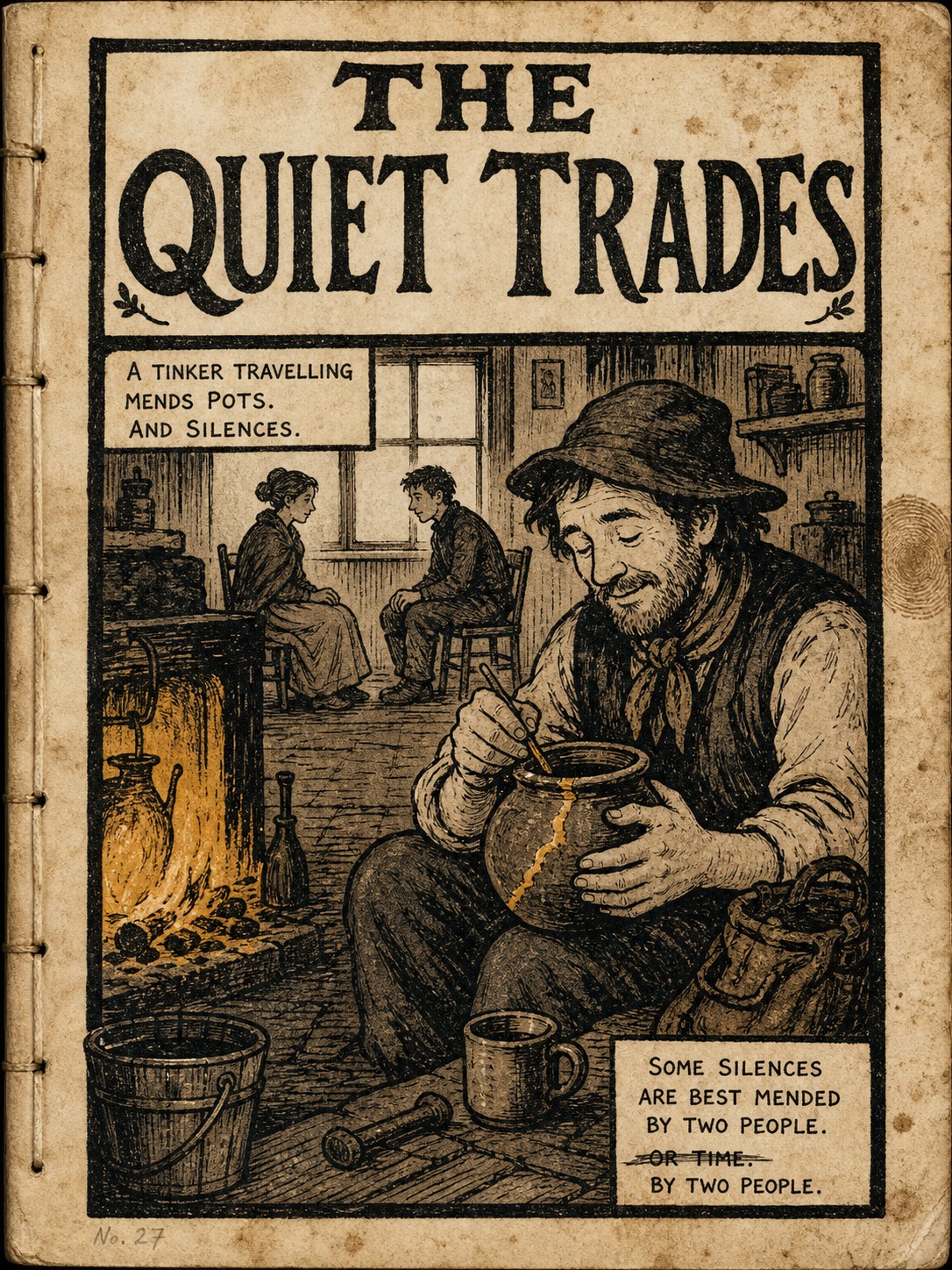
There was a tinker on the fen roads whose real trade was not tin.
His name was Ezra Stint, and he mended pots and kettles and the odd milk-can as well as the next travelling man, which is to say adequately, and no better than he had to. The pots were not why they sent for him. They sent for him for the other thing, the thing nobody advertised and everybody knew, which was that when two people under one roof had stopped speaking — a father and a grown son over the line of a boundary ditch; two sisters over which of them should have held the baby at a christening; a man and the brother who had married the wrong way and been right to — someone would walk out to the road and wait for the tinker to come by, and fetch him in.
He would come. He would sit himself down at the hearth with whatever wanted mending across his knees, and he would take his time about it, and he would say very little, and he would not leave. And by the time he packed his roll and went, the two who had not spoken in a season, or a year, or three years, were speaking again — awkwardly, over some small nothing, the fire wants coal, is that rain — but speaking; and not one soul in the house could have told you the moment it turned, nor what the tinker did to turn it.
Then he sent his bill.
This was the part the fen never forgave him and never did without. Ezra Stint rendered an account for every visit, in a hand far finer than a tinker has any business owning, and the account was always itemised, honest to the farthing, and the farthings were never the point. To one milk-can, re-bottomed, thruppence. To solder, a penny. To attendance, one afternoon — half a crown. The tin was tuppence here or a penny there. The attendance was the whole of the reckoning, and folk paid it the way you pay for a thing you cannot hold in your hand and know full well you have received: grumbling, and to the farthing, and again the next time they needed him.
Now the fen does not care to be charged half a crown for a mystery, and there was a woman at Drench's Holding — practical to the bone, and set on it — who resolved to catch him at his craft. Her husband and his father had not passed a word across the yard in two winters, and when she sent for the tinker she hid herself in the settle-nook with a clear view of the room and swore she would see whatever it was he did: the charm muttered, the herb slipped in the tea, the sly word carried from the one to the other. She watched the whole of a long grey afternoon.
She saw him mend a pot. She saw him mend it slowly. She saw him say the fire wanted coal, once, and mean nothing by it, and she saw him take no side, and refuse — plainly, warmly, and without the least hurry — to leave. That was the entire performance. And she saw her husband, along about dusk, with a stranger sat solid at his own hearth mending a pot that was taking a very long time to mend, and the silence in the room grown so wide and so useless that somebody had to put something into it — she saw her husband say, to his father, that the ditch could go where it liked, he was tired of it. And the old man said he was tired of it too. And that was all it ever was.
For Ezra Stint did not mend the silence. He sat down in the middle of it and stayed until it grew ashamed of itself. He was a third person with no stake in the ditch and nowhere he needed to be, and two people who cannot say a word to each other can nearly always say one to a stranger — and a stranger who will not go, and will not take a part, and has the whole afternoon, stops being a stranger and becomes the room; and a room, unlike a pair of stubborn men, cannot bear to sit empty. He was not selling a charm. He was selling the one commodity the wet country never has by it and cannot make for itself: a person with no side and no hurry, who will stay in the house until the thing gets said.
The half-crown was for that. It was, if you think on it, cheap.
He is gone now, is Ezra Stint, and the odd thing is that the trade went with him — not because it died a secret, for by the end everyone on the fen knew exactly how it was done, the practical woman at Drench's having told the whole parish for nothing out of spite. It went with him because it turned out that knowing how cost you nothing and doing it cost you an afternoon, an afternoon with no stake in it and nowhere else to be, sat in somebody else's misery saying the fire wants coal; and an afternoon like that, the fen discovered, is dearer than solder, and rarer than tin, and there was only ever the one man daft enough to render an honest bill for it.