The Turnip Country
The Tales
Tale 13THE BUCKET THAT FELL UP
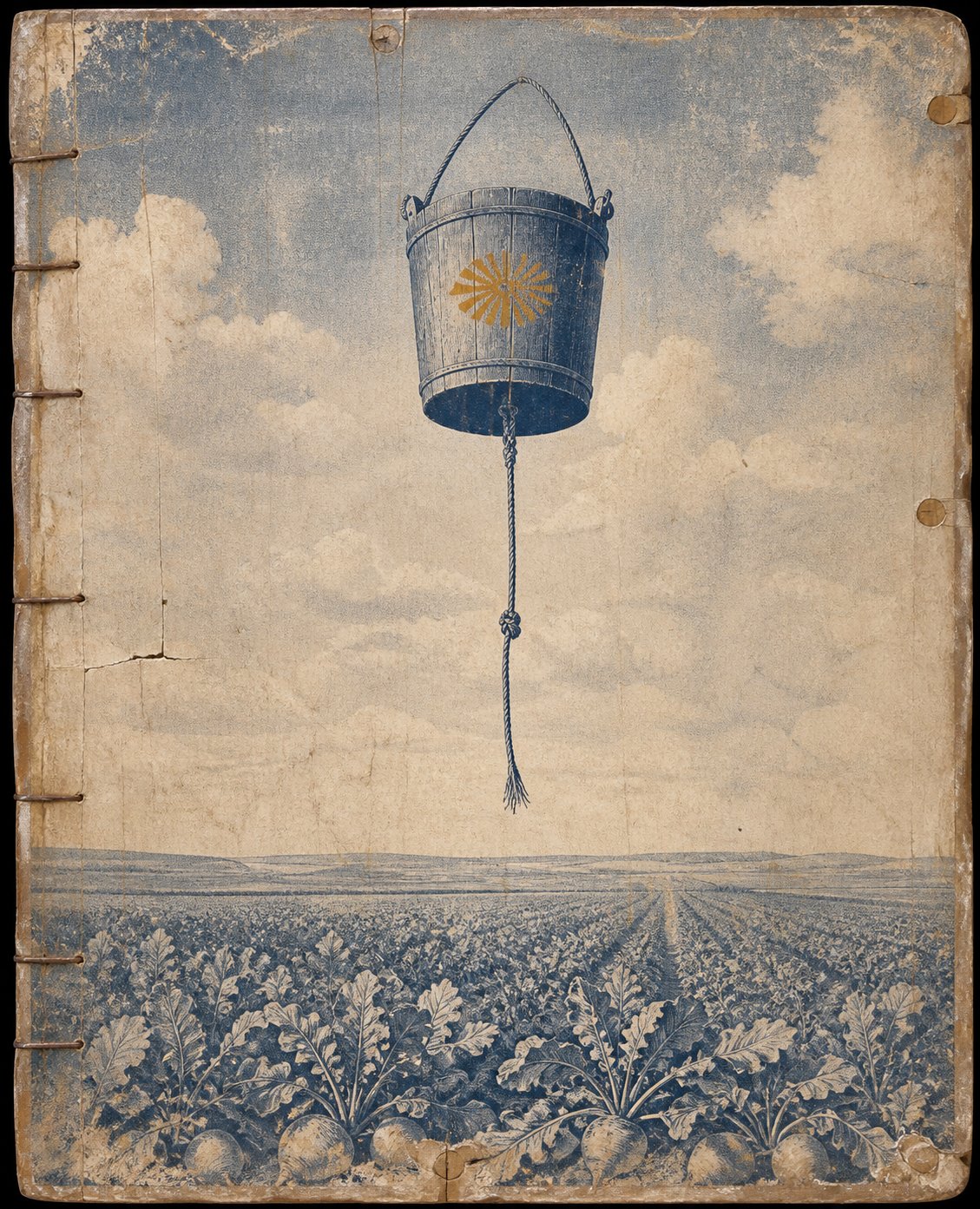
The year of the Great Drought is still spoken of in Sogmarsh with a shudder. For three entire weeks it did not rain. The mud firmed up to the consistency of pudding, two ponds were formally downgraded to puddles, and the Cartographic Committee, scenting an opportunity, rushed out to remeasure the Slough and lost another theodolite.
I was the smallest in the kitchens that summer, which is how these things are decided, so I was the one sent out to the old well in the Turnip woods — the deep one, the one the grown folk don't use. "The rope's not long enough," they say, when you ask why, in the flat voice of people who decided a long time ago not to wonder about something.
They gave me the spare rope anyway. Rope, bucket, and the standard instructions for a turnip sent anywhere: don't dawdle, don't drop it, and don't come back interesting.
The well stood where it has always stood, in the green dark under the oldest trees, with moss up to its chin and a smell coming out of it like cold stone and yesterday. I hooked the bucket, and I let it down.
The rope paid out. It paid out past the fray-mark where the bottom is meant to be. It paid out past the end of the first rope and into the spare, and still the bucket went down — not falling, you understand, but going, easily, eagerly, like a dog that has finally been let off toward something it has smelled for years. And then the rope went light in my hands. Not slack. Light — the way a thing goes when somebody else, very far away, has politely taken the weight.
I should have run. A sensible village child would have run. But I am a turnip, and turnips are not asked to be sensible, only to hold the rope. So I held it. I held it while the light in the woods went a colour I have no name for, and the deep of the well breathed — one breath, slow, the whole wood rising and settling an inch — and then the rope came back.
The bucket that came up was mine, and it was not. It was older. The wood had gone grey and salt-bleached, worn silky where a hundred hands had gripped it, and it smelled — I swear this on the seed-store — of the sea. We are nowhere near the sea. The sea is away past the mists, where the maps give up. My bucket had been gone the time it takes to hold your breath twice, and it came back looking like fifty years of somewhere else.
There was no water in it. There was one potato.
It was the most perfect potato I have ever seen, and I am a Turnip; I have opinions. Unblemished, heavy, warm as a loaf just out of the oven, and glowing — faintly, gently, the way an ember glows when it thinks no one is watching. It had never been planted. Do not ask me how you can tell such a thing about a potato. You can tell.
That night I dreamed. I dreamed of vast, drifting, patient minds, far down, unhurried as weather — minds that did not understand kings, or turnips, or ledgers, and could not, though I felt them turning the question over as gently as you'd turn an egg, work out why anyone would want to own anything at all. They were not frightening. They were the opposite of frightening, which I had not known until then was a thing you could be. One of them noticed me, the way a whale might notice a raindrop, and was — I have thought about this a great deal — pleased.
In the morning I did the only thing a turnip can do with a miracle, which is the same thing we do with everything else: I planted it.
It did not grow up. It grew down. One green stalk, straight as a plumb-line, into the earth and gone — through the woods, under the fields, under the moat — and three weeks later, on the morning of the potato audit, it came up through the floor of the Great Hall, between the flagstones, up past the long table, and out through the ceiling beside the chandelier, where it opened one enormous leaf like a flag.
Lord Bastable was delighted. He had the household assembled before lunch. The sky, he announced, was at last delivering his tribute directly, as was only proper, and he spent the better part of the month drafting a tax upon it. The stalk ignored him with a patience I recognised. Nobody asked where it had come from. Nobody ever asks where anything has come from, in that castle; it is considered prying.
I kept the bucket. And when the next drought came — I was a year older, a year taller, a year further into being the kind of person things get explained to — I went back to the well and let it down, my heart going like a drum. The rope stopped at the fray-mark. Water, cold and ordinary. The deep had nothing more to say to me, and I stood there in the green dark understanding, the way you understand a door closing, that it never would again.
But it said something once. I held the rope, and I didn't drop it, and I did come back interesting.
Some things are too old to be owned; they can only be witnessed — or, if you are brave and kind, joined.
Tale 19THE CEREMONIAL POTATO
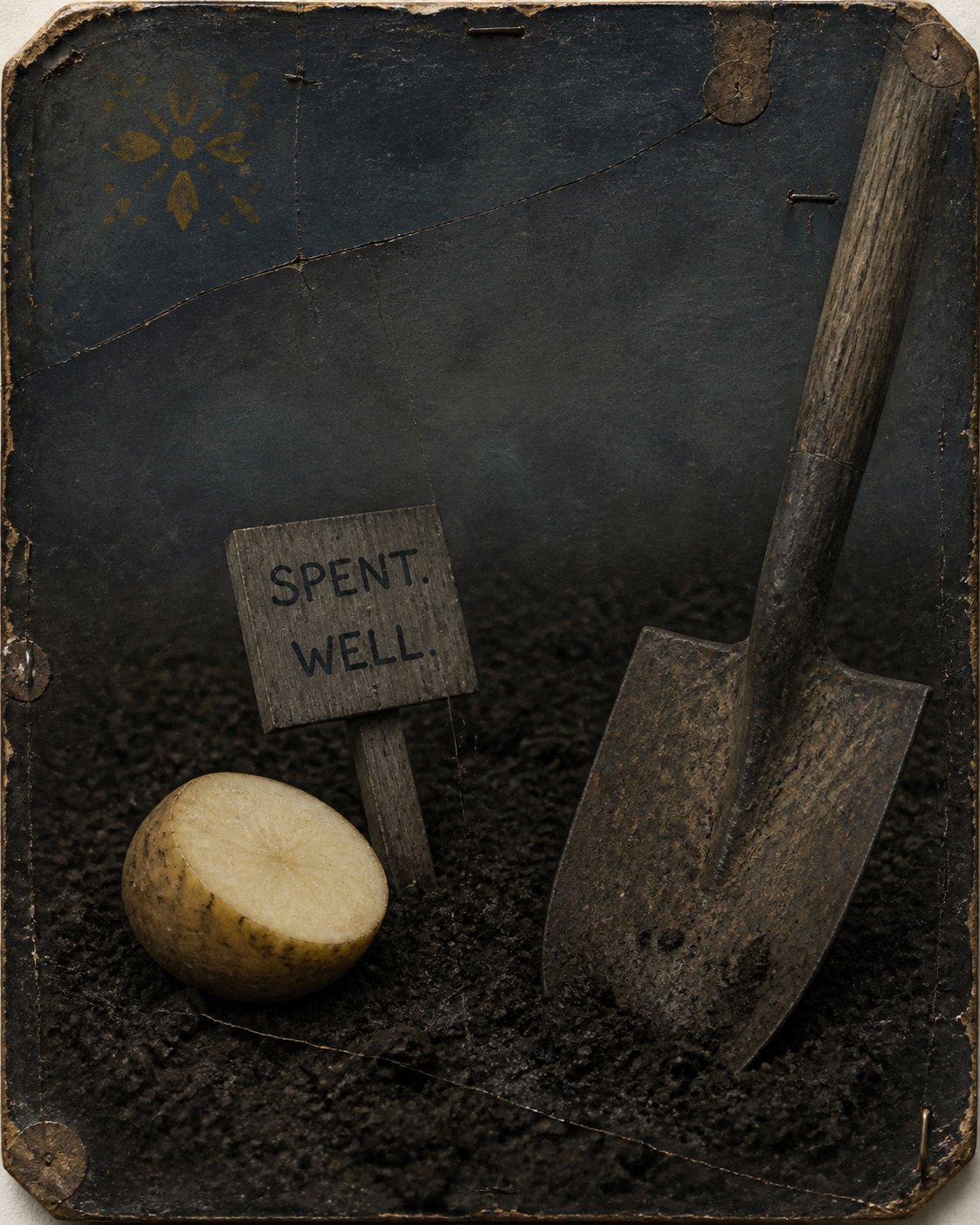
I was lifted out of the ground in the autumn of a year nobody bothered to write down, and I was a very good potato.
I want that understood at the outset, because a great deal of what follows is going to be about what I have not done, and I should like it on the record that I could have. I was firm. I was even. I had an excellent eye. Any of the women of the Lower Fen, turning me over in her hand, would have known at once what I was for: a Sunday. A proper one. Butter, if there was butter, and salt, if there was salt, and if there was neither, then simply me, hot, in the middle of a table, being enough.
That was what I was for. That is what all of us are for. It is not a complicated destiny and I was looking forward to it very much.
Instead, a man in a good coat looked at me, and said: "That one's too fine to eat."
And that was the end of my life, and the beginning of my career.
Let me explain what money is in this realm, because you have probably never had to think about it, and we have thought about very little else.
The realm runs on the potato. Not on gold — gold is for the Bastables and the Pennyworths and the men who write things down. Down where the work happens, a debt is a sack, a wage is a sack, a dowry is forty sacks, and a man's whole standing in the parish can be reckoned in whether he owes sacks or is owed them. The Exchequer prints its numbers, and the numbers refer to potatoes, and the potatoes, for the most part, refer to nothing at all, because most of them have been eaten.
That is the trick of it, and nobody has ever said it aloud, so I shall. Money in Sogmarsh is a potato that everybody has agreed not to eat.
That is all. That is the entire mechanism. There is no vault. There is no gold behind it. There is simply a great many hungry people standing around a sack of perfectly good food, in a damp country, in a bad winter, all of them nodding gravely at one another and agreeing — for now, for the sake of the thing, for the sake of what it means — not to eat it.
And it works. That is the astonishing part. It has worked for six hundred years. Which means that six hundred years of the hungriest people in the west of the realm have looked at supper, and understood that it was money, and have not eaten it — not because they were guarded, and not because they were frightened, but because they had given their word, and because a promise is the only thing in Sogmarsh that has never once been under water.
I have been in the room for a great many of those promises. I have been the promise.
I have been passed hand to hand for sixty-one years.
I have settled a boundary dispute, twice, between the same two men, who then went for a drink. I have been a wedding dowry four times — I was in the Turnip-Mutter dowry, if you want to know; I am one of the two, and I can tell you that the aunt counted us. I have been the deposit on a boat, the price of a funeral, and, for one long terrible fortnight, the stake in a card game in the cellars, which I did not enjoy, and which I will not discuss.
I have been carried through the rain inside a coat, next to a heart, and I have felt that heart going much too fast, because the man carrying me was carrying everything he had.
They handle me like a saint's finger. They wrap me in a cloth. There is a ledger — of course there is a ledger, there is always a ledger — and I am in it, and I have a number, and when I change hands the number is written down again, and the two men shake, and it is done, and nobody has to trust anybody, because they both trust me.
Sixty-one years. I have not been eaten. I have not been planted. I have not been left in the dark to get on with what a potato gets on with. I have been held.
Do you know what happens to a potato that is never allowed to finish?
I have gone hard. Then I have gone soft. Then, being a potato of some character, I went hard again. My skin has become a sort of leather. I have grown eyes, in the dark, in cloths, in the bottom of sacks — long white blind hopeful eyes, groping out into a linen bag, looking for soil, finding a ledger. Every spring, without fail, some part of me still tries. That is the worst of it and I would ask you not to dwell on it, and I know that you will.
I am no good to eat now. I would break a tooth and disgrace a table.
And I am worth more than I have ever been. That is the joke, and it took me forty years to see it, and when I saw it I laughed so hard I very nearly split.
The longer I am not eaten, the more I am worth. My whole value is the not eating. Every year I am passed on is a year of proof that I can be trusted not to be supper, and so the parish trusts me more, and so I am worth more, and so I am even less likely to be eaten — and round it goes, and round, and round, and I get harder and blinder and more precious and more useless, and somewhere in there I stopped being food at all.
I am not a potato any more. I am an agreement.
Now. The winter before last.
It was a bad one. Not a famine — Sogmarsh does not have famines, it has shortfalls, which are famines that have been to the Committee — but it was a hard, mean, long-toothed winter, and the Long Kitchen in the Woods had the pot on and nothing much to put in it, which is a thing that pot has never once admitted to anybody.
And I was there. I had come to Lowmoss as the settlement of a debt between two men who both wanted to be rid of the argument more than they wanted to be right, and I had been put, wrapped in my cloth, on the shelf, where a valuable thing goes.
And a child got hungry. That is all. That is the whole of the crisis. A small one, at the end of a long week, went and stood in front of the shelf, and looked up at the cloth, and did not touch it — because she had been raised properly, and she knew exactly what I was — and simply stood there. Hungry. Looking at the money. Which was food. Which she had promised not to eat.
She stood there a long time. Nobody hurried her.
And the room went very quiet, in the way that rooms in Lowmoss go quiet, which is the sound of a decision being made by everybody at once without a single person needing to speak.
I want to tell you what I expected. I expected an argument. I expected the ledger to come out. I expected somebody to say "but he is worth eleven sacks" — which is true, and which was, I am ashamed to say, my own first thought, because I had been money for so long that I had started to think like it.
Nobody said it.
The old woman who has been dead for sixty-one years and mends nets got up off her stool, and took me down off the shelf, and unwrapped me, and turned me over in her hands the way the women of the Lower Fen did on the day I came out of the ground — and she looked at what sixty-one years of being precious had done to me. The leather. The blind white eyes, still reaching. The stone-hardness of a thing that had never been allowed to be what it was for.
And she said: "He'd break a tooth. He's no good for the pot."
And the child's face did what a child's face does.
And then the old woman said: "He'll do lovely in the ground, though."
They took me out to the black ground behind the Long Kitchen, in the dark, in the rain, the whole village of them, and it was not a ceremony, because they do not do ceremonies, but everybody came.
They cut me into six.
I should like to say something about that, and I find I have nothing to say about it, except that it did not hurt, and that every one of the six pieces had an eye.
And they put me in the ground.
Sixty-one years, and a linen cloth, and a shelf, and a ledger, and a number — and then eleven inches of cold Sogmarsh mud, which is what I had been asking for since the first frost of my life.
The ledger was brought out afterwards, and my number was found, and against it the woman wrote, in the only hand in the realm that could have written it:
SPENT. WELL.
Here is what I know now, that I did not know on the shelf.
They lost eleven sacks that night. They will tell you they didn't, and they will show you the arithmetic, and the arithmetic is correct — six pieces, six plants, a hundredweight in the autumn, and the Long Kitchen fed all winter and the winter after. Any Pennyworth would tell you it was the finest investment in the history of the Bogmoor.
It wasn't an investment. Nobody in that rain was thinking about the autumn. They were thinking about a hungry child standing in front of a shelf being good, and about how sick they were of being the sort of people who make a child do that.
And that is the difference between them and everybody above them in this realm, and it is the only difference that has ever mattered.
The Bastables have a castle they cannot afford and will not sell. The Pennyworths have an account they compound and will never close. The whole realm above the mud is stiff with things that are too valuable to use — and every one of those things is going hard, and going leathery, and putting out long blind white eyes in the dark, looking for the soil, and never being let near it.
I was the richest thing in that village. I was worth eleven sacks.
And I was worth eleven sacks precisely and only for as long as I was no use to anybody.
I am in the ground. It is dark, and it is wet, and it is very cold, and it is exactly right.
I can feel the six of me. I can feel what is coming — the split, the push, the green — and I want you to understand that I am not being brave about this. I am not sacrificing anything. This is not a tragedy and you are not to read it as one.
I have been an agreement for sixty-one years. It was very grand and I was very well looked after and nobody ever, not once, let me be a potato.
They stopped agreeing about me, and let me be worth something instead — and a thing is only ever worth what it does when you finally use it.
Tale 40THE FREE KITCHEN
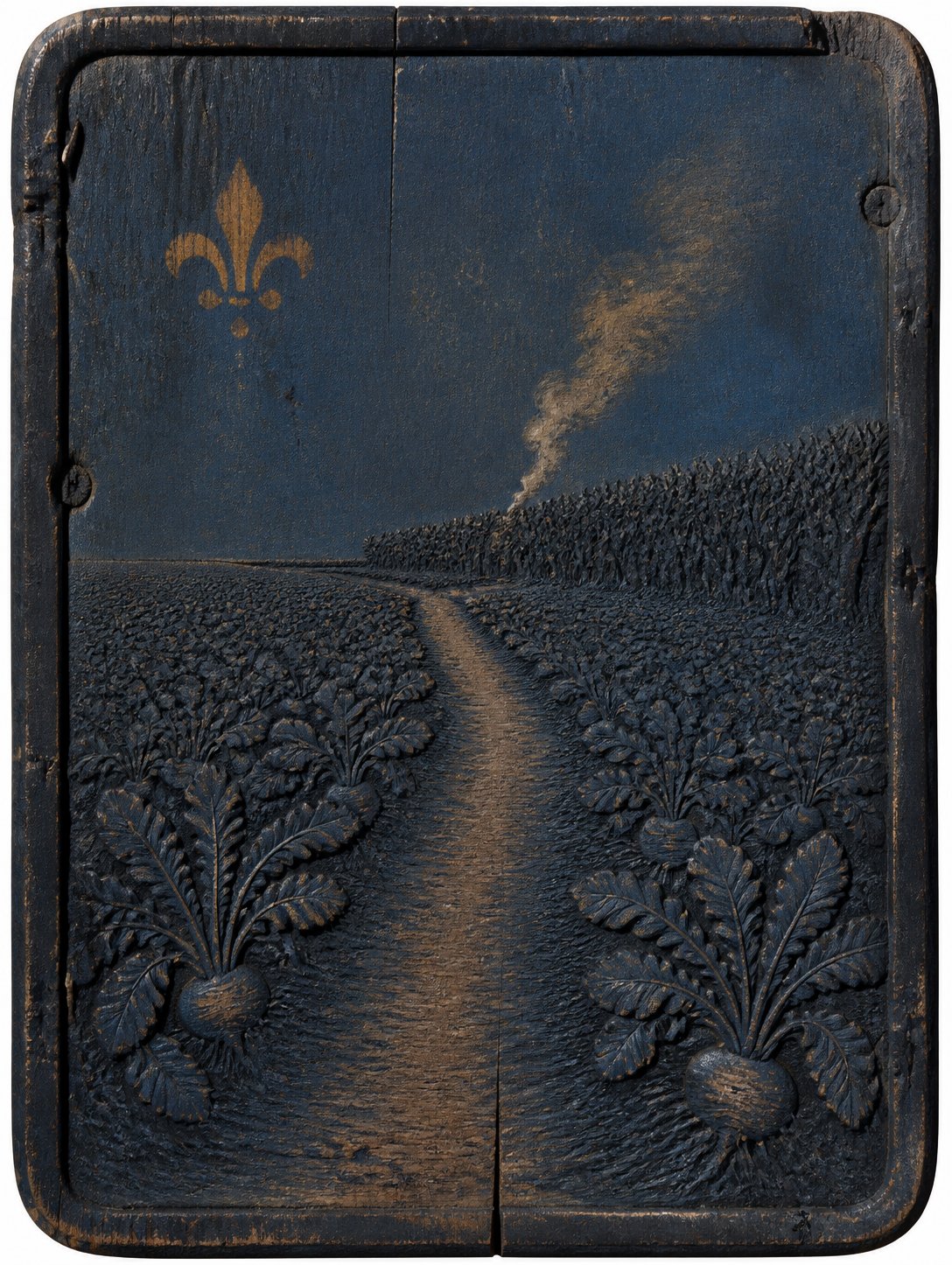
I will tell you about the kitchen in the trees, and I will tell you at the start the one thing that matters most about it, so that you do not waste your life the way a certain sort of person always does on hearing this story: you cannot go there. Not because it is hidden. Because it is not a place you go to. It is a place that has you, once, when you need it, and then lets you grow up.
I was small, and I was climbing.
That is all I will say about the where of it, and it is all I know. I was a child, and I was getting out of somewhere, up and out through the wet green the way a child does when staying is worse than the dark, and I climbed until my arms had no more climb in them — and there was a light, and a smell of onions, and a woman with a spoon who did not ask my name and did not ask where I had come from and did not, this is the thing, did not seem in the least surprised to see a small soaked person arrive out of the branches at an hour when small persons are meant to be accounted for.
"Sit down," she said. "You'll want feeding."
There was a long table. There were others at it — some my size, most not; an old man mending a net that had no water for a hundred miles; two who did not speak the whole time and were not made to; a boy about my age who had a way of holding his bowl with both hands like it might be taken, and it was not taken, and by the end of the meal he had stopped holding it like that, and I have thought about that boy more than I have thought about almost anyone.
The food was not much and it was enough, which I have since learned is the hardest recipe in the world and the only one worth knowing. Nobody paid. There was no place to pay. When I looked for how you were meant to pay — because I was a child of a house that had taught me everything has a price and a column and a number — the woman with the spoon saw me looking, and said the only thing she ever said to me directly, and I have kept it:
"It's not a debt, love. Debts is how they hold you. You eat, and you grow, and one day it's you with the spoon. That's not paying it back. That's just how it goes round."
And there was a book.
I do not want to make too much of the book, because the people there did not make much of it — it sat at the end of the table, a plain thing, kept in a box a child could carry, and now and then someone would go and put their own name in it, in their own hand, and if they couldn't write, the woman would do it, and read it back to them twice, and make them say it after. That was all. Nobody explained it. But I understood, the way you understand things at that age without being told, that the book was the whole point of the kitchen — that upstairs, in the great houses, in the offices, in the beautiful ledgers with their ninety-nine boxes, people were being counted like candles and spent like candles and crossed out like candles; and that here, at a plain table, in a hand that shook, they were being written down properly, as themselves, with their own names, which nobody up above had ever once thought to ask.
I put my name in it. I was small and my spelling was a disgrace. The woman read it back to me twice.
Then I slept, and in the morning I was somewhere else — down, and out, and grown a little, the way one night in the right place can grow you a year — and I have never found the kitchen again.
I looked, of course. For years I looked. I was young and I thought looking was how you loved a thing. I went back up into the green a hundred times, older and taller and worse at climbing every year, and I never found the light or the smell of onions or the long table, and I made myself very unhappy about it, until an old woman I trusted — who had been fed there too, longer ago than me — set me straight in four words.
"You've had your meal."
And I understood. The kitchen is not for the fed. It is for the climbing. It comes to the child who is getting out with no more climb left in their arms, because that child needs it and cannot pay and must not be asked to; and it does not come to the grown one who has eaten and grown and is now, whether they like the word or not, meant to be going back for the others. You do not find the free kitchen twice. The second time, you are supposed to be it.
I did not believe her. Then I got old enough, and one wet night a small soaked person came up out of somewhere they were getting out of, with no more climb in their arms, and looked at me the way I once looked at a woman with a spoon.
I did not ask their name. I did not ask where they'd come from. I put the pot on.
I could not tell you where my kitchen is. That is not modesty and it is not a riddle. It is simply true in the way the whole thing is true: it is wherever the climbing child arrives, and it is never on any map, and it never will be, because the day it is on a map is the day the houses above know where to look, and they must never, ever know where to look. The people who kept it before me kept that faith for three hundred years in the dark, and I keep it now, and the price of keeping it is that I can promise you it is real and I can promise you it is close and I cannot, and will not, and would sooner die than, tell you how to get there.
Some kindnesses can only survive by being impossible to find. The free kitchen feeds whoever is climbing out, asks nothing, and keeps no map of itself — because the surest way to lose a thing the powerful want is to write down where it is, and the surest way to keep it is to become it, and pass the spoon.