Boundaries & Thresholds
The Tales
Tale 47GRIMSHAW'S HEDGE

The war over Grimshaw's Hedge is the oldest continuous quarrel in the realm, and its distinction — the thing that makes it worth a tale, when the realm is full of quarrels — is that for the last two hundred years or so nobody has been able to find the field.
Not lost the deeds. The deeds are magnificent; both families have a set; they disagree in eleven particulars and agree on the important one, which is that the parcel exists and is bounded on its northern side by a hedge planted by a Grimshaw who has been dead since before the Bastables. It is the ground that has gone. Somewhere between the flooding of the low pasture, the shifting of the Sog, four hundred years of a landscape that will not hold still, and the well-known unhelpfulness of Committee surveys, the actual physical field to which both families are indisputably entitled has quietly stopped being anywhere in particular.
This did not slow the quarrel down for a moment. If anything it improved it. A dispute over a field you can walk on is limited by the field; a dispute over a field nobody can locate is limited by nothing at all, and the Snaggs and the Fettles had been getting four hundred years of excellent use out of it — the cut direct at market, the ostentatious not-being-served, the funerals attended in order to be seen leaving early — when the Chancery, in a fit of tidiness nobody has ever forgiven it for, resolved to settle the matter.
And the Chancery's ruling was, in its way, perfect. It read:
Jointly. After four hundred years. Old Snagg is said to have read the word three times and then gone and stood in his own yard for a while.
They started, naturally, by not speaking.
The first fortnight was conducted entirely through a boy of eleven, who was paid by both families to carry messages between two parties standing about ninety feet apart in a wet pasture, and who is now a grown man with a good farm bought entirely out of that fortnight, and who declines to say what was in the messages on the grounds that he did not always deliver them accurately and it went better when he didn't.
The second fortnight they spoke, because you cannot chain a boundary through a child.
And the third fortnight — this is the part the district enjoys, and the part they tell at Drudgeford market — the two families discovered, standing in the wet with a chain and a bundle of ancient deeds between them, that they were the only two people in the realm who knew anything whatever about Grimshaw's Hedge.
Nobody else cared. Nobody else had ever cared. Four hundred years of a quarrel that had shaped both families entirely — their marriages, their pew, their route to market, the way they held their faces — and the rest of the parish had regarded it, throughout, as weather. But Snagg knew the 1519 survey had the hedge running to a stone that Fettle's grandfather had seen as a boy; and Fettle knew the flood of 1704 had moved the ford, which meant the 1519 survey's north was not the present north; and Snagg had not known that, and stood there working it out with the rain coming down, and said, before he could stop himself:
"…That'd put it under the withy carr."
"It would," said Fettle.
"That's not — hang on. That's not possible, because your lot's 1611 grant has it east of the carr—"
"Which is wrong," said Fettle, with enormous feeling, "and I've said so for thirty years, and my own father would not hear it—"
"Your father," said Snagg, "was a fool about that grant—"
"He was," said Fettle. "He was."
And the two of them stood in the rain looking at each other with the awful dawning recognition of men who have just found, at sixty, the only other person alive who is interested in the thing they are interested in.
They did not find the field.
I want to be clear that they tried, and tried properly, for two years — because the tale is usually told as though they gave up, and they did not. They chained the low pasture in both directions and got two different lengths. They dug for the stone. They found a stone, and spent a memorable evening establishing that it was a stone. They took the 1519 survey and the 1611 grant and the Committee's own sheet and laid all three on the Fettle kitchen table and discovered that they agree with one another in no particular whatever, and that where two of them agree the third is emphatic.
They were, by the end of the second year, the two leading authorities in the Kingdom of Sogmarsh on a piece of ground that is not anywhere, and they were in the Fettle kitchen four evenings a week, and their wives had become friends without consulting anybody, and the boy who had carried the messages was engaged to be married to one of them and neither family had objected, which the parish took as the true end of the war and the parish was, as usual, right.
And in the third year they went to the Chancery, together, and made their joint report, which is entered in the register and is eleven words long, and which is the best-loved document in that office:
The Court, to its credit, understood exactly what it was being told, and had the good manners to write back in kind. The matter is adjourned. It is adjourned sine die, which the Clerk explains means without a day appointed for its resumption — a form of words the Chancery keeps for things it has decided not to finish — and the costs remain reserved, and the parties are directed to report if the situation is established, and it has been ninety-one years and they have not reported.
The Snaggs and the Fettles are still looking. It is a fixture now, like the tournament. They go out twice a year with a chain, in April and October, both families, and they chain a pasture that will not give the same answer twice, and they argue about the 1611 grant, and they come back and eat at one another's tables, and neither house has ever suggested stopping.
Because they worked it out, somewhere in that third year, and old Fettle said it out loud at the market once and has never been let forget it:
if they ever found the field, the Court would divide it, and it would be over.
There would be a boundary and a ruling and two tidy parcels and nothing further to say — and the four evenings a week would stop, and the April chaining would stop, and two families who have nothing else in the world in common would go back to having nothing in common, and the oldest continuous relationship in the realm would be concluded.
So they are looking, carefully, thoroughly, in good faith, for a thing they have both privately agreed to hope is not there — which is, the Clerk observes, not so very different from a marriage.
A quarrel that lasts four hundred years is not a quarrel; it is the longest conversation two families ever had, and the only thing it cannot survive is being settled. Some things are best kept unfound, and the wise are the ones who go on looking anyway, twice a year, in the rain, together.
Tale 51SAINT TARRY'S PLATE
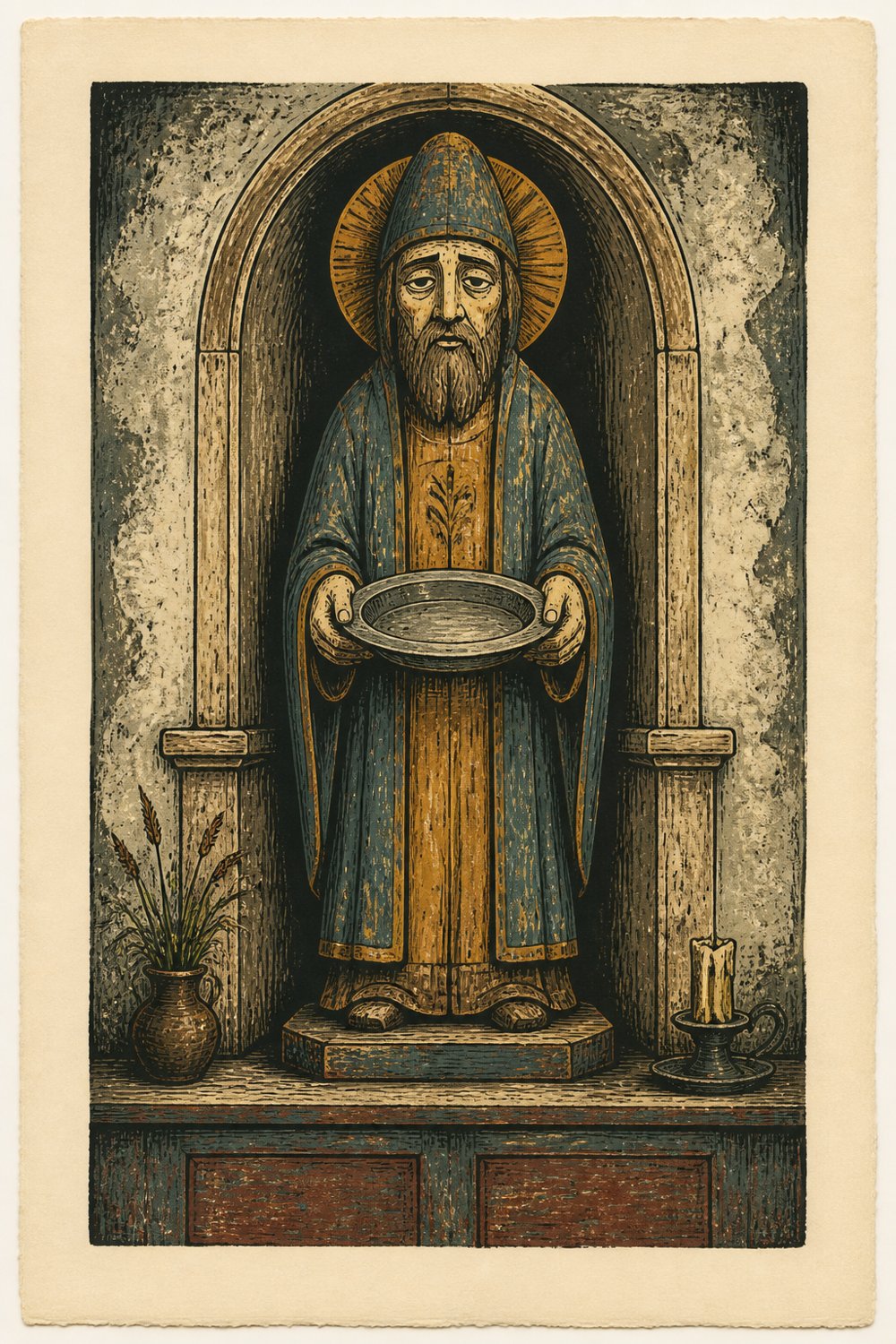
Saint Tarry is the patron of the about-to-be-served, and he is, by a wide margin, the most popular saint in this realm, for the excellent reason that he is the only one whose job description matches anybody's actual life.
He is not the patron of the fed. The Loafians have that, and are welcome to it. He is not the patron of the starving, who are looked after — in the parish's opinion, badly — by a committee. Saint Tarry belongs to the enormous middle: the ones whose dinner is nearly coming. The ones on the third hour of a four-hour wait. The ones whose ship is due, whose ford will be passable by Thursday, whose harvest is looking not bad if the weather holds.
That is most people. That is most of everybody's life. And the parish's word for it — the whole theological position of this realm, in two syllables — is "just about."
Ask a Sogmarsh man how the crop is. Just about. Ask him how his wife's chest is, or the roof, or the year. Just about. It is not optimism and it is not despair; it is the precise and honest grade of hope available to people who live in a bog, and Saint Tarry is its saint, and his shrine is at an inn in Murkminster called the Empty Chair, and his shrine is a plate.
One plate. Clean. Laid at a set place at the long table, with a chair nobody sits in.
And empty. Always empty. Emptied, if need be, by whoever notices — which is the same arrangement the parish has with the bucket, and it is not a coincidence, and nobody has ever remarked on it.
Now: Aunt Sowerby.
She was not from that parish. She had married in from Drudgeford and she had been there eleven years and she was, by every account I have collected including the ones from people who were cross with her, a genuinely kind woman — the sort who notices a cold child at the back of a room and does something about it before anybody else has finished feeling sorry.
And she had been looking at that plate for eleven years.
You can see how it happened. She came from a market town, where a plate is a plate. She sat at that table week after week with her own dinner in front of her and an empty plate beside her, at a place laid for a guest who never came, in a parish where a good half of the congregation were going home to less than she was. And one evening after a Loafian sermon on abundance which she had not much enjoyed, she got up and went and put food on it.
Not a token. A proper plate: bread, a good piece of the ham, two of the eggs she had brought in. The best of what was on that table, laid out neatly, the way you would for somebody you were glad to see.
Then she sat down again, rather pleased, and waited for the room to notice.
The room noticed.
There is no version of this story in which the room does not go quiet, and I want to be fair to Aunt Sowerby here and record what she said afterwards, which is that the quiet was the worst thing she had ever sat through, and that she genuinely could not tell, for about four seconds, whether she had done something kind or something appalling.
It was old Meg Cobb who got up. Eighty-one, three parishes' worth of funerals behind her, and — this matters — fond of Aunt Sowerby, which is why she got up rather than letting somebody unkinder do it.
She did not clear the plate. She sat down next to her, in the chair nobody sits in, which she was entitled to do and nobody else was, and she said:
"That's a lovely plate, love. That's the best plate anybody's put down in this room in forty year." She patted her hand. "And we're going to have to take it off again in a minute, and I'm going to tell you why first, because you've earned that, and because if we just took it off you'd think we were mad or cruel and we're only the one."
Here is what she told her. I have it from two people who were there and they agree, which in this realm is a stronger warrant than a document.
"He's not hungry, love. That's what you've not got yet. Saint Tarry's not a hungry man waiting on his dinner — if he were we'd have fed him, we're not monsters, we'd have fed him in 1712 and had done with it.
"He's the man whose dinner is nearly here. That's the whole of him. That's his entire job and there's nobody else doing it.
"Now think what you've just done. You've fed him." Meg Cobb turned the plate slightly, the way you do with a thing you are about to take away. "And a fed Saint Tarry is no use to a living soul in this parish. He's finished. He's got his. He's out.
"There's a woman in the third row whose lad's ship is a fortnight overdue and she's been sat here every week looking at that empty plate and it's been the only thing in this building that's been any use to her — because it says the thing she needs said, which is: not yet, and still coming. And you've just gone and given him his dinner in front of her."
Aunt Sowerby, they say, put her hand over her mouth.
"Aye," said Meg Cobb. "Now you've got it."
They emptied it together, the two of them, and they did it reverently, which is the detail the whole parish keeps, and the food went — this was Meg's idea and it is the reason the story is told with affection rather than as a warning — it went to the woman in the third row, in a cloth, to take home, with nothing said about it.
Because that is the other half, and the parish is very clear about it, and I have heard a curate get it wrong from the pulpit and be corrected afterwards in the yard by four separate people: the plate stays empty and the neighbours get fed. Those are not in tension. The empty plate is not an instruction to withhold. It is a statement about hope — that the hope worth having is the kind you have not received yet, because hope you have already got in your hand has stopped being hope and become dinner, and dinner is excellent and is a different thing.
You keep the plate empty so the parish has somewhere to put not yet. And then you feed the actual person, quietly, in a cloth, and say nothing about it.
Aunt Sowerby lived another thirty-one years in that parish and was much loved and is remembered for exactly two things.
The first is the plate, which she never lived down and eventually stopped wanting to, and which she would tell on herself, at length, with relish, to any newcomer who looked at that empty place and got the look on their face she had had.
The second is that from that evening until the week she died she was the one who kept it — because the parish, having explained itself to her, promptly and without any discussion handed her the job, in the way this realm always hands the job to the person who cared enough to get it wrong first.
She kept it clean. She kept it empty. And on the bad weeks, when there was somebody in the third row waiting on something, she made sure it was laid especially well.
Hope is the thing that has not arrived. Fill the plate and you have not been generous — you have ended the only prayer this realm knows how to make. Keep it empty, feed your neighbour in a cloth and say nothing, and understand that these are the same act performed by people who have thought about it for six hundred years.
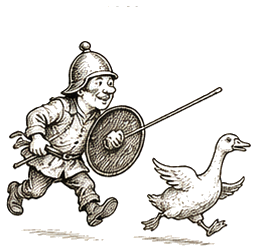
Tale 58THE TUESDAY SCHEDULE
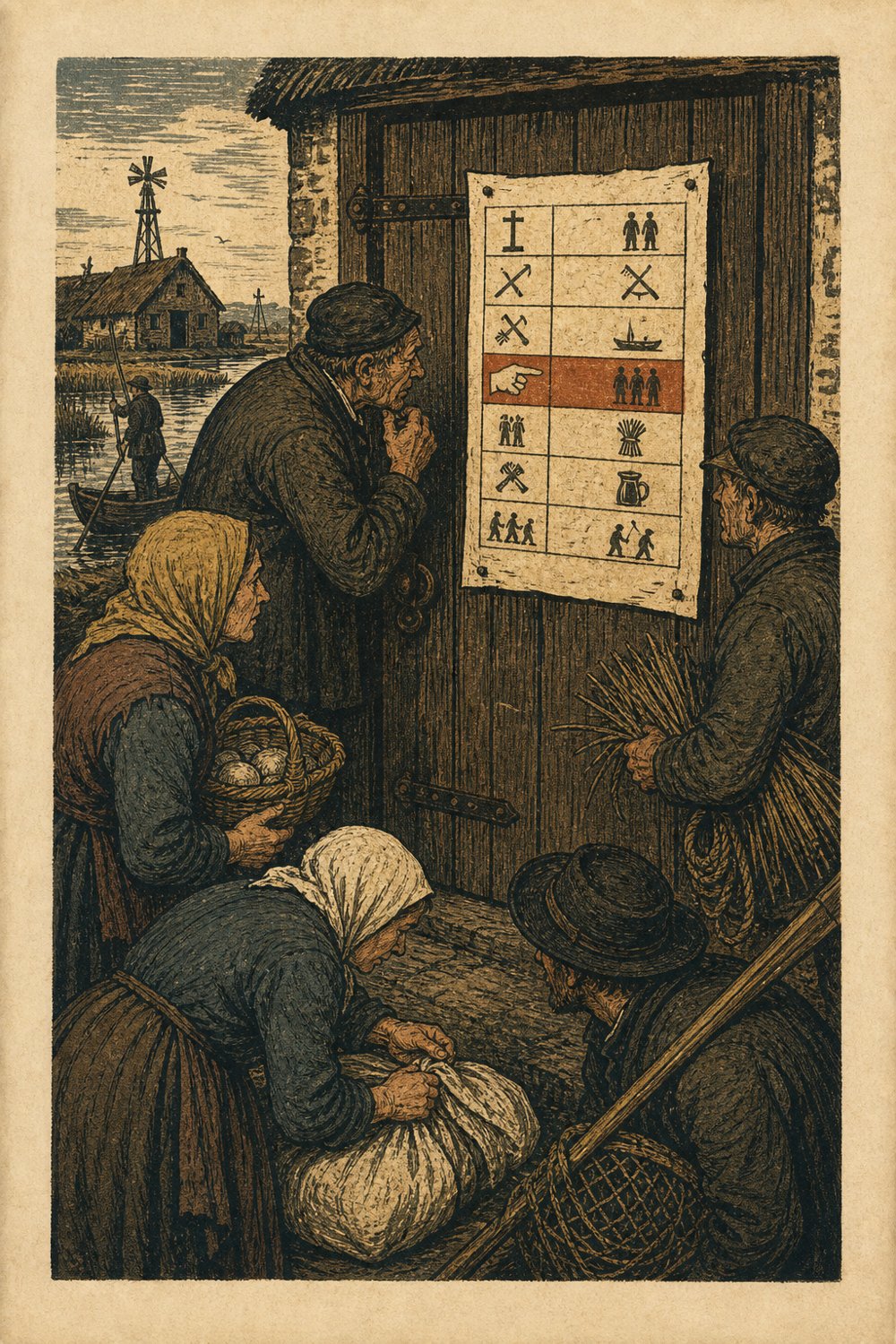
The larder at Castle Bastable contains, at the time of writing:
- flour, oats, onions in a quantity the household declines to specify; - one cheese, fresh for ever, aware, and holding a grievance the length of its own life; - a quantity of alchemically-cured bacon which is opinionated, ambulatory and territorial; - one mechanical rasher of brass, built by Professor Clank to replace the above, which has instead unionised it; - and Old Mother Stilton, who is seventy-something, forgives nobody, and is at this moment sitting at the scrubbed table opposite a strip of bacon, reading a document.
The document is the Tuesday Schedule. It arrives weekly. It is beautifully formatted.
## HOW THE LARDER CAME TO HAVE A BARGAINING BODY
Briefly, because both halves are on record elsewhere and neither is anybody's fault except in the way that everything in this castle is somebody's fault and that somebody is usually Fizzle.
The bacon was cured by a process the kitchen would not sign its name to, and became, over a season, opinionated. Then ambulatory. Then territorial, which is the stage at which a household stops calling a thing the breakfast and starts calling it them.
The mechanical rasher was Professor Clank's remedy: brass, biddable, wholly without ambition, installed to end the negotiation by removing the other party from it. It was in the larder eight days before it had organised the living bacon into a bargaining body and appointed itself shop steward.
Clank's own account of this is the most rueful paragraph in his Register, and the line everybody quotes is the one where he notes, with professional envy, that the schedule of demands is formatted rather better than his own.
It is. I have seen both. It is not close.
## THE FIRST NEGOTIATION
Mother Stilton did not send for anybody. That is the first thing to understand about her and the reason the larder is still standing.
Lord Perry offered a footman with a poker. The Quail watch offered to classify the whole pantry as a military position, which they had been wanting to do about the smell for years and which she declined on the grounds that she was not having Quail in her dairy. Fizzle offered to try a working, and was removed from the passage by two people.
She went in alone with a chair, sat down, and said — the girl on the stairs heard it and it is the version everybody tells —
"Right. What do you want."
The mechanical rasher passed her a document.
## THE SCHEDULE, AS ORIGINALLY SUBMITTED
I have the first one. It runs to two pages. The demands, in the order given:
1. That the larder door be shut properly, the current arrangement admitting a draught along the third shelf. 2. That the salt be moved. The salt was on the shelf above. The bacon had views about the salt being on the shelf above and the views were, on inspection, entirely reasonable. 3. That there be notice. Not a stay of execution — the schedule is explicit and rather dignified about this, and Mother Stilton has never let anybody misrepresent it: the party does not dispute the principle of breakfast. What the party disputes is being taken without warning, in the dark, by a hand. Two days' notice was requested. 4. That the cheese be consulted on matters affecting the cheese. 5. That the mechanical rasher be recognised as the sole bargaining representative, which everybody noticed was in the document's own interest and which nobody could see how to object to.
She read it twice. She turned it over to see whether there was more. Then she took the pencil from behind her ear and went through it in front of them, which is the part of this story the kitchen has never got tired of:
Four of five, inside a quarter of an hour, by a woman of seventy-something with a pencil.
The mechanical rasher is understood to have regarded it as a satisfactory first engagement. Mother Stilton went back to the range and said, to nobody, the sentence that is now painted on the beam over the larder door:
"They only wanted telling."
## HOW IT WORKS NOW
The Tuesday Schedule still comes. It is mostly one item and is often about the draught.
The notice is honoured. This is the thing visitors find hardest and the kitchen finds ordinary. On a Sunday, Mother Stilton goes to the larder door and says what is wanted for the Tuesday, out loud, plainly, and shuts the door and goes away; and on the Tuesday it is there on the slab, and nobody has ever established the mechanism, and nobody asks, and the kitchen has agreed not to find it strange because finding it strange makes the pastry go wrong.
Is it kinder? I have heard the argument and I will report it and not settle it. The party is not spared; the party has never asked to be spared. What the party has is two days and a warning, which is more than the goose gets, and more, as Mother Stilton observed at a supper in front of company and a churchwarden, than most of us get.
The cheese was not consulted and has never forgiven it. The cheese has not forgiven anything. It sits at the back of the third shelf, fresh for ever, resenting the arrangement it was not asked about, and Mother Stilton speaks to it every morning while she takes the flour down.
She has never once said what she says. The girl who does the fires says it is not words.
## THE ONE THING SHE WILL NOT DO
Fizzle has offered — annually, in writing, for years, in a hand that gets smaller each time — to attempt the undoing.
He believes he could lift it. He may even be right; it is the only working he has ever proposed that he does not claim will do the opposite. He has said, at various times, that it would end the smell, and the schedule, and the whole ridiculous business, and give her back a plain larder with plain food in it.
She has refused every year.
She has never given a reason to Fizzle, who assumes it is unforgiveness, and it partly is; Mother Stilton forgives no one and it is in the dairy.
But she gave the reason once, in the kitchen, late, to a girl who had asked and was too young to know better, and the girl is old now and has told it perhaps twice, and it is this:
"I've fed this house eight-and-forty year and it's never once said thank you. That lot in there send me a letter every Tuesday."
The realm is full of arrangements that started as a disaster and were not undone, and the reason is almost never sentiment — it is that somebody found, in the wreckage, one small thing they had not had before and were not going to give back. A cook who is negotiated with is not a cook with a problem. She is a cook with correspondence.

Tale 72THE WRONG FUNERAL
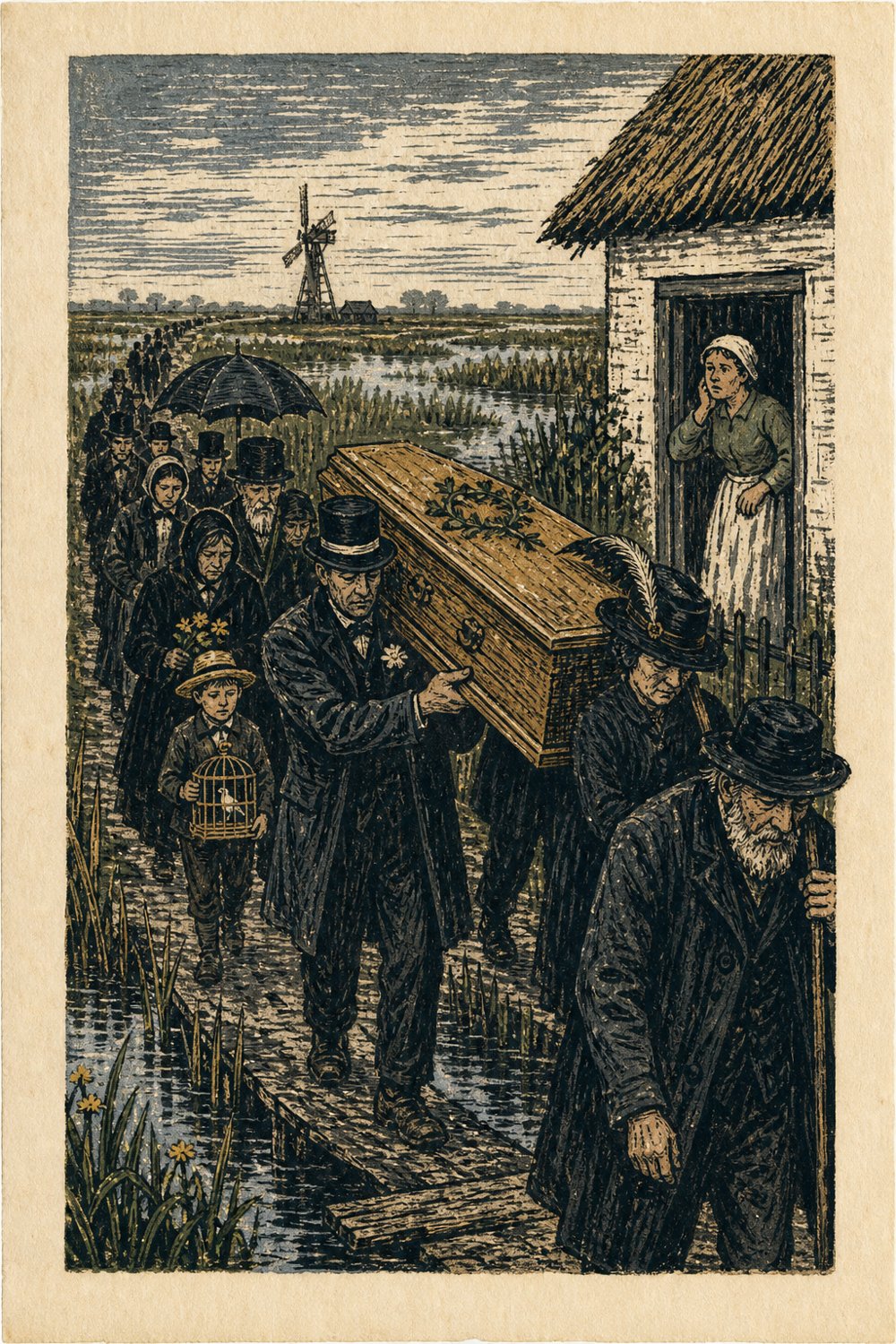
You must understand two customs of the parish before this will make any sense, and both of them are entirely mad, and both of them are the whole of the story.
The first is that in this parish nobody is buried alone. Not the beloved and not the beast; not the one who paid his way and not the one who never did. When the bell goes, you go. It is not about the dead — the dead, as a rule, are past minding — it is about the parish being the sort of place where a person is seen out, whoever they were, because a village that will let one soul go into the ground unattended will, in the end, let anybody.
The second is stranger, and it is this: the words over a grave are spoken not by a friend of the dead but by the last person the dead wronged. The reasoning, if you can call it that, is impeccable in the local manner — the last word on a man should come from someone with no earthly reason to flatter him — and it means that a Sogmarsh eulogy is the only one in the world you can absolutely trust, because it is given through gritted teeth.
Now. There died, one wet week, old Bartholomew Sneap, and I will not pretend to you that he was mourned. Sneap was sharp where a man could be blunt, and tight where he could have been open, and he had a tongue on him that could take the shine off a wedding at forty paces, and had. When word went round that Sneap was gone, the general feeling in the parish, honestly reported, was a kind of guilty lightening, as of a cart taken off a soft road.
But the funeral notice on the chapel door had done what every notice in this realm does, which is turn to grey pulp in the wet, so that by the morning of the service the only thing you could read on it was the one word SNEAP — and the parish, which also contained a beloved Sneap, kind old Gammer Sneap of the green who had been poorly all winter, read the pulp the way you read anything you cannot quite see, which is to say they read what they hoped, and their hearts went out, and they came. All of them. In their good black. In force.
They were most of the way through the door and into the warm before the coffin was near enough to see whose it was, and by then it was, of course, far too late — because there is precisely one thing you cannot do in this parish, one act beyond all forgiveness, and it is to be seen getting up and walking out of a funeral. So they sat. A chapel packed to the rafters with people who had come to bury the wrong Sneap, trapped shoulder to shoulder by their own good manners, burying the right one.
And then, by the custom, the eulogy fell to be given by the last man Sneap had wronged — which was young Nab Cutler, the fiddler, whom Sneap, the week before he died, had informed in front of the entire taproom that his playing was "a noise fit to curdle milk," and sat down to general laughter.
Nab Cutler stood up with every right in the world to bury Sneap a second time, in words, and the parish, if it is honest, rather leaned forward.
And he could not do it.
He stood over the box, and he found — as men do, over a box — that you cannot land a blow on a thing that cannot flinch. So instead, because he had to say something and could not think of anything cutting that did not curdle in his own mouth, he said the one true kind thing he knew, which was that mean old Sneap, the very morning after the taproom, had left a set of new fiddle-strings on his sill, with no note, because a man who would shame you in public and mend your instrument in private is a more complicated article than the parish had troubled to work out.
And that opened it.
Because once one true kind thing is said over a man, the others come, the way water finds a crack. Someone said, low, that it was Sneap who had quietly paid the doctor for the Hoby child, years back, and let the family think it was the parish. Someone else said that the half-blind stray that everyone assumed was nobody's had been fed on Sneap's own step, every night, for eleven — for a great many years, and there it was now, that very dog, sat in the chapel doorway in the rain, waiting, which no one could afterward explain and no one tried. And old Prewitt said, not looking up, that when her man was dying and the whole parish found reasons to be elsewhere, it was Sneap — Sneap, whom her man had feuded with for thirty years — who had sat up the three last nights, so that his enemy would not go into the dark alone.
And the parish sat in its good black, having come to see the back of a man, and understood, all at once and far too late, that it had never once looked at him — that it had decided about Bartholomew Sneap the way you decide about a locked door, from the outside, and had been wrong about the room.
They buried him beautifully. They could not help it; they had the numbers, and the grief was real by the end, though it was a peculiar grief — not for the man exactly, whom most of them still could not have said they liked, but for the man they might have known, and now never would, because he had had to die before anybody thought to ask.
The dog followed the coffin to the hole and would not be led away, and somebody took it home, and it is fat now, and sour-tempered, and universally beloved, which is the joke Sneap would have appreciated most, and the one he is not here for.
Moral: You will decide about people the way you read a notice in the rain — from the little that shows, and mostly from what you already expected — and you will be wrong more often than the weather. Go to the funeral. Say the one kind true thing. And if you must wait for a man to die before you trouble to look at him, at least have the decency to be ashamed of it, standing there in your good black, holding the words you should have said while he could still have heard them.