Beasts & Banes
The Tales
Tale 4THE TALE OF BARNABY'S BANE
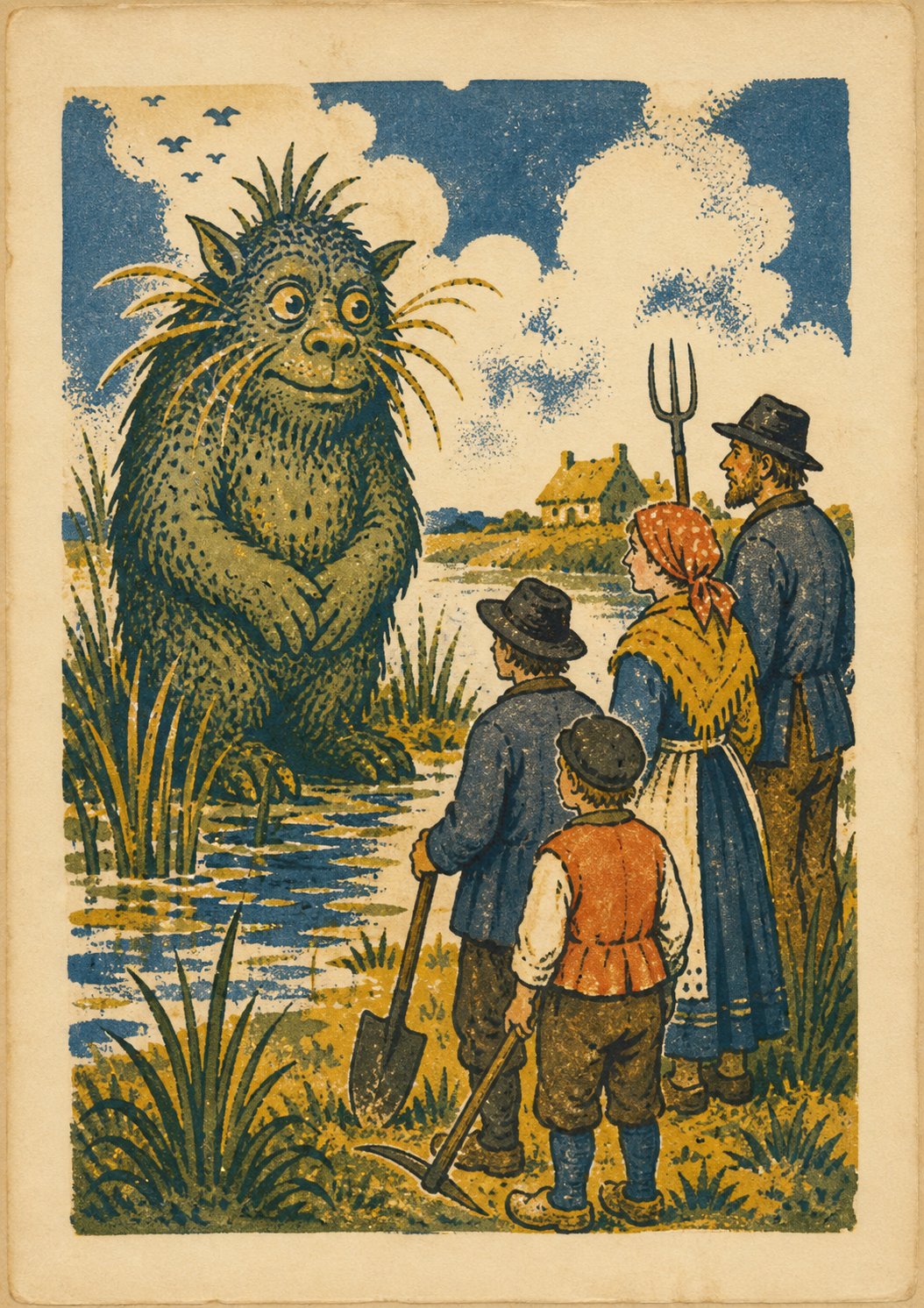
In the damp, moss-choked, cabbage-smelling heart of Sogmarsh — in the Bogmoor, a cart-ride south of Mucklecombe — where the fog hangs low and the dreams hang lower, there lived a lycanthrope named Barnaby.
Barnaby was, on paper, magnificent. He had claws like rusted ditch-hooks, eyes like burning peat-coals, and a frame broad enough to blot out a full moon. He was built, root and marrow, for the ancient and terrible traditions of night-stalking.
He had never once tasted blood. He had never even tasted a wild berry. For the moment the silver light touched his skin, the curse did not merely bring forth the beast — it brought forth the dander.
Barnaby was profoundly, catastrophically allergic to his own wolf-fur.
Every full moon, the change would take him, and his sinuses would slam shut like a heavy oak door in a draught. While other werewolves spent the night howling at the heavens and curdling the blood of distant villages, Barnaby spent his in a state of violent, undignified suspension, surviving the long hours on lukewarm vegetable broth swallowed whole — because chewing made it altogether too hard to breathe.
"I am the shadow in the — HEE-CHOO!" he would announce, the force of it laying the cattails flat against the marsh-water for forty feet in every direction.
He would set himself to stalk a wandering goose, only for his eyes to swell into two weeping, pink slits. He would draw back his lips to bare his fangs at a lonely traveller, but the tickle would seize his snout first, and out would come a series of wet, rapid-fire snorts that sounded less like a creature of the damned and more like a bagpipe being slowly sat upon. The local folk did not lock their doors on full-moon nights. They left bowls of chamomile tea on their porches, and oversized handkerchiefs, out of sheer pity.
The worst of it came one Tuesday under a perfectly round and frankly mocking moon, when the itch struck him with the force of a falling chimney. He needed to wipe his nose. He needed a rag, a cloth, a bedsheet, anything softer than the coarse marsh-grass — and out of the corner of one streaming eye he caught a blur of soft grey fluff.
A rag! his fevered mind cried. He spun and snapped at it. Missed. Spun faster. Round and round he went, a seven-foot engine of primeval destruction reduced to a self-contained hurricane, jaws snapping inches from his own rear, whimpering, "just — snort — just let me — wheeze — wipe—"
He was chasing his own tail. The frogs stopped croaking to watch. It was a deeply depressing spectacle. He danced himself dizzy straight into a ditch and landed on his back with his legs in the air, sob-sneezing at the stars, looking less like a monster than an overturned, weeping carpet.
And here is the thing that broke him, a little: a family of field-mice — creatures that should, by every rule of the food chain, have been a light snack — paddled out of their nest in an old boot. They did not run. They did not scream. Moved by a profound and agonising pity, they dragged a large dock-leaf across the mud and gently patted it against his streaming nose.
Barnaby whistled a long, shuddering note through his blocked nostrils, too exhausted to eat them and too congested to care. He was, he decided, a failure. His worst self — the great and terrible beast he was born to be — was utterly, comprehensively ruined.
Then came the autumn the iron-miners marched into Sogmarsh.
They came with axes and heavy boots and a plan to drain the bog, fell the willows, and drive out everything that lived in the muck. Barnaby, caught in the silver light atop a peat mound, looked down at them and felt the old fury rise. Now, he thought. Now I will finally be the nightmare. He reared up. He filled his vast lungs. He drew breath for a howl that would empty their bowels and salt their dreams for a generation —
— and the damp marsh air rolled up off the water and mingled, sweetly and catastrophically, with his freshly-sprouted coat.
His nostrils twitched. His ears flapped. His golden eyes crossed.
"AAAAAH — HHH — PEE-TSCHOOOO!"
The sneeze was not a sound. It was a geological event. It did not merely rattle the miners' teeth — it shook loose a great hanging shelf of sodden peat from the bluff above their heads, which came down with a single enormous, merciful SPLAT, burying the entire company to the chest and pinning them, quite harmlessly, where they stood.
Dazed, plastered head to boot in cold black muck, they looked up — at a giant, teary-eyed wolf who was, at that exact moment, trying to wipe his nose on a willow branch. Whatever courage iron-mining had given them deserted them now entirely. They tore themselves out of the mud and fled Sogmarsh, and they did not come back.
Barnaby sat down slowly in the cold ooze, gave one last small, pathetic wheeze, and — for the first time in his entire cursed life — smiled.
The flaw you pray hardest to lose may be the very thing that saves everyone's skin — your own included.

Tale 22THE ROSETTE

I am a rosette. I was red once. I would ask you to take that on faith, as everyone else has to.
I have been rained on since 1989 — not constantly, but as near to constantly as makes no odds in this realm — and I have been pinned, every day of it, over the heart of Sir Reginald "Reggie" Thwackbottom: the Rt. Hon., the Member for Sogmarsh & the Greater Boglands, the people's champion, the man of the marshes, hand on my heart.
I want to be exact about that last part, because I am the only witness in the realm with the standing to testify. When he says hand on my heart — and he says it the way other men breathe — the hand comes up and lands flat upon me, and I am pressed to his chest, and so I can report to you, under oath, the one fact about Reggie Thwackbottom that nobody else can:
The heart is there. And it beats hardest on the word "honest." Every single time.
I shall let you decide, over the course of this story, what that is evidence of. I have had thirty-odd years, and I am still deciding.
This is the story of the Peatdike election, which we walked to overnight, through a flood, arriving with the dawn and half the river.
You will want to know what was being elected. So did Peatdike. The post was Fen-Reeve — which is the person who decides, when two ditches disagree, which of them is right. It carries no wage, no cottage, and no thanks; it carries a rod, a duty to be stood in cold water while both ditches' families shout at you, and a strong likelihood of being blamed for the weather. It had fallen vacant in the usual way, which is that the last Fen-Reeve had finally got his boots dry and refused, politely and from behind a locked door, to ever get them wet again.
We had heard about it two parishes away. My man can hear a vacancy the way a gull hears a dropped chip.
By the time Peatdike woke, he was up on the back of a borrowed cart in the drizzle, hat in both hands, and I was pinned fresh over his heart — straightened twice, though nobody straightens a rosette for the mud's benefit — and the speech was already at full sail.
I have heard the speech, at a modest estimate, eleven hundred times. It is never the same twice, and it is always identical. It has the origin, the hardship, the triumph, and the vow, and each of them grows a little between parishes, like a marrow.
That morning in Peatdike, he was raised in a caravan on the marsh edge — which is true, and I can vouch for it, and it wants no improving. By the second telling, outside the peat-stacks, it had become a coracle. By the third, at the communal fire, it was the mist itself, and a woman stirring the pot asked, not unkindly, whether the mist had been terribly proud of him, and he said, hand upon me, that it had never once written, and that he had forgiven it — and the whole fire-circle laughed, and he glowed, and took it for support.
He was told at school he would never amount to anything more than a prize-winning leek grower. He tells this one everywhere, as the wound that made him. What he does not tell them — what he has never once told anybody, in eleven hundred speeches — is that the leeks are real, and have won things, and that I have been pinned to his coat at three vegetable shows where he stood beside a leek the size of a rowing-boat oar with his face as soft as I have ever seen it. He thinks the leeks are the failure. He campaigns on the wound and hides the actual medal. I have given up rustling at him about it.
And the limp. The famous limp, the first limp in the realm to stand in every constituency simultaneously. I am positioned, you understand, where I can feel the man walk.
It changes legs depending on which side of the room the voters are sitting.
I do not believe he knows. That is the part I need you to understand about my man, and it is the part nobody in the taprooms believes: he is not lying. I am pinned to the chest of the one man in Sogmarsh who has never once, in my thirty years, said a thing he did not, in the moment of saying it, wholly believe. The limp moves. The caravan becomes a coracle. The heart underneath me bangs like a proud drum on the word "honest." All of it, all at once, all sincere. There is a gentleman in a damp coat who sells property on the same principle, and the two of them once shook hands for a full minute, each certain he had at last met the realm's other honest man, and I felt the heart under me going like a wedding bell.
Peatdike gave us the full day. Peatdike gave us tea.
I must say something about the tea, because the tea is the thing I have never got to the bottom of. In thirty years and — he keeps the count himself, in a wet notebook — four hundred and eleven elections, no door in this realm has ever been shut in his face. The tea is always poured. The chair is always pulled out. The old men walk with him along the ditches and point out the bad culverts as if to a colleague; the children follow the cart; the women at the fire feed him twice and wrap a third portion "for the road." They ask after his leeks. They ask after Kevin, the pike, of whom the less said the better, except that the Labrador has never contradicted the story, which my man regards as decisive.
They love him. I am a rosette; we are manufactured to know a crowd; I am telling you, they love him.
And at the count — which in Peatdike, as everywhere, is counted in boots, not heads: stood in a row outside the meeting-hut, one boot per household, and a man may send his boots if honest work detains him — at the count, when the Fen-Reeve's rod went to its winner, the number of boots stood beside the name of Sir Reginald "Reggie" Thwackbottom, the people's champion, the best-fed man on the fen, the only candidate who had campaigned, the only man present who wanted it —
was none.
Not one boot. Four hundred and eleven elections. Not one boot, ever, anywhere, in thirty years.
The rod went to Jethro Podd.
I want you to picture Jethro Podd, because he is the other half of this story. A peat-cutter. Arms like wet oak. He had not stood for the post. He had, in point of fact, hidden behind the peat-stacks when the nominating started, and been fetched out by his own mother, and he took the oath of the Fen-Reeve in the rain with the expression of a man being measured for something he had specifically said he did not want, protesting quietly all the way through it, while the whole of Peatdike nodded with satisfaction and my man applauded warmly from the back.
That is how it is done here. I have watched it four hundred and eleven times. The parish hunts its officers like a press-gang hunts sailors, and the one man running toward the post with his arms open is the one man the parish steps around, gently, with tea. Nobody has ever explained it to him. Nobody has ever explained it to me, and I have had time to think, pinned out here in the rain, and the nearest I have come is this: the parish can smell wanting the way I can smell rain coming, and it has decided — long ago, in its bones, for reasons it has never had to say aloud — that the wanting and the rod are never to be kept in the same man.
He took it, as he takes all four hundred and eleven of them, with tremendous grace and total incomprehension. He shook Jethro Podd's unwilling hand. He called it "a strong result for the movement." He is the movement. He updated the wet notebook. Moral victory, he wrote. He writes that every time. The notebook is nothing but moral victories and rain.
And then — and here is the part I stay for; here is why I have not let the rust take my pin in thirty years of weather —
on the road out of Peatdike, past the last house, where no voter could see and no vote was left to win, we came upon a parlour with the flood still standing in it, and an old man standing in the flood, bailing, alone, slow, with a saucepan.
And my man stopped the cart.
He took off the good coat — I go with the coat; I was hung on the gatepost; I had the whole of it in view — and he rolled up his sleeves, and he went in, and he bailed that parlour for two hours and ten minutes by the church clock, in his shirt, in the cold, properly, the way a man bails who did twelve years of it for wages: fast at the corners, patient at the hearth, kind to the furniture. He unblocked the ditch outside. He listened to the whole of the old man's account of a stubborn bulrush, and asked a follow-up question, and meant it. And he never mentioned it at the next hustings, and he has never mentioned it at any hustings, not once in thirty years — the one true thing, the thing he is actually made of, the thing every parish somehow knows about him anyway, which is why the tea is always poured.
He campaigns on the mist and the coracle and the limp. He keeps the drainage to himself, like the leeks.
I have decided — I said I was still deciding, but there on the gatepost, watching the saucepan, I decided — that I am pinned to him for good, whatever colour I end up.
We slept in a barn. In the morning he brushed the coat, straightened me — twice — and consulted the wet notebook, where it seems there is shortly to be an election in Sodden Bottom for the post of Warden of the Chapel Bell, the bell being underwater, the wardenship being therefore chiefly ceremonial, the ceremony being therefore, in his words, "exactly where a man of vision can make a difference."
Four hundred and twelve.
Hand on my heart.
The moral, from the gatepost: a parish is wiser than it can say — it will pour tea for a man's true self and vote for it never, and both of these, together, are how it loves him. And if you must be made entirely of wanting, want the way Reggie Thwackbottom wants: out loud, in the rain, forever, with your hand on your heart — and do your real good on the road out of town, where nobody is counting. The heart, I can report, is there. I have felt it. It beats hardest on the word "honest." I no longer believe that is a lie. I believe it is a vote — the one vote he has ever won, cast daily, from the inside, and counted by nobody but me.
Tale 41A MATTER OF BREEDING
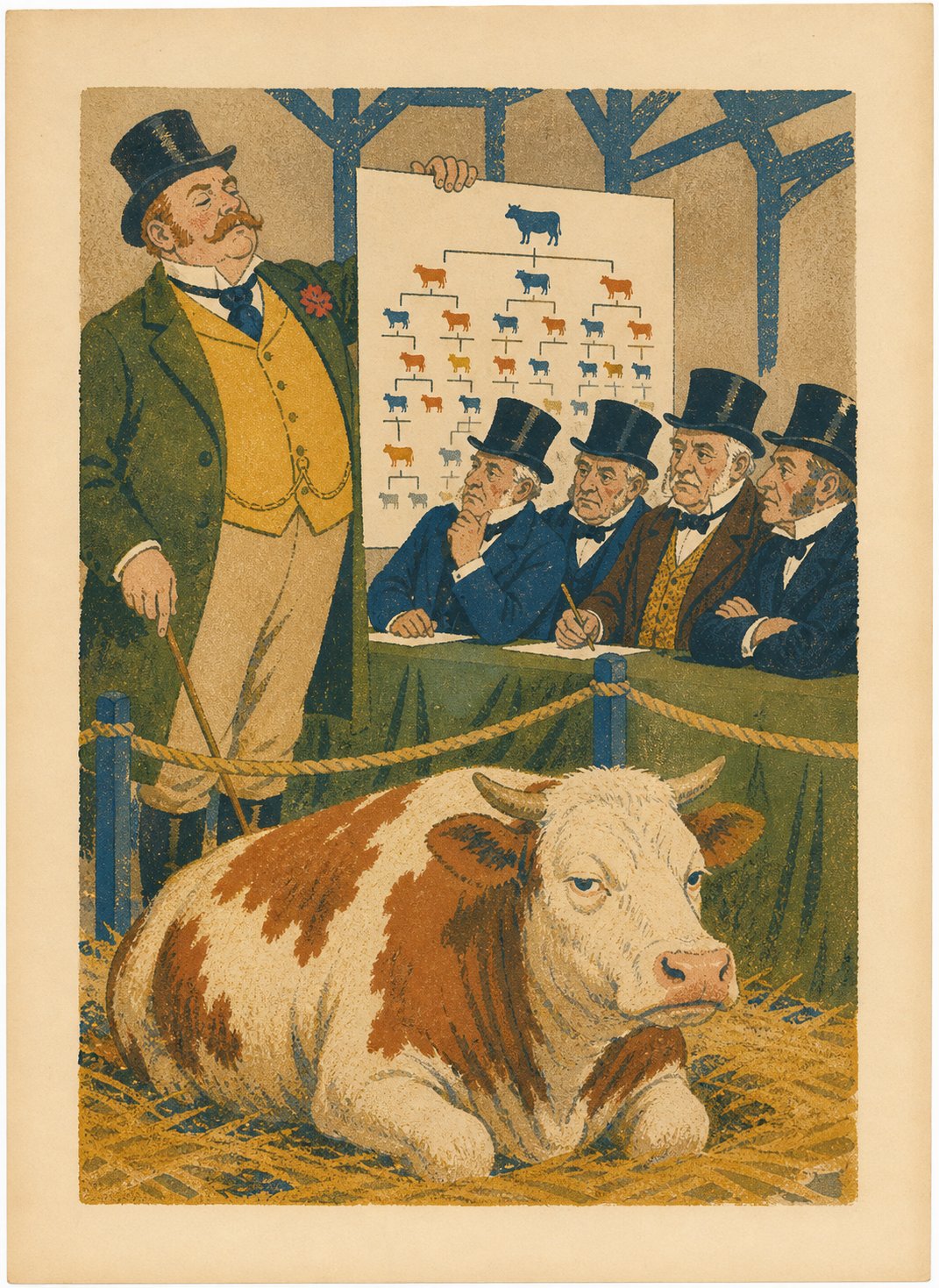
Lord Percival "Perry" Bastable XXVII came down into the village on a Tuesday, which is the day the water is measured and therefore the day nothing else in the parish is getting done, and he came down for the oldest of reasons, which is that there was nothing to eat up at the castle and a great deal of pride to be eaten instead.
He would not have called it that. He would have called it taking the air, and he took it magnificently, in a coat that had been very good in 1841 and had been going off, with enormous dignity, ever since — much like its owner, and much like the whole line of Bastables, of which Perry was, though he would drink rather than say it, the last.
And he came to the door of Goodman Barm, the baker, because Goodman Barm's shop was warm and smelt of bread, and because a lord may stand in a warm doorway for a surprisingly long time before anyone has the standing to ask him to buy something.
Now, you should understand Goodman Barm, because the whole of this turns on him. He was a big, calm, floury man whose bread rose — every loaf, every morning, no matter the wet — and whose fortunes had risen with it, quietly, over thirty years, until he was, though nobody in the parish would have put it so rudely, a good deal richer than the castle. He had four healthy children, a sound roof, and a starter of leaven he had kept alive and fed for so long that it was older than Perry and in considerably better condition.
Perry looked at him for a while, in the doorway, with the particular expression of a man loading a joke.
Because that is Perry's gift, and it is worth being fair to him about it: he is genuinely, baroquely funny, and he knows the parish will forgive a great deal from a man who makes it laugh, and he has been living on that credit for years, having no other kind left.
"Are you a baker?" said Perry.
"I am, my lord," said Goodman Barm, who could see the shape of it coming the way you see weather coming off the Slough, and stood square to it.
"Ah," said Perry, and let it land in his own time, the way the good ones do. "Forgive me. I only wondered — you have rather the look of the interbred about you."
And it was, everyone agreed afterwards, a lovely joke. It is a breeding joke and a bread joke at once, and it is exactly the kind Perry does best — the sort that sounds like a compliment for a whole second before it turns — and two lads by the trough laughed before they could stop themselves, and were sorry, and told their mothers so.
Goodman Barm did not laugh, and did not scowl. He wiped his hands on his apron, and thought about it, the way a man thinks about whether a loaf is done, and then he said the only thing he said in the whole affair, and he said it kindly, which was the worst of it:
"That'll be the bread, my lord. It comes of turning it. You have to keep working the same stock, over and over, hand over hand, and feed it, and never once let it sit — or it goes sour, and falls, and won't rise again." He nodded, quite gently, up the hill toward the castle. "I've a starter older than your house. Difference is, I've turned mine."
There was a silence in that doorway of the particular quality you get when a joke has gone all the way round the parish and come back by the other road.
Because everyone standing there did the sum. The Bastables had the oldest blood in the valley and had done nothing with it but keep it, and marry it back into itself, and let it sit, generation on generation, in a cold house with a hole in the roof — until it had gone exactly the way Barm's leaven would have gone, untended: sour, and sunk, and unable to rise. Perry was the last of it, broke and grand in a doorway, cadging warmth off a baker.
Perry, to his enormous credit, and this is why the parish keeps him, understood it completely and at once.
He stood a moment. Then he inclined his head — properly, the bow he gave to equals, which the parish had not seen him give to a tradesman in living memory — and he said, "Yes. Quite. Well turned, Goodman Barm," and he bought a loaf, at the full price, in coin he could ill spare, and he carried it up the hill himself.
He ate it, they say, to the last crust, and did not make the joke again, and told it on himself at dinner that night to the Bust, who has opinions, and who agreed with the baker, which Perry found unbecoming but did not dispute.
A joke about breeding is a mirror with a laugh painted on it. Make one at a man's expense, and be very sure your own stock has been turned — because the parish is doing the sum while you deliver the line, and the oldest blood in the valley is worth nothing at all if it has been left to sit and sour, and a baker who feeds his leaven every morning of his life has better breeding than a lord who has only ever kept his.