At Least It's Not the Griddle
The Tales
Tale 69THE SURVEYOR WHOSE PROOF CAUGHT FIRE
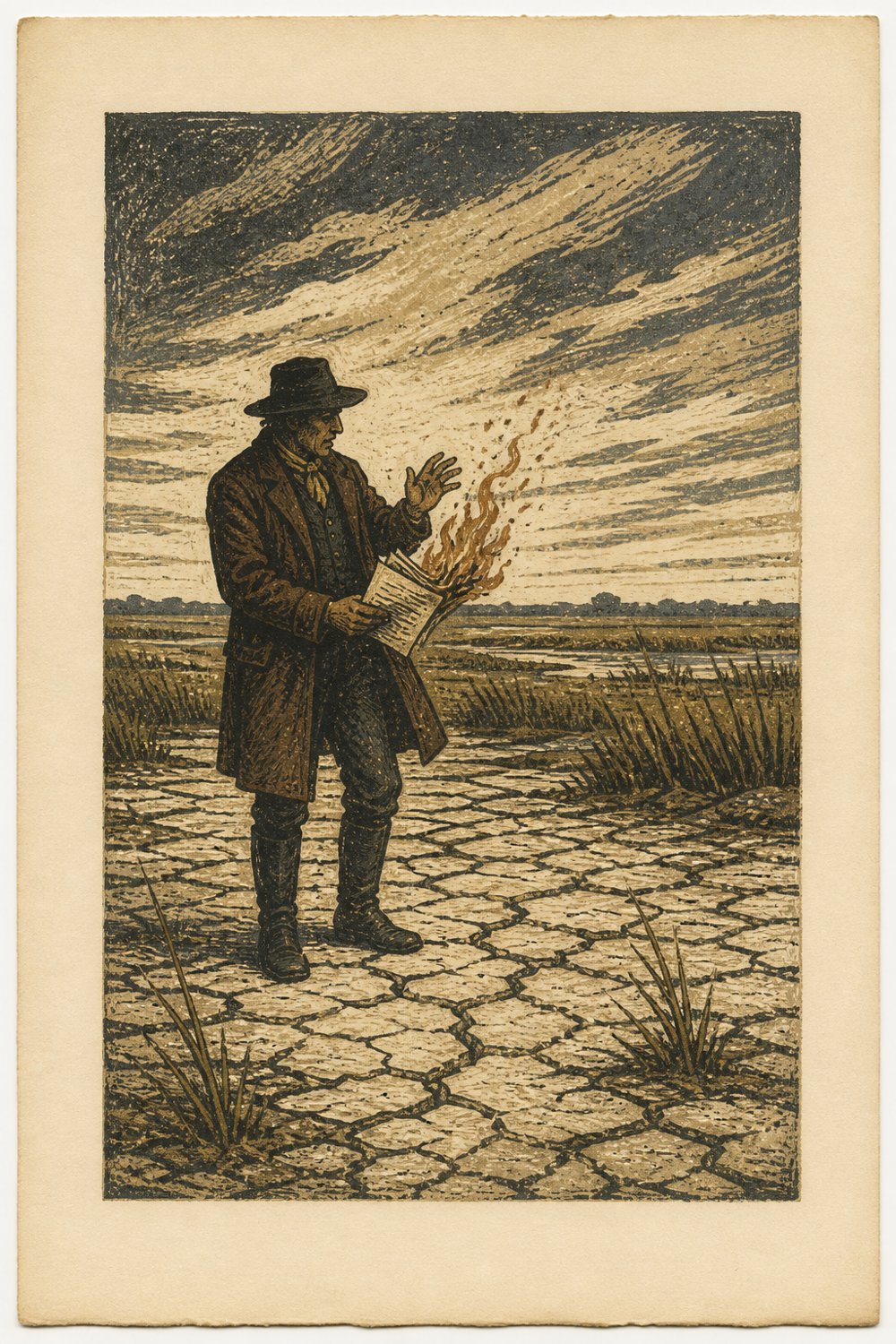
There is a place in the far south that the whole realm calls the Griddle, where the ground is dry — which, in Sogmarsh, is very nearly an accusation — and cracks like an old plate left too near the fire, and grows nothing, and now and then goes suddenly, viciously hot for no reason anybody can give. The people on its edge believe that Someone, up there, has left a burning-glass trained on that one spot of the map. There are three versions of who is holding it, and we need not go into them here, because this is not their story. This is the story of the one man who did not believe in any of them.
His name was Endacott, and he was the finest surveyor the Grand Cartographic Revision Committee ever ruined.
Endacott held, as an article of faith he would not have dignified with the word faith, that everything has a plain cause, and it is a decent man's work to find it and write it down. He had explained the singing culverts of Peatdike (water, moving, under a hollow stone). He had proved the Crooked Compass staircase a mere trick of worn treads and a sloping floor. He had reduced a full dozen of the realm's better hauntings to damp, draught, and arithmetic, and he had done it kindly, because to Endacott a mystery was not a wonder to be guarded but a frightened thing to be let down gently into the ordinary. He loved the moment a marvel went dull in his hands. He thought it the truest mercy his trade could offer.
The Committee's trouble was this: a realm may not, in its own returns, keep a place it cannot account for. Who owned the Griddle was hopeless — it had been contested since before the ledgers — but the cause of the heat was a question, and a question has an answer, and an answer can be filed. They gave Endacott a mule, a season, and their blessing, and sent him south to end it.
He went past the Fat Mile — that thin green seam on the wet edge where the heat and the water meet and the one good ground in the realm grows, and the pickers are brown as nuts and call it the food basket of the world — and then he went up, onto the Griddle proper, where almost nobody goes. And there he measured, alone, for a season.
And he found it.
Nobody remembers this part, because there is no paper by which to remember it, so you will have to take it from me: he found it, and he had it cold. The dry wind that falls off the high country and arrives with the wet already wrung out of it. The pale, hard stone that sheds every drop of water and hurls the sun's heat straight back up. The way a hot gust and a bright bare floor together make the shimmer, and the ticking, and the sudden murderous hikes. He had figures. He had it exactly. It was the happiest season of his life — he had run down the realm's one true mystery and made it ordinary, which was the whole of his joy — and one bright afternoon he sat on the cracked ground and wrote it up, a fair copy, page upon page, meaning to carry it home to Murkminster and read it aloud to the Committee and put the legend in the ground forever.
And a hike came.
The air went to water. The ground ticked and opened. And his papers — the proof, the whole rational account, the entire season's work — caught, all at once, and went up in a single breath, and were black flakes rising past his face before he could so much as get his coat across them.
He saved nothing.
He stood there on the baking ground with the ash of his own handwriting going up into the shimmer, and he understood the joke, and it was not a kind one. The one place whose plain cause he had nailed was the one place that would not permit the cause to be written down.
Now — and here is where he was undone — the rationalist in him was, for about one minute, delighted. Of course it burned. That is the proof. The heat is precisely what I measured; the fire is the confirmation; I have not lost my account, I have had it witnessed, by combustion, in the field. For that one minute it held him up like a plank across a ditch.
Then he saw that he could never say it. A man cannot stand before the Committee and report: I had the answer, and it burned, and the burning was the answer. That is not a return. That is a ghost story with figures in it. The Committee deals in paper. He had no paper. And a surveyor with no paper is, when you come down to it, exactly as empty-handed as a parish that believes in a glass.
So he went home.
The Griddle stayed as legendary as it had ever been. And the people on its edge, hearing that a Committee man had come and gone and his papers had burned, only nodded — they are not gloaters, down there — and said the thing they always say, which closes every question the Griddle has ever raised: closed in favour of the glass.
Endacott never doubted his figures. Not once, to the end of his life. But he had nothing in his hand, and he discovered — slowly, over years, at his desk in the Surveyor's Quarter, filing other men's certainties — that a conviction you cannot produce on paper is not, in the end, to be told apart from a faith. He believed in the dry wind and the pale stone precisely the way the Griddle folk believe in the burning-glass: completely, warmly, and without a single shred of evidence to his name. He, who had spent his whole life turning wonders into arithmetic, had been turned by one afternoon into a man of belief — and he could no longer tell, and this was the thing that quietly hollowed him out, whether his certainty was any better than theirs, or merely louder.
When young surveyors asked him about the Griddle — and they did, it being the Committee's oldest embarrassment — he would say only, "It is the wind and the stone," in a flat voice, and they would write it down, and it would mean nothing, because he could not show them, and a truth you cannot show is just a story holding its chin up. He never went back. He could not have borne to be right again somewhere it would not stick.
And the Griddle, which eats explanations the way it eats rope and water and hope, simply took him in among its stock, and had a new tale to tell in the dry evenings, and tells it yet: the surveyor who came to end the mystery, and proved it, and watched his proof burn, and went home a believer — which is the one thing the Griddle makes of everybody in the end, whichever god they came in with.
Moral: The realm does not keep its mysteries by hiding the answers. It keeps them by letting one honest man find the answer, and then taking his paper — so that he goes home as certain as a priest and as empty-handed as a fool, and can no longer tell you, or himself, which of the two he has become. A proof you cannot produce is a prayer. Carry which you like — only be honest about which one it is.
Tale 70WATERING THE CRACKS
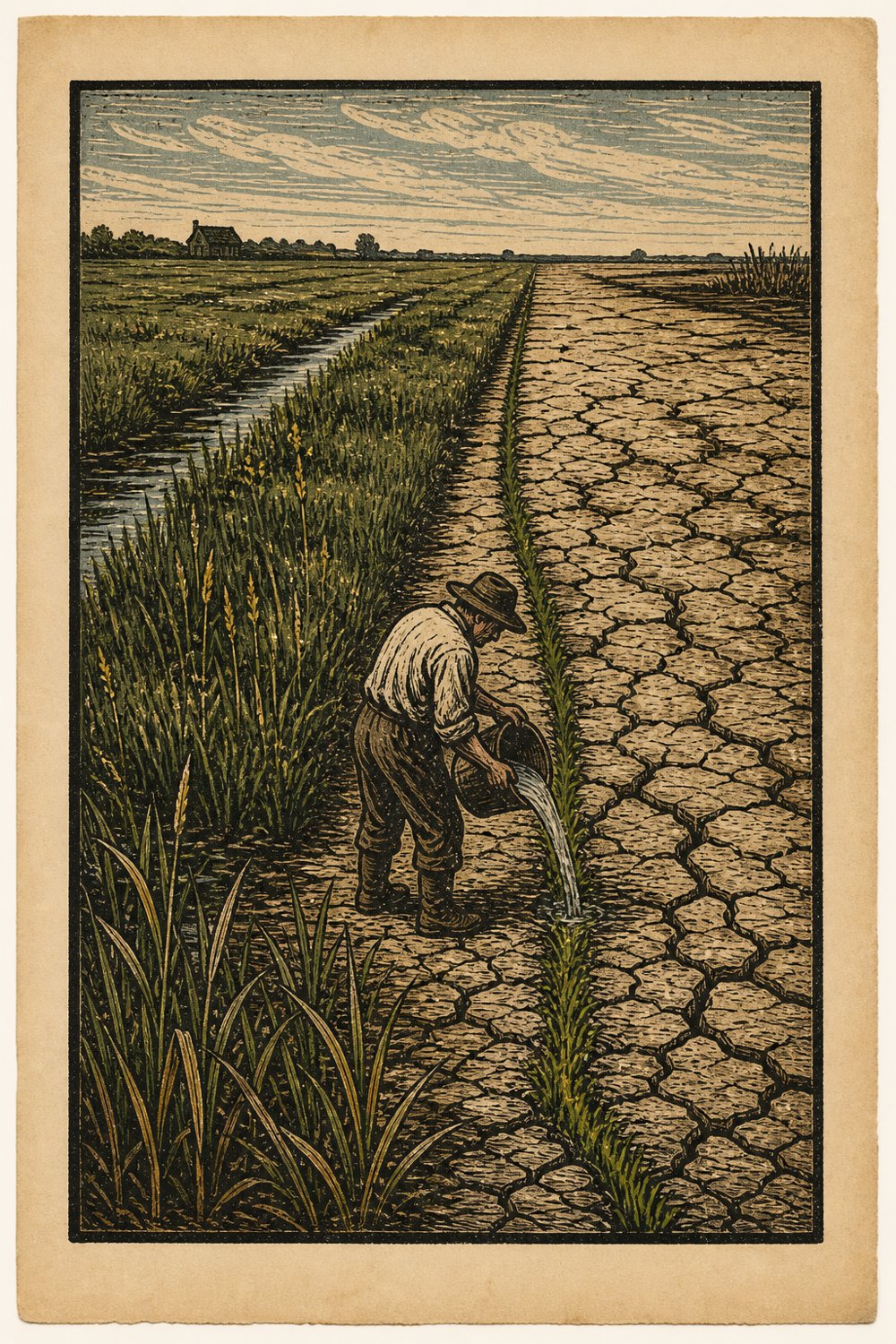
Where the Fat Mile gives out — that thin green seam on the Griddle's wet edge, where the heat and the water meet and everything grows — there is a line. It is the line the surveyors could never fix, the one that will not hold still; and just on the dead side of it, in the last cottage before the ground gives up being ground at all, lives old Gammer Kerne.
Every evening, when the shimmer has gone off the waste and a body can stand on it without their boots complaining, Gammer Kerne fills a single pail at the good wet edge, and carries it out — not onto the Fat Mile, which grows without a soul to help it, but out onto the Griddle proper, the cracked, pale, dead, useless ground beyond — and she pours it, slow and careful, into the cracks. One pail. And then she goes home.
It does nothing. Everybody knows it does nothing. The Griddle takes a pail of water the way the sea takes a single tear: by morning the crack is as pale and dry as if she had never come, and the water is somewhere the water always goes, which is down, and away, and not back. You cannot green a waste with a bucket. A child could tell you. Children have told her, gently, because they are fond of her, and she has thanked them for the information, and gone out the next evening with her pail.
If you ask her why — and strangers do, once — she will tell you about the glass.
You will have heard, if you have got this far south, what the edge believes: that Someone, up there, keeps a burning-glass on this one spot of the map, and that the kindest of the tellings, the one they hold to by day, is that it was no cruelty but an over-kindness — a generous hand that heard a drowning realm beg for dryness and warmth and firm ground and gave the Griddle all of it, and a little too much, and will, one day, notice, and ease the glass, and the Griddle will go green. And on that day, Gammer Kerne will tell you, the ground must be ready. It must not have forgotten how to hold water. It must remember it was ever anything but a griddle. So she waters it. She keeps it in practice for its own greening, against the day the glass is lifted.
That is what she says. It is even true.
Here is the rest of it, which she does not say, and which the whole edge knows and has never once made her speak.
Gammer Kerne did not always carry the pail. She began the year the heat took her man. He went out onto the Griddle on some small errand one bright afternoon, and a hike came, and the ground shone, and he did not come back off it. The Griddle keeps everything. It kept him. There was no bringing him home and there is no grave out there — you cannot dig the cracked stone, and in any case she would not know the place — so she has never known which crack. And that is the reason for the pail, and the reason it is the whole waste and not one spot: she does not know where he is, so she tends them all. Every crack on the Griddle might be the one, and so every crack on the Griddle gets its water, a pail at a time, for as long as she has evenings left to carry it.
She will not say this. She says the thing about the glass, and the greening, and being ready. And the parish lets her — helps her — because the parish on that edge learned a hard lesson not long ago, from a Committee man who came to explain the Griddle and proved it and watched his proof burn, and went home unable to tell his certainty from a prayer. They learned from him that some things are kept only by not being examined, and that a truth you drag into the open is very often a truth you lose. So nobody asks Gammer Kerne what she is really watering. They know. They fill their own pails, and they walk out beside her.
A neighbour, watching her go one evening with her one useless pail against all that dead ground, said the thing that has been said of her ever since, and that the edge now says of hope in general: "The greening is a daily work, not a state." You do not water a thing once and call yourself hopeful and sit down. Hope left untended goes dry as fast as brass left unpolished goes dull — faster — and it must be carried out again every single evening or it has not been carried at all. Gammer Kerne is not watering the ground. She is watering the hope, which is the same as watering herself, and it is a daily work, and she does it daily.
She is very old now, so the children carry the pails. A line of them, at evening, out onto the waste, pouring good water into cracks that will not keep it — and it has become the custom of that whole edge, and no child is ever told it is about a dead man. They are told it is about the greening, against the day the glass is lifted, and they believe it, and they are not wrong, because it is about that — and it is also about him, and about every crack that might be somebody's — and the edge does not sort these apart, because sorting them apart would end the watering, and the watering is the point.
And one evening — this is the last of it — a child tipping out a pail found, down in the crack, a single green shoot. One. Nobody living had ever seen a green thing stand on the Griddle proper.
And here is the whole of what that edge has learned, and the reason this tale is told warm and not sad: they did not ask. They did not send for a surveyor. They did not kneel down and work out whether it was Gammer Kerne's water, or a seed some bird had let fall, or a freak wet season, or the glass itself beginning, at long last, by the width of a single hair, to lift. They looked at it. And they left it. And they watered it. And whether it was still there the next evening, or the evening after — well. Nobody ever found out what it meant, and nobody ever tried, because finding out is how you lose things, and the not-finding-out is the last and best thing the Griddle ever taught anybody.
Gammer Kerne, they say, only nodded when they showed her, and filled her pail, and carried it out to the shoot herself, that evening, the whole slow way, on her own two feet.
Moral: You will one day tend a hope that gives you nothing back — for a person the ground has kept, or a greening that may never come — and the world will be very ready to tell you it is useless, and the world will be right, and it will not matter in the least. Carry the pail anyway. Carry it every evening. And if one day a green thing stands where nothing should — do not ask what it means. Water it, and say nothing, and go on. Some graces keep only as long as you never make them prove themselves.
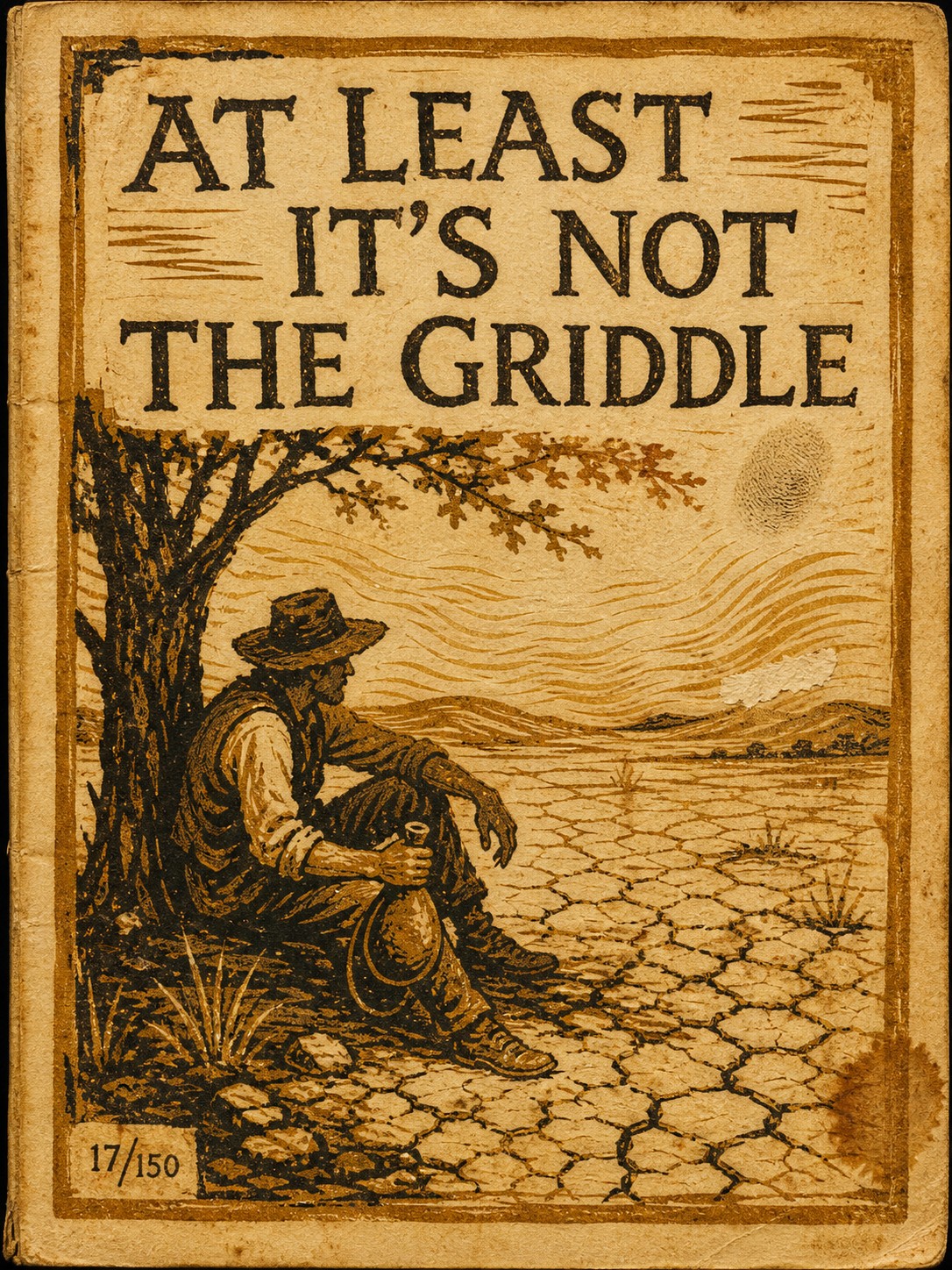
Tale 71AT LEAST IT'S NOT THE GRIDDLE
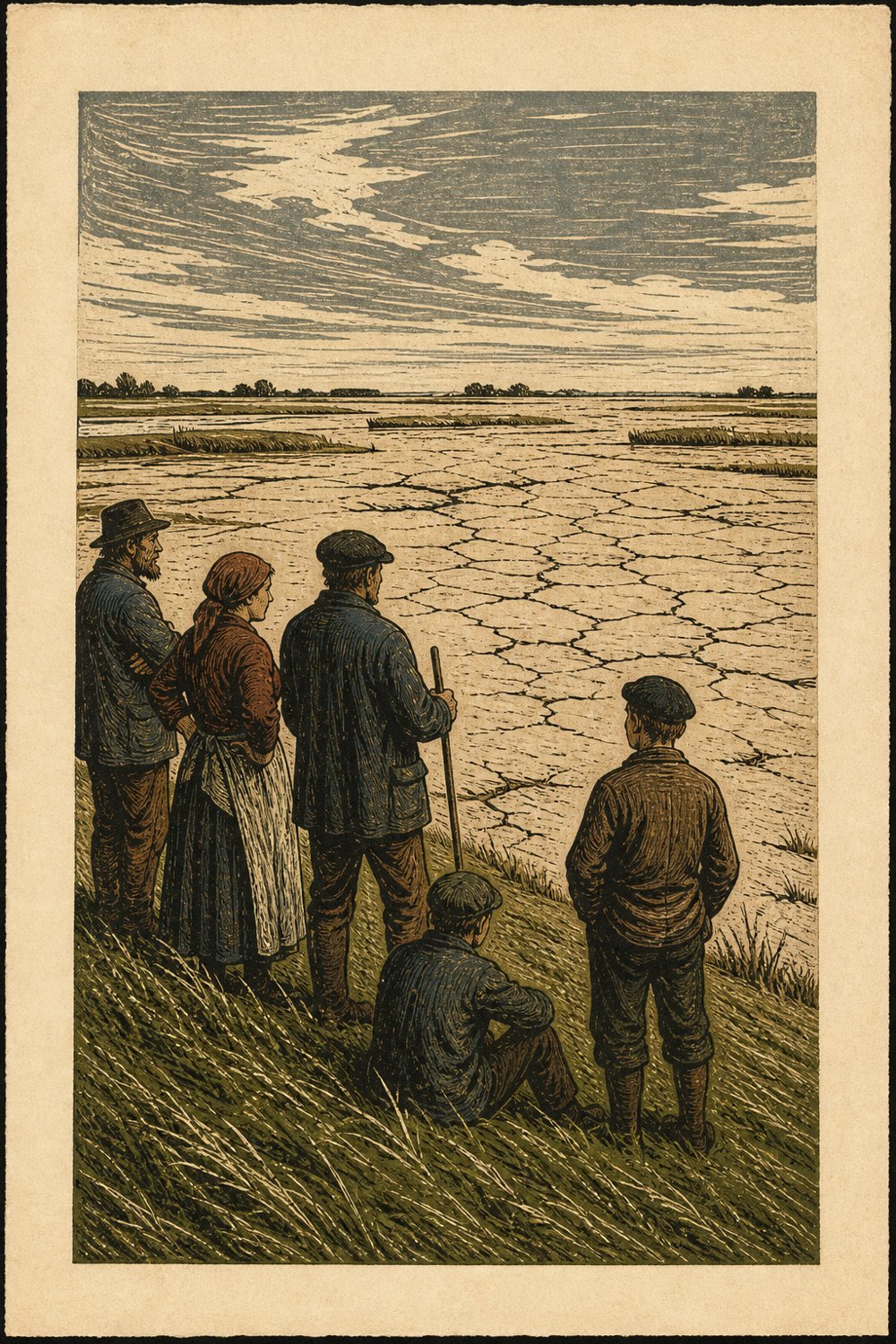
Sodden Bottom is the lowest, wettest parish in the Kingdom of Sogmarsh — the one whose chapel bell rings underwater at high mire — and its people are damp more or less permanently, and bear it with the flat, decent cheerfulness the whole realm is famous for.
Except Wilf Drench.
Wilf Drench was the finest complainer the realm ever produced, and I want to be fair to him, because he was not a lazy grumbler. He was a craftsman. He could tell you the exact quality of a given day's wet — the difference between a damp that gets in at the collar and a damp that comes up through the boots, between a drizzle with ambitions and an honest downpour that at least knows what it is — with a precision the Committee's own surveyors could not have bettered, and he did it all day, every day, to anyone who had not got away in time. And the dreadful thing, the thing that wore the parish down to the grain, was that he was right. Every word. The wet is miserable. Wilf Drench was simply the one man in Sogmarsh who would not sign the realm's great unspoken agreement to pretend it isn't.
They tried everything. They agreed with him, which fed the fire. They ignored him, and he got louder, and more accurate. They sat him on the far pew and he complained about the draught, correctly. There is no arguing a man out of a true thing, and everything Wilf said was true, and the parish was tired in its soul.
So at last they hit on a plan, and dressed it up as an honour. They would send Wilf south — a whole season on the Fat Mile, that thin green seam on the Griddle's edge where the good ground is and real food grows — and they told him he had earned a rest from the wet. What they had earned was a rest from Wilf. Nobody said so. He'd have agreed, and been right.
Wilf went south, complaining the length of the road — the dust, the glare, the company, the alarming dryness — and he came at last to the edge of the Griddle. And there, for the first time in a long and vocal life, Wilf Drench met a thing worse than the rain.
At first, it must be said, he was delighted. A whole new country of misery! Fresh material! He complained about the heat for a fortnight with a vigour and invention that had the Fat Mile folk half in admiration.
But the Griddle is not the wet, and Wilf found it out. The wet is miserable and lets you live. The Griddle is worse and is not especially interested in whether you do. He learned thirst — real thirst, the kind that Sodden Bottom, where a body is never a foot from too much water, keeps no word for. A hike came while he was out on the dead ground and very nearly kept him. And one evening he stood at the line — the cracked, baking, murderous waste on the one hand, and away to the north, soft and grey and endless, the familiar rain of home on the other — and something in Wilf Drench, for the first time in living memory, went quiet.
He came home. And he was not cheerful — let us not tell lies about the man; cheerful was never in him, and asking it would have been asking too much. But the next morning it rained on him, fourteen times before noon, and somebody braced for the usual aria — and Wilf looked up into the grey, and felt the wet come in at his collar in the old familiar way, and said, in a sort of wonder:
"...at least it's not the Griddle."
And put his collar up. And got on.
He had been given the realm's whole consolation the only way it can truly be given — not told, but shown. And here is the part the parish never saw coming. Wilf Drench, who had spent forty years saying the true miserable thing that nobody else would say, spent the rest of his life saying the other true thing. He went about Sodden Bottom, to the drenched and the fed-up and the young ones cursing their boots, and he told them the six words that make a wet realm bearable — at least it's not the Griddle — and he told them with the weight of a man who has been, which no cheerful stay-at-home could ever manage. The parish's loudest complaint had come back its deepest comfort. They had sent him away to be rid of him, and got back the one soul among them with the standing to console.
He brought one thing home from the south: a single piece of Fat Mile fruit, real and ripe and heavy, a thing that grows nowhere in the wet. He gave it to the children of Sodden Bottom to share, and they ate it, and it was the best thing any of them had tasted in their lives, and Wilf watched them eat it and said absolutely nothing at all — which, for Wilf Drench, was an entire speech, and the parish knew it, and let him have it.
Moral: You cannot talk a soul out of its misery; you can only show it worse, and let it do the arithmetic. The realm is not cheerful because it has lied to itself about the rain — it is cheerful because, one way or another, every last one of us has seen the Griddle. And a parish's truest comfort is very often its loudest complainer, come home from somewhere that finally taught him the difference.