A Sogmarsh Wedding
The Tales
Tale 1A SOGMARSH WEDDING
In the boggy hollows of Sogmarsh, where the weather has only ever offered two opinions — damp and more so — there was a wedding. There is always a wedding; the realm is sinking, but it is not, whatever the Cartographic Committee hopes, dying. People go on falling in love in it, which is either very brave or a symptom of the fumes off the Slough; the parish has never settled which.
The couple were young Hob, who cut peat, and young Bryony, who minded the eels, and they had wanted each other since they were small enough to be left in the same dripping doorway. The trouble, as ever, was money — by which Sogmarsh means potatoes. Bryony's people asked nine sacks of King Edwards for her hand; Hob's people had four sacks and a cousin who could be persuaded to count loudly; and the haggling took an entire winter, conducted at full volume across the green, until both families had thoroughly insulted each other's spuds — which, if you know the realm, is not the obstacle to a Sogmarsh wedding.
It is the rehearsal for it.
Because you should understand, before we go a step further, what a Sogmarsh wedding actually is, and it is not the soft business you are picturing. The vow is quiet, and it comes later, and I will get to it. But the part the whole parish comes for — the part the children practise all year, the part that decides whether a marriage is blessed — happens at the chapel door, and it is this:
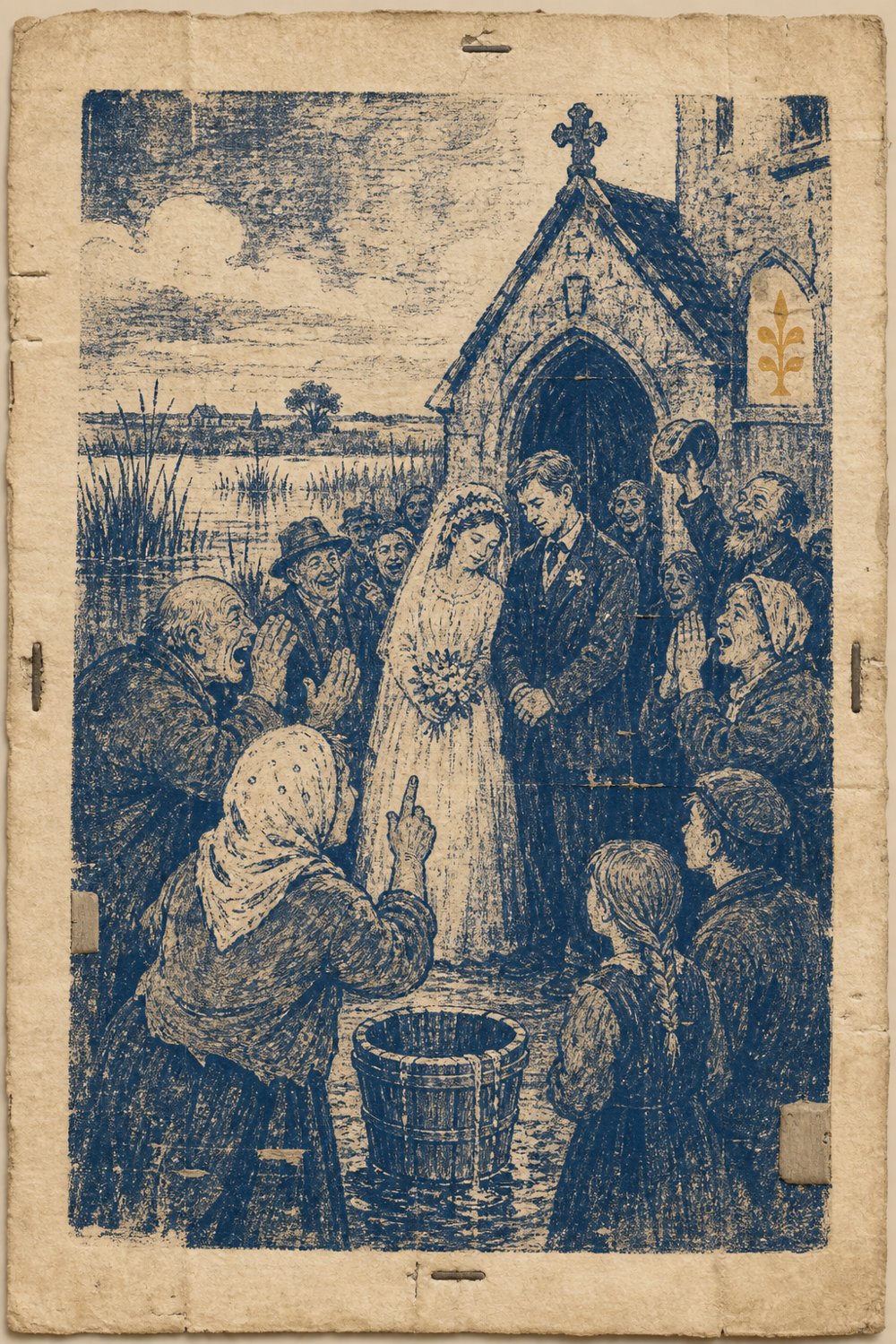
When the bride comes out, the parish curses her.
Loudly. Lovingly. At the very top of its lungs.
The parish calls it the kistomary, and could not tell you why, and does it anyway, and to skip it would doom the harvest, or so they will swear — being, in the way of this realm, entirely wrong and entirely right at once. What they know is the doing of it, and they do it magnificently.
The champions were already massed outside the chapel when Hob and Bryony went in — a dozen of the loudest souls in the parish, in full ceremonial dress, which in Sogmarsh means potato-sack capes and rusted bucket-lids worn as breastplates, and one man (there is always one man) with a colander on his head, taking the whole thing more seriously than anyone has ever taken anything. They had spent, by their own proud account, a fortnight composing. A Sogmarsh insult is not thrown together. It is crafted.
And when the chapel door opened and Bryony stepped out into the drizzle on Hob's arm, the parish drew one enormous breath — and let her have it.
— each delivered with the anguished intensity of a tragedian on his final night, hands flung to the grey heavens, voice breaking on the vowels, two of the champions moved nearly to tears by the sheer quality of their own artistry.
And here is the thing the dry countries could never be made to understand: it is a blessing. The fonder the parish is of a bride, the fouler her send-off. A girl the village did not care for would be waved away in polite, wounding silence — and would know herself unloved to the end of her days. Bryony was cursed for a full four minutes without one repetition. It was among the great send-offs of the decade. Grown women wept at the craftsmanship.
And Bryony did not flinch, or blush, or hurry — because a Sogmarsh bride who cowers at her own cussing has no business at the altar, and she knew it in her bones.
She had come prepared.
From beneath the train of her good grey dress she drew the club — the heavy wooden frying-pan every bride of the parish carries down the aisle for exactly this moment, seasoned black by generations, swung by her own mother before her — and she waded into the barrage, laying about her with a will. She caught the colander-man a ringing blow across his bucket-lid breastplate that sat him down in the mud mid-couplet. She gave back everything she got, and better:
The parish adored her for it. That is the whole tell of a good match in Sogmarsh: not that the bride is gentle, but that she gives back. A woman who can stand in the rain and out-curse an entire village, her mother's frying-pan swinging, is a woman who will still be talking to her husband in fifty years — because she will still have things to say to him, and the breath to say them, and the wit to make them land where they hurt least and mean most.
Hob, for the record, stood through the whole of it beaming like a lamp, and when a cousin cursed his marrow he only nodded, because a man is not cursed on his wedding day. A man just has to watch the woman he loves being told, by everyone who loves her, exactly how magnificent she is — in the only language the parish trusts, which is abuse.
Only after — bruised, hoarse, radiant, the colander-man helped up and forgiven and stood the first drink — did they do the quiet part.
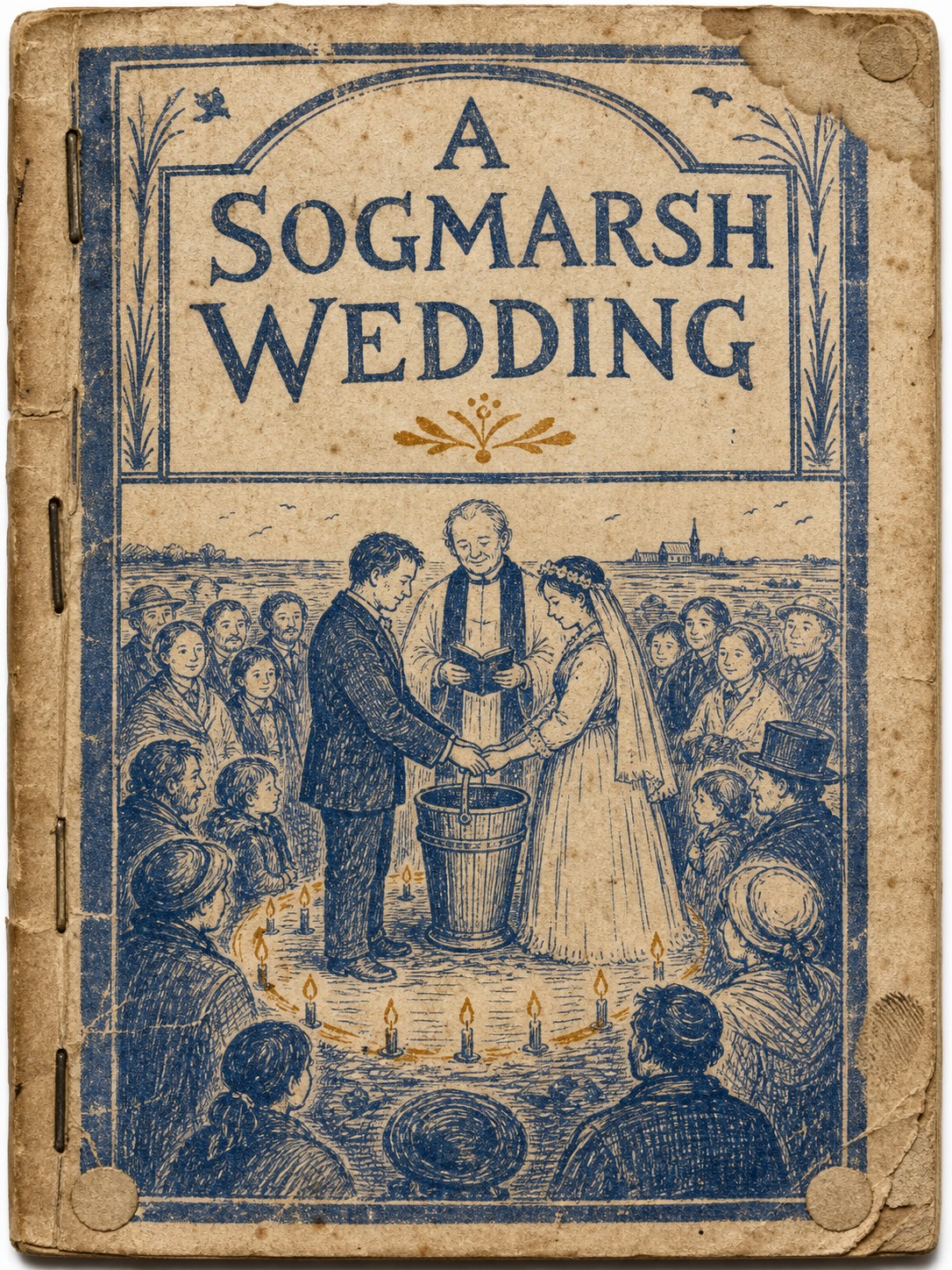
They were married over the bucket. The curate set the parish bucket between them — the one that stands under the worst of the leak — and the pair took the handle together, one hand each, and swore not the soft southern nonsense about sunshine and forever, but the true local vow: to mind the drip together, and to keep holding the handle when it is full. Hob said it. Bryony said it, still catching her breath from the door. The bucket, by long tradition, said nothing, and dripped.
Then the reception, held — as the best ones are — on the firm-ish margin of the moat, in the green shallows the castle still calls, with no evidence whatsoever, the love-lagoon. There was eel. There was peat-smoked everything. There was a cake, three tiers of it, which Old Mother Stilton had been persuaded to bless and which sank, with enormous dignity, four inches into the mire before the speeches were done, so that the happy couple cut the top tier at chest height and pretended this was deliberate.
And then, of course, it rained. It rained the way it rains in Sogmarsh — straight down and sideways at once, with intent — and the cake went under, and the eel jelly slid off the trestle, and the fiddler's fiddle made a noise like a duck being audited. And nobody ran for cover, because there is no cover; there never has been. So the whole parish simply stood where it was, in the rain, in the bog, up to the knees in the love-lagoon, and stayed, because the weather does not improve in Sogmarsh — the weather is the test — and they got soaked to the soul and called it the best wedding in years.
It was, too. Hob got fifty-one years out of it. He said, near the end, that the cussing at the chapel door had been the happiest he had ever been in his life — right up until the fifty years that came after it, every single one of which was better, and louder, and ruder, and kinder.
The moral, from the chapel path: anyone can love in the sunshine, and promise a garden, and mean it in the easy way. A Sogmarsh marriage promises something harder and truer — not a garden but a bog, not sunshine but fifty years of weather — and it is sworn twice: once quietly, over a bucket that will never stop dripping, and once at the top of the lungs, in a hail of magnificent abuse, with a frying-pan. Both vows say the same thing, and it is this: a happy marriage is two miserable people who never once run out of ways to cheer each other up — chiefly by being deafeningly, tenderly, creatively rude to one another, in the rain, for as long as they both shall live. The fonder you are, the worse you are, and you mean every word of it kindly. Mind the drip. Mind the club. And may your best pig learn your name.
Tale 14THE FIRST WONDERING NIGHT
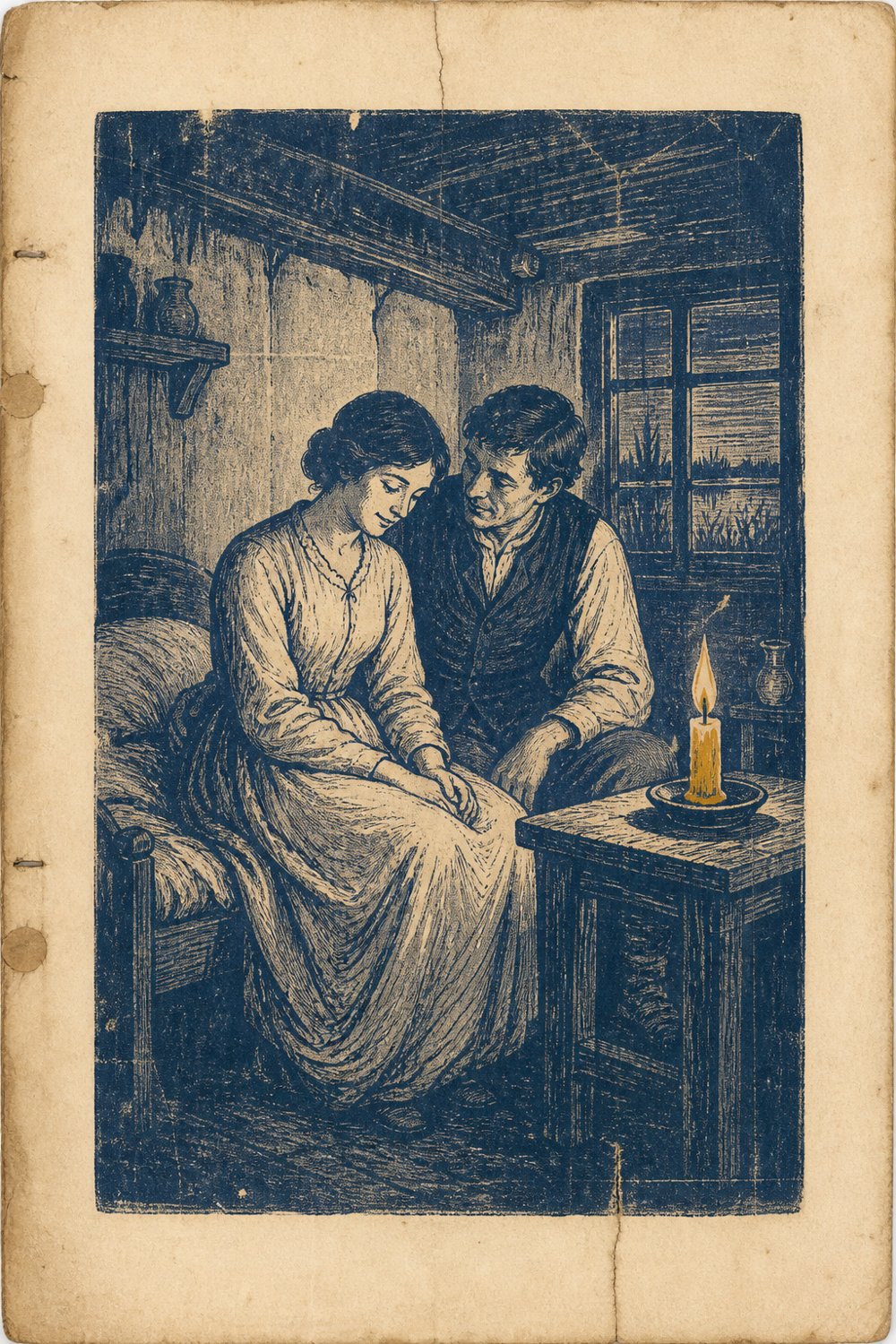
In Mucklecombe, the sensible village, there is a coming-of-age, and it is not what the dry world would guess. There is no hunt, no fast, no climbing of anything. When a child is judged old enough — which is to say, young enough still to mean it — they are taken out, on the foggiest evening of the year, to the edge of the peat where the world goes white, and they are told to ask the fog a question.
This is the Wondering Night. The grown folk gather behind with lanterns and say nothing. The point is not to be answered. The point is the asking — to stand at the edge of everything you cannot know and not run from it. The best questions are written down afterward and posted, with great ceremony, to the Grand Cartographic Revision Committee in Murkminster, who file them all under "Sedition — Mild" and never reply, which the village considers a kind of victory.
My turn came the autumn I was eleven. I had a question ready — a clever one, I thought, to impress the lanterns: why does the castle sink an inch a year, but the Griddle stay bone dry? I had rehearsed it. I meant to perform it.
But when I got to the white edge, with the cold of it on my face and the whole unknowable dark of the realm breathing out at me, the clever question went out of my head, and what came up instead was smaller and truer and frightening to say aloud:
"Is anyone out there? And are they lonely, like me?"
And the fog — I have never told the grown folk this, because they would only worry — the fog answered.
Not in words, exactly. It came back the way a deep pond gives you back your own face, changed: a soft pressure, a turning-over in the white, and then, settling into me from no direction at all, two more questions, gentle as a hand on the head —
"Why do you want there to be? And what will you do, if the answer is yes?"
I did not have answers. I stood there with my eyes stinging and my heart going, and behind me the lanterns waited, and I understood, all at once, the thing the Wondering Night is really for: the fog does not give you answers because answers are a way of being finished with something. It gives you better questions, because a better question keeps you alive to the world a while longer.
The grandmothers say the fog only answers the young, and only ever like that, and that one day I will be too old to be answered — that the asking will get harder, the white will go quiet, and I will become, like the surveyors and the tax men and all the certain grown people, someone the fog has nothing left to say to. I believe them. I felt the edge of it even then. So I wrote my question down — both of mine, and both of its — and posted them to the Committee, who filed me under Sedition, Mild, and I have spent every year since trying to stay the kind of person the fog still bothers with.
The wisest answer a child ever gets is a better question — and the trick of a whole life is staying young enough to be asked one.
Tale 24THE TUESDAY CHILD
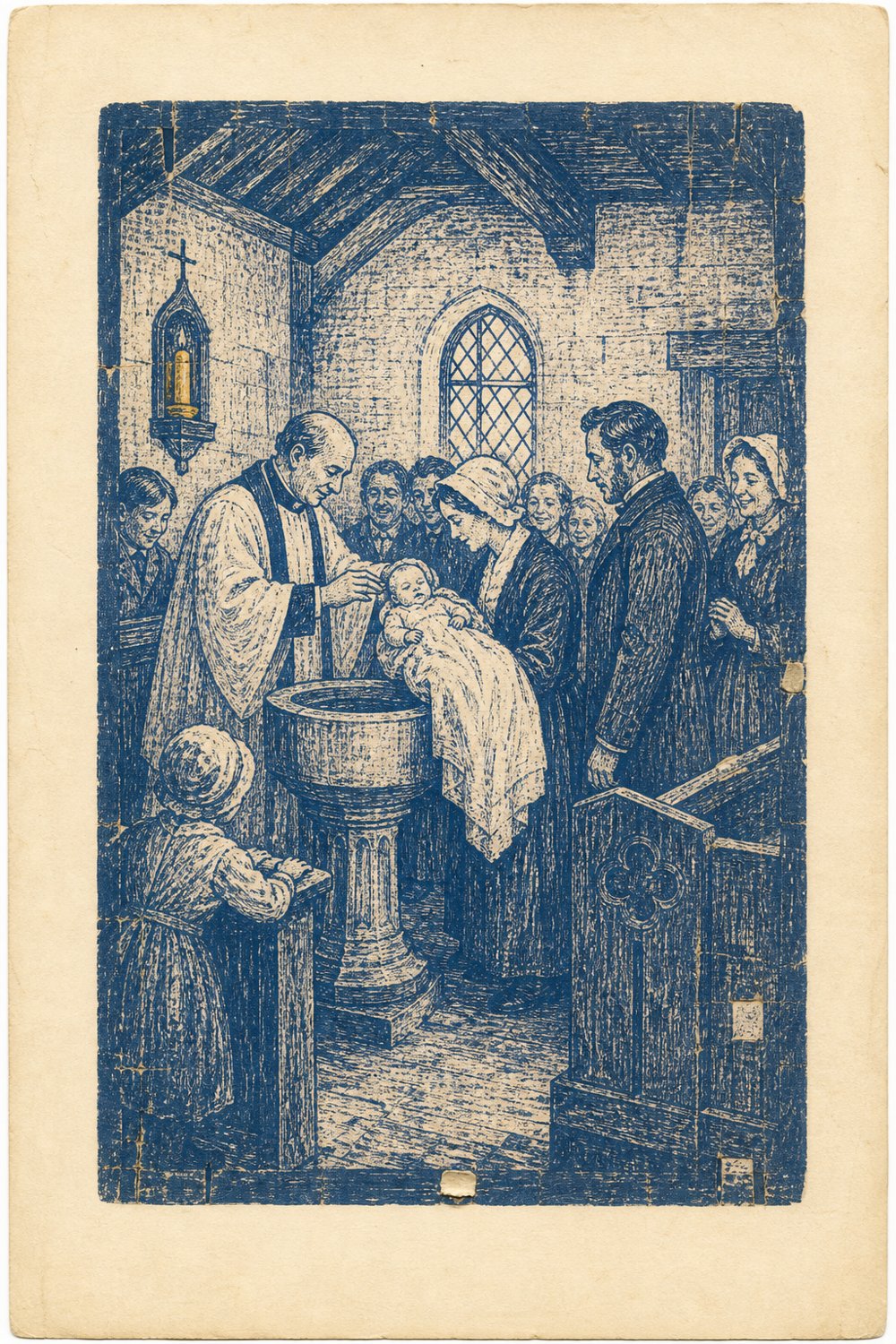
My brother Wick was not a changeling, and I am the only one who never needed telling.
I will grant you he gave the parish a great deal to work with. He did not cry to be picked up, which frightened my mother more than crying ever could — a baby who does not mind being put down is a baby, the whisper goes, who was never quite yours to begin with. He would not look at your face; he looked past it, at the candle, or the window, or a bit of the ceiling that the rest of us had never found interesting and he plainly did. He lined the spoons up along the hearth by size, smallest to largest, every evening, and if you moved one he would put it back without a word and without a fuss, and he could do this for an hour, and be happy the whole time in a way none of the rest of us managed for five minutes together.
And the bells. When the chapel bell rang he screamed as though it were ringing inside his own head, which — I have thought about this a great deal — it very likely was, because Wick heard everything, all of it, all at once, and could not put any of it down the way you and I do without noticing we are doing it.
So. A quiet baby who would not be held, would not meet your eye, ordered the cutlery, and shrieked at the Lord's own bell. You can see how the story wrote itself. The parish did not even have to think.
Changeling. The word went round Mucklecombe the way words do — not said to your face, but arriving in your kitchen anyway, on the shoes of everyone who came in. The fair folk had been at the cradle. They had taken my mother's real boy — the one who would have cried and clung and looked up at her and been, in every particular, an ordinary comfort — and left this cold changed thing in his place, this stock, this fetch, this not-Wick, to be raised at her expense and love in place of her own.
I want you to understand what that did to my mother, because it is the whole of the tale. It was not that she stopped loving him. It was worse. It was that the story gave her permission to grieve a baby who was sitting right there on the hearth, lining up the spoons. She began to mourn the boy she was told she had lost — and every hour she spent mourning that one, she spent not seeing this one. She would look at Wick and her face would do a thing I could not bear, which was hope — hope that today he would turn out to be the other child after all, the returned one, the ordinary one — and Wick would look past her at the candle, and her face would close.
He was three feet from her and she was waiting for him to come home.
The cunning-man came, of course. There is always a cunning-man, and he is always confident, and he is always wrong, and he is never short of the next thing to try.
He looked at Wick for the length of time it takes to be paid, and pronounced. He gave my mother eggshells to brew, because a changeling, seeing something so daft as a supper cooked in an eggshell, will forget itself and cry out in the voice of its true, ancient, wicked age, and so betray what it is. (Wick watched the eggshells with tremendous interest and said nothing, being fourteen months old.) He gave her iron for the cradle-foot and a coat turned inside out and a rowan twig over the door, and each of them cost, and none of them did anything, because there was nothing there to do anything to — but the cunning-man never runs out, and when the small remedies fail he always, always has the big one.
I heard him start to say it. The old way. The hard way. The one the grandmothers only mouth. You put the changeling out on the— and you make it feel the— so that the fair folk, hearing their own child cry, come to take it back and return the stolen one, and every parish has a tale of a night it was done and a whispered tale of what was found in the morning.
My mother had the eggshell in her hand. She was so tired. She was so frightened. And I saw — I was seven, and I saw it plain, the way you only see things at seven — that she was frightened enough to do it.
That is when Goodwife Muckle put her head round the door, because Goodwife Muckle always knows exactly when to put her head round a door, and I have come to think it is the most useful gift in the whole realm.
She did not shout at the cunning-man. She did something worse to him: she ignored him entirely, the way you ignore a draught, and she sat herself down by the hearth next to Wick, and she watched him line up the spoons, and she said — to the spoons, really, not to any of us —
"I have seen a hundred of these."
Nobody spoke.
"A hundred, near enough, in my time. The quiet ones. The ones that count things. The ones that won't be looked at and won't be held the ordinary way and go off like a kettle at a loud noise." She reached out and moved the smallest spoon, just to see, and Wick reached out and moved it back, and something in her face eased, as though he had passed a test she had not told anyone she was setting. "And do you know how many of them were changelings, Goodwife? Out of the hundred?"
My mother could not answer.
"None," said Muckle. "Not one. There is no such thing, and I'll say it in the chapel if the priest will lend me the pulpit, which he won't. The fair folk did not take your boy. Nobody took your boy. Your boy is there." And she nodded at Wick, plainly, the way you'd point out where you'd left the bread. "He came made a little different, that's all — the way some folk come left-handed, and we don't leave them out on the dungheap, though I'll grant you the parish would if it could think of a story for it. He's not a fetch and he's not a curse and he's not a punishment. He's a Tuesday child. He came on his own day, in his own way, and he is not going to turn into a different boy, not tonight and not ever, and the sooner you stop waiting for the other one to come home, the sooner you'll notice you've had this one the whole while."
And then she said the thing I have kept for thirty years.
"You've been so busy mourning the baby you were told you lost, you've not once said good morning to the one you've got."
My mother put down the eggshell.
I think that is the bravest thing I have ever watched a person do, and she did it sitting still, in a kitchen, in front of a fool who was still talking. She put down the eggshell, and the cunning-man's remedy with it, and the whole warm terrible story that had let her grieve a living child — she put it all down, and she picked Wick up.
Not the way you pick up a baby. That had never worked; that was half of what had frightened her. She picked him up the way Muckle showed her with a tilt of her head — facing out, his back against her, both of them looking at the same window, at the same bit of grey Mucklecombe evening, not at each other.
And Wick, who had never once settled against a shoulder, went quiet against his mother's front, and lifted one hand, and pointed at the window, at nothing I could see —
and a moment later it began to rain.
He had known. He always knew. He knew rain the way I know my own name.
My mother laughed — a wet, cracked, astonished sound — and said, "You knew that was coming, didn't you," not to a changeling, not to a fetch, but to her son, to Wick, the first words she had ever said to the boy who was actually in the room. And he did not look at her, because he never would, but he leaned back the smallest amount into the warm of her, which for Wick was everything, which for Wick was clinging, and I saw her understand that, at last, and get her boy back, who had never been anywhere.
He is grown now, my brother, and I will tell you what the fair folk left us, since the parish was so sure.
They left us the only soul in Mucklecombe who always knows where the cat is. Who can tell you how many geese went over without looking up from his work. Who feels the rain a full hour before the sky admits it, so that no washing of my mother's has been rained on in twenty years, and half the village plans its hay by walking past our gate to see if Wick has brought the tools in. He notices what the rest of us are too busy to notice, and he has never once been unkind, because unkindness is a thing you have to not notice you are doing, and Wick cannot help noticing anything.
The cunning-man, I am glad to say, was run out of three parishes and now sells the same eggshells to the dry countries, where I am told they are believed.
The moral, from his sister: when a thing frightens a village, the village will hand you a story about it before you have finished being frightened, and the story will be confident, and it will be wrong, and it will cost you — and it will let you look straight at what you love and grieve for something else. The child is never a changeling. The child is only ever the child. Put down the eggshell. Say good morning to the one you've got. He has been there the whole while, and he knew it was going to rain.
Tale 59THE WALKING-OUT
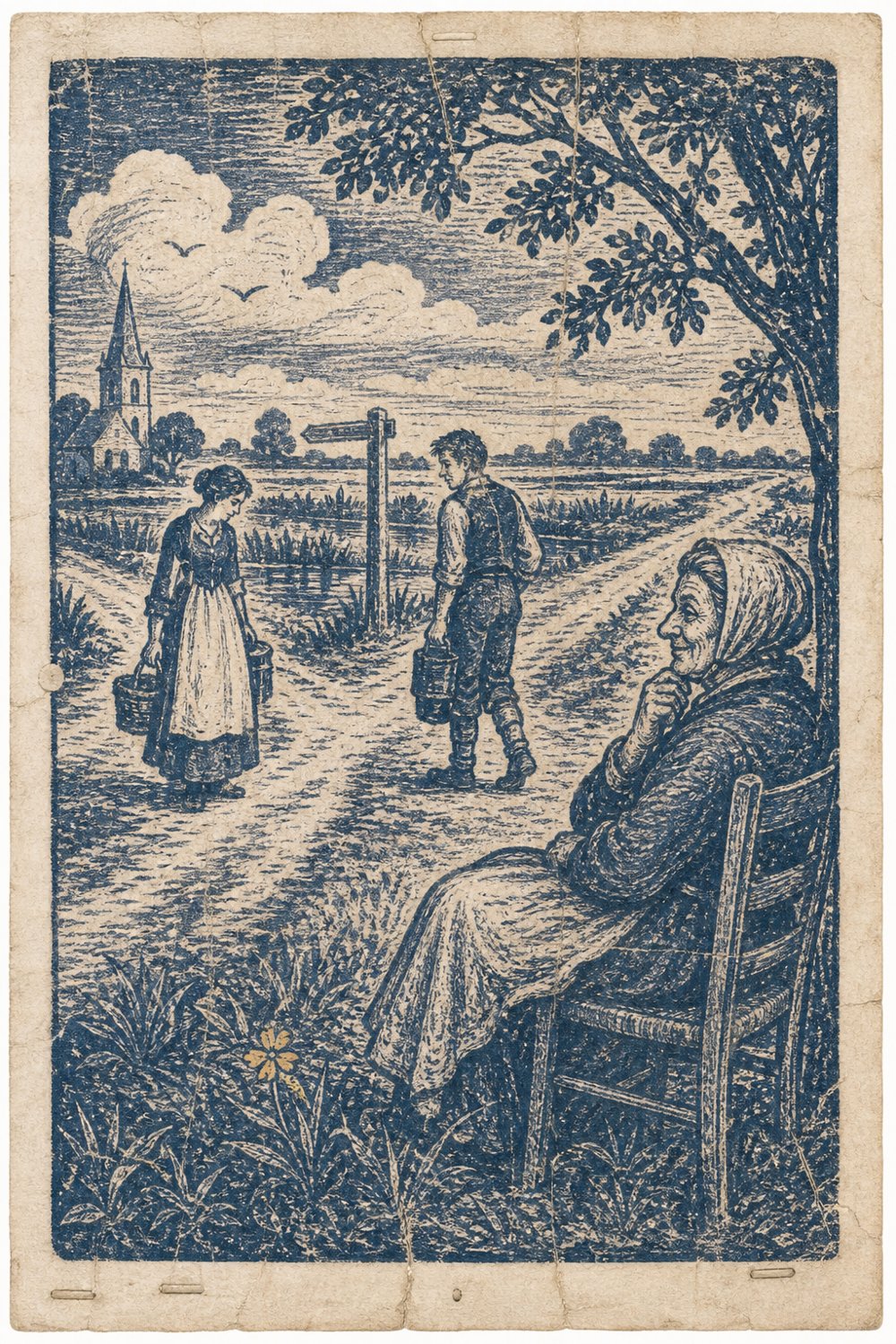
You cannot court indoors in Sogmarsh, because there is nowhere dry, and you cannot court by speaking, because the parish would hear, and the parish hearing is the one thing a courting Sogmarsher will die sooner than allow.
So the realm courts by walking.
A young man is sent to fetch a thing from Drudgeford. A young woman is sent to fetch a thing from Drudgeford. They are sent, you understand, entirely separately, by entirely different people, for entirely unconnected reasons, on the same afternoon, along the one road there is — and they meet in the middle, by the purest chance, and walk the last stretch together because it would be rude not to, and neither of them ever finds out that the whole of Sogmarsh arranged it over their heads and is watching from behind every hedge on the route.
This is called a walking-out, and the parish is very, very good at it.
The two in this tale were Tibb Sennet and Alma Crouch, and they were the hardest case the parish had handled in a generation, because they were both shy — and two shy people, left to themselves, will walk past each other for the rest of their lives, each certain the other has not noticed them and relieved about it.
The parish noticed. The parish always notices. It noticed the way Tibb went the long way past the Crouch gate and the way Alma found reasons to be in the yard when he did, and it did what it does, which was to convene, without ever calling a meeting, and get to work.
The general in charge was Gammer Yarrow, who is eighty and has not stood up in some years and runs the entire social life of the parish from a chair by the green, and who has walked out more couples than the chapel has married, which she considers roughly the same job done properly.
Her method was errands, and the errands began gently.
Tibb was asked, by his mother, who had been asked by a neighbour, who had been asked by Gammer Yarrow, to take a basket to Mucklecombe. Alma was asked, by an aunt, who had been asked by the same chain, to bring one back. They passed on the road. They said good afternoon. That was the whole of the first day and Gammer Yarrow declared it a triumph and everybody agreed.
The second errand put them on the green at the same hour. The third had them both waiting for the same cart. By the fourth, the parish was becoming ambitious, and this is where a walking-out can go wrong, because an over-managed one starts to smell of management, and a shy person who smells management bolts.
Tibb very nearly bolted. He was sent to fetch a bucket that did not need fetching — the fourth invented bucket in a week — and even Tibb, who noticed nothing, noticed that Sogmarsh appeared to have run entirely out of buckets in exactly the places Alma Crouch happened to be standing.
He said to his mother, carefully, that it was strange how many buckets wanted moving lately.
His mother, who is not a liar and hated every second of it, said the roof was bad this year. And Tibb, who loved his mother and did not want to catch her in something, decided to believe her, and the walking-out survived, on the thin grace of a boy choosing not to look too hard at a kindness.
It came right on the day of the long fetch, which is the manoeuvre Gammer Yarrow keeps for the hard cases, and which she had not needed to use in six years.
They were both sent to Drudgeford — properly sent, real errands, real things to fetch, so that even the most suspicious heart could find no fault — from opposite ends of the parish, timed so that the only way either of them got home before dark was to walk the middle stretch together.
And they did. And it was raining, because it is always raining, and they shared the one dry bit of the causeway, which is not wide, and they walked the whole of the Drudgeford road not saying very much, and what they did say was about the weather and the state of the road and a goat they both knew, and it was, by every account that reached Gammer Yarrow that evening, the most successful afternoon in the recent history of the parish.
They were married in the autumn. At the wedding, which the whole parish attended and wept at as though surprised, not one soul mentioned the buckets, or the baskets, or the six years of errands, or the chair by the green from which the entire campaign had been run. That is the rule, and it is absolute: a walking-out is never, ever admitted, least of all to the couple.
Years later — this is the part Gammer Yarrow liked to tell, at the end, when she told it at all — Tibb Sennet came to her chair by the green, on his own, an older man by then, and sat down beside her without being asked, which nobody does.
And he said he had worked it out. Not at the time. Long after. He had lain awake one night and counted up the buckets, and the baskets, and the carts they had both just happened to want, and he had understood the whole of it, every hedge and every hand, and he had told nobody and would tell nobody, but he had wanted, once, to sit by the person who did it and say thank you.
And Gammer Yarrow, who has walked out half the parish and been thanked by none of them because that is the price of the trade, looked at the green for a while and then said the only thing the rule allowed her to say, which was that she didn't know what he meant, and the roof had been bad that year.
And Tibb said aye, it had, and they sat there, the two of them, not admitting a thing, for a good long while.
Some kindnesses only work if the person never knows they were done — so a whole parish will spend six years pretending to run out of buckets, and take the thanks to its grave, because the gift was never the marriage. The gift was letting two proud, frightened people believe they had managed it all by themselves.