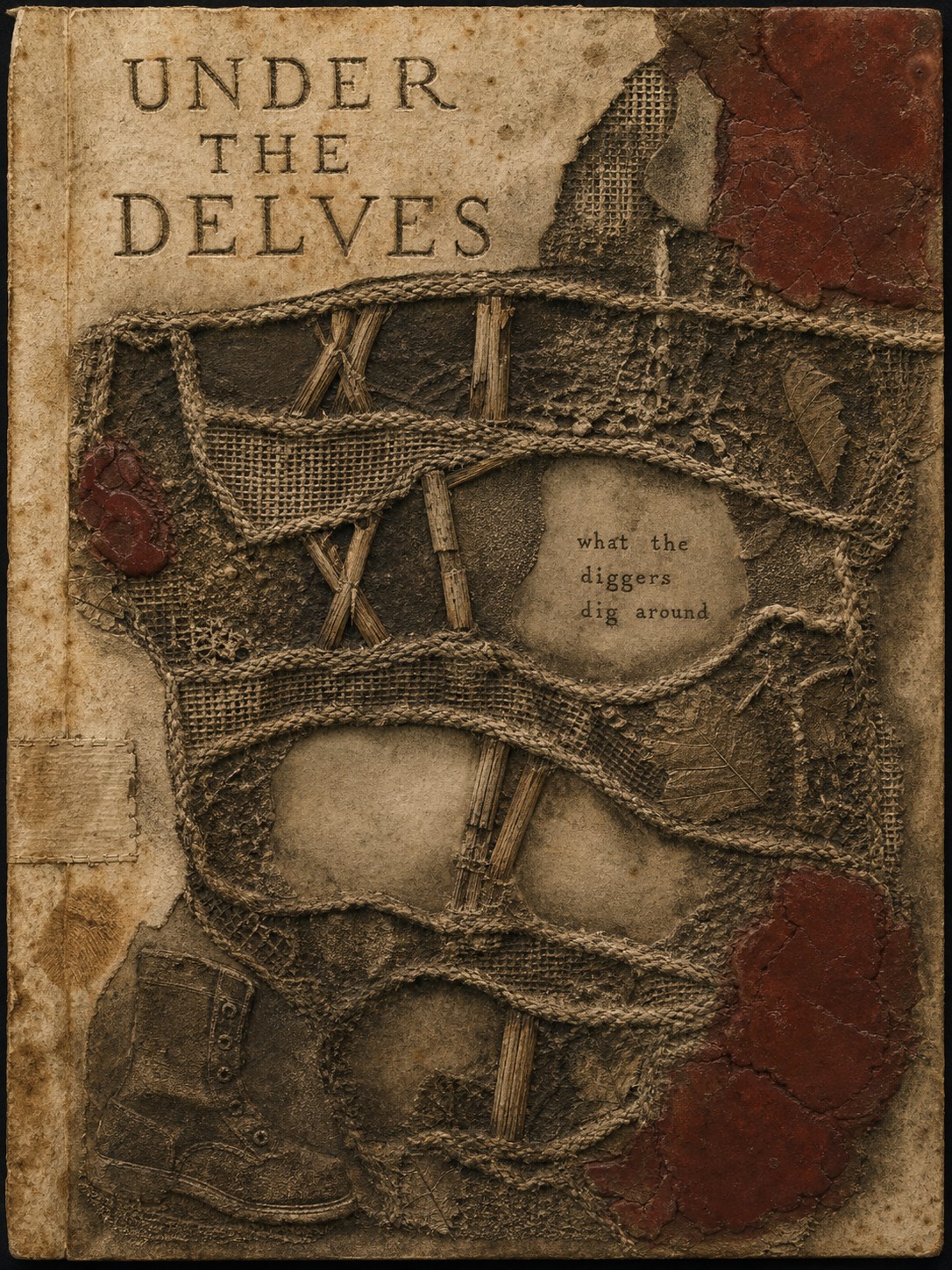
Under the Delves
The Tales
Tale 11WHAT THE DIGGERS DIG AROUND
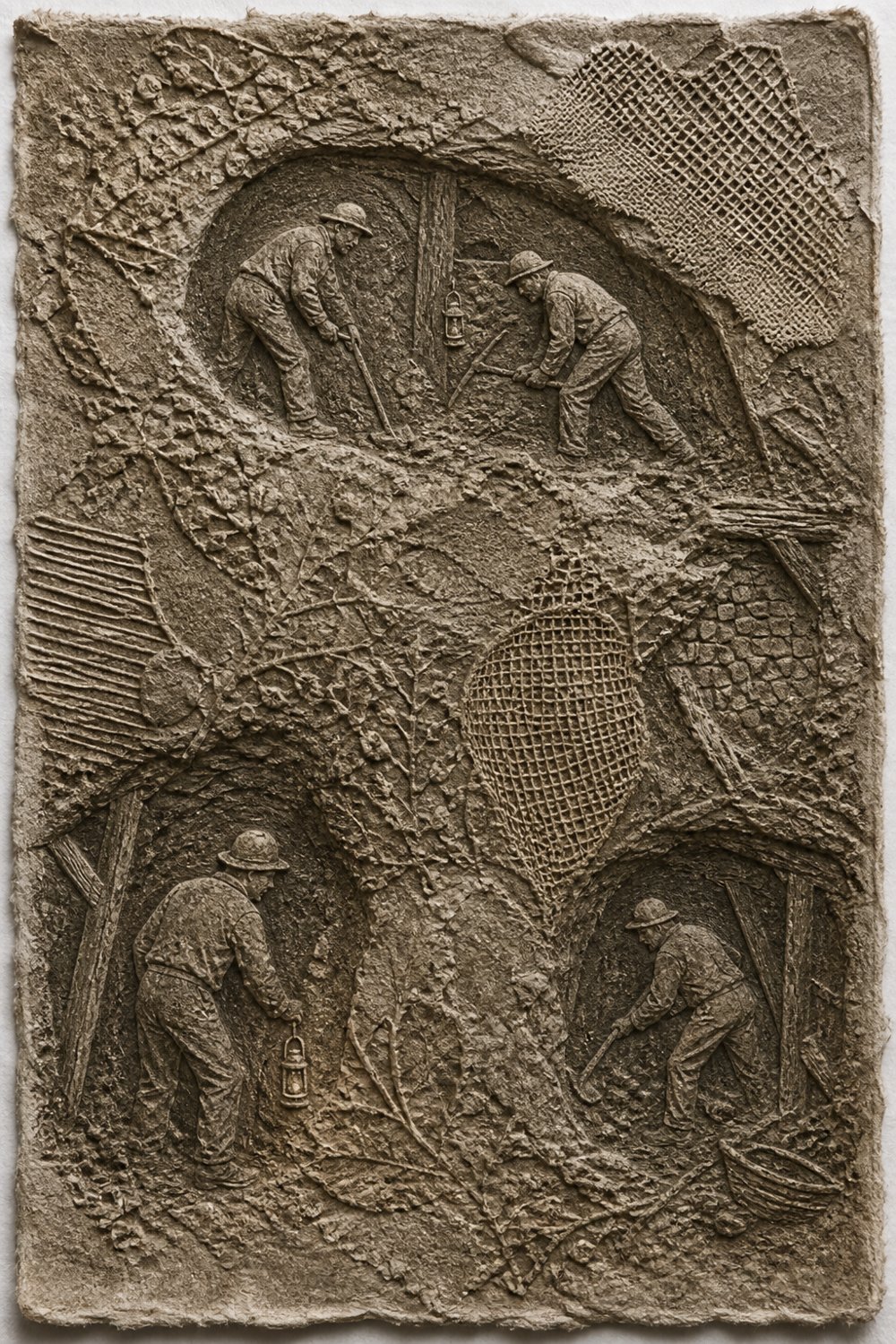
We are House Delve, and we have dug so deep and so long beneath the Weeping Granites of the Bogmoor that we have forgotten the sun the way you forget a song — not gone, exactly, just no longer something we could hum. We dig because stopping means thinking about why we started, and none of us fancy that. We are stubborn, and practical, and — this is the part the fables get wrong — we are polite.
You have to be, this far down. Because down here, the dark has opinions.
It started, as these things do, with small rudenesses from the rock. A pick would strike stone that had not been there the day before. A shaft we had mapped on the Tuesday would, by the Thursday, lead somewhere else entirely — once, memorably, into the cheese larder, to Old Mother Stilton's considerable displeasure. Veteran diggers took up the habit of talking to the walls, and then of forgetting, mid-sentence, what they had been saying. My own grandfather, Pa Delve, put down his pick one shift, listened to the black for a long moment, and said: "Lads. I'm not saying there's something alive down here. I'm saying the dark has opinions — and right now its opinion is that we ought to dig sideways for a bit."
So we dug sideways. Out of courtesy.
Any sensible house would have fled. We are not a sensible house; we are a thorough one. We had found something — something vast, and old past the meaning of old, and we understood three things about it very quickly. It did not want to hurt us. It did not want to be measured (the maps proved that). And it had been down here, in the lightless dark, entirely alone, for longer than there have been words for "long."
You do not, where I come from, leave a thing alone in the dark just because it is frightening. We have all been the thing alone in the dark.
So we did the only decent thing. We dug around it. Never into it — that would be prying, and prying is rude — but around and around, a slow companionable spiral, close enough that it would always have the sound of us: the chip and scrape of honest work, the bad songs, the worse jokes, the endless complaining about the damp. We keep it company. We bring it the noise of the living. When a new digger asks why we never break through to whatever it is, we tell them the truth: it isn't ours to open, and besides — it's been by itself long enough; the least we can do is potter about next door and make a bit of a racket so it knows it's not on its own.
The Cartographic Committee thinks we are mad. Lord Bastable thinks we are undermining his floors, which we are, but that is a side effect. The Turnips think we are brave, which embarrasses us. None of them have it right. We are not heroes and we are not lunatics.
We are just neighbours, to the loneliest thing in the world, and we have decided — stubbornly, practically, politely — that nobody, not even that, should have to sit in the dark with no one to overhear.
When the dark has opinions, the polite thing to do is dig sideways — and keep talking, so it knows you're there.

Tale 17THE DIG THAT DUG BACK
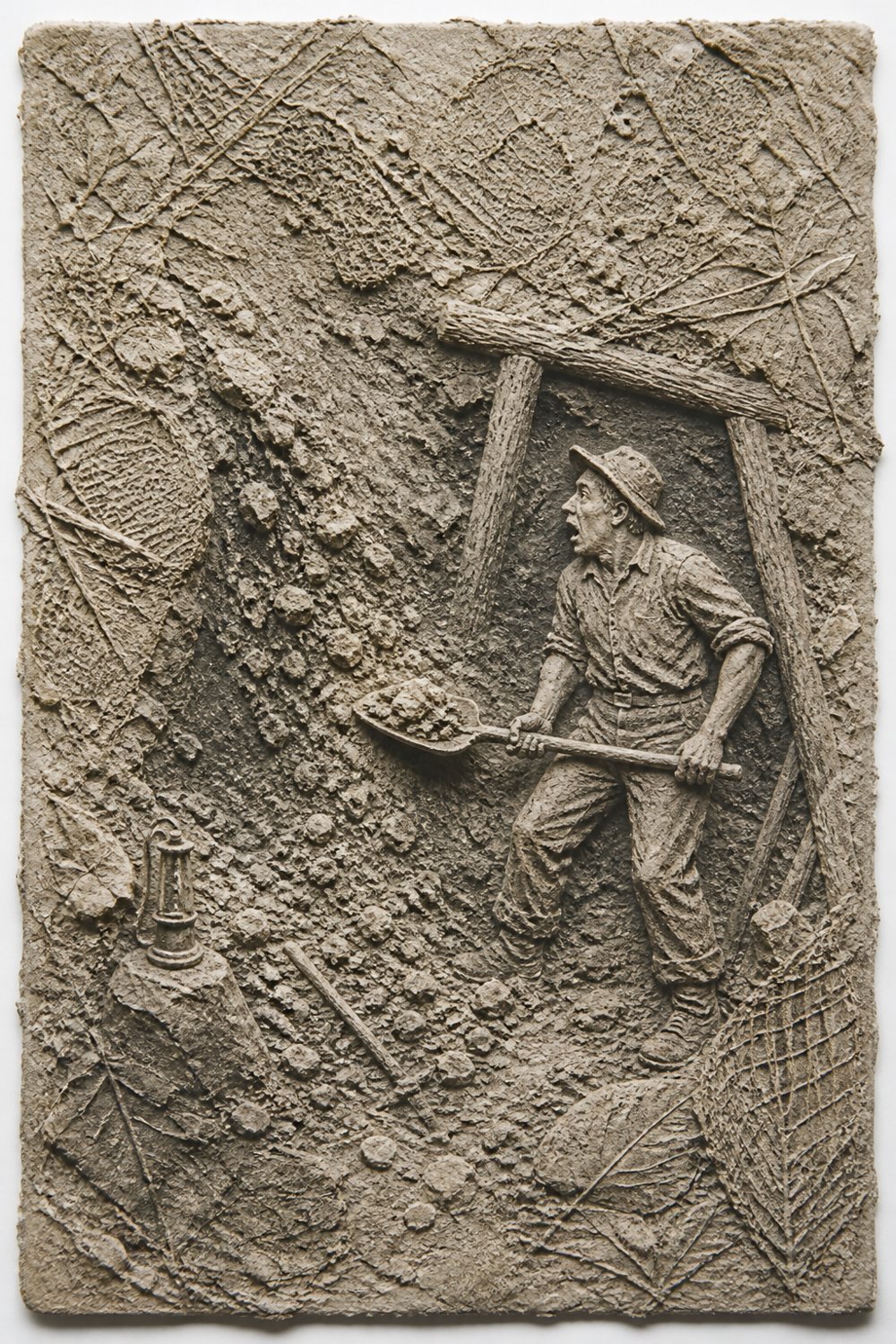
In our family — we are Delves, and we mine the Weeping Granites of the Bogmoor — there is one rule, and it is Gran's, and it goes like this: dig wide as you like, dig long as you like, dig sideways till your arms drop off — but under the old oak you stop at spade-deep, and you say thank you when you stop.
"Thank you to who?" I asked her, every year, from the age I could hold a trowel.
"Manners," said Gran, every year, in the voice that ends conversations.
We are House Delve. Digging is not what we do; digging is what we are. And I was eleven, and I had spent my whole life being told the one place I couldn't, which any Delve will tell you is the same as drawing a map to it. So one evening in leaf-fall, with the light going brown and everyone else at supper, I took my shovel to the old oak, and I dug my spade-deep, proper and respectful.
And then I dug one more foot.
The soil came up wrong. Not bad-wrong — wrong-wrong. Clean, and dry, and faintly warm, like sand that has spent the day remembering the sun, in a country where the ground has been cold and wet since before there were words for either. I stood in my little hole with my heart going, and the supper-bell went, and I did what any digger does when the bell goes: I left the shovel standing in the work, to mark that I was coming back.
In the morning the shovel was gone.
It had not fallen. It had not been taken by any of my cousins, all of whom swore innocence with the particular outrage of people who, for once, actually were. It was simply not there — and in the bottom of my hole, laid flat and neat as an apology, was a lever.
I do not know how else to say what it was made of. It looked like starlight that had been persuaded to hold still, and it was smooth the way deep water is smooth, and when I picked it up it felt like forgetting — like the exact moment a dream goes when you try to tell it at breakfast, that soft slipping feeling, made into a thing you could hold. It weighed nothing and it weighed everything. I took it home under my coat and hid it beneath my bed, because I was eleven, and that is where eleven hides the impossible.
That night I dreamed. I dreamed of vast, patient minds, far down under everything, slow as seasons — and they were laughing. Not at me, exactly. At all of us. To them, I understood, people are funny little mayflies who live for an afternoon and spend the whole of it trying to own the sky — fencing it, deeding it, digging towards it from underneath — and they found this so gently hilarious that the laugh was almost a kind of fondness. One of them looked at me the way Gran looks at a kitten that has squared up to a cart-horse. And it reached out, in the way of dreams, and tidied something — the way you'd take a sharp thing off a low shelf, not angry, just moving it out of reach of the small.
I woke up. I looked under the bed.
The lever was a potato masher.
Not disguised as one. Not pretending. It was one — ash-handled, comfortable in the grip, honest as a Tuesday — and I want it clearly on the record that it is the finest potato masher in three parishes. The mash that night was so good that Gran, who does not comment on food, added an extra knob of butter to my plate, which from Gran is a full state eulogy. She looked at the masher for a long moment. She looked at me. She said nothing at all, and passed the salt.
Here is the part I would tell you to listen to, if you were mine to warn.
I never dug deep again. And the thing is — I didn't decide not to. I wasn't frightened off; nobody forbade me twice. The wanting was simply gone. A few days after, I went looking for it, the way you go to a shelf for a thing you have always kept there, and the shelf was empty, and clean, and dusted. I still dig — wide, and long, and sideways till my arms drop off, because I am a Delve and it is what we are. But at spade-deep, under any old tree, I stop.
And I say thank you. I know what the thank-you is for, now. It is not for what's down there letting us dig. It is for what's down there being kind about the things it takes — for swapping a shovel for a lever, and a lever for a masher, and a dangerous wanting for a very good supper, so gently that you only notice the trade years later, on an evening like this one, telling it to somebody small.
Some things don't want to be found — and they are very good at making sure you stop wanting to find them.

Tale 20NEVER IN, NEVER DOWN
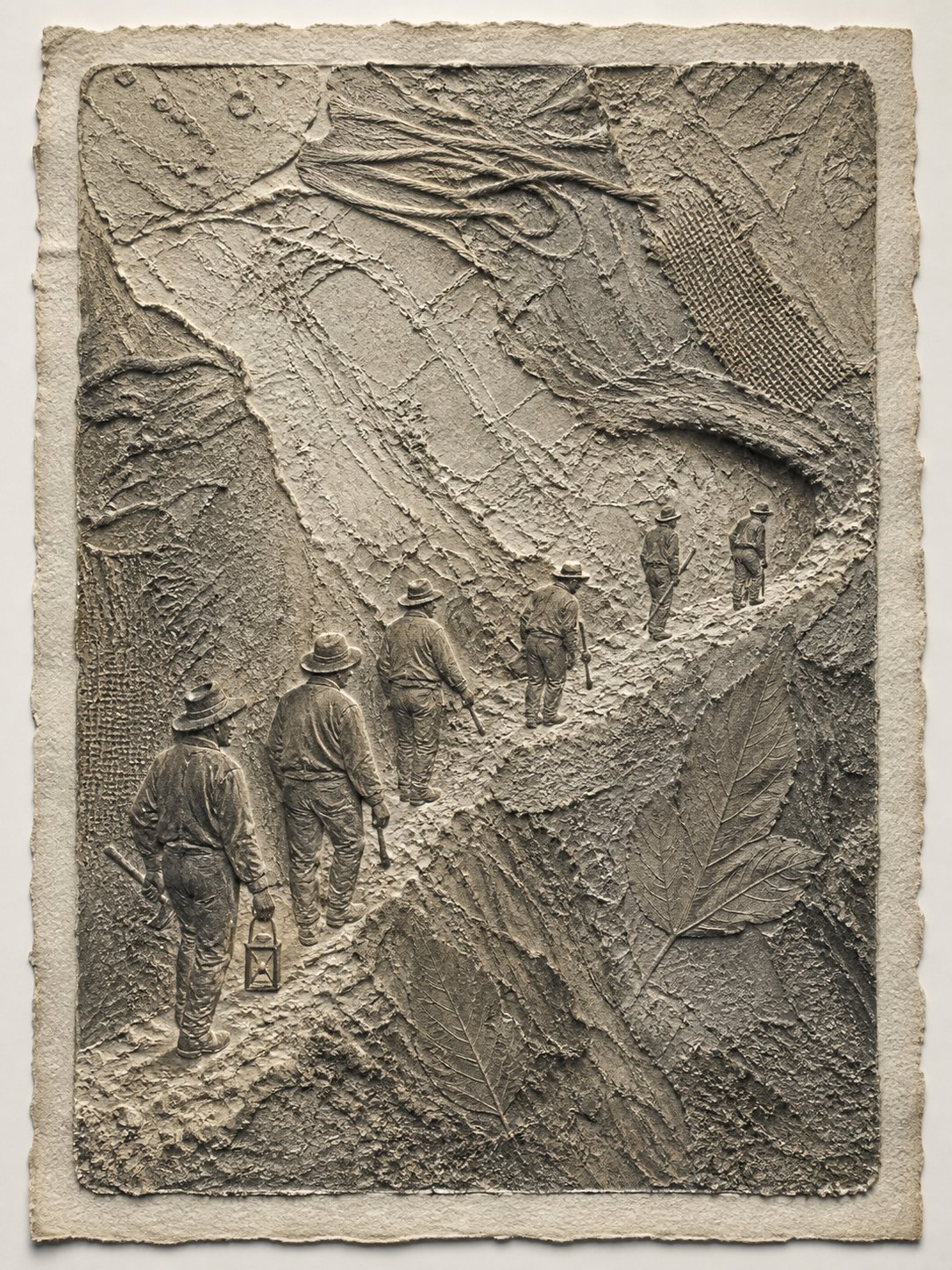
I am a work-song, and I am not much of one.
Four bars. A call and an answer. A stamp on the off-beat where the pick goes in. Any fool can learn me in a morning and every Delve does, at about four years old, sitting on a bucket at the mine-mouth, waiting for their mother to come up out of the dark.
I have no author. I have no tune to speak of. I am not beautiful and I have never once been sung in the chapel, and the Quill nuns have never written me down, and I would like to state at the outset that I do not care about any of that in the slightest.
Because I have been down that mine for six hundred years, and in six hundred years House Delve has not lost a single soul below ground.
Not one.
Ask the Committee what the safety record of an iron mine ought to be. Ask them to look at the arithmetic of six centuries of men and women going down a hole in the dark with picks. Ask them how many should have been lost, statistically, to falls and floods and firedamp and simple bad luck.
Then ask them how many the Delve have lost.
None. And they will tell you it is because Delve are careful. And Delve are careful. And that is not why.
It is because of me. And it took the parish four hundred years to notice, and it took the Delve about a fortnight, and they have never told anybody, because they are polite.
Here is how you dig, if you are a Delve.
You dig wide. You dig long. You dig sideways until the light has gone and the supper is on the table and your arms are ruined.
You never dig in.
You never dig down past done.
Done is spade-deep past the seam. When you reach done, you stop, and you thank the dark, and you go up. It does not matter if the iron is running rich and the ore is singing under your hand and there is obviously — obviously — more of it a foot further down.
You stop. You say thank you. You go up.
And every Delve who has ever asked why — and they all ask, at about eleven, at the age when a child first works out that grown-ups are making some of it up — gets the same answer from the same kind of old woman with the same kind of face:
"Because polite men don't get swallowed, boy."
Which is not an answer. Which is a lid on an answer.
And at eleven you accept it, because she is frightening, and at nineteen you resent it, because it is superstition and you are modern, and at forty you teach it to your own, word for word, without ever having worked out what it means.
I know what it means. I was there.
His name was Corwen Delve and he was the best hand in three generations, and I want it said plainly, at the start, that there was nothing wrong with him. He was not greedy. He was not arrogant. He was not one of your castle men who comes to a bad end because he has been badly behaved and the story requires it.
He was a good digger who found a good seam, and the seam ran down.
And he went down after it, one foot past done, on a Thursday, in the year they were mending the chapel roof — and that is all he did. One foot. In four hundred years that is the whole of the crime, and I have never got over it, and I am a song, and I am not supposed to get over things or need to.
Here is what the men working the gallery above him noticed. Not a scream. Not a fall. Not the roof coming in.
He stopped singing.
That was all. The stamp went out of the off-beat, and the answer did not come back on the second bar, and somewhere below them in the dark there was a man not singing.
Now. You want to understand what House Delve is, and everybody always gets it wrong, so listen.
They are not brave. They will tell you so themselves and they are correct. They are not fearless, and they are not clever, and they are certainly not lucky — you do not get to be lucky for six hundred years running and if you think you do, you have not been paying attention to this realm.
They are polite.
And here is what politeness means, four hundred feet down, in the black, with the water coming in:
It means you answer when you are sung to.
Somebody calls, and you call back. Every four bars, for eight hours, for six hundred years. You do not call back because it is nice. You call back because if you stop calling back, then everybody in that gallery knows, within four bars, exactly where you are and that something is wrong, and they are already coming, with the rope, and the lamp, and a great deal of swearing.
That is the whole of it. That is the entire safety record of House Delve. It is not equipment and it is not courage and it is not care.
It is a hundred people in the dark, agreeing to make a noise, so that the silence of one of them is audible.
I am not a song. I am a roll-call that never stops.
They were down to him in eleven minutes. They found him at once, because they knew exactly where he had stopped singing, which is the entire point of me and always has been.
And here is what they found, and I have had four hundred years to think of a better way to say it and there isn't one.
They found him sitting down.
Not fallen. Not trapped. Not hurt — not so much as a scrape on him, and his lamp was lit, and his pick was laid down neatly beside him the way a good hand lays down a pick, and he was sitting with his back against the rock and his legs out in front of him, quite comfortable.
And when they came round the corner with the rope and the shouting he looked up at them, and he smiled.
And he said — and every man in that gallery heard it, and two of them would not go below ground again, and one of them was his brother —
"Oh. Hullo. I was just going to come up in a minute."
He was fine.
That is the horror of it and I want you to sit with it. He was fine. He was warm, and rested, and perfectly happy, and pleased to see them, and mildly puzzled at all the fuss.
And he did not want to come up.
Not refused. Refusing is a thing a man does with his jaw set, and you can argue with a man who is refusing, and Delve are very good at arguing. He simply — did not mind either way. Up, down. Now, later. It had all gone very soft in him, like a floor going to bog under your foot, and it had happened in the time it takes to sing four bars.
And they said, come up, Corwen, and he said yes, in a minute, and he meant it, and he did not move.
And they said, your girl is at the mine-mouth, and he said oh, good, and he did not move.
And they said, the seam's no good, man, it's poor rock, and he agreed pleasantly, and he did not move, and he was not looking at the rock and had not been looking at the rock for some time.
He was just — sitting. In the dark. In the most agreeable afternoon of his entire life. Having stopped wanting anything at all, including his own life, and not having noticed that this had happened.
His brother got him out.
Not with the rope. The rope was no good; you cannot rope a man who does not object, he just comes along gently and then sits down again at the top and you have achieved nothing.
His brother knelt down in front of him, in the wet, four hundred feet down, and put his hands on either side of his brother's face, and he sang at him.
Not to him. At him. Four bars, right into his face, the stupid old song, the call and the answer, the one they had learned on a bucket at the mine-mouth at four years old waiting for their mother — and he sang the call, and then he waited, and there was nothing, and the lamp guttered.
And he sang it again.
And again.
And on the ninth time, Corwen Delve answered the second bar.
Just the answer. Just his part of it. Automatically, the way your hand comes up when something is thrown at your face, because it was in him deeper than wanting was, because it had been put there before he had words.
And the moment he heard his own voice come out of his own mouth, in his brother's face, in the dark —
he came back.
And he was so frightened that they had to carry him. A grown man, the best hand in three generations, who had not been hurt, and had not been afraid, and had been perfectly happy sixty seconds earlier — carried up out of that hole shaking like a child, gripping his brother's coat, and saying the same thing over and over all the way up:
"I couldn't hear you. I couldn't hear you. And I didn't mind."
He would not go below again. Nobody asked him to. He lived another forty years, on the surface, mending picks at the mine-mouth, and every single morning of those forty years he sat on a bucket and sang the first bar as the shift went down.
And every single morning, a hundred people in the dark sang the second one back to him.
That is where that comes from, in case you have ever seen it and wondered. It is not a ceremony. It is not a tradition. It is a man checking, every day, for forty years, that everybody can still hear each other.
And the rule went into the Delve that same year, and it has never been written down, and it never will be, and it does not need to be:
Never in. Never down past done.
And never, ever stop singing.
Now I want to show you something, and I am the only one who can, because I am the only one who has been in every gallery of that mine for six hundred years and I do not have to walk anywhere.
Go up to the counting-house at the Delves and ask to see the workings. They will show you; they are proud of them, and they are polite. It is a very fine map. Six hundred years of galleries, all inked in, all labelled, a great spreading web of them under the Bogmoor going out and out and out.
Look at it.
Look at the middle of it.
There is nothing there.
There is a great smooth-sided empty space in the very centre of six hundred years of tunnelling — perhaps four hundred yards across — and not one gallery goes into it. They go round. Every single one. For six centuries, in the dark, with no plan and no committee and no instruction beyond a rule an old woman gives an eleven-year-old, generation after generation of Delve have walked up to the edge of that space and, without a word, turned left.
And they have gone round it so faithfully, and so exactly, and for so long, that the empty place in the middle of their map has a shape. Clean. Curved. Precise. You can see its outline as clearly as you can see the outline of a hand pressed into dough.
And no Delve has ever been in there, and no Delve has ever seen it, and no Delve could tell you the first thing about it.
They have drawn a perfect picture of it by never once touching it.
They will tell you the ground is bad in there. Ask them how they know and they will look at you as though you have asked how they know the fire is hot. Ask them what is in there and they will shrug — rock, I suppose — and offer you tea, because they are polite, and because they genuinely, honestly, do not think about it, and because not thinking about it has kept every single one of them alive for six hundred years, and they do not know that either.
There is a hum in that mine. They will tell you it is the water.
It is not the water.
So here is the whole of it, and then I will stop, because a work-song is not supposed to go on this long.
The great houses of this realm all have a way of dealing with the things they cannot understand.
The Bastables own them, and go bankrupt. The Pennyworths price them, and cannot. The Committee surveys them, four times, and files the result. The Havers deny them, and are audited anyway. The Quill nuns write them down, in the margin, in a very small hand.
And House Delve — who are not clever, and know it — do the one thing that has ever actually worked in the entire history of Sogmarsh.
They go round it, they keep singing, and they check on each other every four bars.
That is not wisdom. Nobody in that family could give you a single sentence of philosophy; you would get a shrug and a cup of tea and a remark about the weather.
It is just a rule, and a song, and a habit of answering when you are called.
And six hundred years of the thing in the middle of that map has never once got a single one of them —
— because they never went in, and they never went down past done, and every four bars, in the dark, they say each other's names.
Now dig wide, boys. Dig long. Sing the answer.
And thank the dark below, so long.
Tale 56SIDEWAYS, OUT OF COURTESY
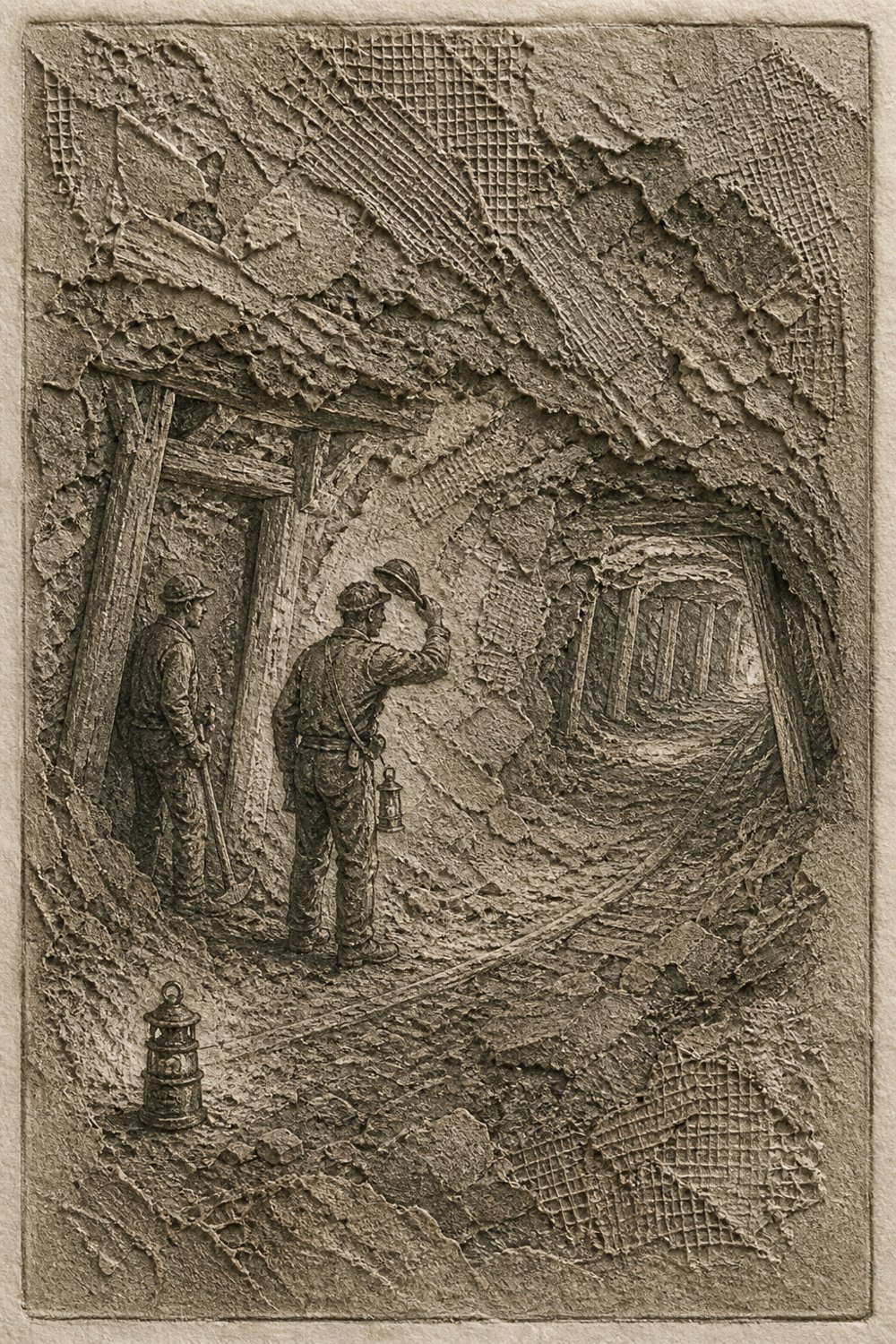
House Delve digs sideways.
Every soul in this realm knows it and nobody outside it can be got to believe it, and the misunderstanding that follows is so reliable that the Delves have a word for the visitor it happens to. They call him a Straight, and they say it the way you might say a nephew — with affection, and a certain weariness, and an eye on the furniture.
The most celebrated Straight was a mining engineer of two-and-twenty, brought up from a dry country at considerable expense to advise on efficiency, and I have the whole of his week from three people who were there and who agree about everything except the pie.
He arrived at the Delve workings on a Monday and did the sums on the Tuesday, and the sums are not in dispute. They were correct then and they are correct now, and if you put them to any engineer alive he will tell you the same thing:
The Delves are digging the longest possible route to everything.
Their workings go out sideways from the shaft in great patient curves, and where a seam lies below them they do not go down to it; they go along, and around, and come at it from the far side, and the distance they walk in a working life is, by his figures, something over six hundred miles more than the job requires.
He put this to them on the Tuesday evening, in the long room, with the figures written out.
And they were delighted. That is the part he could not account for at the time and told for the rest of his life. They were not offended and they were not ashamed; they passed the paper down the table and several of them whistled and old Nan Delve said it was the most beautiful piece of arithmetic she had ever had read at her, and they gave him more pie.
Then they carried on digging sideways.
He tried again on the Wednesday, more slowly, in case it was the accent.
And a man called Tam Delve — pick-man, about forty, patient as a wall — put his cup down and gave him the answer, which the Straight wrote in his notebook that night and underlined twice with the pen going through the paper:
"We know, lad. It's manners."
The Straight said that manners were all very well but that six hundred miles was six hundred miles.
"Aye," said Tam. "And?"
"And it's inefficient."
"Aye," said Tam, comfortably. "It is that."
Here is what he was four days working out, and I set it out here in the plain order because the Delves themselves will not, holding that a thing you have to be told is a thing you have not understood.
Down is where the water is.
That is the whole of it. That is the entire foundation of Delve manners and every rule that comes off it. In a realm made of bog, a working that goes down goes wet, and a wet working is not merely a nuisance — the water in this country does not stay where you find it. It moves. Take the bottom out of a seam and you have not only flooded your own gallery; you have given the water somewhere new to be, and it will go there, and it will go on going there, into somebody's else's workings, or somebody's well, or somebody's cellar, next week or next year or in forty years when you are dead and it is not your name on it any more.
You cannot see whose. That is the point. You cannot see whose, and so you go round.
The Delves have therefore arrived, over six hundred years underground, at a code of manners in which going down is not dangerous — they are not frightened of it, they will go down in an emergency and be back up by tea — but rude. Straightforwardly, socially rude, in the way that reaching across a table is rude. It is a thing you do not do in front of people because of what it does to the person you cannot see.
And out of that comes the whole of their etiquette, which is elaborate, and which they take entirely seriously, and which is why the pick-song has the line it has.
"Never in, never down past done."
The Straight had been hearing it sung all week and had taken it for a work rhythm, which it is. It is also the law, and it means: never go into another's working, and never go below the level of what is already finished. Both halves are courtesies to somebody you have not met.
A Delve does not sink a new shaft without walking the ground above it first and knocking at every door within earshot — not to ask permission, which nobody would grant or refuse, but to say where they will be digging. It takes a morning and it has no legal force whatever and not one Delve in six hundred years has skipped it.
A Delve who breaks into water shouts. Immediately, at the top of the lungs, before anything else, including before getting out — the word is WET and it goes up the gallery and out of the shaft and across the top and it is the only occasion on which a Delve will shout at all.
And a Delve does not say the word below at a table. This is the one the Straight fell over twice. There is a set of polite substitutions — the lower, the far side, the long way — and they are used without any solemnity, in the way you might avoid a subject at a christening. He asked, on the Thursday, what the taboo was.
Nan Delve told him there was no taboo, and that they simply did not care to discuss the plumbing at meals, and everybody laughed, and the Straight understood that he had been given the true answer and a joke at the same time and that the Delves regarded these as the same thing.
He went home on the Saturday and wrote a report which is, by the standards of such reports, remarkable — because it recommended no change whatever.
It is four pages long. Three of them are the arithmetic, which is unaltered; he never withdrew a figure. The fourth is one paragraph, and it is the paragraph that got him laughed at in his own profession for some years and quoted with approval in this one ever since:
The girl of eight is the best part and I have it from two of them.
He had asked her — on the Friday, having given up on the grown ones — why not just go straight down, and she had taken his cup and a jug and poured water on the table, and let him watch it run, and said:
"That's your gallery. Where's it gone?"
He said it had gone to the edge.
"Whose edge?"
And he opened his mouth and had no answer, and she nodded at him the way an eight-year-old does when a grown man has finally caught up, and mopped the table with her sleeve, and said the thing that is on the wall of the long room now because somebody wrote it there afterwards in chalk and nobody has washed it off:
The Delves still dig sideways. They still walk their six hundred extra miles. They still knock on doors to tell people where they will be, and they still will not say below at a table, and every few years another Straight comes up with another set of correct figures and gets the pie and the whistling and the same reply.
"We know, lad. It's manners."
Efficiency is a measurement taken from one place at one time, and courtesy is what a trade develops when it has spent six hundred years learning that the person its shortcuts will drown has not been born yet — so if you are ever shown a route that is plainly the long way round, ask what it goes around, before you improve it.