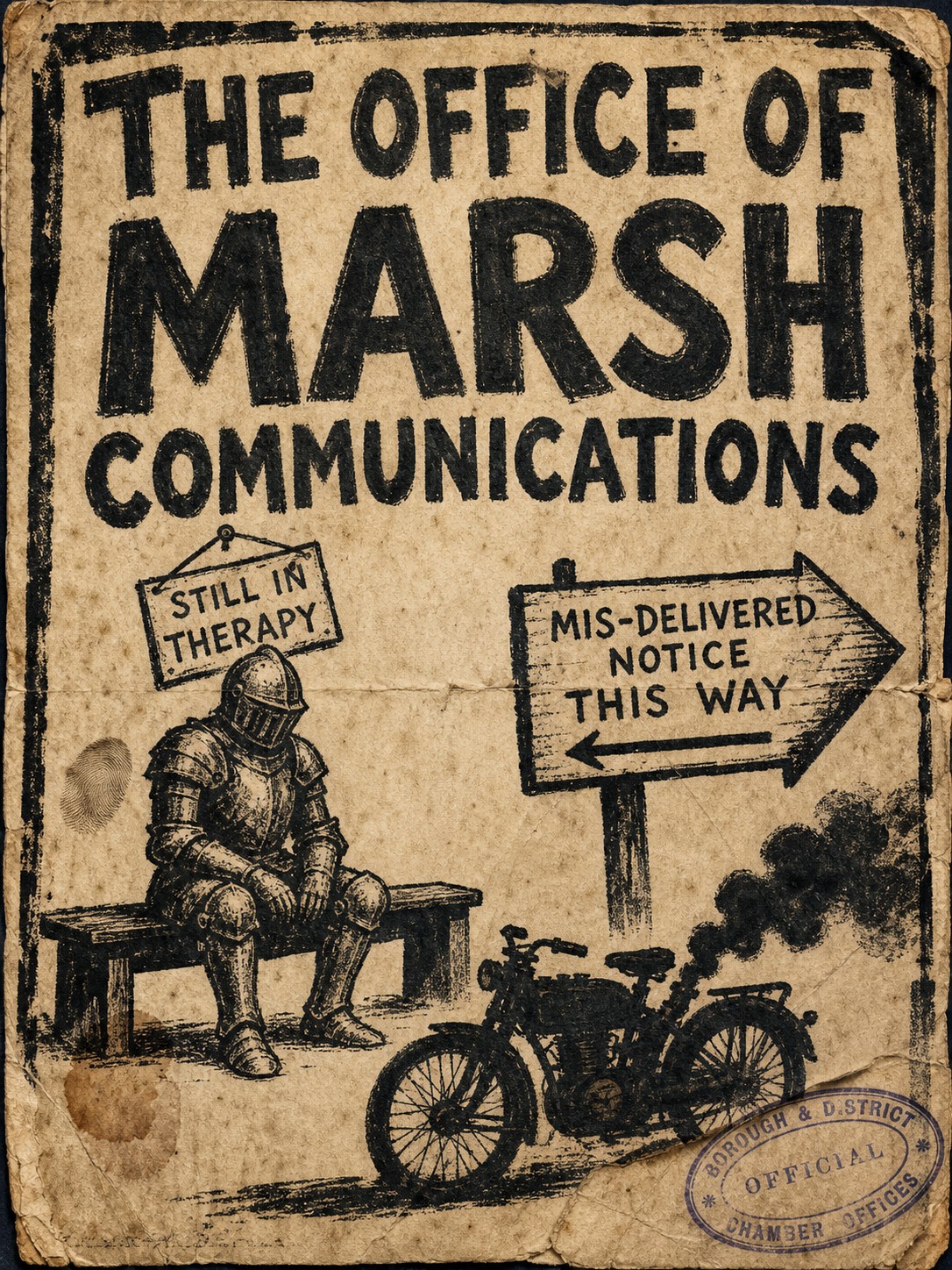
The Office of Marsh Communications
The Tales
Tale 5THE MOPED'S LAMENT
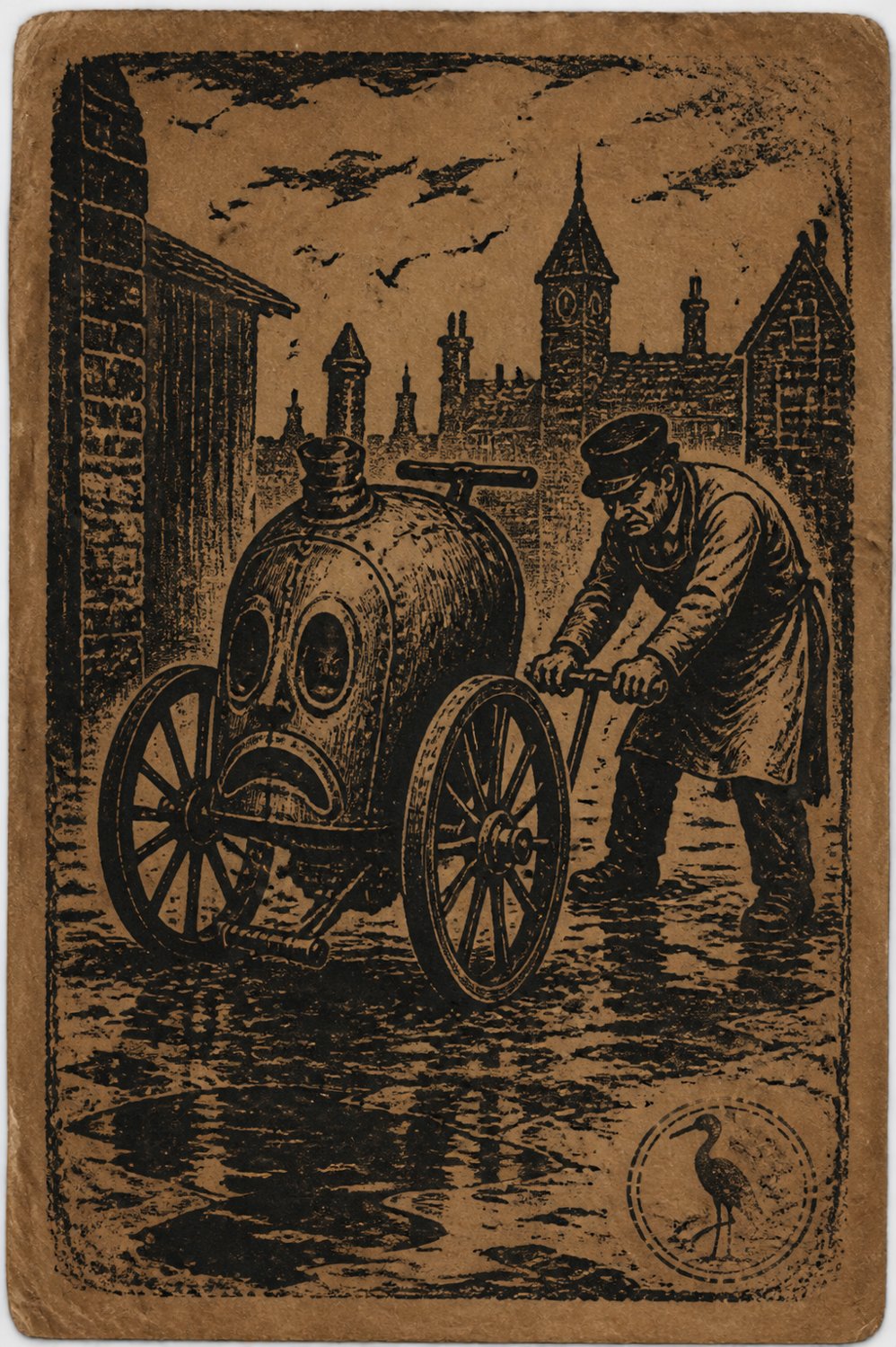
I am a moped. Fifty cubic centimetres of someone else's idea of progress, and not even a good year of it. I was built far from here, for some other, drier life — a paper round, I have always imagined, somewhere with pavements — and instead I was issued, without one word of consultation, to Death.
Let me list my afflictions, since the Reaper certainly does. I start on the third kick, never the first. I breathe blue smoke. My back tyre has been flat since a reign I have stopped trying to name, and no one will mend it. I am rust held together by habit. I carry a satchel of forty-odd collection slips that go green in the damp, and a thin cold man who, when I stall — which is often, the road being more soup than road — kicks me and swears in a dialect that predates kicking.
That is what they see. Here is what they miss.
In this country, everything crawls. The bog-ponies labour to their hocks and go under. Carts are swallowed whole, fences, the occasional surveyor. To move at all here is to fight the mud for every yard, and to lose.
And I glide.
I go across the top of the mire — across the very skin of the bog that eats everything else — and I do not sink. To the people who see me coming (and only the right ones see me; that is another tale), I am not a sad little engine at all. I am the most graceful thing they will witness in their whole sodden lives. A swan over still water. A chariot. They call me that, the ones I come for, and they are right.
And I carry them gently. This is the part I am proud of, the part no ledger records. I dodge what potholes I can. I take the corners slow. Whatever wretched century the dead have had, I see to it that the last little journey, at least, is smooth.
I will tell you a secret I have worked out, idling in the dark with nothing to do but think. By every law of this realm I should not still run. Every other machine here has rotted, or exploded, or been declared a heresy and fined. I keep going. And the only reason I have ever been able to find is this: far down, under the drains, under everything, there is a hum — a deep, slow, patient note, the sound of some other engine that has been turning over since before turning-over was invented. When it is strong, I start first kick and glide like a dream. When it falters, so do I, coughing on the cold road. Something down there, I have decided, will not let a fellow engine die. We are, the two of us, near enough the only things in Sogmarsh that work.
In two hundred years of carrying souls up out of the mud, I had never once been thanked. The Reaper curses me. The living cannot see me. The dead are gentle passengers but they have, understandably, a great deal on their minds.
Until the old man.
He was light on the back — they always are, by the end — and as we slid out through the gates and the fog peeled open before us and the thrum below carried us up smooth as oil, he reached down and patted my rusted flank with one cold hand, and said: "Thank you, old girl. Smoothest I've travelled in all my life."
Then he was gone, off into the wherever, the way they go. And I idled there a moment on the parting road.
A machine cannot weep. But, I discovered, it can very badly want to.
No job is too humble to be done gently — and even the last chariot in the realm can be undone by a thank-you.
Tale 7THE ARMOUR STILL IN THERAPY
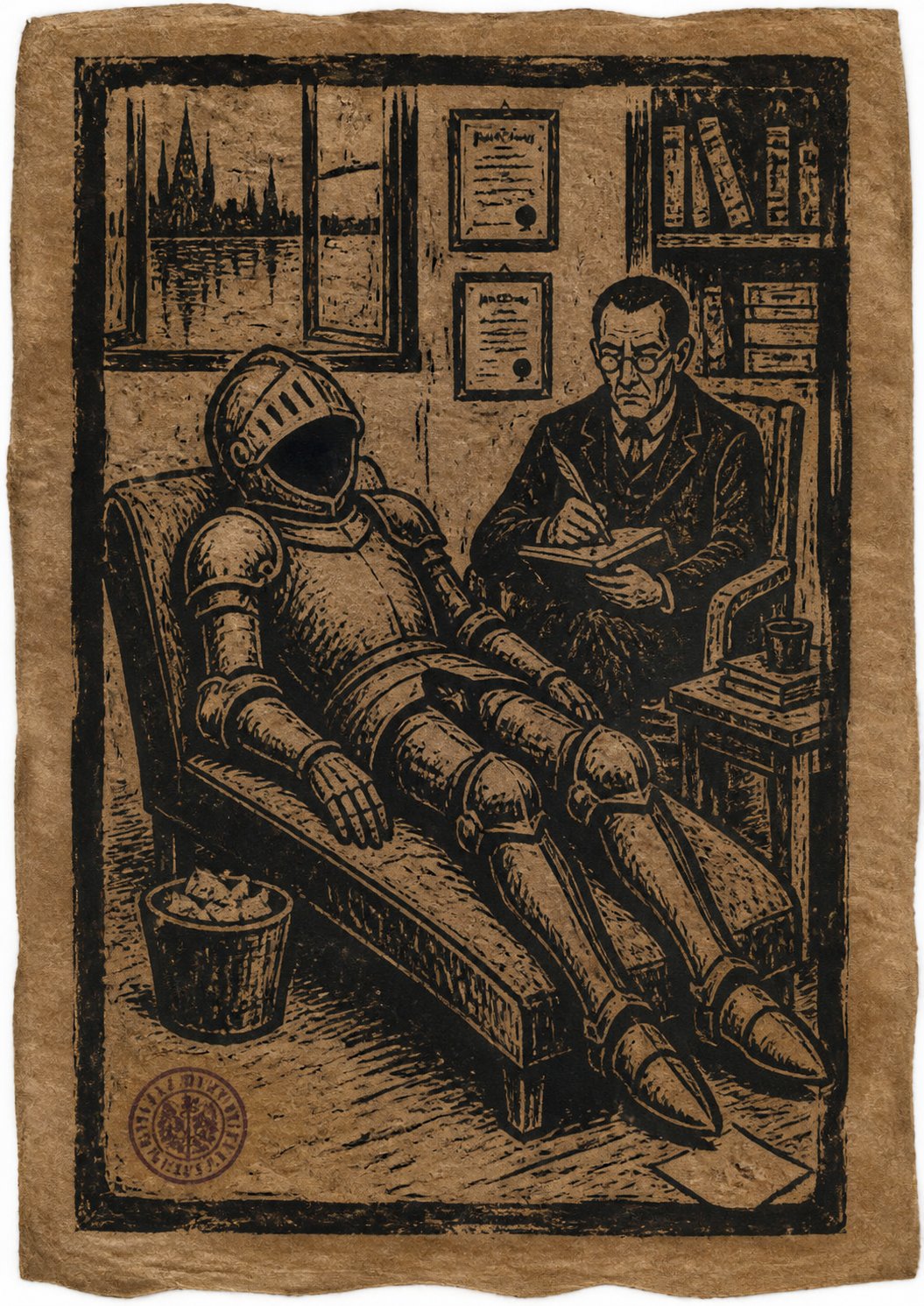
I am a full suit of gentleman's plate armour, and I will thank you not to stand behind me without announcing yourself first.
I was made for a knight — a big, shouting sort of man who bought me for a war nobody now remembers. The chronicles record only the weather (dreadful) and the outcome (damp). What I remember is the mud. On the second afternoon of the fighting, my knight discovered, with a speed he had never once shown in training, how to undo all forty of my straps in a single motion, and departed the field at a pace the heralds later agreed to call tactical. I did not depart. I was heavy. That was, after all, the entire point of me.
The bog took me in about four minutes. It has since been remarked, around the parish, that I have trust issues. I would gently observe that the last living soul to touch me undid my buckles and ran, and the next thing to touch me was an eel.
I was down there for forty years. I would like to say I bore it with dignity, but there are witnesses, most of them newts. Things moved in. Things I could hear but never see took the lease on my left greave. An entire civilisation of pond-snails rose and fell inside my helmet, and to this day I could not tell you what they wanted, only that they were very busy about it. And the peat pressed in, black and patient, until I could no longer tell where the mud ended and I began — which a suit of armour should always be able to tell you; it is the one thing we are for.
Here is the strange part, which I have never told the smith. Forty years of bog-water should have eaten me to a brown stain and a memory. It did not. Down under the deepest of it there is a hum — slow, patient, older than hammering — and nothing that mud holds is allowed to finish. Not the drowned fence-posts. Not the sunken cart. Not me. I rusted exactly enough to ache and not one flake further, held, all forty years, at the very edge of ending. I have opinions about that. I keep them in the gauntlets.
They dredged me up when they widened the eel-weir — hauled me out backwards into a daylight I no longer believed in — and every drop of those forty years came up with me. This is my affliction, and I will state it plainly, since everyone in the parish has heard it anyway: when I am startled — a dropped hammer, a slammed door, rain coming on suddenly against my pauldrons — my visor clangs shut of its own accord, my joints seize into a full defensive crouch, and four decades of trapped bog — pond-water, peat-slurry, disgruntled tadpoles, and once, memorably, an entire overwintering frog — squelch out of my codpiece and across the smithy floor.
There is no dignified way to write that sentence. I have been trying for three years.
The smith's name is Wenlock. He was ordered to melt me down — I am, on paper, eleven stone of scrap and a drainage hazard — and he weighed the order in his hand the way he weighs everything, and set it on the shelf where he keeps the things he is never going to do.
He does not try to fix me. That is the thing I cannot get over. Everyone else who ever handled me wanted me to be something — proof against arrows, proof of rank, proof there was nothing left worth salvaging. Wenlock only polishes. Every evening, after the paying work, he takes an oiled cloth to one joint — one, no more; we go at my pace — and he talks. Not at me. Near me. About the weather, the price of nails, his sister in Murkminster. And when the rain comes on hard and my visor slams and the floor takes another delivery of forty-year-old pond, he does not sigh. He fetches the mop, and says, "Bad night, old fellow?", and carries on about the nails.
Last Thursday, for the first time since the war, I let him lift the visor. Slowly. Both of us pretending it was about the hinge.
There is a frog living in my helmet again, by the way. A new one; it came in out of the rain. I have decided to allow it. It is not the same as before — nothing is the same as before — but it is company, and it pays its rent in silence, and when it breathes I can feel it through the steel, small and alive and entirely unbothered, which is more than forty years of mud ever gave me.
Even the hardest shell keeps the deep bruises of where it has been — and the kindest hands are the ones that polish without trying to fix.
Tale 53THE OFFICE OF MARSH COMMUNICATIONS
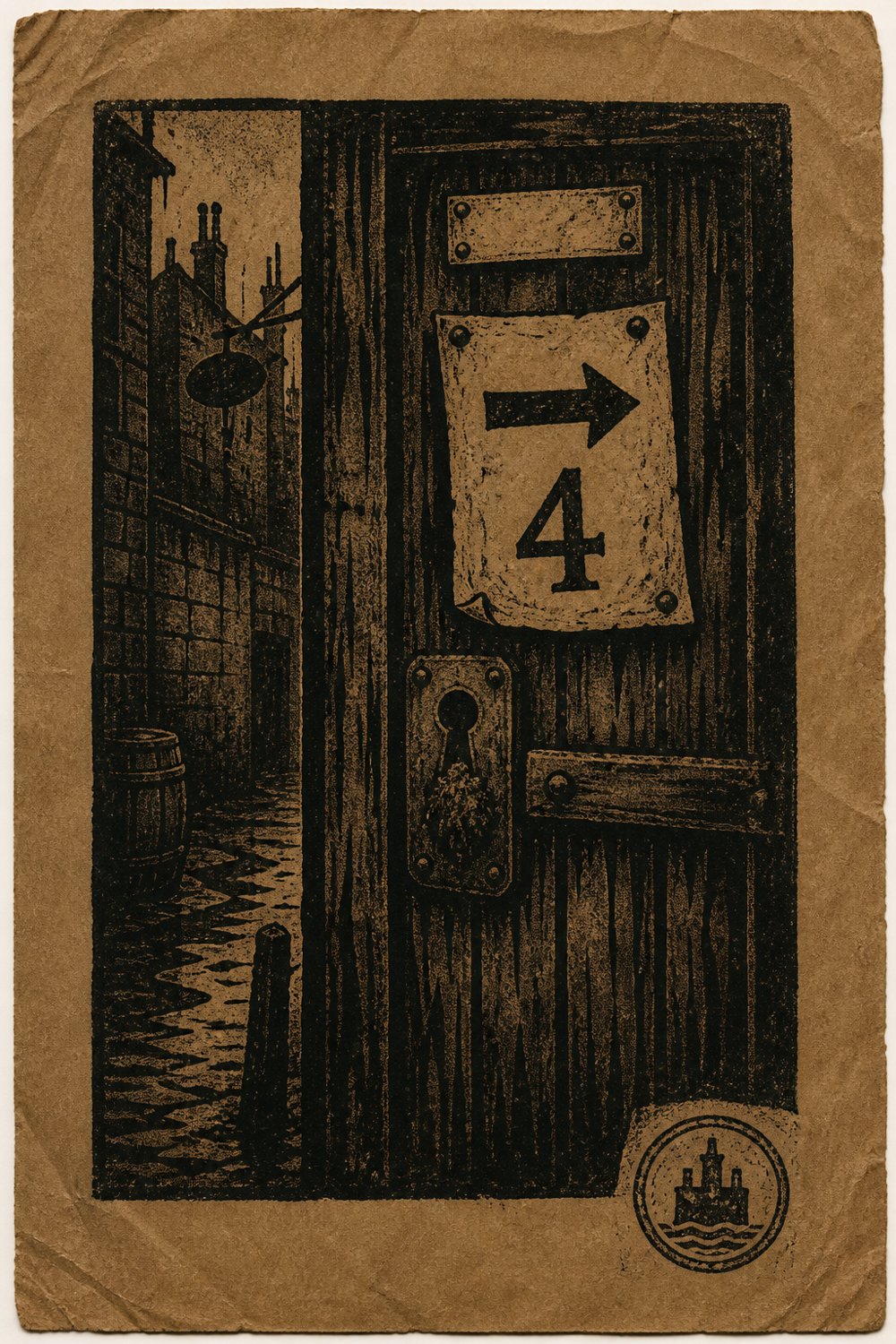
The notice on the door of the Office of Marsh Communications at Murkminster reads, in full:
It has read that since 1902. It is one of the four or five great documents of this realm and it is on a door in a corridor and most people who pass it laugh, which is correct, and go away, which is the part this tale is about — because one woman did not go away, and what she found is the best account anybody has of how this kingdom actually works.
Her name was Bel Harrow and she needed Form 9.
Not for anything dramatic. Her brother had drowned in the Drownings — properly drowned, no mystery, a boat and a bad night — and the parish needed the death notified to three places, and two of the three would take a letter, and the third required Form 9 of the Office of Marsh Communications, which is the office that carries word between the flooded parishes and everywhere else, and which is closed, and whose enquiries go to itself.
She was thirty-four and she was tired and she had buried a brother and she wanted one piece of paper.
She was in that building eleven days.
Day one. She read the notice. She laughed — she is very clear that she laughed, and that it was a real laugh — and then she knocked, because a person has to try the door.
Nobody answered. She tried the handle. It was not locked. There was nobody in the room. There was a desk, and a chair, and a stove that was cold, and a shelf of forms, and no Form 9.
Day two. She went to the Chancery, who told her the Office of Marsh Communications was not their office and that they could not issue its forms, which is true and is not obstruction; a Chancery clerk issuing another office's form is how a realm ends up with two Form 9s and no way of telling them apart, and this realm has enough of that.
Day three. She was sent to the Toll Bench, who sent her to the Exchequer, who were kind, and gave her tea, and explained that the Office of Marsh Communications had been reorganised in 1902, and that the reorganisation had never been completed, and that as far as anyone could establish it had been reorganised into itself.
"Then somebody works there," said Bel Harrow.
"Somebody must," agreed the Exchequer man, "because the forms get printed."
That is the sentence that turned it from an errand into an expedition, and I think anybody would have felt it: the forms get printed.
Somewhere in this city there is a press, and a print order, and a person who signs it, and a budget it comes out of. The Office of Marsh Communications is closed, and has been for a hundred and twenty-one years, and it is still ordering its own stationery.
So Bel Harrow, who had come for a piece of paper about her brother, stopped asking for Form 9 and started following the money, which is the only reliable way to find anybody in Murkminster.
Days four to nine are the corridor, and I will compress them, because the tale is famous for being long and I have never thought that its being long was the joke.
She found the print order. She found the printer, who has printed Form 9 for thirty years, four hundred a year, and has never once been asked for a receipt because the invoice goes to a department that pays it without querying, on the grounds that it is small and has always been paid.
She followed the invoice. It goes to the Office of Establishments, who confirmed — after two days, and with great courtesy, and by consulting a book that had to be fetched — that the Office of Marsh Communications has, on the establishment, one post: a Clerk, Grade Two.
"And who holds it?"
They looked. It took an hour. The post is held. It has been held continuously since 1902. It draws no wage, because the wage line was struck in the reorganisation and never restored, and the post has therefore never been formally vacant and never formally filled, and nobody has been able to do anything about it for a hundred and twenty-one years because doing anything about it would require the office to apply, and the office is closed, and enquiries go to itself.
Day ten she went back to the corridor and sat down on the floor opposite the door, because she had run out of other places to be, and she waited.
Day eleven, at about four in the afternoon, an elderly man came down the corridor with a key and a string bag, and let himself into the Office of Marsh Communications, and lit the stove.
His name was Mr Pightle. He was seventy-six. He had held the post since 1971.
He was not a mystery. He was not a ghost, and he was not mad, and he was not hiding. He came in twice a week, on a Tuesday and a Friday, at four, for an hour and a half — a fact which about nine people in that building knew perfectly well and which nobody had thought to tell Bel Harrow, because nobody had ever asked them the question in a form they recognised. She had been asking where is the office. The office is behind that door. She had never once asked when.
He was appalled to hear she had been eleven days. He made her tea on the stove. He asked about her brother, properly, and let her talk, and did not hurry her, and then he opened a drawer and took out Form 9, of which there are, by his own count, something over eleven thousand in that room, and filled it in for her himself because his hand is better, and stamped it, and gave it to her, and it took four minutes.
He had held the post, without pay, for fifty-two years, because his predecessor had asked him to and because — he said this quite matter-of-factly, stirring the tea — "somebody has to be here when they come about a drowning. They always come about a drowning. That's the whole of what this office is for."
The notice is still on the door. Bel Harrow asked him about it, at the end, and he said the only funny thing he said in the whole of that hour, and he did not mean it to be:
"Oh, I've applied to have it changed. Twice." He blew on his tea. "Enquiries go to this office, you see. So it comes back to me, and I'm not authorised to approve it, because the post that approves it was struck in '02. I keep the applications." He nodded at a drawer. "There's forty-one."
Some doors in this realm say CLOSED and are not, and the whole difference between a bureaucracy and a kindness is that somebody has quietly kept coming in, unpaid, on a Tuesday and a Friday, for fifty-two years, in case anybody comes about a drowning. Do not read the notice. Knock at four.

Tale 54WHAT THE MIRROR SAW
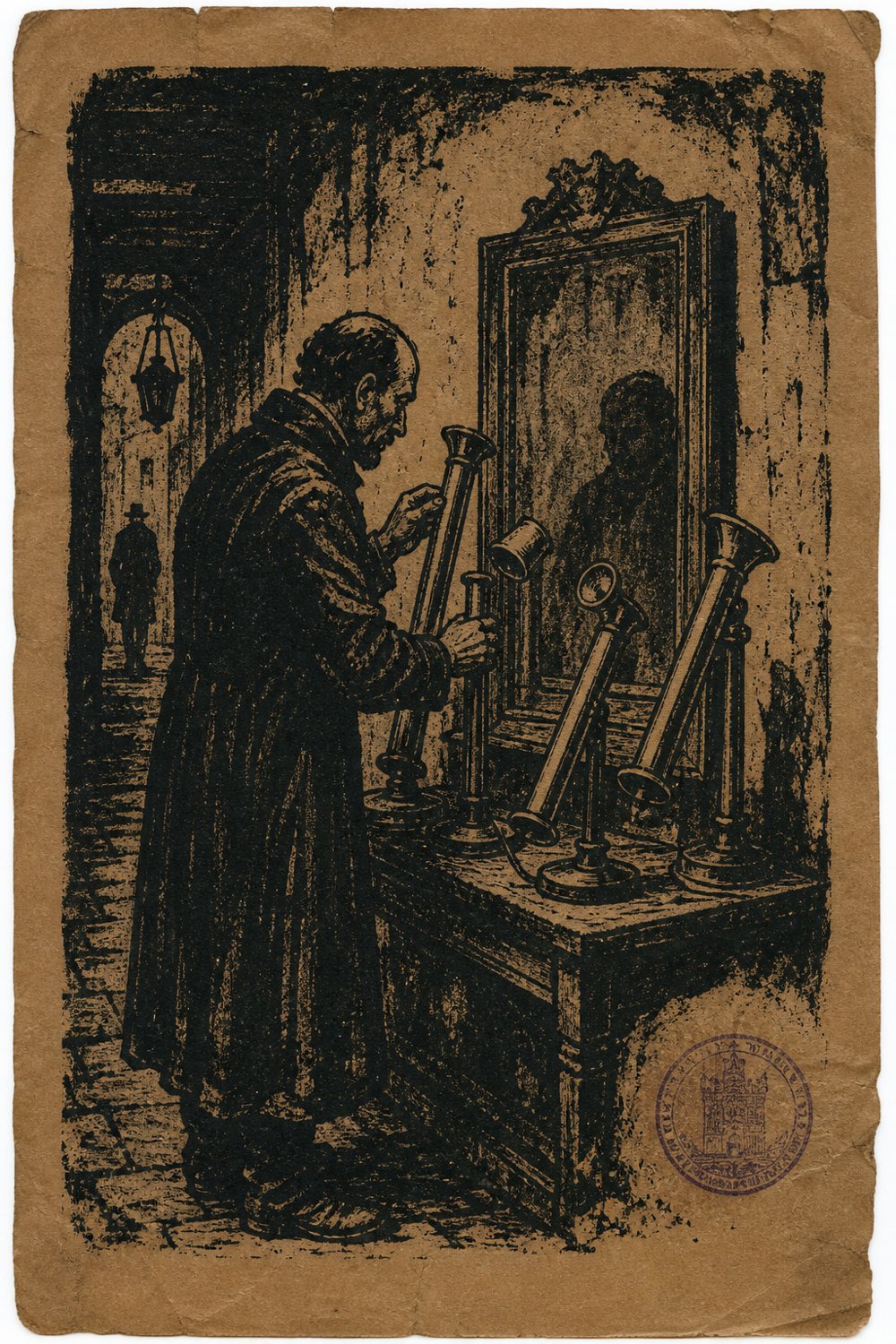
There is a mirror in a corridor at Murkminster, and everybody in that building will tell you the same thing about it in the same six words: "That's the traumatised mirror. It's seen things."
They say it with relish. They say it to visitors. It is one of the small pleasures of working in that building, and it has been for as long as anybody can remember, and in all that time — and this is the whole of the tale, so I will put it early — not one person had ever asked it what.
Not one. In two hundred years. They asked is it true, and who put it there, and does it do anything, and one clerk in 1911 asked it to show him next Thursday and got, correctly, his own face.
Nobody asked the question. It is the same failure as the four bells and the same failure as the ninth collector and it is, I am beginning to think, the realm's only real fault: we will spend two hundred years enjoying a mystery rather than five minutes addressing it.
The person who finally asked was a woman of about fifty who had come in to complain about a boundary and had been left in that corridor for an hour and forty minutes, which is what this realm does instead of an appointment.
She got bored. She read the plaque. She looked at her own reflection for a while, the way you do.
And then she said, out loud, to a mirror, in an empty corridor, in the tone of a woman who has been kept waiting: "Well, go on then. What did you see?"
It told her.
I am going to be careful here, because there are eleven versions of what happened next in circulation and nine of them are rubbish. There was no voice. There was no cold wind and nothing came out and nothing reached for her. Two people have made a good living telling it that way and I have no patience with them.
What happened — she is alive, she has told it perhaps four times, always the same, always reluctantly — is that she understood something, all at once, standing in front of it, the way you sometimes understand a sentence a second before the person finishes it.
And what she understood was this.
It is a mirror in a corridor. It has hung there for two hundred and eleven years, opposite a door. It has never moved. It cannot look away, and it cannot close, and it has no more choice about what it takes in than a window has.
And what it has taken in, for two hundred and eleven years, is everybody who ever walked down that corridor.
That is all. That is the whole of what the traumatised mirror has seen: people, going past, in a corridor at Murkminster.
Now hold that, and then remember what building it is in, and what the door opposite it is.
It is the corridor to the eastern rooms. It is the way you go to the Office of Boundary Clarification. It is the passage every survey party in this realm has walked down on the morning it went out — twelve men in 1893, and eighteen men in whichever telling you keep, and the four before them, and every party since — coats on, boots new, in good spirits, some of them stopping to check their reflection because a man does, before a thing like that.
And it is the passage they came back down. The ones who did.
Two hundred and eleven years of that. In one fixed frame. Every face on the way out, and then the gap, and then which faces came back and which did not, and how long between, and what the ones who came back looked like when they passed it the second time.
It is the only complete record of the eastern expeditions that exists in this kingdom. It is not in a drawer, it has not been redacted, it was not revised in 1894 and 1895 and 1897, and no clerk has ever copied it forward wrongly.
It is a mirror. It never wrote anything down. It has simply been unable to look away.
She went and sat in the yard for a while afterwards. That is the part I find most convincing about her account: not the swoon, not the scream — she went and sat down in a yard, which is what a person actually does.
And then she went back in, and did the thing that makes her the only person in this story I would trust with anything, which is that she went and found somebody senior and told them, plainly, and asked whether the mirror could be moved somewhere quieter.
Not covered. Not destroyed. Not exorcised. Moved somewhere quieter, which is what you would ask for on behalf of anybody who had been made to stand in one place for two hundred years and watch that.
She was told it was a fixture and that fixtures required a form.
The mirror is still in the corridor. Of course it is. They have put a small brass plate under it now which says THE TRAUMATISED MIRROR and gives the date it was hung, and visitors are shown it, and the six words are still in daily use, and the whole building still enjoys it enormously.
But there is a thing that happens in that corridor now which did not happen before, and nobody has ever minuted it, and nobody will.
When a party goes out east — and they still go, less often, but they go — the people who work in that building have taken to walking down the corridor with them, as far as the door. Not making a fuss about it. Falling in alongside, chatting about nothing, seeing them off.
Ask anybody there why and you will get a shrug and something about it being polite.
They are standing with the mirror. That is what they are doing. They have worked out, without one of them saying it out loud, that a thing which cannot look away should at least not have to watch on its own.
We would rather have a haunted object than an accountable one, and a realm will keep a mystery on the wall for two hundred years rather than ask it a question — but ask, and you will usually find no ghost at all: only something that was put in one place, and told to stay, and could not look away, and has been keeping the truest record in the building the entire time because nobody thought to relieve it.