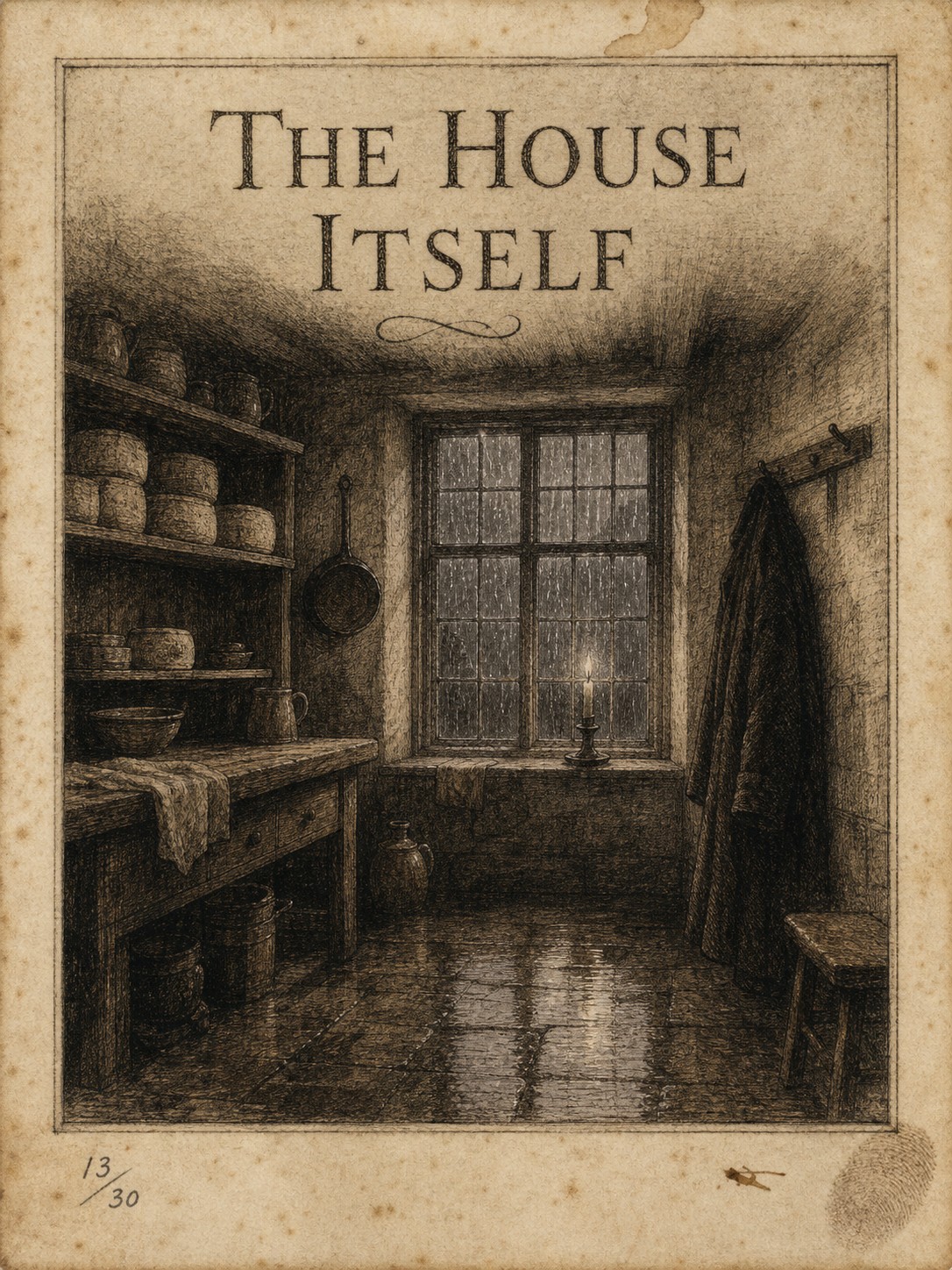
The House Itself
The Tales
- THE CHEESE
- THE MURMURED JOKE
- THE OVERCROWDED LEDGER OF BARON BALTUS
- THE DINNER THAT WAS NEVER BROUGHT UP
Tale 3THE CHEESE
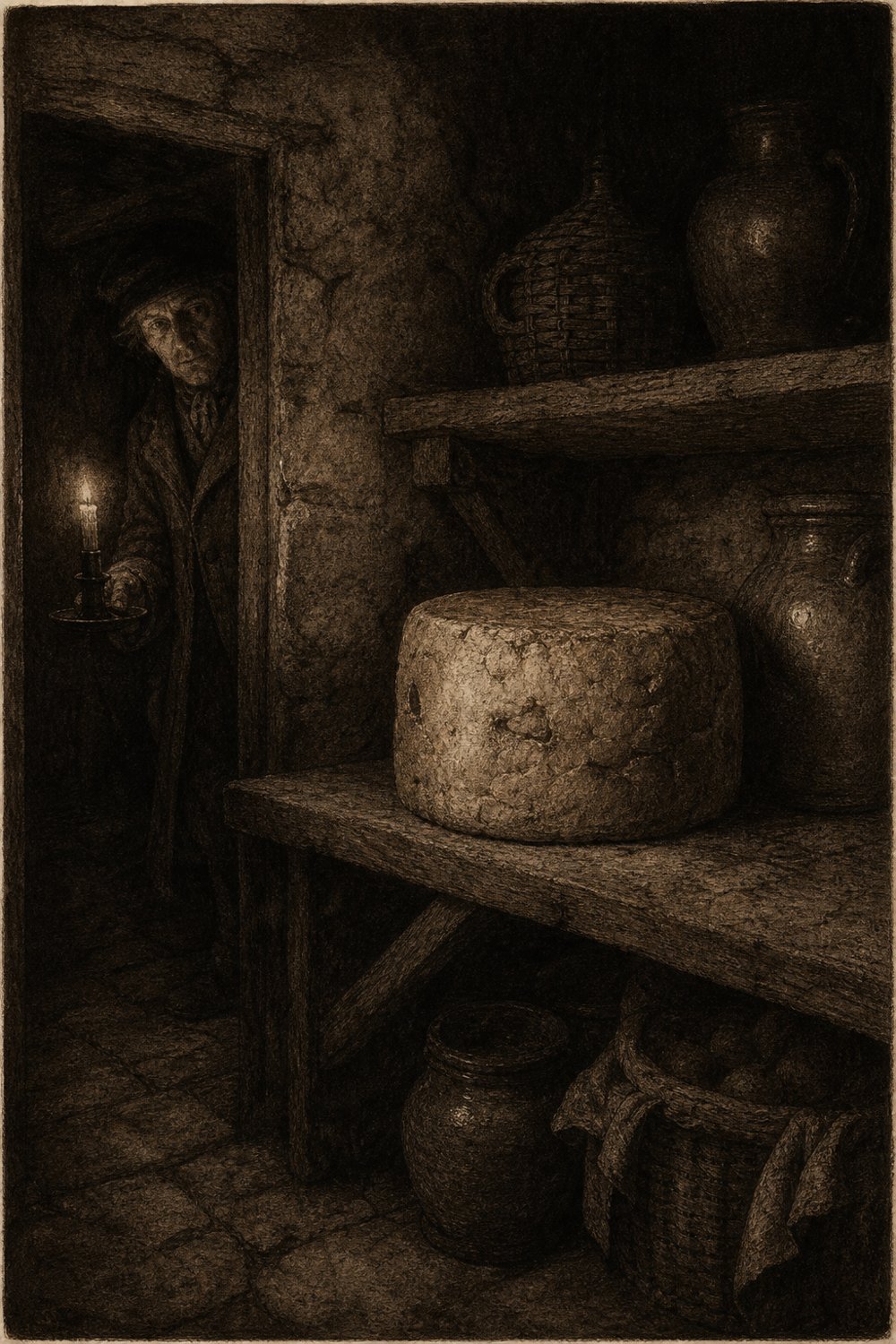
Edition collection.*
I have been aging on the fourth shelf of the Rind larder, in the cold cellars under Castle Bastable, for longer than several of the surrounding counties even considered existing, and in that time I have developed two things a cheese has no business developing: a minor feudal system, and a mild and most inconvenient clairvoyance.
The feudal system runs the shelf. I, a wheel of Sogmarsh Blue, hold the middle estates. Beneath me sit the young chèvres, soft and white and stupid, who do not yet know they are doomed and spend their brief lives gossiping. Above me, on the high shelf, broods the Wensleydale — a vast, cracked, self-important elder who claims to remember the actual date of Creation and will tell you so, at length, whether you have asked or not. And presiding over all of us, of course, is Old Mother Stilton, who stopped being a cheesemaker some centuries ago and became, by slow sad degrees, the cheese itself: the memory of the whole castle, kept cold and kept close, because the cheese remembers everything the chronicles were too embarrassed to write down.
Now. You will want to know what I am like, up close. I will be honest, because at my age there is no point being anything else.
Once a year I have my weeping season. I secrete a fluid — a clear, ambitious sort of fluid — which will dissolve a stout leather boot down to the buckle in an afternoon, and which, spread thin upon a hardtack biscuit, is so addictive that two footmen once came to actual blows over the scrapings. My smell, during this season, has been entered into evidence. My veins move when no one is looking. I am, by any reckoning a sane person would use, a horror in a rind.
And I know things. I cannot help it. The larder is the coldest and oldest place in the castle, and down here, if you are very still and very old, you can feel it: a slow patient hum coming up through the stone, a deep below-the-deep, a thing that does not seem to want anything to finish — and so the milk in me never quite turns the last turn, and I age, and age, and do not die, and I see things coming the way you might see weather.
Which is how I knew about the boy.
He came on the third cold night of the autumn — a scrap of a thing, ribs like a birdcage, the kind of hungry that has stopped crying about it. He had got past the door (the door has its own opinions, but it likes the small ones) and into the dark of the larder, and he stood in front of my shelf with his eyes fixed on the deep blue heart of me, where the rind splits, where the richest part of any cheese lives.
And I saw, the way I see, exactly what would happen if he ate it. My centre is not for a starving child. It is too rich, too strange, too old. He would eat his fill in the dark, and lie down warm and content for the first time in a year, and sleep — and it would be the kind of sleep that lasts forever.
So I did the only thing a cheese can do. I turned. I called up every foul, dissolving, war-crime ounce of my weeping season at once. I rotted my own outer face on purpose; I made myself the single most disgusting object in a castle that has real competition for the title; I drove such a stench off my rind that the boy's empty stomach revolted and turned him, gagging, away from me — and toward the safe, plain heel of yesterday's bread and the cold broth on the low shelf, which would do him no harm at all and see him to morning.
He ate the bread. He kept the warmth. He left, and he came back the next night for more bread, and the night after, and by midwinter he had the beginnings of cheeks again. He never once thanked me. He thinks I am the worst-smelling thing he has ever met. He is correct, and I have never been prouder of anything.
I have had a very long time to learn this, here in the cold where nothing is allowed to end:
True maturity is knowing exactly when to turn sour for the good of the realm.
Tale 8THE MURMURED JOKE
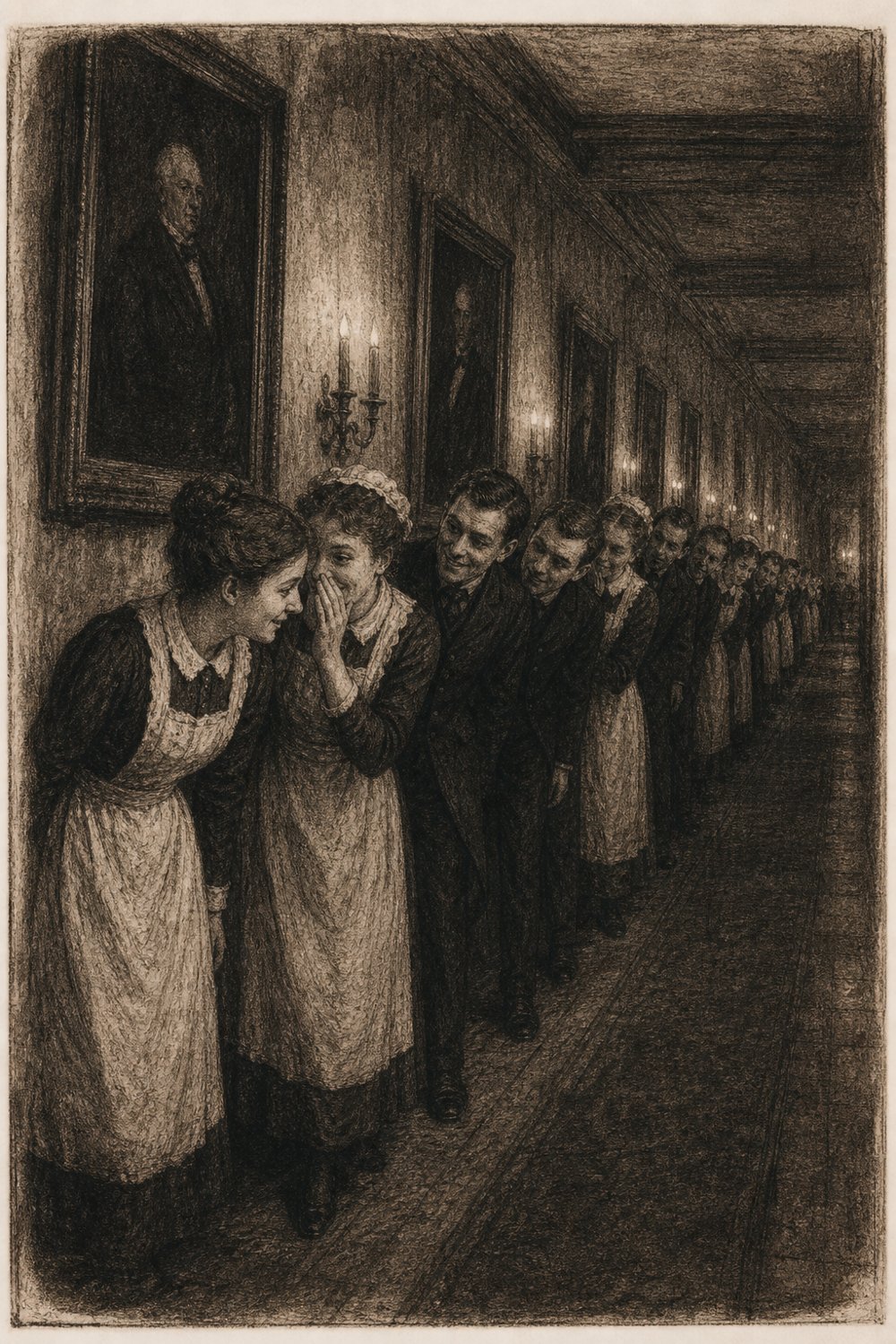
We are forty-odd portraits in the long, gloomy Gallery of Castle Bastable, and I will be honest with you, as the dead can afford to be: we are not good people. We lie. We contradict one another out of spite. We have spent whole centuries in a feud over whose frame catches the better light. I am Lord Grimmble the Third, dead since 1642, and in all that time the most useful thing I have witnessed this family do is leave.
But once a day — more, if a fresh face wanders in looking lost — we do the one decent thing we have left. We tell the Joke.
You must understand that no one of us can tell it. That is the whole point. It is far too precious to trust to a single mouth — and besides, we have learned the trick of it: a thing said in pieces cannot be pinned on anyone, and the chapel takes a very dim view of anyone caught manhandling the hymns. So it goes like this. Mad Earl Peregrine, three frames to my left, opens with the line as the hymnal has it — the grand one, the one every soul in the castle has droned a thousand Sundays running: "Our somewhat disinterested Lord, who watches over us as—" Then I supply the pause. I am very good at the pause; I have had centuries. And then, from behind the canvas at the dark end of the row, where the Nameless Regent hangs with her face long rotted off, a voice finishes it the way he always finished it — with the little words swapped smartly about at the front, so that our watchful loving shepherd arrives, every single time, as "a shoving leopard."
And Lady Agatha the Unforgiving turns the exact colour of a tax demand — she considers it blasphemy, and has considered it blasphemy daily since 1701 — and the whole rotten vine of us titters like a blocked drain, and somewhere a real leopard is presumably very offended, and the Lord Himself, being disinterested, has never once looked up.
The grown ones who hear it groan, every time, and pretend they were looking at the ceiling. The children who hear it laugh until they hiccup, decide we are senile, and run off to shove each other into the moat shouting "MIND THE LEOPARD." Both reactions are correct. That is the genius of the thing, and the genius was not ours.
It was his.
At the far end of the gallery, badly lit, in a frame too small and too cheap for the company it keeps, there hangs a man in faded motley. He is not a lord. He is not even a Bastable. He was the gallery jester — the one soul in six hundred years of this family who was ever funny on purpose, and who is therefore, naturally, hung in the worst spot, where the damp gets in.
The Joke was his. All of them were his. He could take any line this dreary house held sacred and swap its little sounds about until the sacred thing fell over — tons of soil for the sons of toil, a shoving leopard for the loving shepherd — and he spent a short, cold, brilliant life making this miserable family laugh at itself, which is the hardest magic there is. He was halfway through that very garble — the hymn, the pause, the swap — on the night he died, mid-breath, mid-grin, the way the truly unlucky go.
And here is the thing the family does not know, and would not care for if they did. His portrait never finished it. Look at him: his painted mouth is open on the setup and has stayed open for two hundred years, because he never reached the swap, and something in this house does not permit a thing to reach its end. The candle of him will not quite gutter out. The leopard will not quite arrive.
So we finish it for him.
Not because it is funny — it stopped being funny the night he stopped. We finish it because it is the last of him there is: one daft, perfect, upside-down little line, and forty bad people keeping it lit between us, passing the pieces hand to hand down the dark of the gallery so that no single draught can blow it out. When a new face wanders in, we do not perform it to show off. We perform it because performing it is the only way he is still, in any sense that matters, in the room.
You will not catch us being tender about anything else. We are portraits; we are awful; we will mock your shoes and your lineage before you reach the door. But the joke we will keep. We will keep it badly, and forever, and with the whole of whatever the dead have instead of hearts.
The daftest thing in the house can still be the tenderest — if it is all you have left of someone.
Tale 12THE OVERCROWDED LEDGER OF BARON BALTUS
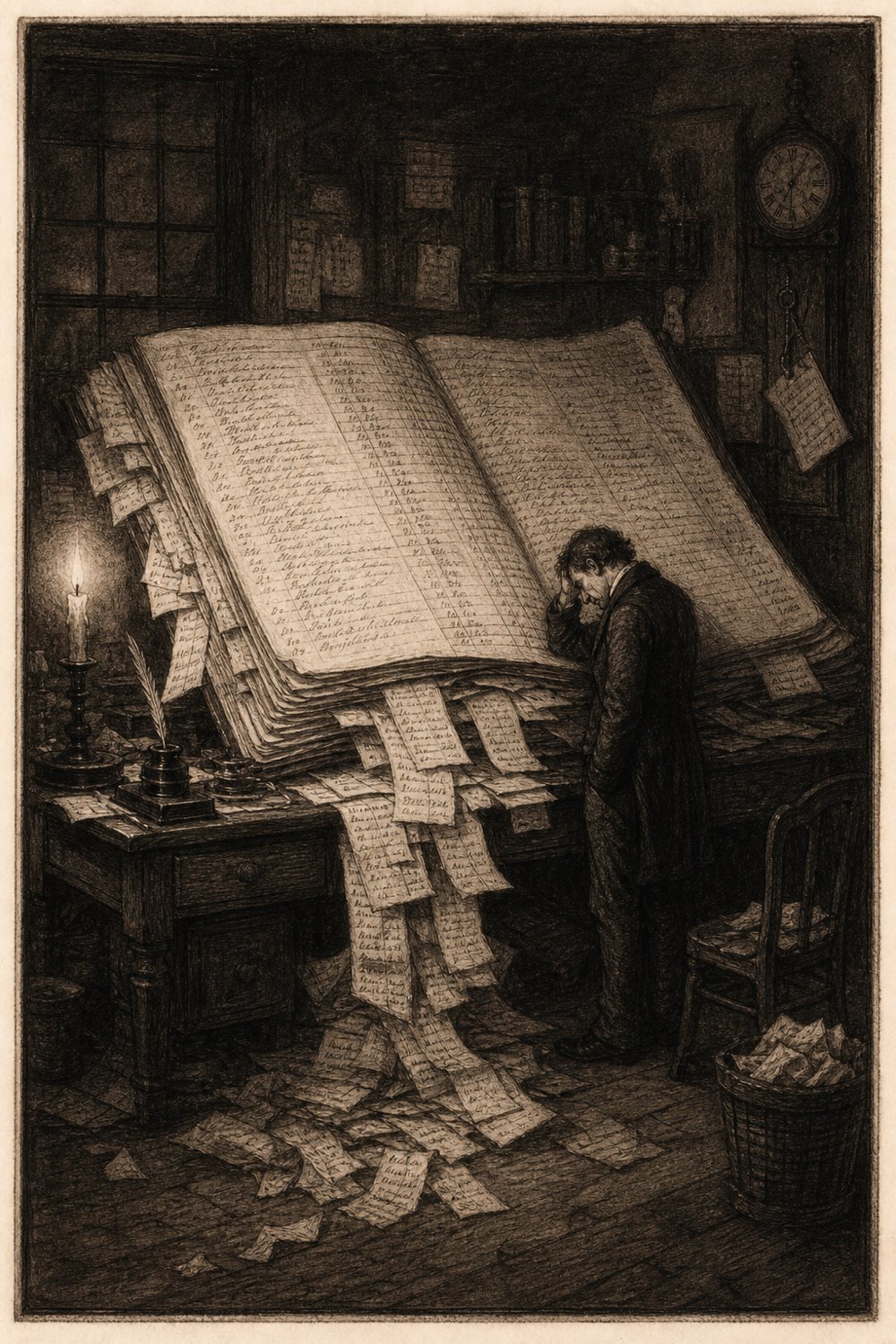
I have no name worth writing down, which is precisely why they send me to do the jobs nobody else will touch. This time the job was down — down past the wine cellars of Castle Bastable where House Dribble snores in its barrels, down past the cheese vaults, down the long stair that House Delve keeps threatening to tunnel out from under, and into the crypt. In Castle Bastable, the crypt is not a restful place.
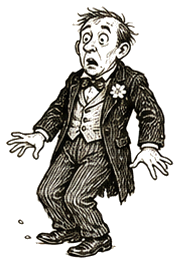
It is not restful because nobody has died on schedule in a very long time. The realm keeps one Reaper, and his moped is forever somewhere else, coughing in a ditch, so the dead of Bastable are not collected. They pile up in the family vaults like lodgers in an inn that has stopped taking bookings and cannot make anyone leave. Through it all drifts cheerful Mr. Mortlake, the undertaker, a tape measure round his neck, happier than any man has a right to be, humming a tune he stole off Old Sozzle — a fellow with more work than he can ever finish and every intention of enjoying it.
Lord Perry had sent me with a cunning plan, which is his word for a scheme that will go wrong in a way he can pin on me. House Delve wished to tunnel through the north wall of the crypt. The dead in the north wall did not wish it. My task was to make them stop objecting — armed with no rank, no coin, and a leaking zinc bucket that had been pressed on me for reasons nobody would explain.
The chief objector was Baron Baltus von Sump, and he had been objecting since 1478. He came at me out of the dark with a cracked spectral monocle and a contract he had been clutching for six centuries, and he told me his grievance the way a man tells a thing he has told ten thousand times to no one at all: that he had been murdered. Cheated at cards, then quietly drowned, by the first Bastable — Sir Reginald — who scratched Baltus's name off the deeds and inked his own on top, and that every soul upstairs was descended from that one rotten hand of cards. If the miners so much as chipped his sarcophagus, he thundered, he would leak every debt the family had ever buried straight to the bankers, unionise every phantom in the vaults, and strike clean through to Spudmas.
Mortlake tried to manage him — offered, smoothly, to misplace the tax collector's paperwork. From up the flue, House Echo threw down an impression of Lord Perry's voice, drawling that I was doing marvellously and that the acoustics down here were superb for screaming.
And then I did the one thing I had not been sent to do. I sat down on the cold flags, and I listened.
Because it came to me, somewhere in the middle of his threats, that Baron Baltus did not care about the masonry. He had not cared about the masonry for four hundred years. What he wanted — what he had wanted since the card table went over and the black water closed above his head — was for one single living person to say the words "you were murdered, and it was wrong, and it should never have happened," and to mean them. Six centuries of the finest disgruntled haunting in the realm, and underneath all of it was just a man waiting to be believed.
So I said it. I am nobody; I had nothing else in the bucket to give him. I said: you were murdered, Baron, and it was wrong, and I am sorry, and I believe you.
The crypt went very still. And somewhere far below us — far below even the Delves' deepest reach — something I have never been able to explain gave a low, slow turn, the way a sleeper eases off a bruise; and for just a moment the whole north wall seemed to lean an inch back from the miners' chalk marks, as if the castle itself had decided, only this once, to be gentle about the digging.
Baltus looked at me for a long time. Then he said, gruffly, that Delve's lads could have their easement — provided they dug around his box and never through it, around, mind, and quietly — and that I might tell that fraudulent weasel upstairs there would be no phantom strike this Spudmas after all.
I climbed back up with my empty bucket. Perry took the credit, as he always does.
But I know what truly settled it, and it was not the cunning plan, and it was not the misplaced tape measure. It was that the loneliest thing in the dark is so rarely a monster. It is usually just someone who was wronged a very long time ago, and has been waiting, all this while, for a nobody with the time to hear them out.
The dead do not haunt you for the house. They haunt you to be believed — and even a nobody can give them that.
Tale 36THE DINNER THAT WAS NEVER BROUGHT UP
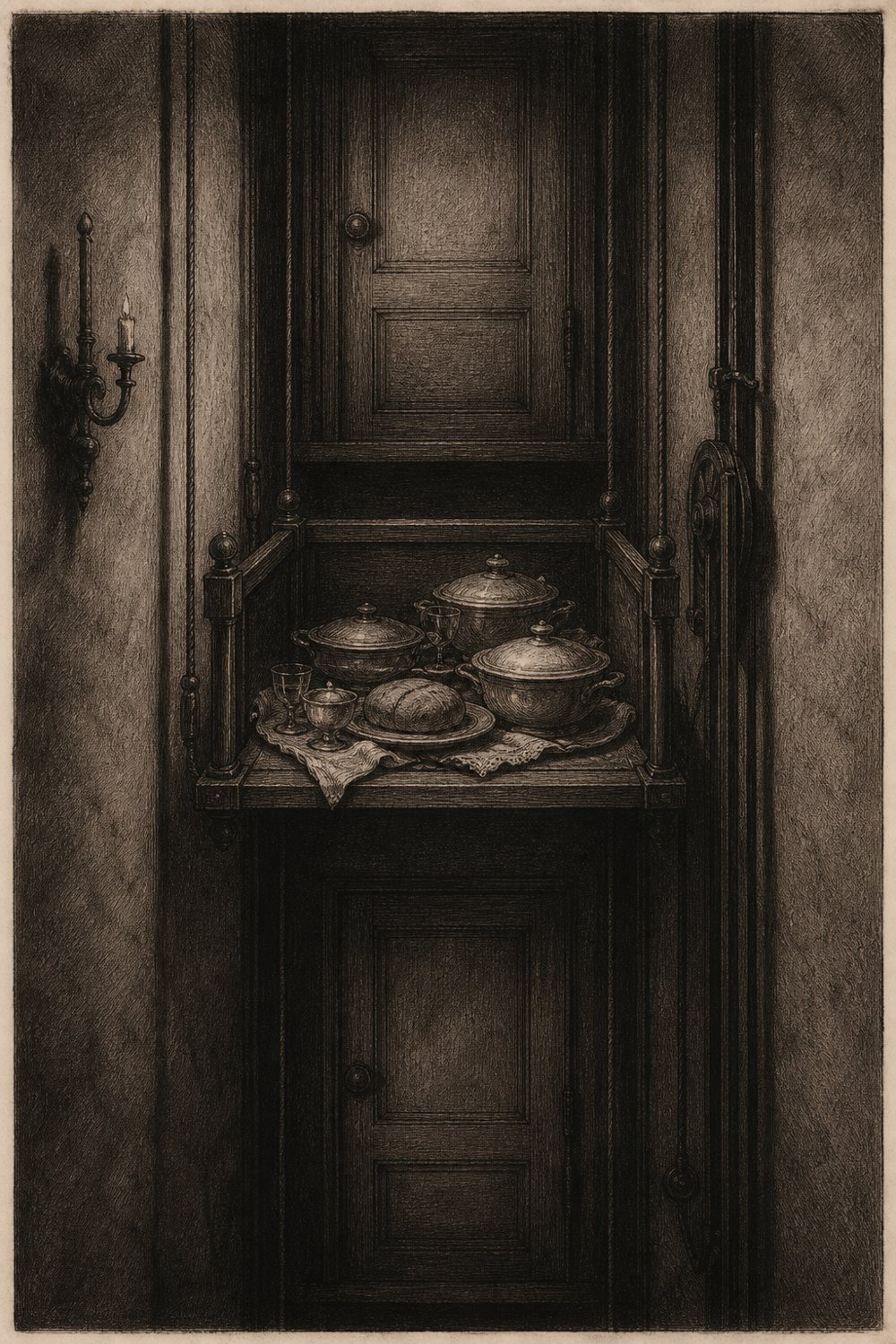
I am a tray.
Ash wood, warped, and so heavy with two hundred years of Castle Bastable's grease that I have stopped being furniture and become, more or less, geology. For all that time I have rested exactly twelve steps below the parlour floor, on the cold stone lip of the cellar stair, held up by the trembling thumbs of a man named Sozzle who is, at every single moment, just about to climb.
I have never seen the parlour. I know it only as a rumour of warmer air leaking down the stairwell, and as a sound: the small, patient creak of a chair that will not be moved.
Let me tell you what I carry, since no one else will look.
There is a bowl of mutton broth. It was, once. It has since grown a thick grey pelt of mould so deep and so hairy that it breathes — rising and falling, gently, with the damp of the cellar, like a sleeping thing that would rather not be disturbed. Beside it sits a dish of cold pease pudding, which over the centuries has calcified into a single sulphurous brick; you could build a wall with it, if you had no neighbours you liked. And there is a tankard of ale, long since fermented down into a black, volatile tar that bubbles to itself in the dark and, now and again, swallows a stray petrified cellar-beetle whole, with a small, satisfied gloop.
The mould, I should say, is now load-bearing. It is the only thing holding the pewter spoon up; beneath it the wood of me has rotted to lace, and were it not for an enterprising blue-green crust spanning the gap, the spoon would have dropped into King Tiddles' drains around the reign of the third bad Bastable.
By every law the cook ever swore by, this dinner should be cold. Stone cold. Cold as the stair, cold as the grave, cold as a Pennyworth handshake.
It is not.
Deep in the centre of the mutton bowl, under the breathing pelt, under the grease, under two hundred winters of stagnant cellar air, there is a small stubborn knot of warmth. It has no business being there. It defies every sensible thing. And I have had a long time, balanced here in the dark, to work out why it persists — and it is not physics.
It is that Sozzle is still holding me.
Not idly. Not asleep, whatever the upstairs gossips say. He holds me the way a man holds the last thing that matters: with his whole trembling weight tipped forward toward the climb he means to make, because somewhere up those twelve steps there is a woman, and the winter was coming, and he wanted — he wanted, fiercely, with everything a careful man has instead of words — for her to have one hot meal before the cold set in.
Her name is upstairs. I have never seen her. But I have heard her, all this time: the creak of the chair she will not move. They tell me — the beetles tell me, the draughts tell me — that her slippers have worn two shallow, perfect dips into the parlour floorboards, just there, by the head of the stair, where she sits and listens. She could move the chair. She could turn it to the fire. She does not. Because to move the chair would be to face the stair, and to face the stair would be to see that it is empty, and to see that it is empty would be to know — and knowing is the one dinner she will not be served.
So she waits at the top with her two worn dips in the floor, and he waits at the bottom with his trembling thumbs, and I wait in between with my breathing broth, and none of us, you understand, can finish.
The night does not quite end. The chair does not quite still. The last bell — there is a bell, I am told, that a butler rings when the day is truly done — does not quite ring. And I do not quite go cold. Forever, and forever, and one more forever after that.
I have had two hundred years to consider my position, and I have reached a conclusion, which I offer to you free of charge, since I am a tray and have no other use left:
It is a terrible thing to be permanent, and better by far to be finished — but if you must wait forever, wait as Sozzle waits: holding something warm for somebody else.