The Frost Fair
The Tales
Tale 25THE FROST FAIR
Once in a life, if you are lucky, and old, and it is very cold, the Great Slough freezes.
Not the skin of it that ices most winters and lets a fool through by breakfast. All of it — down and down, to a hard black glass a cart could cross, a depth of freezing that comes so seldom the parish has to be told it is happening by the very oldest among them, who felt it once as children and have been waiting sixty years to feel it again and mostly died still waiting.
I am one of the ones who did not die waiting. I stood on the bog as a girl, on the ice, where in summer a man is swallowed in the time it takes to shout twice. And now I am old, and it has come again — the once-a- generation cold, the black glass, the bog holding its breath — and I have brought my granddaughter's girl, who is seven, and who will remember this when she is me, and who will bring some child of her own if the cold is kind enough to come round one more time, which it may not, for the winters run down like everything else in this realm.
So. Let me tell you what a frost fair is, and what it is for, before it melts.
Overnight the whole parish came out onto the water that had been trying to kill us since before there were Bastables.
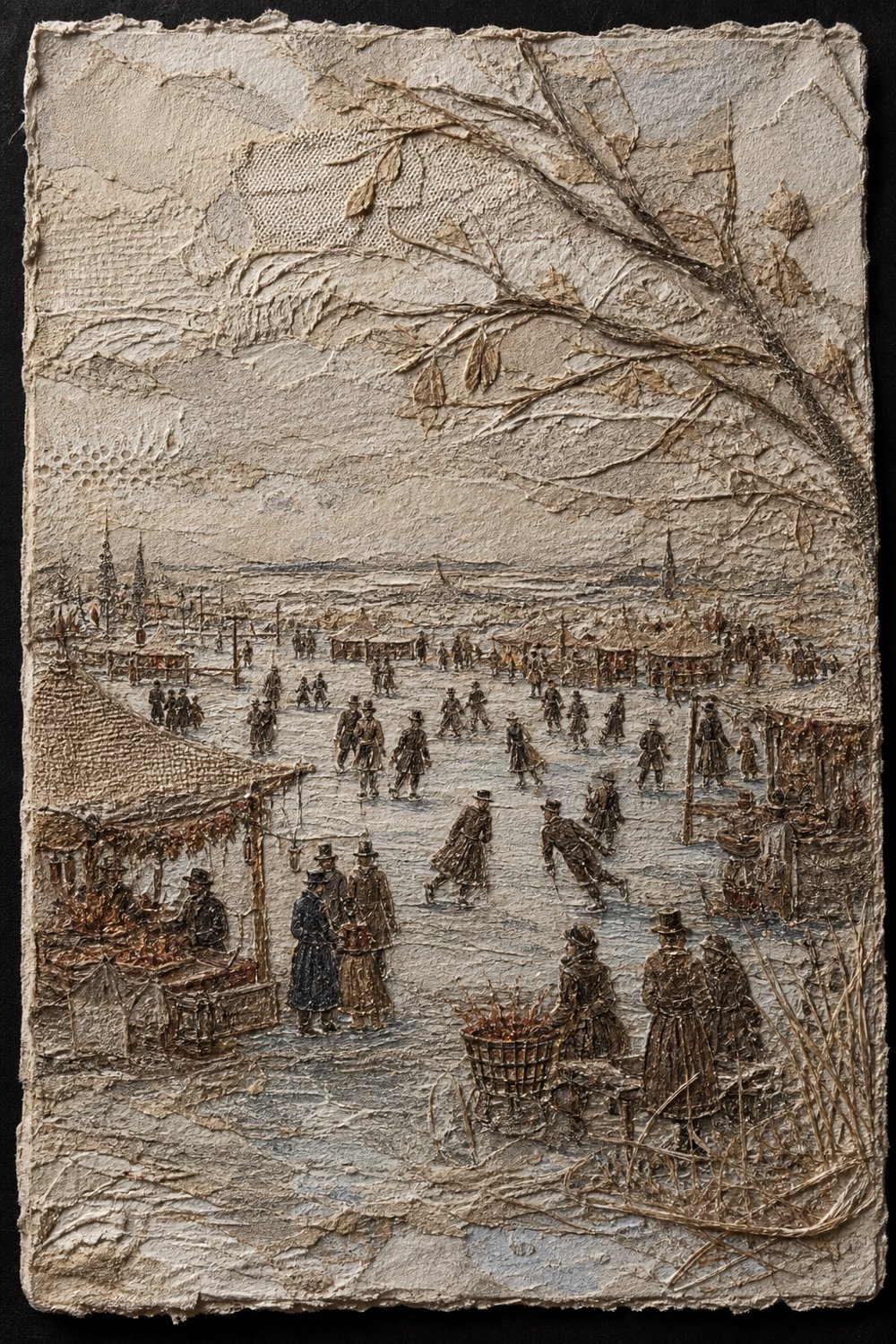
You have never seen anything like it and you never will, unless you are very cold and very lucky. They built a town on the bog. Booths of sailcloth and hurdle, in a double row, a whole crooked street of them laid straight out across the ice where no straight thing has ever been. A pie-man with his oven dragged out on a sledge and lit right there on the frozen mire, the smoke going straight up in the still cold air like a plumb-line. A fiddler. Two fiddlers, who hated each other, playing at opposite ends and pretending not to hear. Chestnuts. Hot spiced ale in leather jacks. And skating — the whole of Mucklecombe and half of Drudgeford skating on bones and blades and the seats of their breeches, on the surface of the thing that eats us, laughing at it, laughing at the bog, which no living soul has ever been able to do before or since, because for these few days it cannot answer.
The children had never seen the bog be anything but the enemy. Now here it was, holding them up. My granddaughter's girl skated out to the middle — the very middle, over the deepest black, where the summer mire has no bottom anybody has ever found — and she stood there, on nothing, on the drowning place, and she was not drowning, and she laughed, and I had to turn away, because I had done exactly that, in exactly that spot, seventy years gone, and my grandmother had turned away too, and I understood at last why.
She was not turning from sorrow. She was turning because it is too much — the sight of your own people, warm and daft and alive, standing careless on the very death of them, for one bright week, by grace of the cold. It is the most Sogmarsh thing there is. It is the whole realm in one picture: dancing on the thing that will have us, while it cannot.
Now. I said I would tell you what a frost fair is for, and it is this, and it is the hard half, and the oldest ones make sure it is taught before the fair is a day old:
A frost fair is for leaving.
The cold does not last. It cannot. The ice is a loan, not a gift — the mire is only holding its breath, and a held breath ends. There comes a day, and the old ones can smell it coming the way my brother could smell rain, when the black glass goes grey at the edges, and the smoke off the pie-oven leans instead of climbing, and a thin dark seam opens along the booth-street like a slow word. And on that day, you strike the fair. You take your sailcloth and your sledge and your fiddle and your children and you come off the ice, all together, while it will still bear you, and you let the bog have its bog back, and you go home, and you are grateful, and you do not go out again, not for anything, not for a dropped coin, not for one more song.
The ones the fair kills are never the careless. It is never the child too far out. The parish watches the children like hawks and no child has been lost to the ice in living memory. The ones the fair kills are the ones who cannot leave a good thing while it is good. The trader with one more cartload to sell. The fiddler who wanted the last word. The greedy, the grasping, the ones who look at a wonder and think not "how glad I am to have seen it" but "how do I make it stay."
The last fair — my first, as a girl — it took a land-agent.
I remember him. A damp, smiling man, not unlike the one who works the inns today, who had spent the whole week doing the single most Sogmarsh thing I have ever witnessed: he was selling the ice.
Plots of it. Deeds and all, drawn up proper, stamped, witnessed. Prime frozen frontage, sir, freehold, hard as a church floor and twice as central — you'll never get bog this solid at this price again. And people bought. That is the maddening truth of it: people bought squares of a frozen bog from a man in a wet coat, because he was so certain, and because when a thing is under your feet and holding you up it is very hard to believe it was ever going to be water.
And when the grey came to the edges, and the old ones cried the fair down, and the whole town began to strike the booths and come in off the black glass — the land-agent would not come.
It was his estate, you see. He stood in the middle of it, on his freehold, on his prime central frontage, and he told us we were fools to run from good solid ground, and he had the deeds to prove it was ground, and the deeds said nothing about a thaw, and a man will believe a stamped paper over his own cold feet right up until the moment the paper is floating.
We called to him from the reeds. We called a long time. He was still explaining the soundness of his title when the seam ran under him, and the bog, which had been holding its breath for a week, let it out.
They never found him. The mire keeps what it takes. But for years after, the story went that on the coldest nights you could hear him, down under, still selling — still certain, still stamped, still explaining to the dark that the ground he was standing on was freehold and central and sound.
(I do not believe that part. The dead do not sell. But I understand why the parish says it: because it is easier to laugh at a ghost than to remember a man who drowned defending a lie he'd talked himself into. We apply a story where the truth is only cold, and greed, and a stamped paper. It is what we do.)
The thaw is coming now, this second time, my last time. I can smell it, the way the old ones could. Tomorrow, or the day after, the grey will reach the edges, and I will cry the fair down with the other ancients, and we will strike the booths, and I will take my granddaughter's girl by her cold hand and lead her off the black glass and home, while it will still bear us, and I will not let her go back for anything.
She will cry. They always cry, the first time, at the leaving — because the fair is the most wonderful thing that will ever happen to them and it is ending and they are being made to help it end. And I will tell her what my grandmother told me, on the reeds, seventy years ago, with a drowned land-agent's story already going round:
The wonder was never yours to keep. It was only ever yours to see. And you saw it. Now come home, and be glad, and let the bog have its bog — for a thing you loved and let go of in time is a thing that never once drowned you, and you will carry this bright cold week down all the years until you are the old woman crying the next one down, and telling some crying child the same.
The moral, from the ice: some wonders come but once in a life, and they come with a thaw already in them, and the whole art of them is the leaving — take the joy entire, all of it, right to the middle of the black glass, and then, while it will still bear you, come off the ice. The bog keeps only the ones who would not go. Be glad you saw it. Take the child's hand. Go home.
Tale 50DEPTH NOT ESTABLISHED
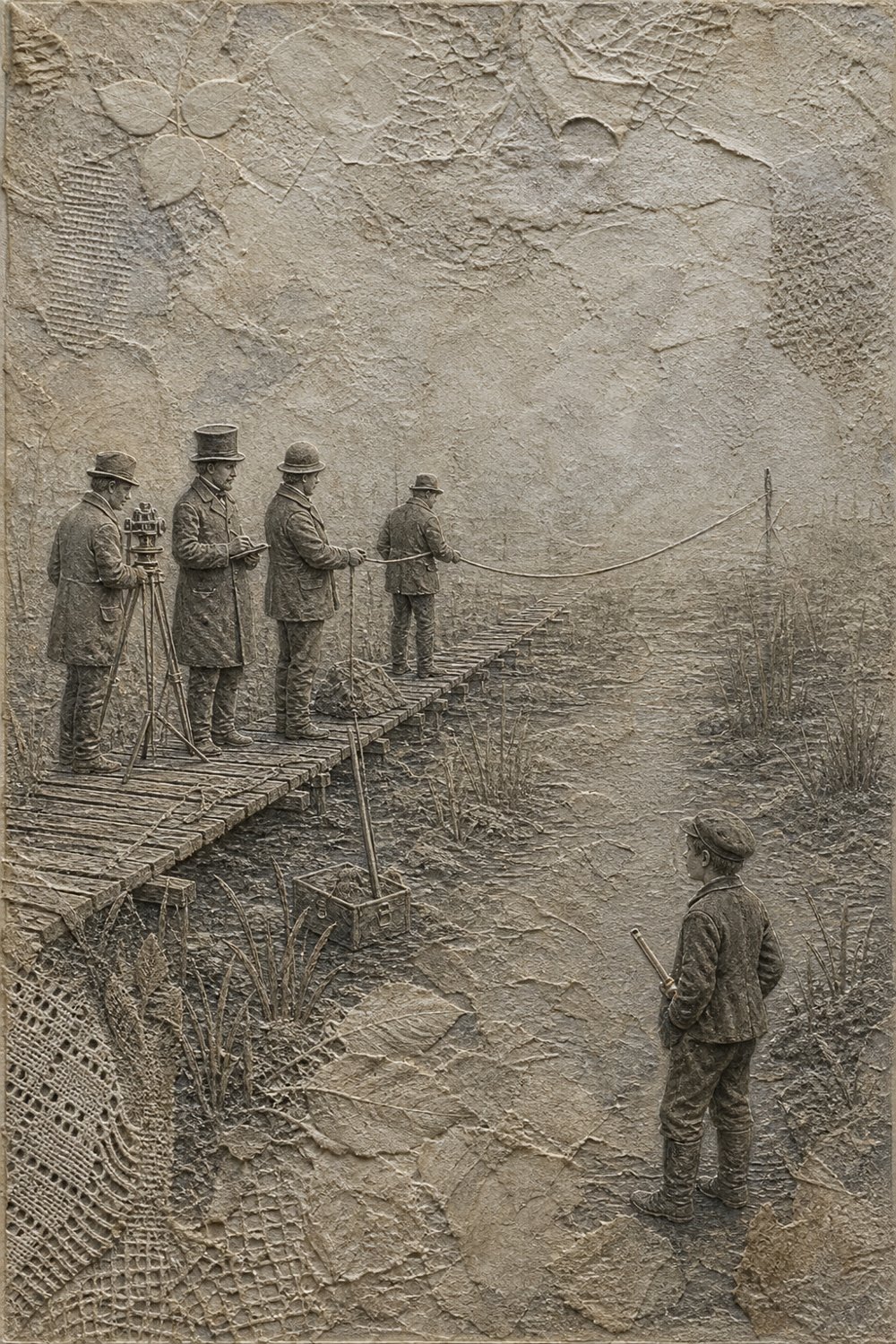
The Grand Cartographic Revision Committee has been trying to establish the depth of the Great Slough since 1841.
It has not established it. This is not the interesting part. The interesting part is how it has not established it, which is with enormous diligence, at considerable expense, over four generations, in a straight line, without at any point stopping to consider whether the method might be the difficulty — and the whole magnificent history is preserved, because the Committee preserves everything, in the one place where this office's soul is fully visible: the requisitions.
I have read them all. It took an afternoon. It is the funniest document in the realm and I do not think one word of it was meant to be.
REQUISITION THE FIRST. 1841. One sounding line, 100 ft, hemp.
The party proceeds to the margin of the Slough, pays out the line, and reports:
Now: a person outside this realm reads came back short and thinks about it for a moment and arrives, fairly quickly, at the answer. The bog is not a lake. It is not water with a floor under it. It is a suspension of peat and fibre and cold water, and it closes on things, and a hemp line paid into it comes back wet, and swollen, and fouled, and — over enough time in enough peat-acid — shorter, because the bog is quietly eating it.
There is no bottom to find in the sense the Committee means. There is only a gradient of increasing unwillingness.
Nobody at the Committee has ever written that down. Not once, in a hundred and eighty years. And I want to be careful here, because it would be easy and wrong to call them fools: every single man on those parties knew the bog. They were fen surveyors. They had walked it their whole lives. Ask any one of them in a taproom what the Slough does to a rope and he would tell you, at length, with feeling.
What none of them could do was put it in a return. Because the return has a box that says DEPTH, and the box takes a figure, and "the bog ate the line" is not a figure, and a return that does not fill its boxes is a return that will come back for amendment. So they filled in the only box the form gave them — Depth not established — and requisitioned a longer line, because a longer line is a thing the form does have a box for, and everybody could sign that with a clear conscience and go home.
REQUISITION THE SECOND. 1843. One sounding line, 200 ft, hemp.
(The Committee has re-issued the survey party with a longer line. The Committee is aware of how the previous sentence reads. The requisition stands.)
That parenthesis is real. It is in the minutes. It is, I maintain, the single greatest sentence any institution in this kingdom has ever written about itself: the Committee is aware of how that reads. They saw it. They saw exactly how it looked. And they ordered the longer line anyway, because seeing how a thing looks and having a different thing to do about it are separate problems, and only the first one is free.
REQUISITION THE THIRD. 1851. One line, 400 ft. Result as before.
THE FOURTH. 1869. One line, 600 ft, and one drum, iron, to wind it. The drum is the first sign of a Committee beginning to suffer: you do not requisition a drum unless the line has got heavy enough to require machinery, and a line that requires machinery is a line nobody is going to pull in by hand and notice the state of.
THE FIFTH. 1877. One line, 600 ft, chain, in place of hemp.
⭐ This is the near miss, and it is the great tragedy of the sequence. Somebody — the requisition is initialled and the initials belong to a junior — worked it out. Chain does not swell. Chain does not rot. Chain does not come back short. If that line had gone out, the Committee would have learned, in one afternoon, that its problem was the rope, and the whole subsequent century would not have happened.
The chain was struck from the requisition by the Chairman of the day, on grounds of cost, with a note that hemp had been found satisfactory in previous years.
Satisfactory is doing a very great deal of work in that note, and it has been doing it for a hundred and forty-six years.
THE SIXTH through THE NINTH. (1884, 1897, 1911, 1934.) Longer lines. Better drums. A boat. A second boat, the first having been retained by the Slough under maritime bog-law, which the Scuttles enforced promptly and which cost the Committee more in argument than in boat.
The returns are identical. I do not mean similar; I mean somebody copied the wording forward, year on year, because it had been accepted before and a form of words that has been accepted is worth more to a clerk than a form of words that is true.
THE TENTH. 1961. One line, 1,200 ft. And appended to it, for the first and only time in the entire sequence, a note from the officer in charge of the party, a woman, in her own hand, not on a form:
It was noted. It was filed. It was not read, until I read it, which is what filed means in this realm.
THE ELEVENTH, AND CURRENT. Standing, since 1989.
One sounding line, 2,000 ft, hemp; one drum, mechanical; and the party to attend annually at the margin.
They still go. That is the thing I want to leave you with. There is a survey party of the Grand Cartographic Revision Committee that attends the Great Slough once a year, in the wet, with two thousand feet of rope on a mechanical drum, and pays it out, and winds it in, and measures what comes back, and enters the result on a form whose wording has not changed since 1841.
They are good at it. They are efficient, and polite, and they have got the operation down to a day and a half from what used to take a week. There is a young man on that party at present who is, by common account, the finest hand with a drum in the profession.
And they know. Every one of them knows. I asked. The senior of them, a man of sixty, gave me the answer that is the whole of this realm, and gave it without any bitterness at all, wiping his hands on a rag:
"Course it's the rope, son. Everyone knows it's the rope. Been the rope since before my grandad."
And when I asked why nobody had ever written that on the form, he looked at me with the mild patience of a professional explaining his trade to an enthusiast, and said:
"There's no box for it."
Here is what a hundred and eighty years of that has produced, and it is not nothing, and this is the part the joke does not cover.
The Committee has no depth for the Great Slough. It has, instead, the most complete record of the behaviour of hemp in peat-acid ever assembled by anybody anywhere: a hundred and eighty years of lines, of known lengths, in known conditions, measured going out and coming back, annually, by careful people. Three separate trades now use those figures. The rope-makers at Saltgate price by them. It is, by a comfortable margin, the most valuable thing that office has ever produced.
It is filed under DEPTH: NOT ESTABLISHED.
An institution that cannot say a true thing will not stop working — it will go on working, beautifully, for a hundred and eighty years, and produce something magnificent and entirely unlike what it set out to find, and file it under the heading it was given at the start. If you would change such a place, do not argue with its conclusions. Widen its form.
Tale 55THE HAVER GOOSE TOURNAMENT
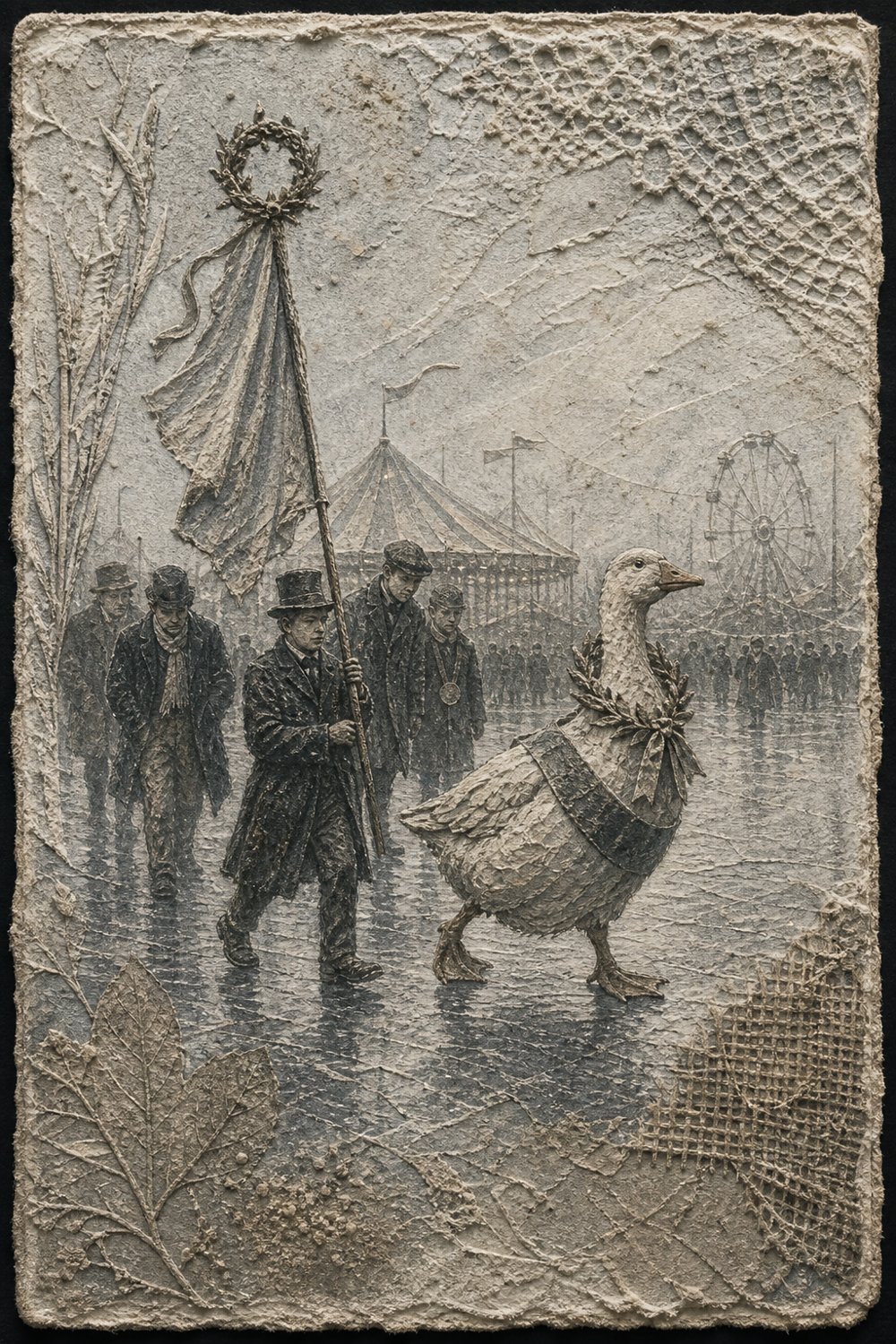
Every spring, on the Haver ground, the parishes of this realm hold the oldest continuous sporting fixture in the kingdom, and every spring it is won by a goose.
I am aware that a great many people know this much and no more. I am going to attempt the whole of it, because I have been going since I was six, and because the last honest account was written by a man who left at the interval, and because I have a piece of paper in front of me that I intend to work through before the ale wears off.
Let us begin with the difficulty that has defeated every previous chronicler, which is the small matter of what the sport actually is.
## THE RULES, SUCH AS THEY ARE
The tournament is a contest of retrieval over broken ground.
That is the shortest true sentence available and I have spent two seasons arriving at it. A thing is thrown — traditionally a bound sheaf, latterly whatever is to hand — and it lands somewhere in the Haver ground, which is three-quarters wet, and the competitors go and get it, and the one who brings it back gets a point, and the one with the most points at the end is the champion.
If you are now thinking that this sounds like a game a dog would be good at, you have arrived, in one step, at the central problem of the Haver Goose Tournament, and it took the parishes two hundred years.
Dogs were barred in 1698. The relevant minute is short and, I think, the finest thing House Haver ever wrote:
Nobody has ever barred a goose. There was no reason to. Nobody at any point in the history of that committee sat down and thought: what if a goose entered.
## WHY THE GOOSE WINS
I want to set this out properly, because the parishes are sick of being told they are fools, and they are not fools, and the Goose's advantages are structural and every one of them was voted in by men trying to be fair.
One. The ground. The Haver ground is bog with opinions. A man crossing it goes in to the knee at every fourth step and spends the day hauling himself out of the fourth steps. A goose does not cross the ground. A goose goes over the top of it, in that low insulting flap that geese do, six inches up, at the speed of a trotting horse, and comes down on the far side dry.
Two. The throw. The sheaf is thrown, by tradition, into the wind, so that the contest is fair to all comers regardless of which side of the ground they start from. This was decided in 1704, unanimously, by men who had thought hard about fairness and had never once considered that a thing thrown into the wind comes back a little, and that the only competitor on that field who understands wind professionally is the one with feathers.
Three. The whistle. Play begins on a whistle. The Goose has learned the whistle. The Goose has, over several generations of geese and one long institutional memory, learned the sharp intake of breath the whistleman takes before the whistle, which is a distinction the rules do not cover and which the parishes have twice declined to legislate on, on the grounds — and this is minuted — that "you cannot fine a bird for listening."
Four, and this is the one that finishes it. There is no rule requiring a competitor to bring the sheaf back to the same place. The rule says back. In 1672 everybody knew what back meant, because everybody was standing together at the near hedge. The Goose brings it back to where the Goose was standing, which is beside the trophy table, which is closer, and which is — read the rule again — entirely permissible.
It has been suggested that the rule be tightened. It has been suggested at every annual meeting since 1806. The motion has never once been put to a vote, because at the meeting of that year a member observed that the Goose was in the room, and the minute records that the matter was held over.
The Goose was in the room. It is always in the room. It has been in the room, in one body or another, for longer than the room.
## THE GOOSE
Nobody is entirely clear whether it is one goose.
I want to be careful here, because this is where a chronicler makes a fool of himself. The parishes say the Goose, singular, and have said it since 1672, and if you ask a direct question you get one of three answers depending on who you ask and how much they have had.
The plain answer, which I believe, is that it is a succession of geese from the same Haver flock, handed down like an office, each one taught the whistle by the last, in the way farmyard birds do learn things off one another and nobody has ever been able to explain how.
The taproom answer is that it is the same goose, which is nonsense, and is asserted with such total confidence by men who can otherwise be trusted with money that I have stopped arguing.
The Haver answer, when the family was applied to in writing in 1843, was "Certainly not."
What can be said with certainty is that the Goose is a goose of considerable presence. It is grey and about the size of a dog nobody would keep. It walks the ground before play like a man inspecting a hedge he intends to complain about. It does not acknowledge the committee — this is not a figure of speech; the committee stands at the trophy table in their sashes at the opening, and the Goose walks past them, and has never once looked at them, in any year, in any body, and every child on that field notices it and finds it the funniest thing they have ever seen.
It is not, I should say, a nice goose. Two of the sashes have been bitten. The Perpetual Trophy has to be brought to it, because it will not go to the table, and the man who brings it goes at a certain angle with the trophy held out in front of him like a shield, and that man is chosen by lot, and refusing is permitted, and about one in three refuse.
## THE CHALLENGERS, IN BRIEF
There have been serious attempts. I will not list them all, but the parishes' honour requires a few.
Boots off (1788). A cutter from Peatdike reasoned that the ground could be crossed barefoot faster than booted, and he was right, and he crossed it beautifully, and he was second by a margin of about a goose. He is remembered fondly and his time stood for sixty years.
The long arm (1822). A man arrived with a rake. There is no rule about a rake. He got the sheaf on the first throw and the crowd went up, and then he had to carry a rake across three-quarters of a bog, and the bog took the rake, and it is still there, and the parishes point at the spot.
The committee's own attempt (1854). Two members entered in an official capacity to demonstrate that the thing was beatable by a man of method. They finished fourth and seventh out of eight and did not enter again, and the minute for that year is one line long and reads "no further demonstration is proposed."
The dog question (1871). A man from a dry country brought a dog, having read the rules and found no dog in them, having not read far enough, and was shown the minute of 1698, and read it, and said — according to four witnesses who agree — "but the goose enjoys it," which is the best point anybody has ever made at that ground and which was ruled out of order.
## THE YEAR OF THE CHALLENGER
Now the year I came to write about, which the parishes call the Long Final, and which is the reason grown men in three villages still cannot be got to shut up about a bird.
The challenger was a woman called Aggie Prowse — of the Prowse family, mud and stone, the ones who re-lay the stepping-stones on Mire Road every time the water takes them, which is twice a year, which turns out to matter enormously.
She was about thirty, built like a door, and she had spent her whole working life crossing exactly the kind of ground the Haver tournament is held on. Not training. Working. That is the part the story keeps and the part I would like on the record: she did not prepare for the tournament. She had a job that happened to be the tournament.
And she had thought about it. This is what raises the Long Final above the rakes and the bare feet: Aggie Prowse had gone and stood on that ground in February, alone, in the wet, and worked out the one thing two hundred years of committee had not.
She did not try to beat the Goose across the ground. She worked out where the sheaf was going to land.
The throw is into the wind, by rule. The wind on the Haver ground in April comes off the west and does the same thing every year, and a woman who has spent her life reading water knows what wind does to a thrown object better than she knows her own family. She paced it out in February. She put a stone down. She came back in March and the stone was right.
On the day, she did not start at the near hedge with the others. There is no rule requiring it. She started out on the ground, at her stone, having walked out there in front of a crowd of about eight hundred people while the committee consulted each other in a rising panic and found, to their visible distress, that she was entitled.
The sheaf came down, they say, close enough to her that she did not have to run.
She had it up and was turning before the Goose was properly airborne, and eight hundred people made a noise that was heard at Mucklecombe, and for about four seconds the oldest fixture in the realm was lost.
And then Aggie Prowse had to carry a sheaf three-quarters of the way across a bog with a goose in the air beside her.
They went the whole way together. That is the detail. Not a chase — level, the two of them, the woman going through it to the knee and hauling out and going again with the sheaf up over her head, and the bird six inches off the surface doing that flat contemptuous flap, and neither of them gaining, all the way across, for what the parishes insist was four minutes and was probably closer to two.
She lost by the length of a table.
Not by the ground. She had the ground beaten; she was ahead at the last firm footing and she is the only competitor in the history of that tournament who was. She lost because at the last she had to go to the near hedge, where the field starts, and the Goose went to the trophy table — the rule of 1672, the word back, the thing that has never been put to a vote — and the table is nearer.
She lost to the minute. The parishes have never been in any doubt about it and neither has anybody else.
## WHAT HAPPENED AFTER, WHICH IS THE PART I ACTUALLY CAME TO TELL
The committee met the following winter, and there was a mood.
Somebody — and it was not Aggie Prowse, who has never asked for anything and finds the whole business embarrassing — somebody put the motion at last. That the rule be tightened; that "back" shall mean the near hedge; that the matter be settled.
And it was debated properly for the first time in two hundred years, and it was going to pass. Everybody in that room says it was going to pass.
And then Old Marle stood up. He was eighty-something and had carried the trophy out to the Goose in 1859 and had the mark on his hand to prove it, and he said the thing that ended the argument and has been quoted at that ground every spring since:
The motion was withdrawn. The minute reads "the matter was held over," which is what that minute has read since 1806, and which the parishes now use as a general expression meaning we all know and we are not going to.
The Goose won the next spring, and the spring after, and it is winning still.
Aggie Prowse has entered every year since and come second every year since, and is, by a distance, the most celebrated competitor in the history of the fixture. There is a bench on the Haver ground with her name on it — not the Goose's; the Goose has the Perpetual Trophy and does not require a bench — and the bench faces the last firm footing, which is where she was ahead.
She was asked once, at a Mucklecombe supper, in front of company, whether it galled her.
And she thought about it, in the Prowse way, which is slowly and with her hands flat on the table, and she said:
"It'd gall me if I'd been beat by a man. Beat by that thing —" and here she made a gesture that everybody present agreed was a very good goose "— that's not a defeat, that's a feature of the county."
A fixture that could be made fair and has been left crooked on purpose for two hundred years is not a failure of administration; it is a parish deciding, unanimously and without ever quite saying so, that it would rather have a story than a trophy — and there is no prouder second place in this realm than the one the Haver ground gives out every spring to the best of us, behind a bird that will not look at the committee.