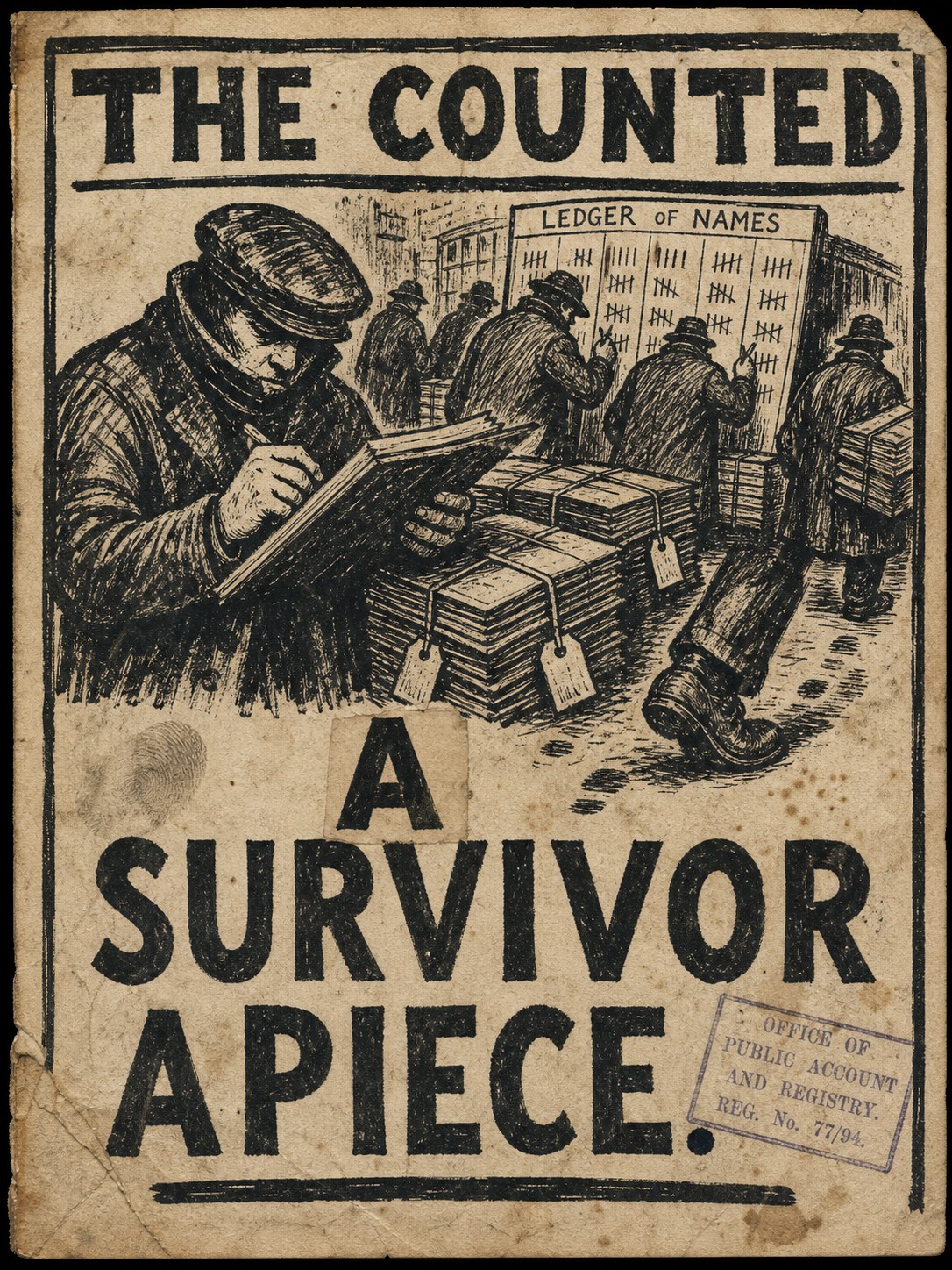
The Counted
The Tales
Tale 42A SURVIVOR APIECE

My name does not matter and my office does not matter, and I have come, in the end, to think that this is the entire point of what happened to me, so I will leave both out and simply say: I was a clerk, and I was a tidy one, and I was given the eastern files to reconcile.
They were a disgrace. I say that without heat, as a professional judgement. The expedition of 1893 had gone east to the Hem and had not come back, and the record of it was — is — a shambles: the number who set out is given as twelve in one place and eighteen in another; the lead surveyor is two different men depending which drawer you open; and, most intolerably to a man of my habits, the survivor does not agree with himself.
That was the thing that set me off. Not the numbers. Any office can miscount. But a survivor is a person — he has a name and a parish and a chair he sits in — and there cannot be more than one of him, and the files gave me three, and when I began to ask, politely, in writing, I was given a fourth.
So I asked for a horse. I intended to be gone a fortnight.
At Peatdike they told me the survivor was Elias Podd, and they told me without hesitating, the way you tell a stranger which way the river runs. He is at Mucklecombe now, they said. He came back from the Hem and he came back wrong and he does not talk about it. His daughter asks the questions he won't answer.
I went and I saw him. He is real; I shook his hand; his hand shook. That would have been the end of my enquiry — one survivor, name, parish, chair — except that I am tidy, and being tidy I went on to the next parish to strike out the error there.
At Saltgate and along the Cold Coast they told me the survivor was Mr Vance, and they told me the same way, without hesitating, as a fact about the world. He took a room at an inn and kept it thirty-one years and was the man you went to when a thing did not make sense, and it always turned out to be the weather. They pointed at the chair he had sat in.
They had never heard of Elias Podd.
At Drudgeford they gave me Quigley the cartographer, who walked out of that fog on the wrong side and believes to this day it was five minutes, and is cheerful, and published a paper.
At Murkminster the Office gave me a sealed file that named other men entirely, and a resolution, and a form to fill in if I wished to disagree with it.
And so on. And so on. I will not itemise the rest, because after the fifth parish it stopped being an itinerary and started being something else, and I could feel it starting, the way you feel weather coming. Nine parishes. Nine survivors. Nine men — some of them living, some of them thirty years dead, one of them a woman, one of them a name and a grave and a family who would not discuss it — and every single parish gave me theirs with the same flat certainty, and not one of them had heard of the others, and not one of them was lying.
I checked. That is my trade and I checked properly. The dates hold. The chairs are real. The families are real. There is no fraud here, and no madness either. Nine parishes are simply each in possession of a different true fact, and the facts will not sit in the same column.
I sat down in the ninth parish — I will not say which, they were kind to me and I have repaid them poorly enough by writing this at all — with my table in front of me. Nine columns. Nine names. I had ruled it myself in the office before I set out, and I had ruled it beautifully, and I had left the last column for the total.
And I could not make the total.
I sat there a long while. And then a woman came and put a cup down beside my table — she was the one who had told me their survivor's name that morning, told me over her own doorstep with her arms folded, as a person tells you something obvious — and she looked at my nine columns for a moment and she said:
"You're never trying to work out which one it is."
I said that I was.
She said, "Ah, love," and sat down opposite me and explained it, kindly, in about a minute, the thing I had spent a fortnight and a great deal of the Office's money failing to see:
"We lost four men out of this parish. Four. Went east and never come back and there's no grave and no account and no end to it — d'you understand me? There's no ending on it. A thing with no ending isn't a grief, it's a — it's a door left open in the winter, and you can't live in a house like that." She turned my table round to face her. "So there's a man in this parish who come back. And I'll tell you honest, since you've come all this way and you look poorly: I don't know as anybody's ever checked him. But he come back. And because he come back, the other four went — d'you see it? He's the full stop. He's not there to tell us what happened out there. He's there so that something happened at all, and it finished, and we can put a hat on and go to it."
She pushed the table back to me.
"You've got nine of them because there's nine parishes that lost people. That's not a mistake in your book, love. That's just the number of places that needed one."
I went home.
I did not fill in the last column, and I have not since, and I never will. I want to set down plainly what I understood on that road, because it cost the Office eleven guineas and a horse and it is the only thing I have ever learned worth the money:
I had not been auditing a discrepancy. I had been auditing a need.
The Hem gives nothing back. That is the whole of what the Hem is: a place where the record simply stops, and no witness ever returns to agree with another witness. And a valley cannot hold that. A valley cannot carry an open door in the winter. So every parish that lost somebody out there has, over the years, without one soul deciding it, without any conspiracy or any lie, come quietly into possession of the one thing it needed and the Hem would not supply: an ending, with a face on it. A man who came back. A full stop.
Nine parishes. Nine full stops. Not one of them false — because a thing a whole parish needs and a whole parish agrees on and a whole parish has believed for thirty years is not what the Office means by false, whatever the Office means by it.
And I was going to correct them. Nine parishes. With a table.
My reconciliation was never submitted. I told my superior that the eastern files could not be reconciled, and he asked me on what grounds, and I said: insufficient evidence, which is a lie, and the only useful thing my whole trade has ever taught me to say.
He entered it as no further action, and it went in the drawer, and it is there now.
I go out east sometimes, on my own account, with no horse from the Office. I sit in the parishes. I let them tell me about the one who came back, and I write nothing down, and I have got very good at the noise you make instead — which is not agreement and is not doubt; it is the noise a person makes when they have been told something true and have no intention of testing it.
Some things a realm gets wrong on purpose, all together, for a reason, and the reason is that they could not otherwise get up in the morning — and a clerk who goes out to correct nine parishes with a ruled table will come home understanding that the truest column in his book is the one he left empty.
Tale 43THE NINTH COLLECTOR
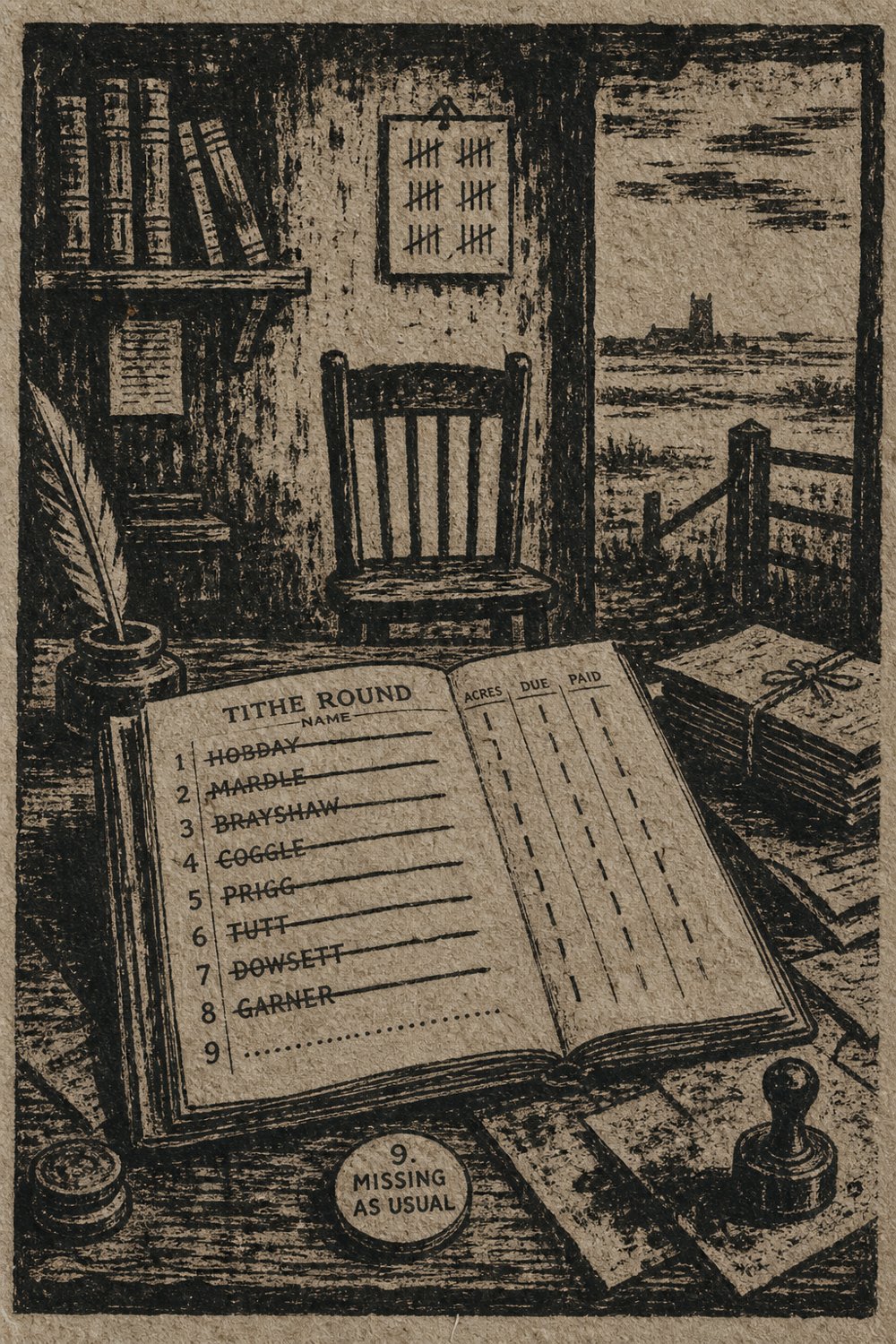
The Drudgeford round has nine collectors.
Everyone in the Exchequer knows it, the way you know how many fingers you have; it is on the standing order, it is on the wage sheet, it is in the arithmetic, and it has been nine since anybody's grandfather. Nine collectors go out with nine ledgers and nine bags, and nine returns come back, and the round balances, and it has balanced every quarter for two hundred years, which for an office of that size is a record so unblemished that it is regarded less as an achievement than as a feature of the landscape.
The trouble began when a new collector inherited the round, and she was — I am sorry to say, for her sake — exactly the wrong sort of person for it, which is to say the right sort of person for anything else. She counted things. She could not help it. She counted the milestones on the way out and the bells on the way back and the eggs at every inn she stopped at, and one wet Thursday, sitting in the Drudgeford office with the nine ledgers stacked in front of her, she counted the collectors.
There were eight of them in that room. She knew all eight. She had eaten with six.
And there were nine ledgers.
She asked, first, in the ordinary way — leaned over to the man beside her and said, who's the ninth? — and got the answer that every collector on that round has given for two hundred years, delivered without looking up:
"Ninth's on the far side."
That is the whole of it. The ninth is on the far side. Ask in the morning and he is on the far side of the round; ask in the afternoon and he came through at dawn; ask at dawn and he is stopping over at Nettlewick and you have just missed him, he was here Tuesday, he'll be through again after the quarter. Nobody is being evasive. That is the part she could not get past, afterwards. Nobody in that office was lying to her or hiding anything; every single one of them believed, comfortably, in the perfectly ordinary way you believe in a colleague on a different shift, that there was a ninth man on the far side of the round, and had believed it their whole working lives, and had never once been anywhere the far side of the round happened to be.
So she did the thing nobody had done. She got the ledgers out and she went back.
The ninth ledger is real. You may hold it. It is a proper Exchequer ledger with a proper Exchequer number and it goes back two hundred and six years, in a dozen different hands, and the entries in it are perfectly ordinary — sums collected, arrears noted, a boot repair claimed in 1789. The wage is drawn quarterly. It has never once been queried.
And here is what she found, going back through it quarter by quarter with her finger, in the failing light of a Drudgeford afternoon, and it is the reason there is a tale:
The ninth return is never short.
Not once. Not in two hundred and six years. Every other collector on that round has had bad quarters — a flooded ford, a bad harvest, a farm that could not pay and everybody knew it — and their ledgers are full of shortfalls, and explanations, and the little apologetic notes a decent collector writes when a family has nothing. The ninth ledger has none. The ninth ledger comes in, every quarter, for two centuries, at precisely the sum required to make the round balance — down to the farthing, whatever that sum happens to be, however the other eight have done.
She sat with that for a while. Then she went and found the oldest man in the office, who was retired and came in anyway because his wife had died, and she asked him straight out, and he told her, straight back, because he was eighty-one and past caring:
"Oh, aye. There's no ninth man, love."
Here is what happened, and it is nothing, and that is the whole horror of it.
Two hundred and six years ago a clerk at Drudgeford had a bad afternoon. His round would not balance — he was out, by some small nothing, some coppers, the kind of gap that is a slipped figure and not a theft — and it was late, and he was tired, and he had been counting rotten turnips for three days, and he did the thing tired clerks have done since ink: he made it good. He opened a ninth column and he put the difference in it and he ruled it off and he went home.
He meant to correct it in the morning.
But in the morning the round balanced — it balanced beautifully, for the first time in his tenure — and a balanced round is a thing an office does not interrogate. And the next quarter it was out again by something else, and there was the ninth column sitting there, patient, ready, and it took the difference without a murmur; and the quarter after that a different clerk found the ninth column already in the book and used it because it was there, and assumed, as you would, that somebody senior had put it there for a reason.
And a column that receives a wage must belong to somebody. So somebody got a name. And a man with a name and a wage must be somewhere, and the somewhere that raises no questions is the far side of the round.
Two hundred and six years. A person invented by a rounding error, given a name to justify a column, a location to justify the name, and a wage to justify all three — drawing pay every quarter from an office that would be genuinely astonished, and then genuinely relieved, to learn he was not there.
She wrote it up. Of course she did; she was that sort; that is why it had to be her.
She took eleven pages of workings to the Chief Clerk at Murkminster and laid out the whole thing — the ledger, the never-short, the bad afternoon in 1690, the lot — and stood there while he read it, and he read it all the way through, twice, which she says was the worst part, because it meant he understood it.
Then he put it down and asked her one question.
"If I strike out the ninth column," he said, "what does the round do?"
She had known this was coming. She had done the arithmetic on the road. "It doesn't balance, sir."
"For how long?"
"…For two hundred and six years, sir. Every quarter of it. All the way back."
"So what I would be putting into this office," said the Chief Clerk, "is not a correction. It is two hundred and six years of unbalanced returns, every one of which was signed off by somebody, most of whom are dead and cannot answer for it, and all of which the Crown would then wish to examine." He folded her eleven pages carefully in half. "You have not found an error, madam. You have found a load-bearing wall. Would you like to be the one who removed it?"
She said, and she is proud of this, and I think she should be: "I'd like it to be true, sir."
And the Chief Clerk said, not unkindly, the sentence that is carved into the working life of every office in this realm and most of the ones in yours:
"It is true. That is exactly the difficulty."
The ninth column is still in the book.
He is called Mr Loyne, on the wage sheet, and has been since about 1740, and nobody knows who named him. He is on the far side of the round. He has never been short. Twice a year somebody new asks about him and is told he came through Tuesday, and believes it, because there is no reason on earth not to.
She stayed on the round eleven more years and drew her wage beside his and never mentioned it again to anybody in the office — though she did, once, on a bad quarter, when a farm at Nettlewick had nothing and the arithmetic was going to fall on a family who had already lost enough, find herself looking at the ninth ledger for a long moment.
She has never said whether she used it. She says only that it was there, and it was patient, and it took the difference without a murmur, the way it has for two hundred years, and that she understood that afternoon exactly why not one of the hundred clerks before her had struck it out.
The most permanent things in any office are not its laws but its convenient mistakes — and a lie that makes the books balance will be defended, quarter after quarter, for two hundred years, by a hundred honest people who each assumed that somebody senior had put it there for a reason.

Tale 61THE UNFINISHED JOKE
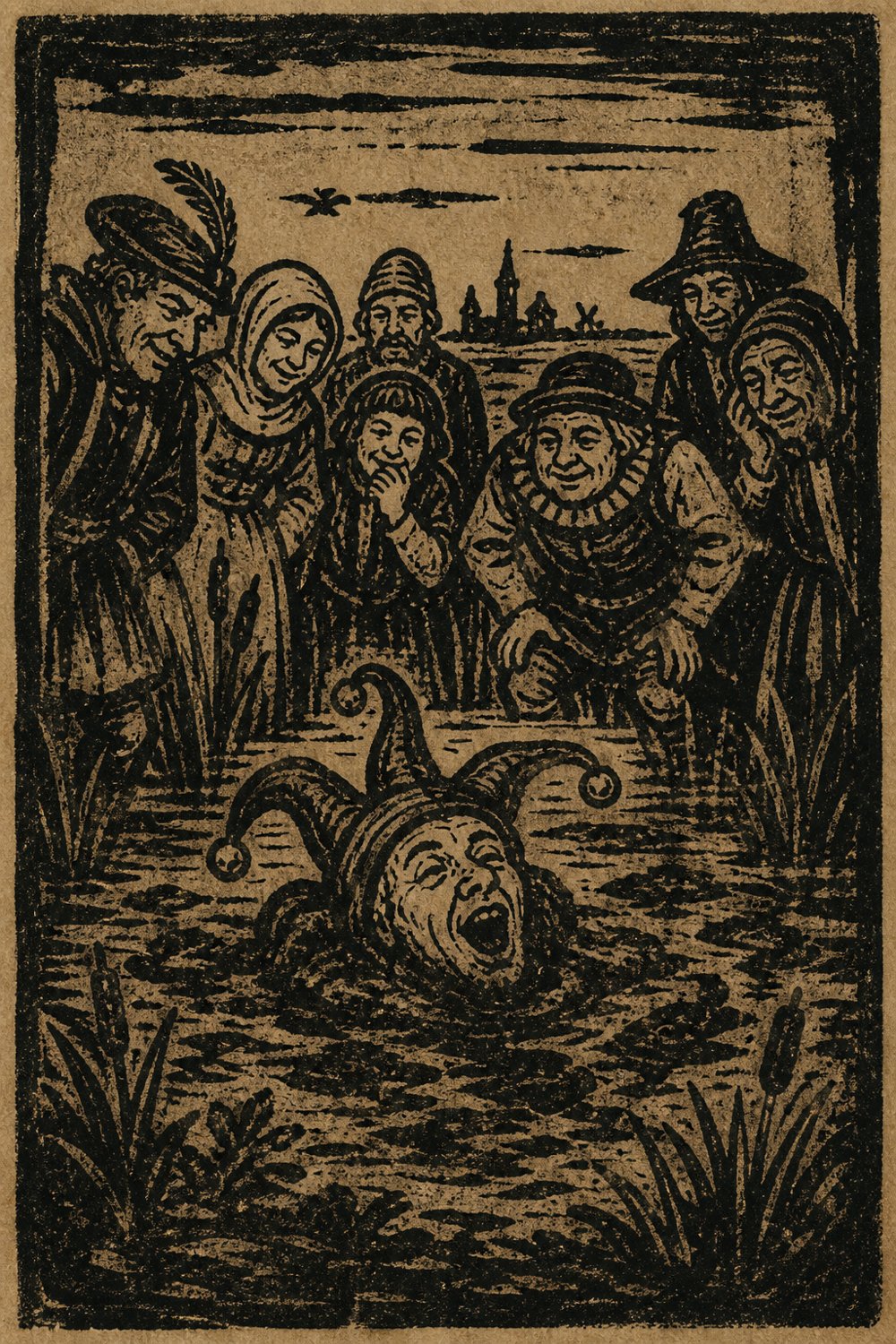
Long ago, and this part everybody agrees on, the Court Jester of Castle Bastable went to Murkminster to welcome the High Duke, as was his office, and was not welcomed back.
He gave his name, at the gate, as the Dirt Tester — which was the joke, or the start of one, the Duke's seat being built on the finest reclaimed marsh in the realm and everyone knowing it and no one saying it — and the Duke, who had no humour whatsoever and a hat you could park a cart under, did not laugh, and the men in the swamp shoes took the Jester out onto the Duck Muck, which is the soft ground below the Murkminster wall, and left him there.
And the Jester, going down, with the mud at his chest and then his chin, and the whole court watching from the dry, began a joke.
He got out the setup. Witnesses agree on the setup, more or less, allowing for the years. It was long, as his jokes were, and it was building, as his jokes did, toward a turn that everyone on that wall could feel coming the way you feel weather.
And then the mud reached his mouth, and he never got to the turn.
That was generations ago, and the parish has been trying to finish the joke ever since.
It is the great argument of Sogmarsh, larger than the drains, older than most of the feuds. At every Bog Night, when the ale is down and the fire is low, somebody says "well, the way I heard the end—" and the whole room is off, because everyone has heard the end, and no two ends are the same, and each is defended by its holder with a passion that has, on three occasions, ended friendships.
The Rind family hold that the turn was about the Duke's hat. The Dribbles are certain it was about the Duke's mother. The Quills, who are archivists and should know better, maintain a version so elaborate and so structurally perfect that it is almost certainly wrong, because the Jester's jokes were never tidy. There is a Mucklecombe end and a Saltgate end and a scandalous Cold Coast end that the chapel has asked people to stop repeating. Goodwife Pell, before she died, claimed to have had it from her grandmother direct, word for word, and told it once, and it was so filthy and so funny that the parish has spent the years since deciding it could not possibly be true and being unable to prove it.
They will fight about the ending of that joke until the marsh takes them all. It is, without any of them saying so, how they have kept the man alive — a village that will not let a joke die, because letting the joke die is letting the Jester finish sinking, and they have decided, without a meeting, that he is not going to.
The child who broke it open was a small one, of no house in particular, at a Bog Night some years back, during a Rind-versus-Dribble round that had been going, at that point, for about an hour and was generating more heat than the fire.
And the child, in the way of children, who ask the questions that are too simple for grown people to reach, waited for a gap and said:
"But what was the beginning?"
And the room stopped.
Because they had all spent their whole lives arguing about the end — inventing turns, defending punchlines, coming to blows over a joke's last six words — and not one of them, in all the generations, could tell the child how it started. The setup was gone. The witnesses had passed it down as "it was long, and it was building," and somewhere across the years the actual opening — the first line, the thing the whole joke was walking toward — had slipped under, the way the Jester had, quietly, while everyone was looking at the wrong end.
They had been so busy giving him an ending that they had lost his beginning.
There was a long quiet after the child's question, of the kind Sogmarsh does well, and then old Marle — a different old man, an older one, the kind every good hearth has one of — said the thing that ended the round and is now said at that fire whenever the argument threatens to turn nasty, which is often.
He said: "Doesn't matter what the beginning was, nor the end. He was telling a joke. That's the whole of it. A man's up to his chin in the Duck Muck with the Duke's whole court laughing at him from the dry, and he looks at the lot of them, and he decides the last thing he's going to do on this earth is make 'em laugh. You don't need the words for that. The words were never the joke. He was."
And the room was quiet again, differently, and somebody put more peat on, and after a while a Dribble said that all the same it was obviously about the hat, and a Rind said something back, and the argument started up again, warm now instead of hot, the way it is supposed to be.
The child never got an answer. There is no answer. That is the point, and the parish protects it fiercely without ever admitting it protects anything: the joke must stay unfinished, because a finished joke is over, and this one is not allowed to be over, because it is the only thing holding a brave dead man up out of the mud.
They still argue about the ending, every Bog Night, and they will not thank you for supplying one.
But since the child's question there is a new custom at that fire, small and unspoken, that was not there before. Before the argument starts — before the Rinds and the Dribbles square up over the punchline — one of them, whoever is nearest the child, will lift a cup, just slightly, toward the door and the dark and the marsh beyond it, to the man on the wall who never got his turn.
And then, and only then, they begin to fight about how he finished.
A joke's ending is the least of it. What Sogmarsh remembers — what it will brawl to keep — is a man who, with the mud at his chin and the powerful laughing at him from the dry, chose to be the one still making the joke. You do not need to know the words. You only need to know that he was telling it.
Tale 66THE SECOND OPINION

Doctor Tolbert Ebbrell believes every ailment in the realm comes from the air. Gammer Sowden, the midwife of Mucklecombe and eleven miles about, believes this is nonsense, and has told him so at two suppers, and their disagreement is the longest-running feud in the district that has never once come to blows, because neither of them will give the other the satisfaction.
He is a physician, trained, expensive, and wrong about why nearly everything he does works. She is untrained, unpaid past a fashion, and right about nearly everything with no theory to hang it on. In forty years they have agreed on precisely nothing and been, between them, the best medicine the parish has, a fact that would appall them both equally if either could be got to admit it.
So when the Marle child took a fever that neither of them could shift alone, and the family, in despair, sent for both, the parish gathered outside the cottage to watch, because there is no entertainment in Sogmarsh finer than free, and this was going to be free and considerable.
It went as everyone hoped.
Ebbrell arrived first and opened the window, because it is the air. Sowden arrived second and moved the child off the floor and put a boiled cloth to its head, because it is the water and the wet. Ebbrell said the window must stay open. Sowden said the draught would finish the child. Ebbrell said the draught was the cure. Sowden said she had buried a good many of his cures. Ebbrell said he had a degree. Sowden said she had a thousand and some arrivals and not one of them had asked to see it.
They did not shout. That is the thing the watchers at the window remember. Two people who despise each other's entire understanding of the world, working over a sick child, in a small hot room, in furious, clipped, immaculate politeness, each doing their own half of the job perfectly and narrating loudly why the other half was witchcraft.
He got the child up and sat and the air moving — which was right. She got the water into it boiled and the fever cooled with cloth after cloth — which was right. He kept the fire in and the window cracked on the leeward side, which was the one thing they never quite argued about because it was, though neither would say so, exactly what the other would have done. And between the two of them, over one long night, doing everything twice and agreeing on none of it, they hauled the Marle child back from the edge it had been sliding over.
Toward dawn the fever broke, and the child sat up and asked, in the way of children who have frightened everyone half to death, whether there was anything to eat.
And there was a silence in the little room, the two of them exhausted, the argument suddenly with nowhere to go, and the plain fact sitting in the middle of the floor that the child was alive and neither of them could honestly say it was their doing alone.
Ebbrell looked at the open window. Sowden looked at the boiled cloths. And Ebbrell said, stiffly, that he supposed the warmth Mistress Sowden had insisted on had done no harm. And Sowden said, just as stiffly, that she supposed a little of the doctor's fresh air had not, on this one occasion, actually killed anybody.
Which is, from those two, a declaration of love, and the whole parish at the window knew it, and had the enormous good sense to say nothing.
They left separately, at dawn, by different doors, so as not to be seen leaving together. Ebbrell wrote in his account "attendance, and the air improved." Sowden wrote in hers, "the doctor came, and was some use, which I did not put to him." Neither has ever conceded a word to the other since.
But it is noticed, in the district, that when a case is truly bad now — when it is a child, and it is the edge — somebody sends for both of them, and both of them come, and come quickly, and neither has ever once asked why they were called together, or refused to be.
Two people can be completely, immovably wrong about each other and still be, between them, the best thing a parish has — because a truth you understand and a truth you cannot explain will save a child far better working side by side than either will alone, and the only thing that need never be admitted, by either of the proud fools doing the saving, is that they have needed each other all along.