The Cold Coast
The Tales
Tale 26THE DRY DOCK
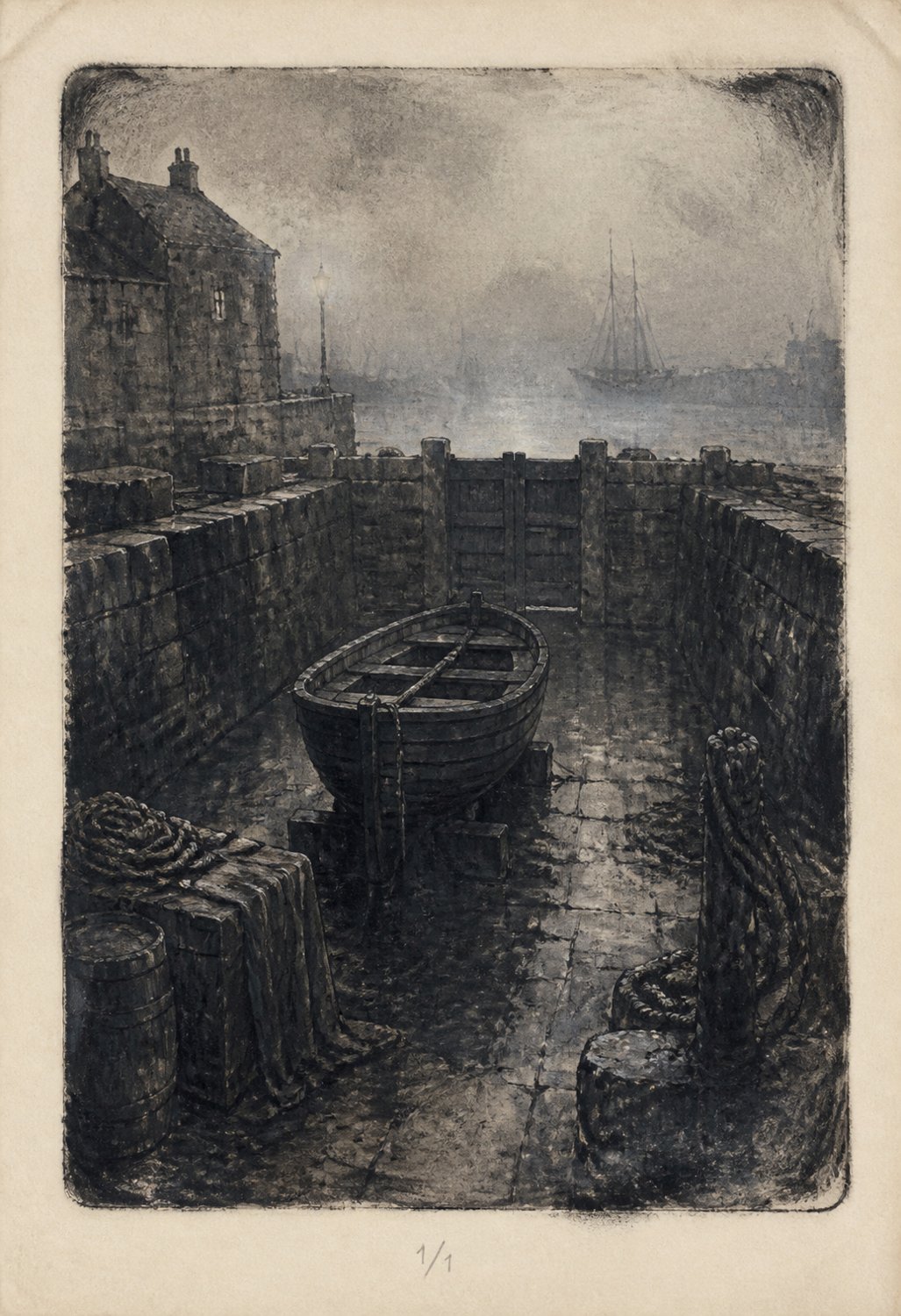
I am a dry dock, and I am going to tell you my dimensions, because nobody else ever mentions them, and they are the whole of this story.
I am four hundred and odd years old. I am cut from grey coast granite, forty courses deep, and my gates are oak and iron and swing sweet as a chapel door, and when I was made I could take a ship of three hundred and forty tons — full-rigged, three masts, a crew of sixty — take her out of the sea entire, hold her in my two stone hands, and set her back on the water better than she came.
I know this because I did it. The first ship into me was the Constance of Saltgate, three hundred and forty tons exactly, and she went out beyond the mists — beyond the mists, you understand, all the way out, where the sailors' stories go — and she was gone two years and four months, and she came back. They careened her in me that winter. Her keel had seen water no chart in this kingdom has ever owned.
I held her. I would like that noted.
At present I contain the Little Sister. She is a fishing smack. She is nineteen tons, single-masted, open to the weather, and she goes coastwise, nine days out at the very most, and she is a good boat and honestly worked and I will not hear a word against her.
She sits in the middle of me like a boot in a ballroom.
Here is what you will want to know, and what I cannot tell you: when it was decided.
Because that is how you people do things, isn't it. A thing ends, and somewhere there was a meeting about it — a resolution, a bad harvest, a war, a decree with a seal on it. Something you can point to. I am a dock; I am fond of a fixed point.
There was no meeting.
I have stood here with my gates open for four centuries and I have watched for the decision the way I watch for the tide, and I am telling you plainly: nobody ever decided. No storm took the fleet. No edict beached it. No grief closed the sea. The shipwrights of Saltgate never once downed tools — they worked every year of it, fathers and daughters and sons, and every keel they laid was laid with skill, and every keel they laid was the boat that was wanted — and every year, what was wanted was a little less sea.
You can read it in the names, if you ever get into the Harbour-Master's roll, which you will not, because it is a tax document, and why would you.
After the Constance came the Brave Endeavour. After her, the Widow's Hope — who went beyond the mists and did not come back, and I will allow that a realm may be forgiven for flinching, once. But then came the Perseverance, who went only to the deep water. And then the Good Intent, who went not so deep. And then — and I want you to sit with this one, because I have had a hundred years to sit with it — then they built a ship, a fine ship, sound in every plank, and they gathered on the quay and they christened her the Sufficient.
The Sufficient.
Nobody laughed. Nobody wept. Sixty people stood in the drizzle and agreed, without one of them saying it, that sufficient was a thing a ship could aspire to be.
After her came the Adequate. After the Adequate, the Handy. After the Handy, the Little Sister, nineteen tons, who is a good boat, and honestly worked, and goes nine days out, coastwise, in sight of land the whole way round.
That is the entire history of the port of Saltgate. It is four hundred years long and there is not one event in it. Every single year of it, taken alone, was reasonable.
People say, when they say anything, that the far sea got too dangerous.
I hold the sea back twice a day with my own gates, so I am well placed to give evidence here, and my evidence is this: the sea did not change. The sea is exactly as it was when the Constance went out across it. Same weight. Same manners. Same deep patience against my oak. The mists sit where the mists have always sat, and behind them — well. Sailors used to speak of kinder lands back there. You will hear it said now that they were liars. Perhaps. I held the keel of a ship that went and looked, and she did not come home ashamed.
The water is right here. It stands at my gates every tide, the same water that touches every shore there is. The rope-walks still stand — they keep nets in them now, and a cart with one wheel. The capstans turn. My gates swing sweet; I have seen to that.
Nothing was ever locked. That is the part I would tell them, if a dock could get a hearing. Nobody locked anything. The door has stood open for four hundred years, and the realm has walked past it, year by year, wanting — each year, and always reasonably, and always by the smallest measure —
to stay a little nearer in.
Twice, I nearly had my say.
Once a clerk of the Harbour-Master's office — young, ink on his cuffs, a frown he'd not yet grown into — sat down on my coping stone with the great roll and read it end to end, which no living soul had ever done. I watched him set the Constance's tonnage and the Little Sister's side by side with his finger. I watched the frown deepen. I creaked every joint I have. Go on, boy. Add it up. Say it out loud, to anybody, to the gulls—
And then his shoulders came down, easy as a slack tide, and he closed the roll, and sat a while in the sun, and had, by every sign I could read, a thoroughly pleasant afternoon. He went in at dusk, content as a fed cat, and if you asked him — and nobody did — I do not believe he could have told you what he had come out to do.
I have seen weather do that to a man. There was no weather.
The other time was a boy, a reed-cutter's boy, who stood on my gate every day of one summer and looked at the mists and wanted — wanted so hard and so loud the gulls stood off him, wanted the far water the way the young want things, with the whole of themselves. He asked the fishermen what was out there. He asked the Harbour-Master. He asked me, which no one had done in a century, and I gave him everything I have, which is a hundred foot of standing granite that once held the Constance, and I believe — I have gone over it many times — I believe, for that one summer, he heard me.
He came back in the spring a hand taller. He looked out at the horizon the way you look at furniture. He is a good fisherman now. Nine days out, at the very most. I do not know what a winter does.
So. Here is where I am to give you the warm thing, because I have been around the tales of this parish long enough to know the shape of them, and I would not leave you out on the cold quay with all this and nothing in your hands.
It is this.
Every year — I do not know who ordered it; nobody ordered it; it is on no roll and nobody is paid — every year, somebody comes and greases my gate hinges. It was a shipwright's widow once. Then her daughter. It is a granddaughter's granddaughter now, a woman with strong wrists and no time for questions, and when the fishermen ask her why she oils the gates of a dock that has held nothing bigger than a smack for two hundred years, she says, "because they're there," and that is the end of the conversation.
She does not want anything of the far sea. Wanting is not, apparently, a thing this realm gets to keep.
But the hinges are greased. The gates will swing. The granite is forty courses deep and I have not shifted a finger's width in four hundred years, and if ever anything comes back out of those mists — however big, from however far, whether or not there is a soul on this coast who can still say what they once wanted of it — the water at my gates will be deep enough, and I will be standing ready, and I will take her out of the sea entire and hold her.
That is not hope. I am a dock. I would not know hope if it berthed in me.
That is masonry.
The moral, for the quay at dusk: you cannot always keep hold of what you are for — the wanting slips away quieter than a tide, and no one can say where it goes. So grease the hinges anyway. Readiness is a kind of memory, and it is the one kind that stone can keep for you — and stone does not get a say in what it stops wanting.

Tale 28THE LETTER THAT BEAT THE SHIP

I am a letter, and I was posted at the Saltgate Arms, which stands on the harbour front at Saltgate — the founding port, the realm's one and only door to anywhere else at all — and everybody on the Cold Coast will tell you the same peculiar thing about the post that goes out from that particular inn, next to the customs house, under the gulls:
Letters posted at the Saltgate Arms sometimes reach the Isles faster than the ship that carries them.
Nobody can explain it. The postmaster least of all. Ask him how, and he licks his thumb, and he counts your coppers twice, and he finds something that urgently needs doing at the far end of the counter. It is not a thing the coast discusses. It is a thing the coast relies on, quietly, the way you rely on a stair you have stopped seeing.
I was written on a wet afternoon by an old fisherman — I will not give you his name; he would not want it in a story, he was that sort — with a stub of pencil worn down to the brass, in a hand like a gull's footprints, at the table nearest the fire because his knuckles no longer did cold. He was writing to his boy, who had gone out the year before to crew a boat off the Isles, which is a day's nervous sail west and the only abroad anyone from here ever reaches, and which we do not name, and neither will I.
You would expect, given everything, that the letter would be about the important matter. It was not. The old man never once mentioned the important matter, which was that he was dying, and knew it, the plain unhurried way a coast man knows weather is coming — by the ache in a joint and the colour of the light. He did not write a word of that.
He wrote that the boat wanted recaulking before the son came home and would he see to the starboard strake himself, because the yard did shoddy work and charged for lovely. He wrote that the crab pots off the First Anchorage were fishing well this year, which was a lie, a small kind lie, so the boy would not fret about the housekeeping. He wrote that his mother had moved her chair three inches nearer the fire and would not be moved back, and that this was the great domestic war of the season, and that she sent her love and a pair of socks that would arrive by a slower boat, the socks not sharing my peculiar gift. And he wrote, at the bottom, in the largest and worst letters of all, pressed so hard the pencil nearly went through me: Come home when you can. And if you can't, that's the sea, and I'm proud of you, and that's an end of it.
Then he folded me, and licked me shut with more ceremony than the flavour deserved, and carried me down to the Saltgate Arms through the rain, and posted me, and went home to his chair by the fire.
And that night, quietly, with no fuss, which was very much his way, he died.
Now here is the part the coast would understand and the dry countries never will.
The news of it went out on the next morning's boat — the black-bordered word, the official sorrow, the letter with the wax the colour of a bruise. And I went out too, ahead of it, carried on a different hull. And though not one living soul knew it, and though neither ship's master would ever have believed you, it was a race. The news of the death, against the letter of the love. The bruise-wax, against the crab pots and the socks and I'm proud of you.
And I won.
I will not tell you how, because I do not know how, and the postmaster does not know how, and it is not the kind of thing that survives being explained. I can only tell you that three times in the fog off the First Anchorage the news-boat and my boat came level in the grey, so close the two crews could have shaken hands, and three times the fog closed, and three times when it opened I was ahead. The Saltgate post does not so much travel as arrive. It always has. Nobody knows why. Nobody, on the whole, asks.
So the boy — out on the Isles, in a cold bunk, with the wind doing its worst — got his father's ordinary, loving, lying, wonderful letter first. A whole day first. He read about the starboard strake and the shoddy yard and his mother's chair and I'm proud of you, and that's an end of it, and he laughed, and he put me in his shirt against his chest, and he went to sleep warm, in the good and rightful order of things — the love arriving before the grief, the way it always should, and hardly ever does.
The other letter found him the next day. It did what it had to do. I will not pretend it didn't; grief is a strong swimmer and needs no help from anybody, and it reached him, and it was terrible, and it was true.
But it came second. And because it came second, the last thing that old man ever said to his son was not a black border and a bruise of wax. It was the crab pots, and the socks by the slower boat, and come home when you can. The boy had that first, and had it whole, and had it warm — and he has it yet, folded soft as cloth now, these forty years, against the same chest, grown so worn you can barely read the gull-tracks, though he does not need to read them, having them by heart.
That is the whole of what I am for.
The moral, from the harbour post: the bad news of the world will always find you; it is a strong swimmer, it knows every current, and it needs no fair wind from anyone. But a plain word of love, written badly by a hand that could not say it aloud, is a frail thing on a wide grey sea, and it deserves every mercy the weather can be persuaded to spare — and once in a life, if you are very lucky and the fog is very kind, the love beats the sorrow home, and lands first, in the order it was always meant to.

Tale 29THE BELL-BUOY OF THE FIRST ANCHORAGE
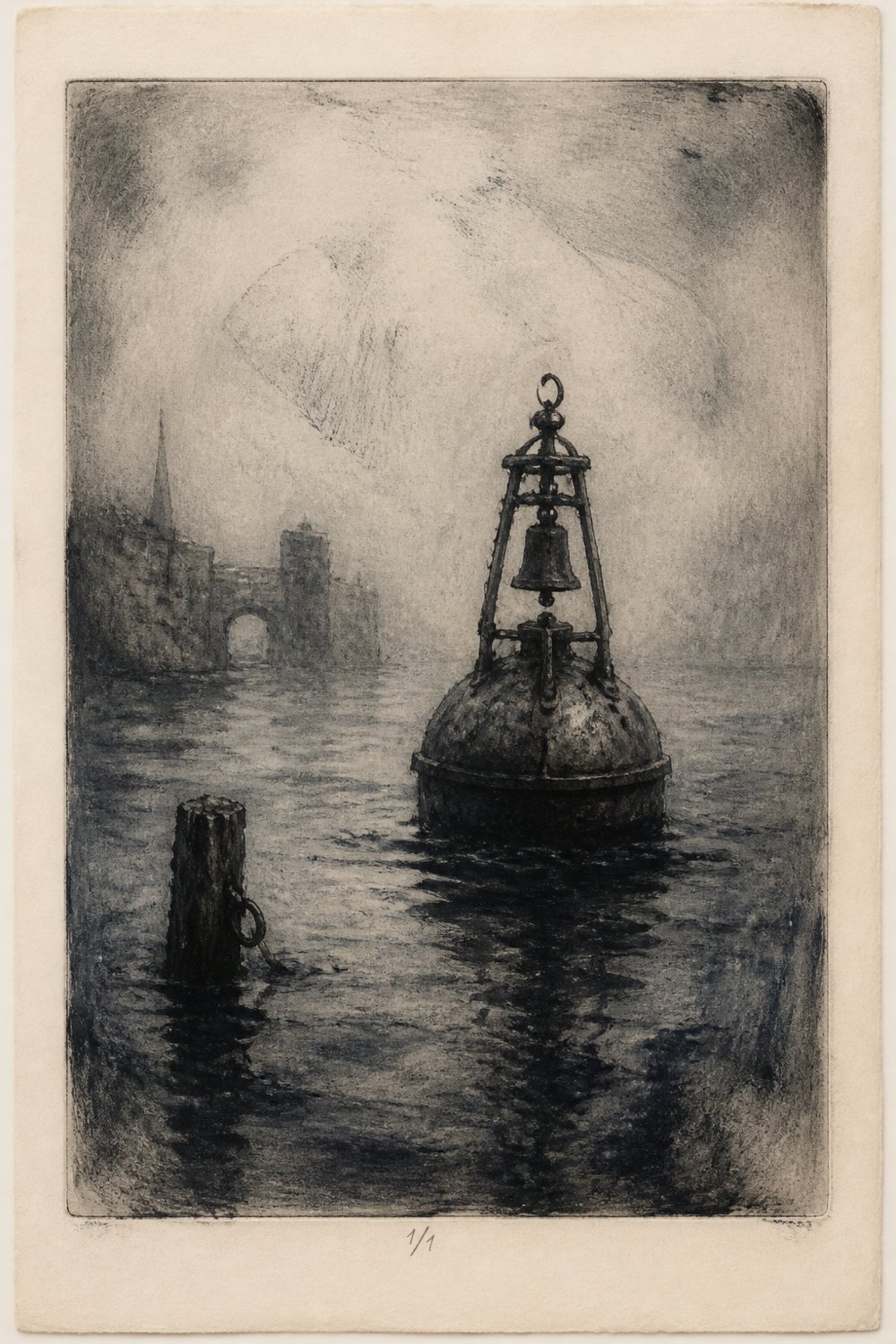
I am a bell-buoy, rusted the colour of old blood, and I ride the grey swell south of Saltgate, moored over the ruined First Anchorage — which is to say, moored over a town. There is a whole town down there under the cold water, the first place the exiles are supposed to have landed, drowned so long ago that the records of the arguments about it are older than the arrival itself, which is very Sogmarsh, and I shall not attempt to explain it.
Down in the drowned town there is a drowned chapel, and in the drowned chapel there is a bell.
That bell and I have an arrangement.
I ring on the swell — that is all I do, all day and all night, a slow iron clong as the sea lifts me and lets me down. And I ring the hours. But here is the thing that has driven three generations of harbour- masters to distraction and one to drink: I ring them half a beat behind the living church up on the Saltgate front. Always have. Cannot help it; the sea sets my tempo, not the sexton. So the two bells fall across the water at each other, the quick living one and the slow drowned one, and no soul on the whole Cold Coast has known for certain what o'clock it is in four hundred years. They have stopped minding. On the Cold Coast, "about the time the bells disagree" is considered a perfectly good appointment.
The dry-country folk who come to gawp — and they do come, in the summer, when the road is passable — want something else from me entirely. They stand on the cliff and they want. They want a drowned monk. They want a sea-ghost with weed in its hair. They want a judgement: a town sunk for its wickedness, a moral they can carry home and feel improved by. They ask the harbour-master, and the harbour-master, who keeps the Bell-Tally and has no time for tourists, tells them the truth, which is that the town drowned because the ground was low and the sea was high, and that this is the entire story, and that the sea passes no judgements because the sea cannot count. Then he charges them a penny to hear it, which is a judgement, of a mild and local kind.
But they have the wrong end of me, the gawpers, and so did I for the first century or so, when I thought my whole purpose was to warn the living off the shoal.
I do not warn anybody. Nobody sails the shoal; they have known about it since before I was forged. So what, I used to wonder, is a bell for, moored over a place with no living soul left to call?
Then one flat, black, freezing night, with no ship out and no ear on the water and no reason under heaven to bother, the drowned bell below me rang.
It does that, before the worst storms — rings of itself, down in the chapel under the sea, and the harbour- master hears it come up through the water and marks it in the Tally, and battens the town. But that night it did not ring for a storm. There was no storm. It simply rang, once, the way you might say a name into an empty room just to hear that the room is still there.
And I understood, at last, the whole of my arrangement.
It rang, and — half a beat behind, because the sea sets my tempo — I rang back.
That is what I am for. Not to warn the living; the living are fine, the living have the church on the front and the fire in the Cold Anchor and each other. I am for the drowned. I am the answer from the surface to a town that has been ringing up out of the dark for four centuries — ringing, I think now, not to threaten anybody, but only to ask the same thing the drowned have always asked, which is: is anyone still up there? does anyone still keep the hours? are we entirely forgotten?
And every hour, half a beat behind, I tell them: no. not forgotten. still here. still counting. sleep on.
The living time and the drowned time, a half-beat apart, across the cold water, forever — so that neither the town above nor the town below is ever, on any hour of any night, entirely alone.
Let the tourists have their sea-ghost. I have better work than haunting. I have a whole town to sit up with.
The moral, from the end of the mooring-chain: not every bell rings to warn the living off the rocks. Some ring for no ear at all but the ones under the water — to keep the hours for the forgotten, and to answer, half a beat late and every single hour, the oldest question the lost ever ask: is anyone still there? The kindest thing a bell can say is simply yes.
Tale 30THE COLD ANCHOR'S SIGN

I am an anchor, and I hang above the door of the Cold Anchor inn, up the coast from the Saltgate docks where it is quiet, and I am, if you want the plain truth of it, the worst inn-sign in the realm at the one job an inn-sign has, which is to hang still and be looked at.
I cannot hang still. I hold.
That is what I was made for and I have never once been able to stop. All day and all night I haul on my bracket, leaning out over the door as though there were a gale, as though there were a hull under me dragging for the deep, as though everything depended on my grip — and there is no gale, and there is no hull, and there has not been for a very long time. I have pulled the whole north wall of this inn a full degree out of true. The landlord gave up straightening it about thirty years ago. He wedged the door to still open, poured himself a measure, and said, "Let it hold, then, if holding's all it knows," which was the kindest thing anybody had said to me in a century, and I have leaned a little easier since, though I have not stopped. I cannot stop.
Because I came off a ship.
She was called the Fair Return, which the coast now considers the blackest joke in its long book of black jokes, and she sailed out past the Isles and on toward the Hem — the fog-rim, the edge, the place where the maps give up and the roads go to nothing — after a cargo somebody in a warm office had decided was worth it. Seven men crewed her. She did not come back. Nothing came back. Only I did, cut loose and washed in on the tide three weeks later, cold and alone, the single thing the sea saw fit to return of the Fair Return.
They should have melted me down. Iron is dear on the coast. Instead the landlord — the grandfather of the one who wedged the door — hung me over his lintel, and there I have hung, holding, ever since.
And here is what the Cold Anchor does, and has always done, and will do until the sea takes it too.
There are seven stools along the far wall that nobody sits on. Every evening the landlord pours seven measures and sets them under those stools, and lets them stand, and pours them out again cold at closing, and the next night pours seven more. Seven men who have no graves — no stones, no churchyard, no plot in any ground, because the Hem does not give back what it takes and there was nothing to bury even if it had — have, instead, this: a warm room that keeps their places, a measure poured against their coming, and an iron anchor over the door that will not, that cannot, that has flatly refused for a hundred years to let go of them.
Once a year, on the night she sailed, the landlord names them. Just the seven names, out loud, into the warm. And every year, on that night, I haul hardest on my bracket, and the old north wall groans, and the regulars look into their cups and nobody — nobody in that whole low warm room — says it is only the wind.
Because they know what I am doing. I am doing the one thing I was forged for and the only thing I have left. Somewhere out past the Isles the sea has seven men and will not give them up. So I hold what I can reach. I hold their places. I hold their names above a lit door on a dark coast, and I lean out into a gale that ended a hundred years ago, and I grip, and I grip, and I grip.
An anchor cannot bring a ship home. I know that now; I have had a century to learn it. But it can refuse, with its whole iron heart, to admit that the ship is not coming — and on a coast that loses so many, to so much water, that refusal is not foolishness. It is the last kindness the land has to offer the sea's unburied. It is a grave for men who never got one. It is holding on, which is the only prayer iron knows.
The moral, from over the door: an anchor's whole religion is holding on to what is already gone — and on a coast that keeps no graves for the ones the sea takes, that stubborn, useless, unbreakable grip is not a failing. It is the only headstone the drowned will ever have: a warm room, a measure poured, their names said once a year into the light, and a rusted iron thing over the door that will never, ever let go.