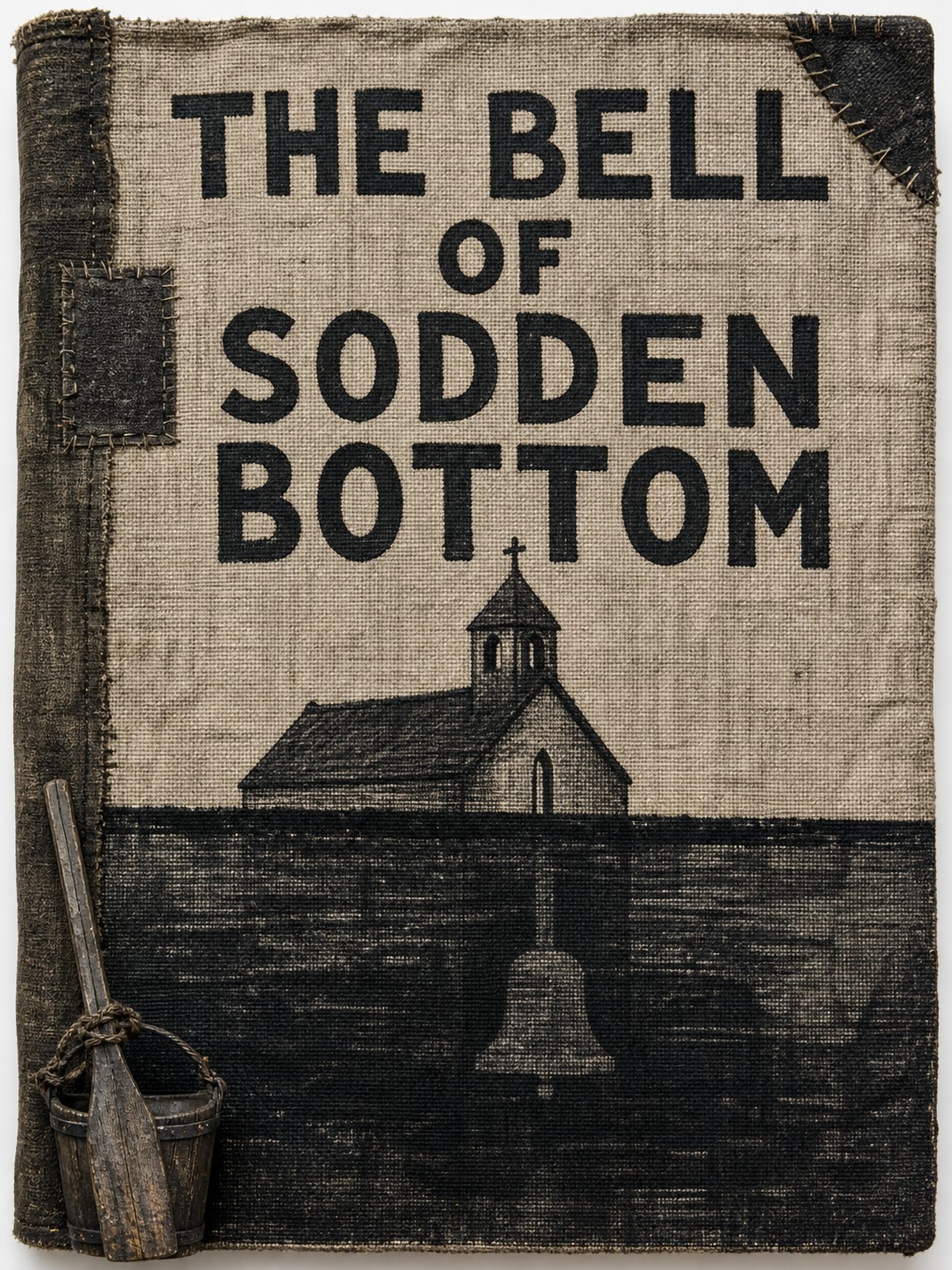
The Bell of Sodden Bottom
The Tales
Tale 6AN ANAGRAM CURSE
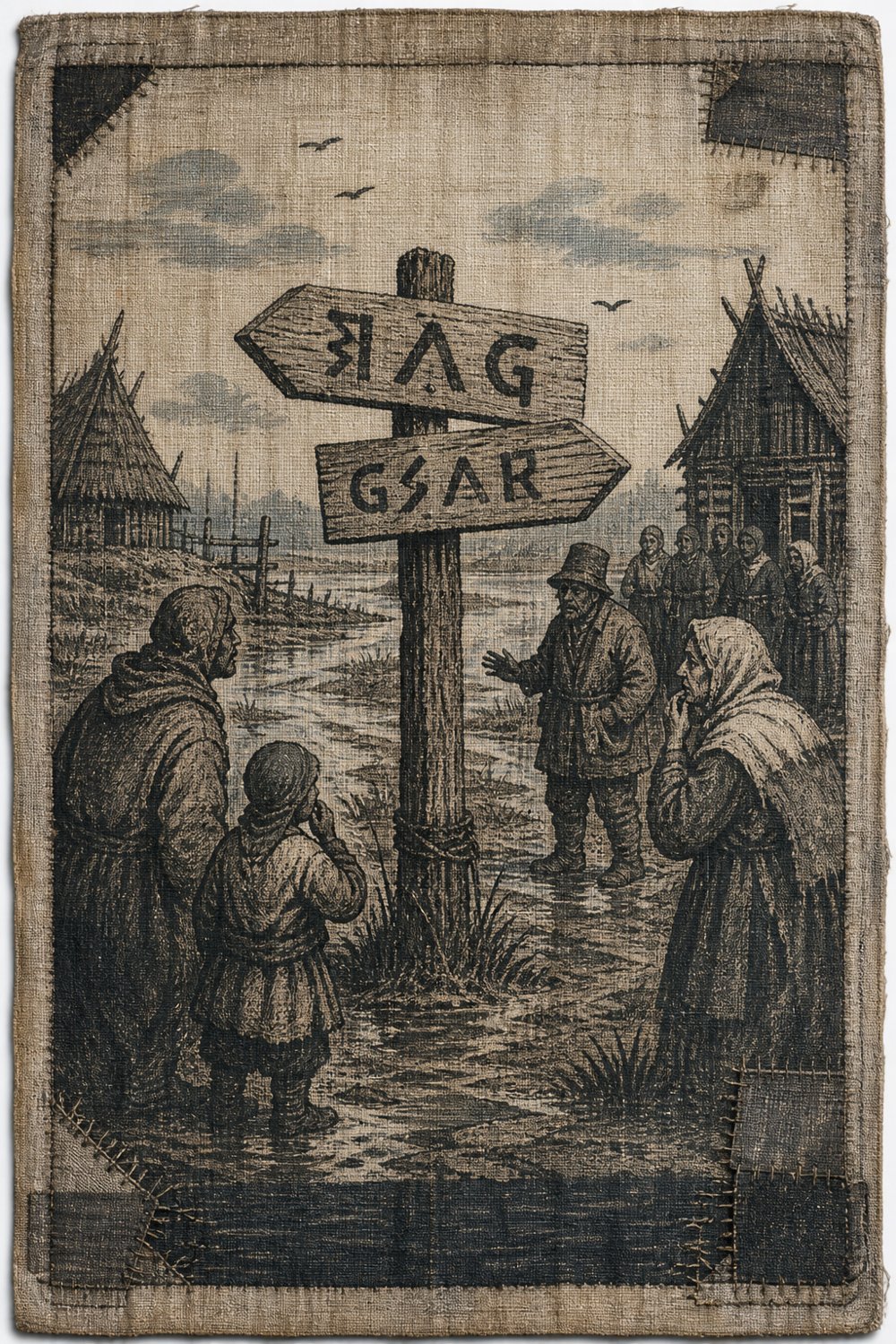
I am the curate of Sodden Bottom, the lowest and wettest parish in all Sogmarsh — where the chapel bell rings underwater at high mire — and I will carry to my grave — which, in this damp, will not be deep — the three letters I put in the wrong order.
You must understand the conditions. A Sogmarsh christening is held in a chapel with a hole in the roof, in a draught that has its own name, by a man whose spectacles fog the instant he comes in from the rain. The font is half rainwater. The family crowds close for warmth, the baby bawls, the responses are mumbled, and somewhere in the rafters House Echo leans in to record the first lie told over the cradle — for there is always one, usually the godfather swearing he is solvent.
The child was to be named Mariel. A good plain name; her mother had chosen it off a faded sampler. And I had it, I swear I had it, right up until the moment I tipped the water and my spectacles went white and the draught took the page — and what came out of my mouth, in front of the Disinterested Lord and the godparents and the attentive walls, was three letters out of true.
Now. In most realms a slip of the tongue at a font is a slip of the tongue. But this is Sogmarsh, where names are not labels but bindings — say one wrong and you have not misspoken, you have re-spelled — and the poor mite was christened into a small, exact, lifelong affliction. To this day, whenever her name is spoken backwards — and children, being children, worked out within a week that it could be — she sneezes. Not ordinary sneezes. She sneezes perfectly formed, microscopic cubes of salt, a little drift of them, glittering, which the cat then knocks off the table.
I wept for a year. I had taken a clean new soul and put a typographical error in it.
And then the parish did the thing that, after a long life of christening the doomed, still undoes me.
They learned a new language.
Not all of it — a working amount. Enough that the child's name need never be said in the dangerous direction, even by accident. The whole sodden village sat down, that winter, and between them invented a small private tongue of nicknames and hand-signs and careful sideways phrasings, so that a girl could be called to her supper, scolded, sung to, and loved, her whole life through, without one stray salt-sneeze. They did it for her, who had done nothing, to mend a thing that I had broken. They were not clever people. They were better than that.
She is grown now, that girl, and famous up and down the fen for two things: the faint taste of the sea that hangs about her, and the fact that she is, by common agreement, the best-listened-to person in three parishes — because everyone, all her life, has had to try a little harder to say her properly, and people who are spoken to with care tend to grow up worth the care.
I still have the page, with my three crooked letters on it. I keep it as a penance, and a reminder.
A misspelled life can still be read perfectly well — by those who bother to try.
Tale 27THE BELL OF SODDEN BOTTOM
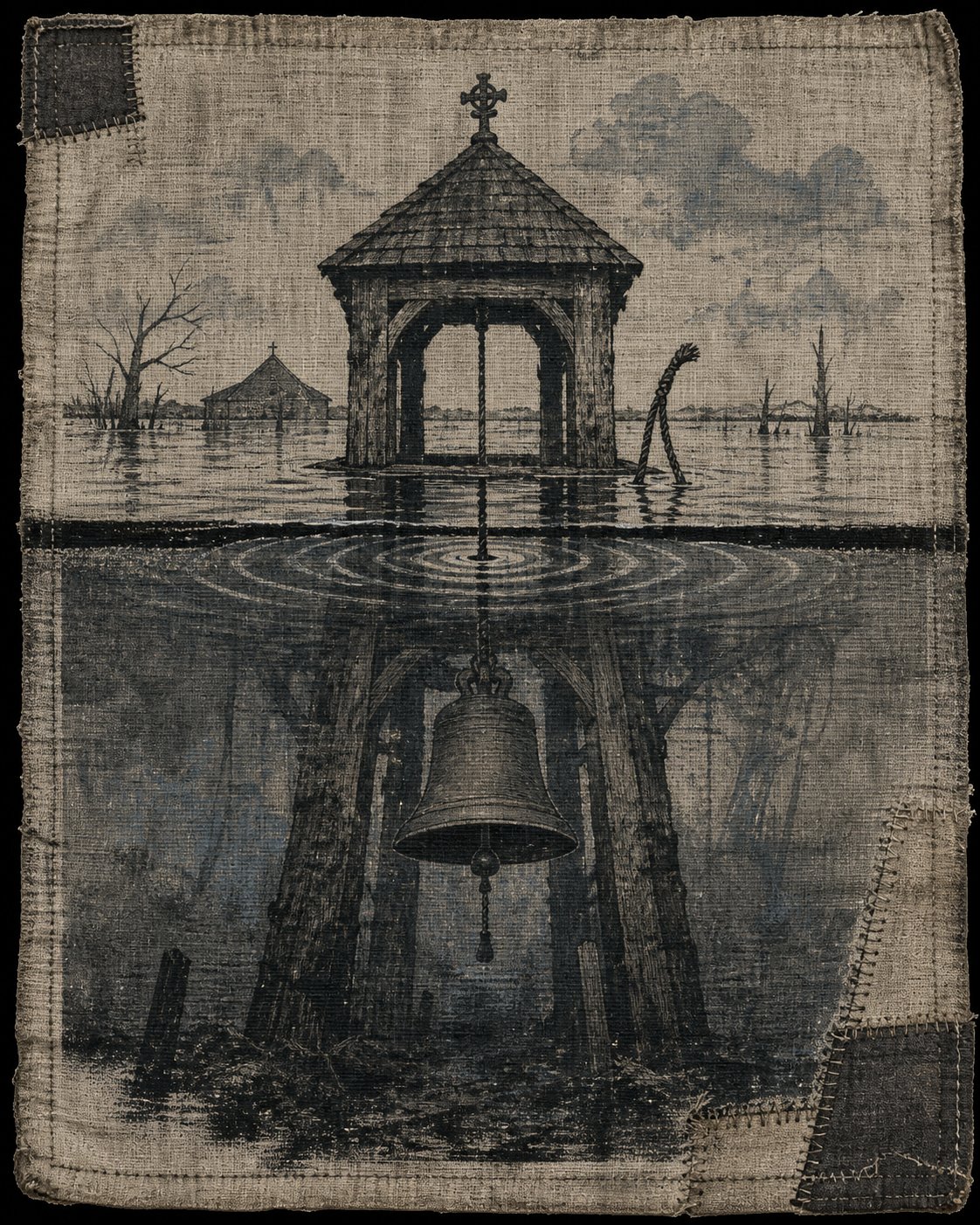
I hang in the chapel tower of Sodden Bottom, which is the lowest and the wettest parish in all Sogmarsh — lower than the Drownings proper, lower than the water table, lower than good sense, and lower every single year — and I mean to tell you the one thing a bell is actually for, because I have had six hundred years of hanging here in the wet to work it out, and I had it wrong for most of them.
When I was cast I rang out over dry hayfields. You will have to take my word for that, because there is not a soul left alive who saw them, and the fields themselves gave up and went under so long ago that the eels hold the freehold now. But I rang high, once — a good bronze note that carried three miles on a clear morning, and I was very proud, in the way a young bell is, which is insufferably.
Then the water came up. Not in a rush — nothing in Sodden Bottom does anything in a rush except drown — but a finger's width a year, patient as rent. My tower sank to meet it. The churchyard learned to breathe through a snorkel. And one wet spring, at the top of the high mire, the flood climbed over my lip while I was ringing Evensong, and I discovered what I sound like underwater, which is a cow lowing into a wet pillow at the bottom of a well.
This caused difficulties.
Chiefly, no stranger could any longer tell the difference between me calling the faithful to worship and me simply drowning. A visiting deacon from a drier country, hearing my muffled Sunday bloop rolling up through the floodwater, organised a full rescue — ropes, a boat, a man with a grappling hook and a great sense of occasion — for what was, in point of fact, the eight o'clock service. The congregation had to be fished out one by one and assured that they had not been sinking; they had been praying, which in this parish looks identical, and feels warmer.
I found it humiliating. I am ashamed to say how long I found it humiliating.
Because it got worse, you see. At the very height of the mire, when the water stands over the whole nave and the curate delivers the sermon from a coracle, I cannot be heard above the surface at all. I toll, and the sound goes sideways — out into the flood, into the reeds, into the drowned dark — and not one note of it ever reaches an ear held up in the dry air. I would ring, and ring, and ring my bronze heart out into the water, and up above there would be nothing but the drip and the frogs and the vast grey patience of the rain.
And I thought: well, that is the end of me, then. A bell that cannot be heard is not a bell. It is a lump of wet metal with opinions above its station. I very nearly stopped. One black night at the top of the flood I hung there and thought, why bother; there is no one to hear; and I rang anyway, only out of six hundred years of habit, down into the water, to nobody.
And they came.
The whole parish. Wading. In the dark. To a bell they could not hear.
I did not understand it. I am a bell; understanding is not my long suit. But they came slopping up the drowned lane with their lanterns held high and their skirts held higher, the whole soaked congregation of Sodden Bottom, gathering to a summons that had not made a single sound anybody owned an ear for.
It was old Widow Sump who explained it to me, though she did not know she was doing it, being deaf as a post herself and had been for sixty years. She had never once missed a service in her life. And when the new curate — gently, thinking her afflicted — asked her how on earth she always knew the hour, she looked at him as though he were a simpleton who had wandered in out of the dry, and she said:
"I feel thee, bell. I feel thee come up through the floor. The puddles know afore the ears do."
And that is the truth of it, and it took a deaf woman to hang it on me.
The people of the Drownings do not pray with their ears. They cannot afford to; ears are the first thing the flood takes. They pray with the soles of their feet, standing in the cold water in the dark, and when I ring down into the mire they feel me come up through the flood and into their boots and into their bones — a tremble in the water that has only one meaning, and the meaning is here, and now, and together, come. Not a sound. A summons you attend by standing in it.
I had spent five centuries mortified that I could not be heard, and all that while I was being felt, which is the deeper thing, and I was too proud to notice.
So I do not stop now, ever, at the top of any mire, however black the night and however empty the air. I ring down into the water on purpose. Because in a parish that is sinking — in a whole realm that is sinking, if you want the truth of it — the one fixed thing, the one point that does not move, the thing that says you are not lost, you are not alone, it is time, wade to it — that is worth more than being heard. That is worth a great deal more than being heard.
They call me the drowned bell, up in the dry countries, when they mention me at all, which is seldom, and always with a little shudder. Let them. I am not drowned. I am attended. There is a difference you only learn at the bottom, and it is the whole of my sermon, and I ring it every evening into the flood, and every evening the water carries it home.
The moral, from the bottom of the mire: the world will tell you that a thing unheard is a thing wasted, and the world says it from somewhere dry. But down where it is deep and dark and everything you built is going under, the faithful learn to listen with their feet — and a bell you cannot hear will still call them home, so long as it has the heart to keep ringing into the water for a congregation it will never once get to see arrive.
Tale 46MARSH TOKENS
The genius of Glibb & Sons was never the swindle. Anybody can sell a man a share in a drainage scheme that will not drain. The genius was the terms, printed small at the foot, and they read — they still read, you may go and look, the prospectus is nailed up at Drudgeford — as follows:
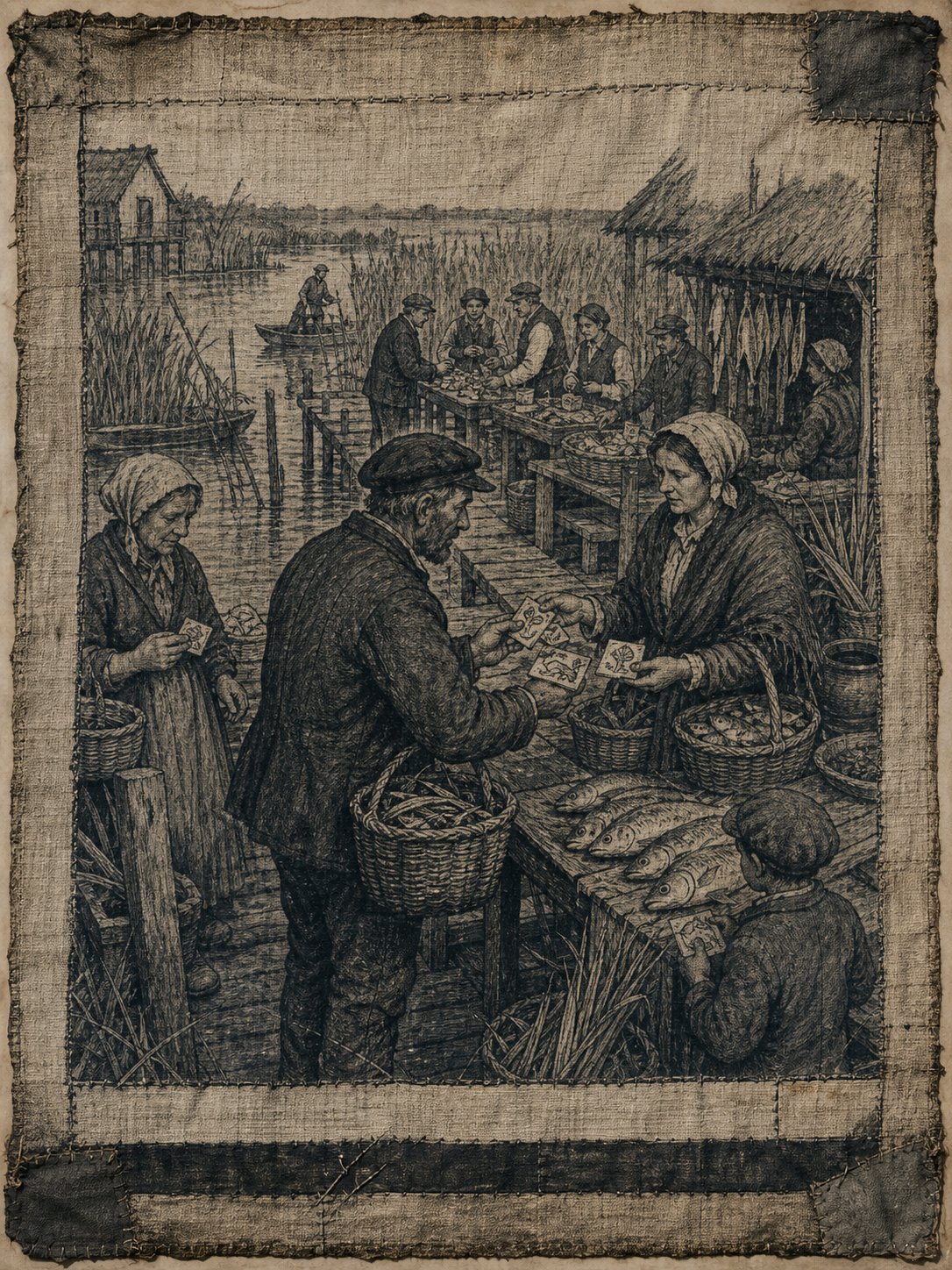
And Glibb & Sons were as good as their word. That is the part everybody misses. Barnaby "Bargain" Glibb never once refused a refund in his life; he was famous for it; he would refund you cheerfully, immediately, in full, and hand you a fistful of small stamped tin discs with a reed on one side and GLIBB & SONS · REDEEMABLE on the other, and shake your hand, and wish you well.
The tokens are redeemable. They have always been redeemable. You may walk into the Glibb office any day of the week and redeem a marsh token, and you will receive — this is the whole of the trick, and it is perfect, and it has never been successfully complained of — another marsh token.
Spendable nowhere. Refundable always. It is on the prospectus. Nobody was lied to. Half the district got rich in tin and poor in everything else, and Glibb bought a house with a dry roof.
Now. Sodden Bottom had rather more marsh tokens than most, having believed rather more of the prospectus, and Sodden Bottom had, that winter, almost no coin at all — because the coin had gone into the drainage scheme, along with the district's optimism, and the drainage scheme had drained, as advertised, precisely nothing.
So there was a parish with a great deal of worthless tin and nothing to buy anything with, and it was in this condition that Tobit Beake, who kept the ale at the Stilt & Reed and was not a clever man but was an observant one, did the thing that changed the district.
He had a customer with no coin and a pocketful of tokens. And instead of the usual conversation, he found himself looking at the little tin disc on his own counter and thinking a thought that had, apparently, not occurred to a single soul in the whole realm in eleven years of Glibb's cheerful refunding, which was:
Well. I'd take one.
Not because it was worth anything. Because he knew Sary would take one off him for eggs, since Sary owed Podd for the thatch and Podd had been complaining for a month that nobody had any small money, and Podd would certainly take one, and if Podd would take one then so would half the green, and if half the green would take one—
He put the pint on the counter and took the token and said, "Go on then."
It went round the parish in a fortnight, the way things do on the net. Not by proclamation; there was no meeting; there is never a meeting. Somebody took a token for eggs because somebody else had taken one for ale, and by the end of the month the position at Sodden Bottom was that a marsh token was worth one token's worth of anything the parish had — which is not a definition an Exchequer man would accept, and is precisely how every currency in the history of the world has ever worked.
And here is what Sodden Bottom had, that winter, which it had not had in November: money.
Not wealth. Nobody was richer; there were exactly as many eggs and pints and thatched roofs as before. But the stuck-ness came unstuck. Podd could mend Sary's thatch in December and be paid before the eggs came in April. The Widow Cobb, who had nothing to sell but time, sat with children and was paid in tin, and bought bread with the tin from a man who wanted his ditch cleared, and paid a boy in tin to clear it. Eleven years of a parish being unable to trade with itself for want of small change ended in about six weeks, because a hundred and forty people had, without one of them putting it in words, agreed to believe the same thing at the same time.
That is money. That is all money has ever been. The tin was still tin. Glibb's promise was still worth precisely one further token. Nothing whatever had changed except that everybody now expected everybody else to take one — and the expectation was the value, and had been all along, sitting in every pocket in the parish for eleven years, waiting for one publican with no imagination and a great deal of common sense to go first.
Word reached Glibb in the spring.
He came out to look. He stood on the green at Sodden Bottom in his good coat and watched his own worthless tin buying bread, and buying labour, and settling a debt on a gate-post between two men who did not much like each other, and he did the arithmetic that any swindler would do, which is that there were something over four thousand marsh tokens loose in that district and every one of them was now, functionally, a claim on real goods — and that he had printed them, and could print more, and that the parish's belief was, in the most literal sense available, his to counterfeit.
He stood there a long time. Two hours, they say; long enough for somebody to bring him a chair, which he did not sit in.
Then he went back to the office at Drudgeford and did the only genuinely honest thing recorded of Barnaby "Bargain" Glibb in his whole life. He had the plates for the marsh tokens taken up, and he had them destroyed, in the yard, in front of two witnesses he paid to be there, and he had a notice printed and nailed to his own prospectus, which is still there under the first one and is much the shorter of the two:
Asked why, by one of the witnesses, on the walk back, he is recorded as saying only: "It's theirs now."
The district has never agreed on what that meant. Half of Drudgeford holds it was conscience — that a man who had cheated everybody he ever met got, at the end, one clean thing and knew it when he saw it. The other half, which contains all the tidy minds, points out that a currency nobody can print more of is a currency that holds its value, and that four thousand permanently scarce tokens in a district that believes in them made Barnaby Glibb, on paper, the richest man in the Drownings.
The Clerk's own view, for what it is worth, is that both are true, and that this is very much what people are like, and that it does not make the notice less good.
The tokens are still going. They have outlasted Glibb, and the drainage scheme, and two Exchequer attempts to have them suppressed as an irregularity — the second of which failed on the grounds, entered in the register with visible reluctance, that the tokens are not a promise of money and have never been represented as one, and the parish's willingness to accept them is not a matter into which this office may enquire.
You can spend one at Sodden Bottom today. You cannot spend it eleven miles away at Mucklecombe, where they will look at you politely and hand it back, because Mucklecombe never agreed and so it never became true there.
Money is not a thing you are given; it is a thing a parish agrees to. Glibb sold four thousand people a refund worth nothing — and they turned it into the best small change the Drownings ever had by the only means anything in this realm is ever made real, which is that enough people decided at once to act as though it already was.