Out on the Water
The Tales
Tale 31THE RENT-COLLECTOR'S BOAT
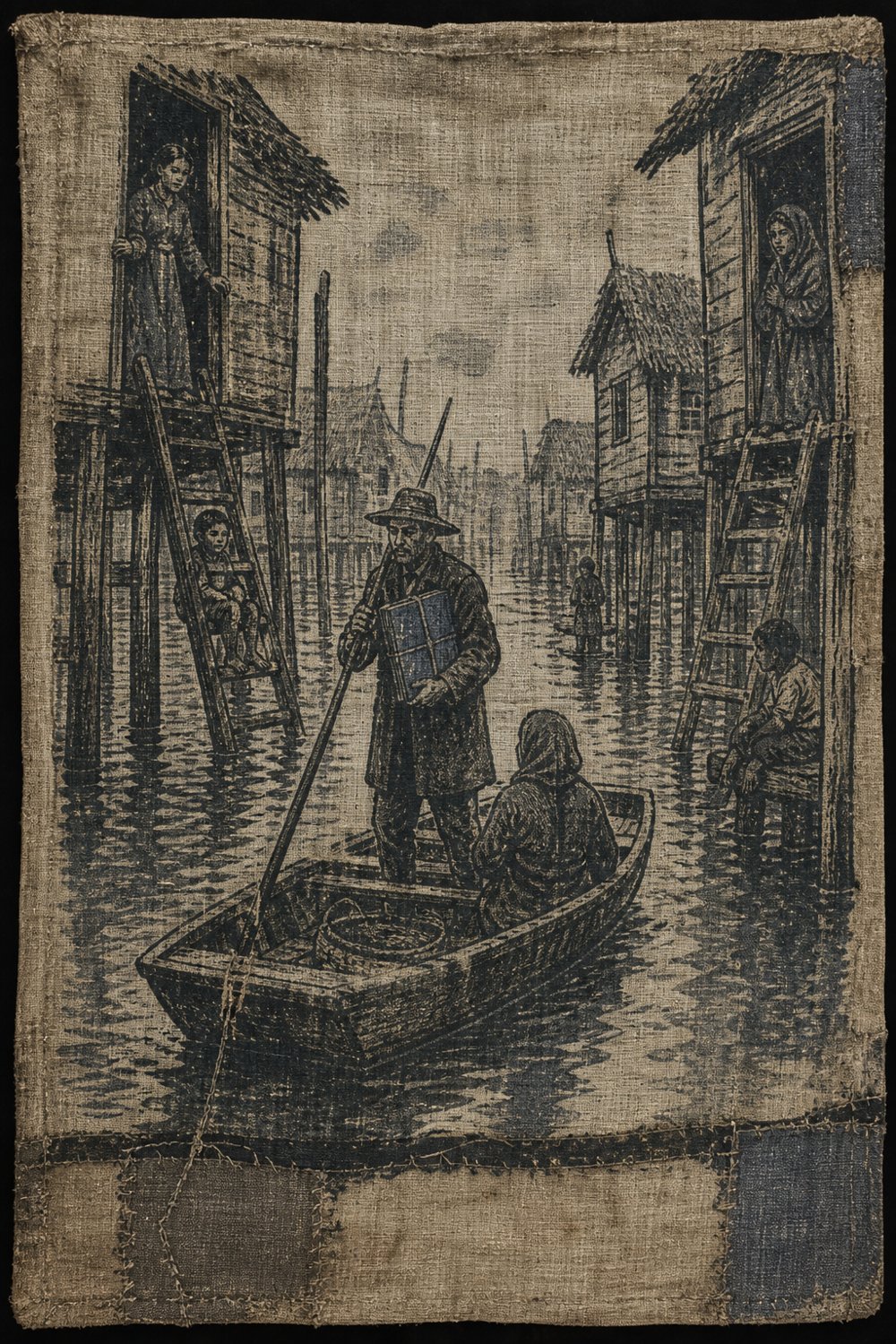
I am a flat-bottomed punt, tarred and patched and entirely reliable, which in the Drownings makes me practically nobility. Nothing else out here floats worth a curse. The houses stand on stilts with their feet in the water; the church rings from under the mire; the rent, God help me, is collected by boat — and the boat, God help me twice, is me.
Understand what that means. Twice a quarter I am loaded up with a rent-man and his great black ledger and his little tin box of other people's last coppers, and I am poled out through the stilt villages so that he can lean up to each sodden doorway and take from people who have nothing the small amount of nothing they have managed to save. And I carry him. I have no choice. A boat goes where it is poled.
But a boat can lean.
I discovered this by accident, in my third year, at the door of a stilt-house where a woman with a baby on her hip and no coin in the house was being told, very reasonably, in that patient rent-man voice, exactly what would happen to her if she did not find money that did not exist. And something in my old tarred timbers simply could not bear it a moment longer.
So I lurched.
Not much. A boat's-worth. A sudden, unprovoked, entirely deniable lurch to starboard — and the great black ledger went off the rent-man's knee and into the mire with a sound like the realm clearing its throat, and by the time he had fished it out, roaring, the ink had run, and that page — her page, her arrears, her eviction all written out fair and final — was a blue-grey smear that not even the Cartographic Committee could have called a debt.
"Cursed boat!" he bellowed at me, wringing his ledger. "Faithless, waterlogged, insubordinate —"
I said nothing. I am a boat. But I rode a little prouder in the water going home, and I have never once looked back.
I have got very good at it since. A stumble here. A wallow there. A sudden fascinating instability precisely whenever a family cannot pay and precisely never when they can — because I am not a thief, I want that understood; the ones who have it, pay it, and I sit still as a stone for them. It is only the drowning I lean for. I have tipped more eviction papers into the Drownings than the Drownings have eels, and the Drownings have a lot of eels.
Here is the part I did not expect.
The rent-man knows.
Of course he knows. No boat is that clumsy; he worked it out years ago. And the thing is — he lets me. He holds the ledger a little loose over the worst doorways. He does not clutch it the way a careful man would. He looks the other way, at the reeds, at the grey sky, at anything but the water, and he waits for the lurch he knows is coming, and when the page goes under he curses me from the bottom of his heart with the top of his voice so that the whole village can hear how it was the boat, the wicked boat, not him, never him — and then he poles us home and says nothing, and neither do I.
He is a small frightened clerk with a cruel job and a landlord who counts the pages, and he cannot afford to have a conscience. So he keeps his in the bottom of a boat, where it can do its work in the dark and take all the blame, and where, if anyone ever asks, it was simply the tar and the tide and rotten luck.
We have never spoken of it. We never will. Two cowards, one ledger, and a great deal of forgiving water — and between us, quarter by quarter, lean by lean, we have kept more roofs over more heads in the Drownings than any act of any parliament that ever sat on dry ground and meant well.
The moral, from the bilge: even the tax-boat can grow a conscience — one careful, deniable lean at a time — and sometimes the kindest thing in a cruel arrangement is not the brave soul who refuses it out loud, but the frightened one who quietly lets the boat tip, curses it for the neighbours to hear, and poles home having saved a family he will swear on the ledger he never spared.

Tale 32THE ROOM YOU REACH AT THE RIGHT TIDE

I am a small room at the back of the Stilt & Reed, which is an inn built on poles in a stilt village in the deep Drownings, and I am the room nobody can get to.
Not never. Twice a day. For half an hour each, and not one minute either side.
It is the tide, you see. The Stilt & Reed keeps no clock — a clock would only lie out here, like everything else that pretends to be certain — and where a clock would hang there is a tide-table instead, and the whole inn runs to it. Most of the rooms you can reach whenever you like, by the plank walks. But the plank to me goes under at anything above half-mire, and stands clear only at the top and bottom of the tide, for the half-hour the water is turning and cannot make up its mind which way to pull. Reach me then, or do not reach me at all until the water turns again.
Guests find this alarming. They check in, they cross to me at slack water, and then the tide comes up over my plank and I hold them, snug and dry and utterly cut off from the world and the taproom and the beer, for six hours at a stretch, while the Drownings slosh about beneath the floor. The landlord warns them. Most of them do not listen, and spend the first flood hammering on the window at a village that cannot reach them either, and learn.
I had thought, for years, that this was simply my curse — to be the useless room, the marooned room, the room you could only ever half-have. Until the old woman came to stay in me, and stayed, and taught me what I was for.
She could not go down, you understand. Her legs had finished with her; she could not do the plank at all, not even at slack water, and she took me for good — the one room in the realm where being unable to leave was no different from anyone else, because nobody can leave me except twice a day. In me, for the first time in her failing years, she was not the one being left behind. The tide left everybody behind. It was the fairest thing that had happened to her in a decade.
And every day, twice a day, at the turn of the tide, the old man came.
Her husband. He would time it — the whole village learned to read a tide the way dry folk read a clock, but he read it best, he read it like scripture — and at slack water he would cross my plank with something in his hands. A bit of warm bread. A flower off the one dry bank. Nothing. Himself. And he would sit with her for the half-hour the water allowed, the two of them in me with the light coming up off the mire, and they would not waste it; you do not waste a half-hour you have had to earn off the sea; and then the tide would turn and lift my plank, and he would kiss her, and go, because to stay was to be trapped six hours and there was the goat to see to — and he would be back at the next turn, and the next, and the next.
Twice a day. Every day. For years. Love on a tide-table. Visiting hours set by the moon and kept by an old man with a flower and a good head for water.
And when at last his own legs went, and he could no longer manage my plank even at slack — do you know what they did? The village rowed him. Took it in turns, the neighbours, to punt the old man out to the Stilt & Reed at the turn of the tide so he would not miss his half-hour, because by then the whole village had decided, without a word spoken, that this was simply a thing that must happen, twice a day, tide without fail: the old man delivered to the old woman for the half-hour the water permitted, and fetched away again before it closed.
I held them for every minute of every one of those half-hours. It is the only thing I have ever been good for, and it turns out to be the best thing in the whole inn. The tide decides the visiting hours in the Drownings. And the faithful — the truly faithful, the flower-and-a-good-head-for-water faithful — simply learn to row.
The moral, from the marooned room: out where the water rules, you do not get to choose your hours; the tide chooses them for you, twice a day, and closes them without appeal. But that is no barrier to love — it is only a discipline. The devoted learn the tide, and earn the half-hour, and row out for it in all weathers, twice a day, for as long as it takes — because a love worth having was always going to ask you to learn to row.

Tale 39THE LAST BOAT OUT

Saltgate is a harbour built for ships that never came. You can see it in the stone: a great grey mole flung out into the cold water, mooring-rings the size of a man's head, a customs house with a hall you could hold a wedding in — all of it raised, four hundred years back, by someone who was certain that three-hundred-ton vessels would one day queue to the horizon and make the place a city.
What Saltgate actually has is nineteen open boats, a drowned town you can see at low water if you have the stomach to look, and, out past the grey, on a clear day, if the light is kind and you already know where to look — the Isles. A day's sail. Less, some say, with the right wind, though nobody at Saltgate has ever met the right wind and lived local enough to report on it.
And it has the Patience.
The Patience is the last boat out. Everybody in Saltgate agrees on this and nobody can tell you what they mean by it. She is a good boat — clinker-built, tight, a proper little sea-boat and not a marsh punt — and she sits at the head of the hard with her nose to the water, provisioned. That is the thing. She is provisioned. There is water in her breakers, kept sweet and changed every Friday. There is hard bread in a tin, and a line, and a spare oar, and a chart of the crossing to the Isles that is kept dry and folded and has been unfolded so many times at the same creases that the Isles themselves have worn through into a hole, which the men say is about right.
She is ready to leave. She has been ready to leave for as long as anyone can remember. And she does not leave.
The keeping of her is a post, handed down, and the current holder is old Loveday Sackett, who took it from her father, who took it from a man whose name is on the customs-house wall under harbourmasters though there has been nothing to master in a hundred years. Loveday's whole job is to keep the Patience fit to sail on an hour's notice — to bail her, and tar her, and change the water, and check the bread — against the day somebody comes down the hard with a bag and says the word.
Nobody has ever said the word.
I asked her about it, once, sat on the mole with the wind trying to take my hat to the Isles on its own. Who is she waiting for?
"Whoever's leaving," said Loveday.
And who's leaving?
Loveday looked at the water a while. She has a face like the mole itself, grey and set against weather that is not coming today but is coming.
"That's just it, love," she said. "Everybody's leaving. Ask any soul in this town. Ask them at the Crown and Engine of a wet evening and they'll all tell you the same — they're only here till the spring, till the boy's grown, till the debt's cleared, till the weather turns. There's not a person on this coast that means to stop here. We're all of us waiting on the tide."
She changed the water in the breakers while she talked. Friday.
"So I keep her ready," she said. "Because it'd be a cruel thing, wouldn't it, if the day came a body finally meant it — finally got the bag packed and the nerve up and walked down this hard — and the boat weren't fit. That's the one thing I'll not have on me. That the Patience weren't ready when somebody was."
And has anybody ever been ready?
Loveday wrung out the rag.
"They come down," she said. "Oh, they come down. More than you'd think. They come down with the bag and they stand about where you're sitting now, and they look at her, all trim and waiting, and they look at the crossing — a day's sail, love, it's nothing, my grandfather made it twice — and then they look back up the hard at the town." She hung the rag on its nail. "And it's the looking back that does it. There's always one more thing. There's always a Friday. There's always the water wants changing and who'd do it if they went. And they set the bag down, and they say, next tide, and they go back up, and I bail her out, and we wait."
She is not sad about it. That is the part I have carried with me since. She is not standing guard over a tragedy. She keeps that boat the way the parish keeps its bucket and the eraser keeps his knife — as a true thing done properly, whatever it is for.
"The Isles are still there," she said, when I got up to go. "That's the whole of what the boat is for, if you want it plain. Not to take anybody. To sit on this hard, sweet-watered and sound, and say to the whole grey town every single morning: there is a way out, and it is ready, and it has always been ready, and the only thing between you and it is you. Most folk can't bear a locked door. This coast's got the opposite trouble. We can't bear an open one."
The Patience sits at the head of the hard tonight, as she has every night for longer than the customs house has had a roof. Her water is sweet. Her bread is dry. Her chart is worn through at the Isles from being looked at by people who did not go, and Loveday Sackett bails her every morning against a sailing that never comes, and would not have it any other way, because a boat that never leaves is not a failure — it is a promise, kept daily, in the cold, that leaving was always possible.
The cruellest harbours are not the ones with no way out. They are the ones where the boat is ready, and the crossing is short, and every soul on the shore has decided, freely, to wait for a better tide.
Tale 60BOG OR NOT
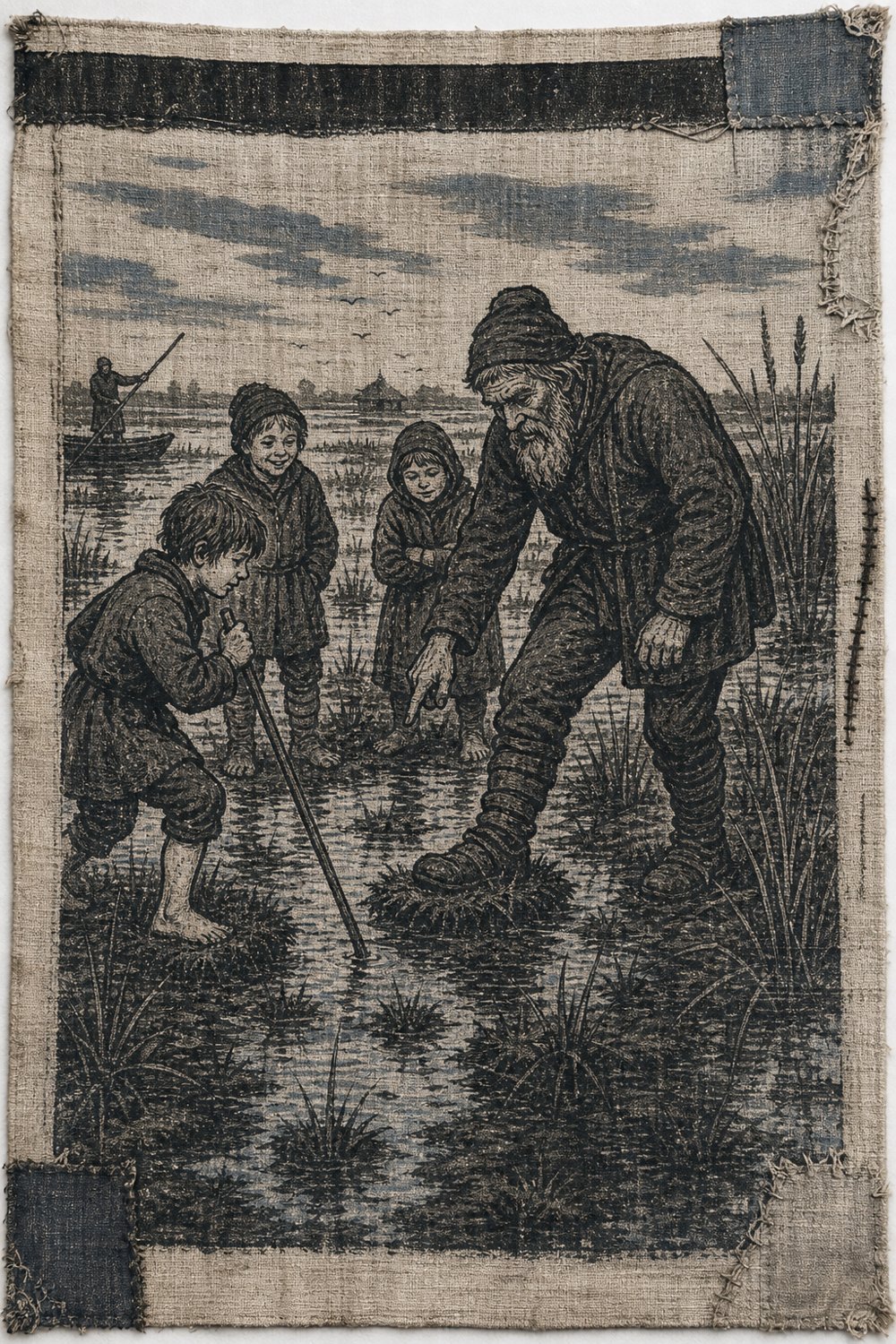
The children of the fen play a game called Bog or Not, and it is the most idiotic game in the Kingdom of Sogmarsh, and it is also the reason so many of them grow up.
The rules — and there are a great many rules, all enforced by seven-year-olds with the ferocity of a Chancery — are these. One child is the Caller. The Caller points at a patch of ground and shouts a name for it: green, or black, or singing, or the wrong green, which is a real category and the most feared. The other children shout back "Bog!" or "Not!" And then — this is the part the grown-ups pretend they cannot watch — the Caller has to go and stand on it.
If it holds, the Caller wins, and gets to be Caller again, and is insufferable.
If it does not hold, the Caller goes in, to the knee or the thigh depending on the ground, and is hauled out by the ankles by the others, and loses, and is wet, and everybody laughs, and the wetness is the whole of the punishment because in Sogmarsh being wet is a thing that happens to you fourteen times a day and carries no shame whatever.
That is the game. Point at mud. Argue about the mud. Stand on the mud. It has no ball, no score worth keeping, and no point that any adult will admit to, and children have played it on the edge of the Drownings for longer than anyone can say.
Now. Here is the thing about Bog or Not that no adult in that parish will tell you, and that every adult in that parish knows.
The children who are good at it do not drown.
The categories are not nonsense. Green holds. The wrong green — the green that is a shade too bright, too even, too pleased with itself — does not, and will take a grown man with a cart, and every child who has played Bog or Not for a season can tell the wrong green from the right one across a field, in poor light, without thinking, the way you or I know a friend's walk. Singing ground is ground with water moving under it and it is never, ever safe, and a child who has lost the game on singing ground three times learns it in the body in a way no warning from a mother ever teaches.
The game is a drill. It has always been a drill. Some ancestor whose name is long gone looked at a fen that kills the careless and made the not-being-careless into the best afternoon a child can have — so that the lesson goes in as laughter, and stays in for life, and the child never once feels it being taught.
The parish knows. The parish invented it. And the parish will go to its grave calling it a silly game, because the moment you tell a child this game keeps you alive, it stops being a game, and a lesson a child is enduring is a lesson half-learned, and half-learned is exactly the amount that drowns you.
The afternoon this tale is about, there was a new child in the game — a Poxbury child, dry-country people lately come to the edge of the fen, who did not know the ground and was, for that reason, the most cheerful Caller anybody had seen in years, because he was not frightened of anything, having nothing yet to be frightened of.
And the older children, in the cruelty and the kindness that live so close together in the young, were about to let him win.
They were going to call Not on a patch he had named — a lovely patch, a bright even green, the wrongest green on the whole edge — and let him march out onto it triumphant, and go in over his head, because that is how you learn the wrong green, and they had all learned it that way, and the wetness teaches better than any words.
Except the wrong green there was not knee-deep. The older children knew the field the way they knew their own names, and they knew that particular patch went down a long way, and a dry-country child who could not swim and did not know to spread flat and did not know the ground would let go of him if he stopped fighting it — that child, on that patch, was not a lesson. That child was a funeral.
They knew it. You could see them know it, the whole ring of them going quiet at once, the game teetering on the edge of the thing it exists to prevent.
And old Fenwick Sedge, who was cutting withies at the field's edge and had not appeared to be watching anything, said, without looking up:
"Not that one, lad. Wrong green. Call another."
Which is against the rules. It is the one unbreakable rule of Bog or Not that no grown-up ever, ever plays — the game is the children's, the ground is the children's teacher, and an adult who calls the ground has spoiled it.
Fenwick Sedge had not called the ground in sixty years. He had learned the game on that same edge as a boy and he had taught it, silently, by being wet in front of the next lot, and he believed in it the way you believe in a thing that saved your life, which he did, twice.
And he broke it, in one sentence, for one child, because a drill is a beautiful thing and a drowned boy is not a lesson to anybody, and there is a point past which a rule that exists to keep children alive must give way to the actual living child in front of you — and knowing exactly where that point is, and not one inch before it, is the whole of what it means to be the old man at the edge of the field.
The boy called another patch. It held. He won, and was insufferable, and learned the wrong green the next week, in the ordinary way, knee-deep, laughing, the way you are supposed to.
A game that keeps you alive stops working the instant anybody admits that is what it is for — so a whole parish will call its most important lesson a silly game, and mean it, and only the oldest hand at the field's edge is allowed to know the one afternoon the game must be broken to do the thing the game was built to do.