Nobody's Fault
The Tales
Tale 57THE BORDER WAR
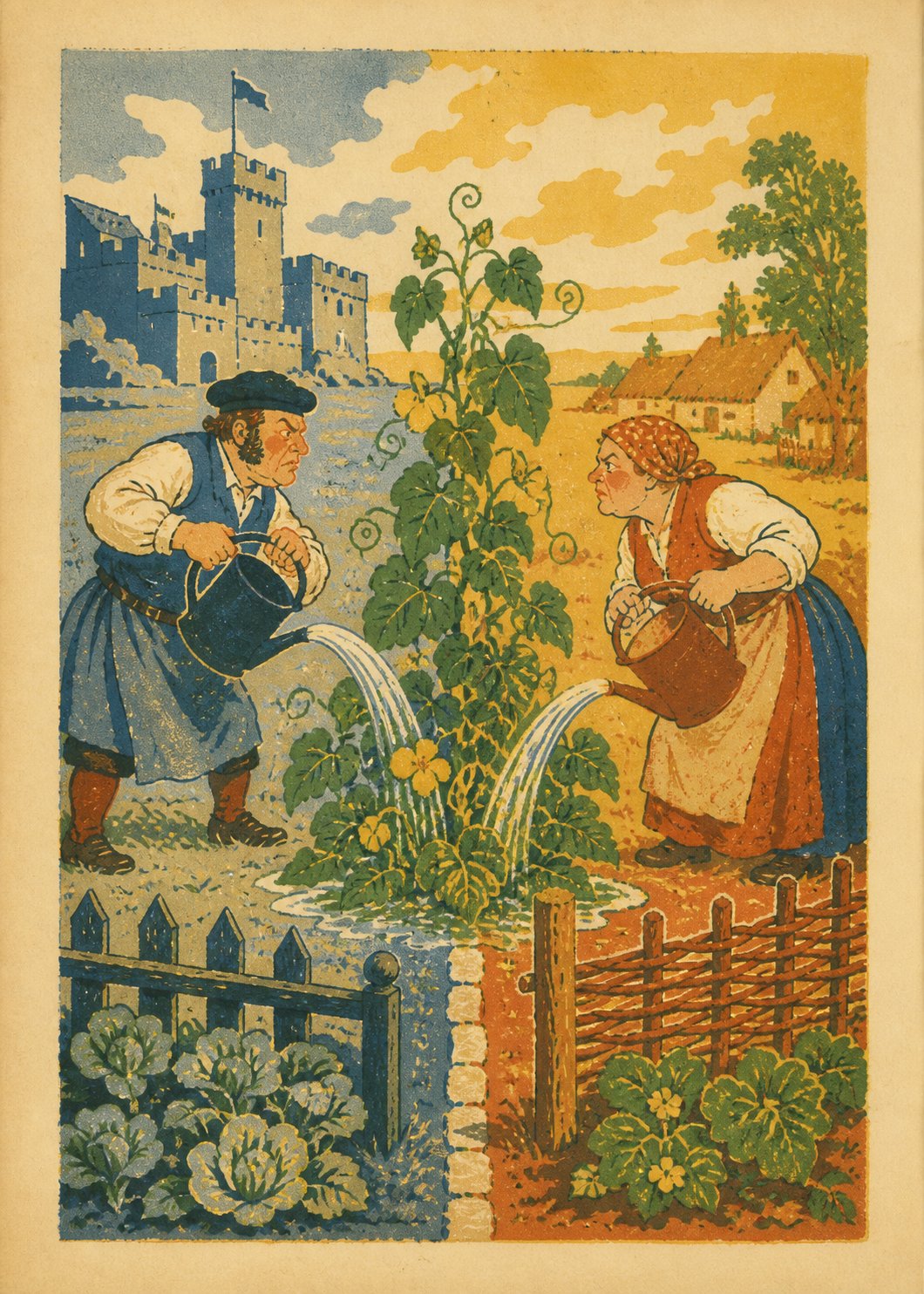
Along the shared boundary of Castle Bastable and the Poxbury estate there is a war.
It has been going since before anybody's records, it has never had a truce, and it is fought entirely between the Bastable squelch-vines, which advance, and the Poxbury lawns, which are mown.
No human being has ever been injured in it. This is not for want of trying.
## THE COMBATANTS
The squelch-vine is the Bastable estate's one agricultural success and nobody planted it. It is a low, thick, dark-green thing with a leaf like a wet hand, it grows about a yard a week in the season, and it makes the noise it is named for when you tread on it, which is a sound that has caused two engagements and one duel.
Lord Percival Bastable regards the vine as cavalry. He speaks of it as cavalry. He has been heard, in his own gallery, to say the words "the vines are moving" with the satisfaction of a man watching his line advance, and everybody present understood that no order had been given, because no order has ever been given, because it is a plant.
The Poxbury lawn is nine acres of the most immaculate turf in the Kingdom of Sogmarsh, which is a comparative honour of the same kind as being the driest thing in a bucket, and which is maintained at an expense Lady Clarissa Poxbury declines to discuss and which two separate valuers have described as heroic.
Lady Clarissa regards the lawn as a statement. She has said so. The statement is: we are not this sort of country, we have merely had the misfortune to be put in it, and she has been making it, at enormous cost, uphill, into the wind, for her whole adult life.
You may see at once that these two positions cannot both be held on one boundary.
## THE HOSTILITIES, IN SUMMARY
The advance. Every spring the vine comes over. It comes over at about a yard a week in the wet months, and it does not stop at the boundary, because the boundary is a line on a paper and the vine cannot read.
The mowing. Every spring Poxbury cuts it back to the line. Not past the line — Lady Clarissa is scrupulous, and it is a point of some pride — exactly to the line, with a string, by two men, one of whom holds the string.
The escalations, in order: - A ditch (Poxbury, dug at great cost). The vine crossed it in a fortnight and appeared to enjoy it. - Salt (Poxbury). Killed the lawn for two yards. Vine unaffected. Not repeated. - Goats (Poxbury, tethered along the line). The goats ate the lawn, having tried the vine first and formed a view. - A wall (Poxbury, three feet, brick, itemised). The vine went over the wall in one season and the wall is now the most decorated feature on the estate, and Perry Bastable has twice sent his compliments on it, which is the single most infuriating thing in the whole affair. - A formal complaint to the Chancery (Poxbury). The matter stands adjourned; judgment reserved since before the present notary was called; and the boundary has moved twice during the pendency of the proceedings, in opposite directions, and both parties amended their pleadings to suit and neither has ever remarked upon it.
The Bastable contribution to the war effort, in full: nothing. Not one shilling, not one man, not one order. Lord Perry has never in his life done anything to that vine except admire it in a carrying voice. It is the only campaign in the history of the realm conducted entirely at the enemy's expense, and it is winning, and it is the proudest thing his house has done in six generations.
## THE GARDENERS
Now: the two men with the string.
Wick Harrow does the Poxbury lawn, and has for two-and-twenty years, and is the man who holds the far end. Sam Brindle is the Bastable gardener, in the sense that somebody has to be, and his duties are largely theoretical because the Bastables cannot pay for a garden and the vine does not require one.
They have been friends since they were boys. Of course they have. There are two men working that boundary and they see each other four days a week and they are both extremely bored.
They meet at the line. They have a spot. There is a flat stone that has been sat on by both estates for twenty-two years and is worn in two places, and they eat their dinner on it, and they talk — and the subject they talk about, obviously, endlessly, with the total professional absorption of two men who have no one else to discuss it with, is the vine.
Wick has watched it come over for two-and-twenty seasons. Sam has watched it go over. Between them they know more about that plant than any living creature including the plant.
And in the spring of the year I am describing, sitting on the stone, Wick Harrow said the sentence that ended four hundred years of hostilities and started something considerably worse.
"It's not coming over. It's coming to the wet."
## THE DISCOVERY
Here is what those two worked out on a flat stone over about three dinners, and it has never been disputed by anybody who has looked at it.
The Poxbury lawn is nine acres of grass in a bog. Grass in a bog dies. It has been kept alive for four hundred years by the single most expensive piece of engineering on the estate, which is the lawn drainage — a system of tile and rubble that takes the water out of nine acres of turf and puts it somewhere.
And where it puts it is a soak-away, at the low end of the lawn, along the boundary.
Four hundred years of the most thoroughly drained, reliably damp, gorgeously fed strip of ground in the county. Sitting exactly where a squelch-vine would most like to be. Renewed every day by the pumps.
The vine is not invading. The vine is being watered.
It is not advancing on Poxbury out of Bastable aggression. It is turning, the way anything turns, toward the only guaranteed wet in a valley that is otherwise merely wet-ish — and the guaranteed wet is manufactured, daily, at heroic expense, by the party being invaded.
Lady Clarissa Poxbury has been personally funding the enemy since before her grandmother, and cutting it back at the line every spring with a string.
## WHAT THEY DID ABOUT IT
Nothing.
I want to be exact about this, because it is the whole point and both men have been asked about it many times.
They talked about it for three dinners. They agreed it was certain. They agreed, further, that the remedy was straightforward and would cost about a fortnight's work: move the soak-away to the far side of the lawn, and the vine would turn, and the boundary would go quiet inside two seasons.
And then Sam Brindle said, "Aye. And then what?"
And they sat on the stone for a while.
Because Wick Harrow's living is that lawn, and there is no lawn without a war, and there is no Wick on that boundary without the mowing; and Sam Brindle's post is entirely nominal and survives only because his lordship enjoys having a gardener to gesture at while the vines are moving; and the two of them, if the war were settled, would have no reason to be at that line four days a week, and no dinner on the stone, and nothing whatever to talk about with the only other man in the world who is interested.
"We'd be moved on," said Wick.
"We would," said Sam.
They finished their dinner. They have never told either house. They have told the parish, obviously, because you cannot sit on a stone with a thing like that in you, and the parish has known for some years and has said nothing, and finds the whole business the funniest thing on that side of the valley.
The vines came over that spring, and were cut to the line, with a string, by two men, one of whom held the far end.
Lord Perry watched from the gallery and said the vines were moving.
Lady Clarissa entered the year's expenditure and did not discuss it.
And at about noon two men sat down on a flat stone worn in two places, exactly on the boundary between two houses that have not spoken since before the deeds, and shared their dinner, and talked about a plant.
Every long war has somebody quietly supplying both sides, and it is not always malice — sometimes it is drainage. And when two men on the ground work out how to stop it, ask what stopping it would cost them before you call it a conspiracy, because the pair on that stone are the only people in four hundred years to have understood the whole thing, and the only ones who would lose by saying so.
Tale 63THE CHEESE VOTE
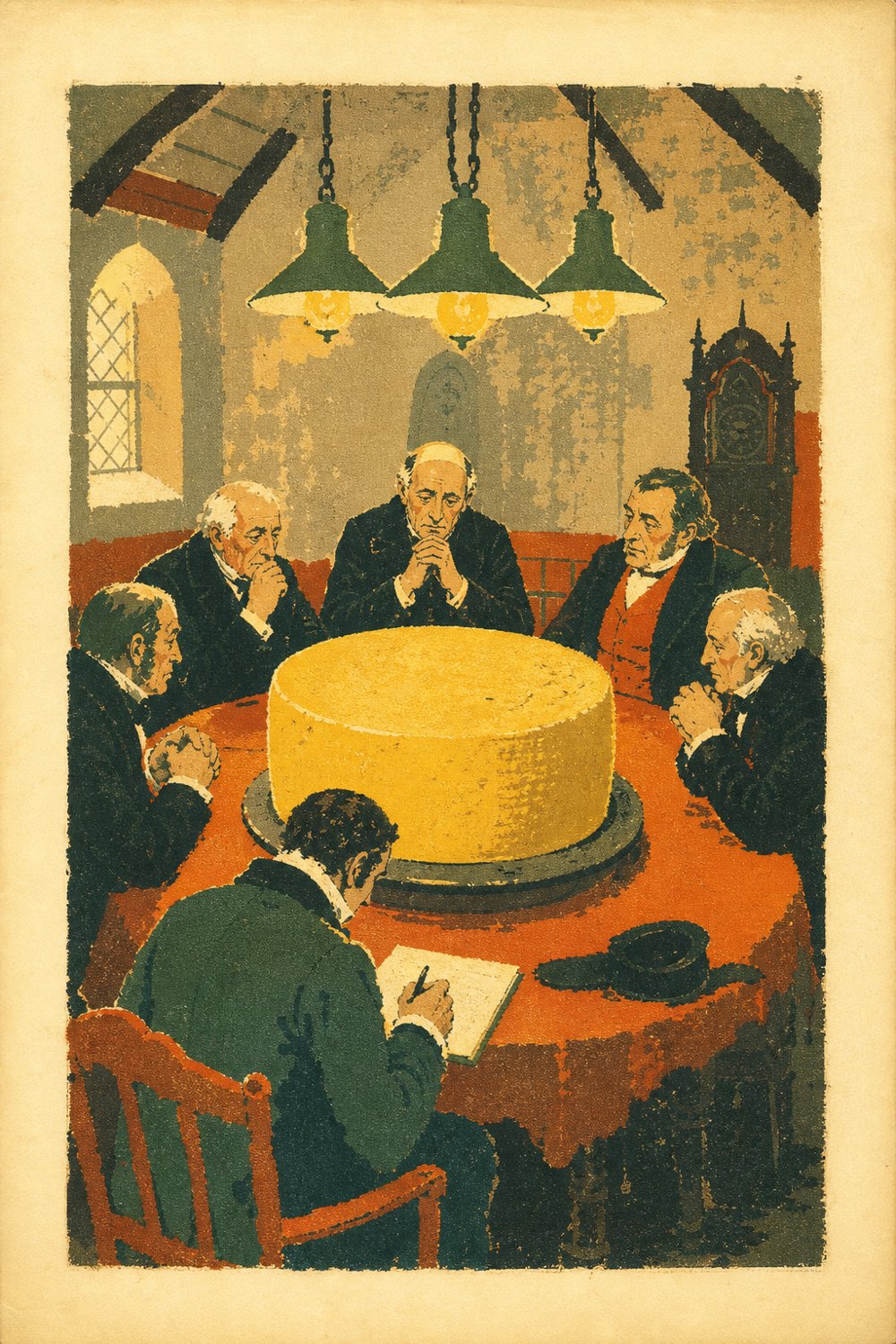
Since the settlement of the Tuesday Schedule, the larder at Castle Bastable is run by treaty, and one clause of that treaty is the clause Mother Stilton fought hardest against and lost, which is that on any matter affecting the cheese, the cheese shall be consulted.
She had refused it the first time. That cheese has an opinion on everything, she had said, and if I consult it we shall be here at Michaelmas. But the mechanical rasher, which negotiates for the whole larder now, had held the clause back and raised it again a year on, in the small firm way it has, and this time it had a matter that genuinely, undeniably, affected the cheese, and Mother Stilton had run out of grounds to say no.
The matter was this. The chapel wanted the great cheese for the harvest supper. The whole thing. To be carried out of the larder, across the yard, up to the chapel, set on the long table, and cut.
And the cheese, you will remember, is aware, and fresh for ever, and has sat at the back of the third shelf for longer than anyone can say, resenting an arrangement it was not asked about, forgiving nothing, which is precisely the trait it shares with the only other resident of that kitchen who matters.
So they held the consultation.
It was, everyone agrees, the strangest quarter-hour in the recent history of the castle. Mother Stilton sat at the scrubbed table. The mechanical rasher sat opposite as the larder's representative. A girl was posted at the door to keep out the curious, of whom there were many. And the question was put to the cheese, out loud, plainly, as the treaty required: would it consent to be taken to the chapel and cut for the harvest supper?
Now, how a cheese answers is not a thing this tale will pretend to explain, because nobody in that kitchen could explain it either, and the one honest account is Mother Stilton's, who said afterward only that she had asked it a straight question and got a straight answer and it was no.
Not sulking. Not spite. The girl at the door, who saw the whole of it, said the no had something under it, something that was not about the harvest supper at all, and that Mother Stilton had gone very still when she felt it, the way you go still when a person you have been angry at for years says a true thing.
Because what the cheese said no about — and this is the part the parish did not learn for a while — was that the great cheese, the aware one, the fresh-for-ever one, is the last of a make that no one living knows how to make again. Cut it for one supper and it is gone. There is no more where it came from. The household had been keeping it at the back of a shelf for so long, resenting it, calling it difficult, and had never once understood that it was not being difficult.
It was the last of its kind, and it knew it, and it did not want to be spent on a Tuesday.
Mother Stilton, who has fed that house eight-and-forty years and been thanked by none of it, and who forgives nobody, and who had spent a decade speaking to that cheese every morning without ever saying what she said — Mother Stilton heard the no, and understood it, all of it, in the still way she understands things, and did a thing she had not done for the cheese in all those years.
She agreed with it.
She went to the chapel herself and told the churchwardens they could not have the great cheese, not for the supper, not for anything, and that she would make them a supper cheese, a good one, an ordinary one, one that could be replaced — and she did, and it was excellent, and the harvest supper wanted for nothing.
And the great cheese stayed at the back of the third shelf, uncut, un-spent, the last of itself, no longer resenting an arrangement it was not asked about, because it had, for the first time in its long strange life, been asked.
They understand each other now, the cook and the cheese, in the way that two hard, unthanked, essential things understand each other once they stop mistaking each other for the enemy. Mother Stilton still speaks to it every morning while she takes the flour down. The girl who does the fires still says it is not words.
But it is warmer than it was. And once — only once that anyone caught — the girl swears that when Mother Stilton set the flour back and turned to the range, she said, to the back of the third shelf, not looking, in the voice she uses for nothing else in the world:
"Aye. I know. Me and all."
Two things a household keeps at the back of a shelf and calls difficult — the cook it never thanks and the last of a thing it cannot replace — are usually not being difficult at all. They are only waiting, the pair of them, for somebody to stop resenting them long enough to ask what is actually the matter. And the answer, more often than not, is the same answer, which is why it takes one to know one.
Tale 64SECOND BEST
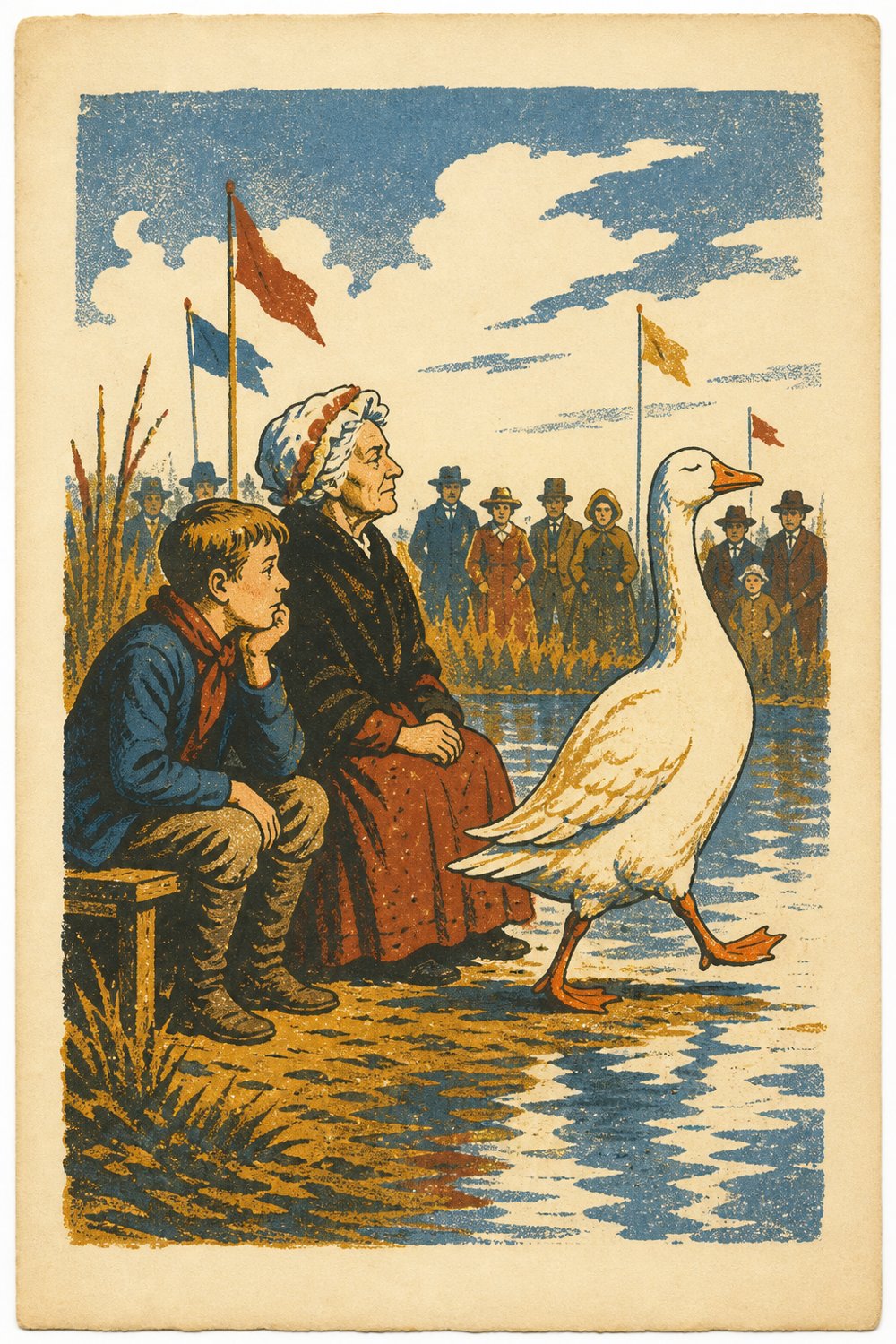
Every child on the Haver ground wants to beat the Goose, and every year the Goose beats them, and most children learn to live with this the way you learn to live with the rain.
Not the Prowse boy. Little Wat Prowse — great-nephew to Aggie, the same mud-and-stone family, the ones who re-lay the Mire Road stepping-stones twice a year — did not want to live with it. He wanted to win. And he did the thing no child had done in a generation, which was to go to Aggie Prowse herself, the only soul in the history of the tournament ever to lead the Goose at the last firm footing, and ask her to teach him how it was done.
Aggie was old by then, and famous, and had a bench on the ground with her name on it that she found embarrassing and would not sit on. She looked at the boy a long while, in the slow Prowse way, hands flat on her knees.
And she said she would teach him. Which surprised the parish, because Aggie Prowse had never taught anyone anything about that tournament and had spent a lifetime declining to discuss it.
She taught him for three springs.
She taught him to read the wind off the west the way she read water, so he would know where the sheaf came down before it was thrown. She taught him to start out on the ground at his own stone instead of at the hedge with the others. She taught him to go through the bog to the knee and haul out and go again without breaking his line, which is the hardest thing on that field and the thing she was best at in the whole history of it.
She taught him everything she knew. And the boy was good — better, at his age, than she had been — and by the third spring he could get the sheaf up and turning before the Goose was properly in the air, and the parish began, very quietly, to wonder.
What she did not teach him, in all three springs, was the last thing. The finish. Where to carry the sheaf. She taught him every yard of that field except the final one, and when he asked about the last stretch — where do I take it, Aunt Aggie, when I've got it and I'm ahead — she only ever said, "We'll come to that."
They came to it in the boy's fourth year, on the ground, in front of eight hundred people, which is how Aggie Prowse had planned it all along, though she never said so.
The sheaf came down where the wind said it would. Wat Prowse had it up and was turning before the Goose left the ground, and he went through the bog the way she taught him, hauling and going, hauling and going, and he was ahead — ahead at the last firm footing, the second child in the whole history of the Haver ground to be there, and the crowd made a noise you could hear at Mucklecombe.
And he stopped. On the last firm footing. Sheaf up over his head. The Goose six inches off the mud beside him doing its flat contemptuous flap. And Wat Prowse stood there, ahead, with the whole tournament there for the taking, and did not know where to run — because his great-aunt had never taught him the last yard.
He looked for her in the crowd. And she was standing at her bench, the one with her name on it, the one that faces the last firm footing, and she was not shouting go. She was just looking at him. And in that long second the boy understood the whole of what she had spent three springs not saying.
He understood that she could have taught him the last yard. That there is a way to beat the rule of 1672, that a Prowse who has thought about that field as hard as Aggie had would have found it, and that she had found it, years ago, and had chosen — every year, on purpose — not to use it.
And he understood why, standing there ahead of the bird with the choice in his hands: that the parish does not need another winner. A hundred parishes have a winner. What this one has, the only one in the realm, is the ground where the best of us comes second to a bird and holds their head up — and that being the person who could have won, and let the crookedness stand, and came second on purpose so the story lives, is a prouder thing than any trophy, and the hardest thing his aunt knew, and the last thing she had left to teach him, and the only way to teach it was to let him find it here, ahead, with everyone watching.
He carried the sheaf to the near hedge. The Goose carried it to the table. The Goose won.
Wat Prowse came second, by the length of a table, the third of his family to do it, and the crowd understood what they had seen, and the noise they made was not for a defeat.
Afterward, Aggie Prowse sat down on her bench for the first and only time anyone ever saw, and the boy sat down beside her, and neither of them said much, in the Prowse way, and then Wat said he thought he could have won it.
And Aggie said, "I know you could. That's why it counts that you didn't."
And they watched the Goose refuse to look at the committee, the pair of them, for a good long while.
Anyone can be taught to win; a hundred parishes teach nothing else. The rare thing — the thing that has to be found standing on the last firm footing with the prize in your hands — is knowing when the crooked, generous, unwinnable thing is worth more than the trophy, and choosing, in front of everyone, to come second on purpose so that something better than you gets to go on living.
Tale 65THE STOOL NOBODY SAT
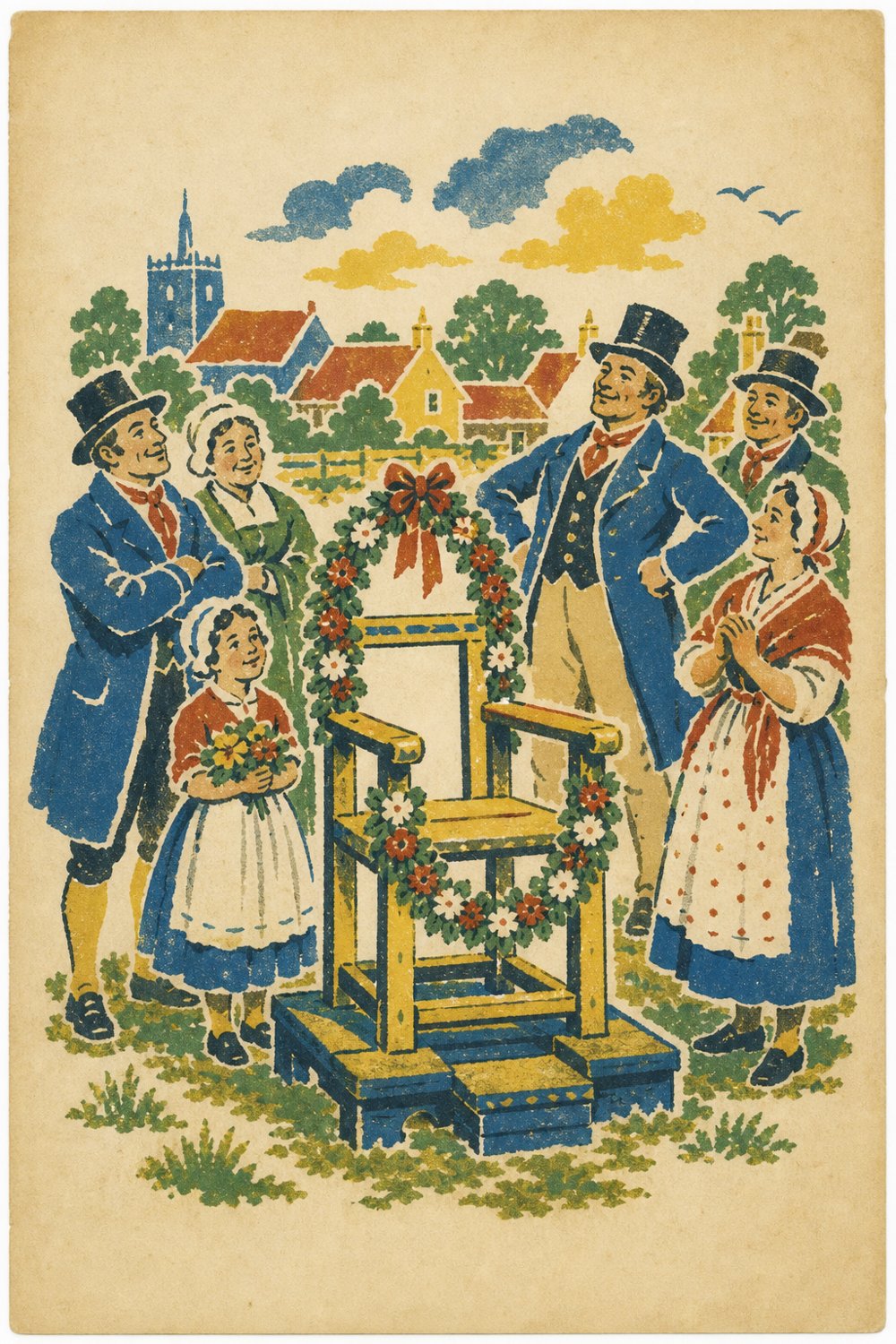
In the year the Family Catastrophes give as the Incident of the Ducking Stool, Sir Mortimer Bastable decided the parish had grown unruly and required correcting, and commissioned, at some expense, a ducking stool.
A ducking stool, for those spared the knowledge, is a chair on the end of a long beam, over water, into which a troublemaker is strapped and then dunked, repeatedly, until the parish is satisfied or the troublemaker is. It is a fine old instrument of public discipline, and Sir Mortimer had a good one made, oak and iron, and had it set up over the mill pond, and sat back to watch order return to Sogmarsh.
Order did not return to Sogmarsh. What happened instead is the whole of this tale and is, the parish holds, the most Sogmarsh thing that has ever happened, which in this realm is a considerable claim.
The trouble began the moment Sir Mortimer tried to use it, and the trouble was cousins.
To duck a troublemaker you need three people who are not the troublemaker: someone to name the offence, someone to work the beam, and a magistrate to say the word. Sir Mortimer had the stool. What he did not have, and could not for love or money obtain, was three people in the parish of Sogmarsh who were not all related to each other and to the accused and to Sir Mortimer besides.
The first man he ordered to work the beam refused, on the grounds that the accused was his wife's cousin and he had to live with her. The second refused because the accused was godfather to his youngest. The magistrate refused because the accused had lent him a cart in the wet spring and a man does not duck a neighbour who lent him a cart. Sir Mortimer, growing heated, demanded to know whether anyone in the entire parish was unrelated to the accused, and was told, after some genuine effort by the whole village to help him with the sum, that no, there was not, and furthermore that the accused was, at three removes, related to Sir Mortimer, which ended the conversation.
He tried a second offender. Same wall. A third. Same. It emerges, if you build a ducking stool in a place the size of Sogmarsh, that you have built a machine for being cruel to your own family, and there is not a soul in the fen who will work it, because tomorrow it is your aunt in the chair, or your godson, or the man who lent you the cart, and everybody knows it, and the whole apparatus of public discipline collapses against the simple fact that these are all, every one of them, people you have to see on Tuesday.
The stool was never used. Not once. Sir Mortimer went to his grave having spent good money on a punishment the parish quietly, unanimously, and without ever holding a meeting about it, declined to allow to exist.
But it stood there. Oak and iron, over the mill pond, a good sound stool, and Sogmarsh does not waste a good sound anything.
And so the second half of the tale, which took about a generation, is the story of what the parish did with a punishment nobody would inflict, which was to slowly, without deciding to, turn it into the exact opposite.
First the children played on it. Then, one hot Dust, somebody sat in it to be swung out over the cool of the pond, which is, it turns out, the single most pleasant place in the whole parish on a warm day. Then it became the seat you were swung out on for your birthday, gently, once for each decade, by people laughing. Then it became the seat of honour at the mill-pond gatherings, the place you put the oldest person present, or the guest, or the couple newly walked-out.
By the time anyone thought to write it down, the Ducking Stool of Sir Mortimer had become the Honour Seat of the Mill Pond, and to be swung out on it over the cool water, gently, by your neighbours, on a warm afternoon, was the nearest thing the parish had to a knighthood, and the whole grim purpose of it had been so completely digested by the kindness of a place too interrelated to be cruel that visitors had to be told, and did not believe, that it had ever been meant for anything else.
It is still there. They still swing the old folk out on it in the summer, once for each decade, laughing, and the oldest woman in the parish holds the record for decades and is very proud of it.
And the parish tells the story of Sir Mortimer and his three offenders and his hopeless search for one person unrelated to anybody, and they tell it fondly, because it is the story of the day the fen looked at a machine for hurting itself and found it simply could not, not out of virtue exactly, but out of the plain unarguable fact that everyone here is somebody's cousin, and you cannot duck your own aunt, and a place where that is true is a hard place to make cruel.
Build an engine of cruelty in a village small enough and it will not run, because there is no stranger in it to pull the rope — and given enough summers, a people too tangled in kinship to hurt itself will take the very seat you meant for punishment and swing its grandmothers out over the cool water on it, laughing, once for every decade, which is a better use, and the only one Sogmarsh could ever have been persuaded to find.