Murkminster, Capital of Paper
The Tales
Tale 38THE ERASER-IN-CHIEF
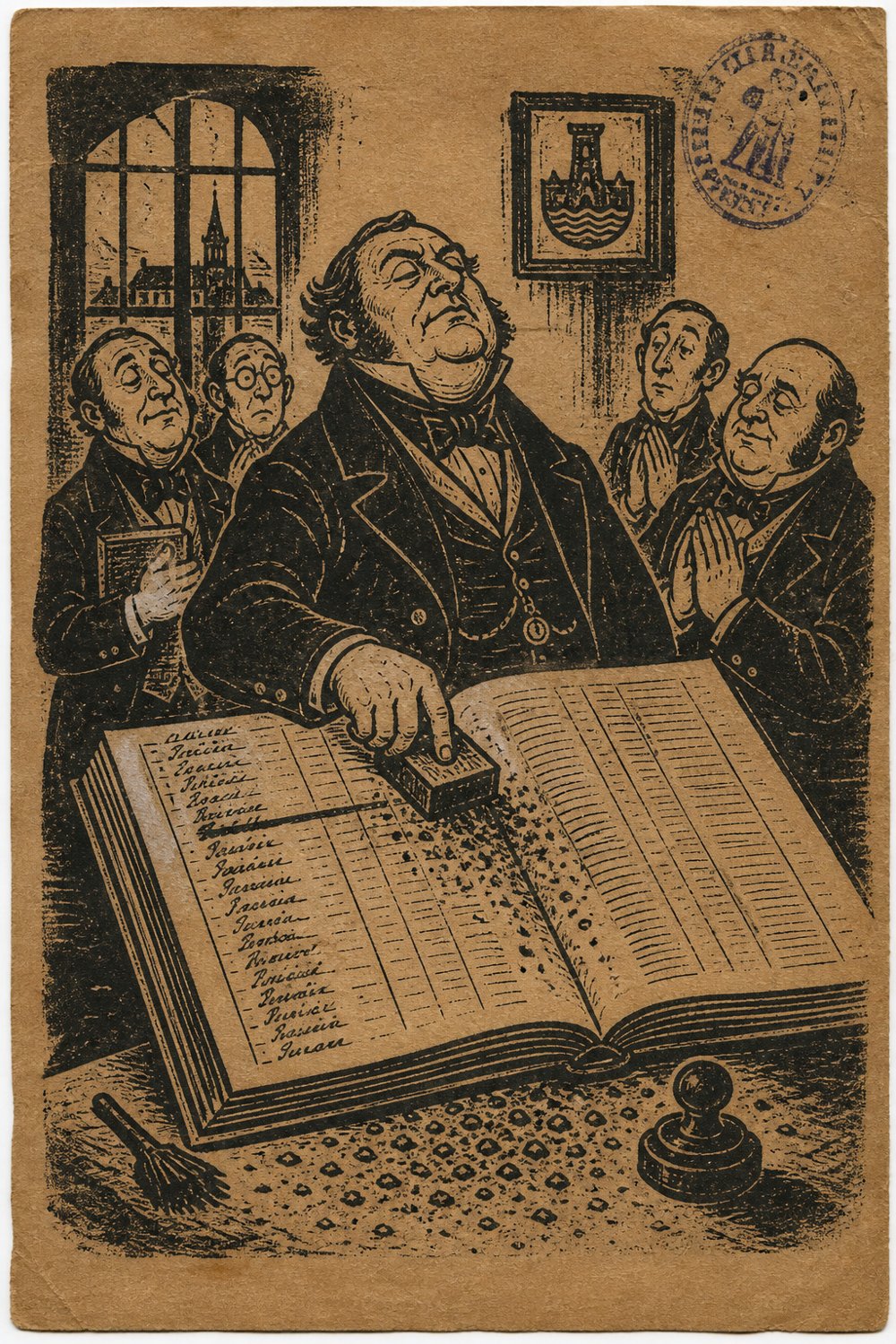
In the Iron Ink Quarter of Murkminster, up a stair that smells of lampblack and grievance, there is an office nobody applies to and nobody leaves, and over its door a sign that has been scraped and recut so many times the wood beneath it has given up and gone concave: THE OFFICE OF THE ERASER-IN-CHIEF.
Master Scribesby holds the post. He has held it forty years, and he will tell you — he will tell anyone, he tells the wall — that it is the only honest office in the Chancery, because every other clerk in that building spends his life writing things down, and writing things down is how the trouble starts. "A thing written," says Scribesby, "is a thing that has decided to be permanent without asking anybody. I am the only man here employed to disagree with it."
He is very good at his work, which is this: when the Chancery records something it wishes it had not — a promise a Baron regrets, a boundary that turned out to belong to the wrong marsh, a debt that would embarrass the whole exchequer to collect — the paper comes up the stair to Scribesby, and Scribesby takes his blade, which is worn to a curve like a smile, and he removes it. Not crosses out. Any fool can cross out, and a crossing-out is just an argument you have lost in public. Scribesby lifts the ink clean off the skin of the vellum, layer by patient layer, until the page cannot remember there was ever a word there, and the trouble is not resolved but un-happened, which is far tidier and pays better.
His desk is scraped raw in the middle from the sheer quantity of not-happening he has performed upon it.
Now, understand the pride of the man, because the whole of this tale turns on it. Scribesby believes — sincerely, the way you believe in weather — that there is nothing in the realm he cannot take off a page. Kings have leaned on him. He unmade a marriage once between breakfast and noon and both parties went home unwed and never knew they had been anything else. He is the last word, and the last word's whole trade is having no last word above it.
And then, one wet Tuesday, a sheet came up the stair from the Grand Cartographic Committee with a note pinned to it, and the note said the Committee would be most obliged, and a Committee that says most obliged is a Committee that has already tried three times and failed.
It was a survey plate of the eastern marshes. And in the margin, in a small hand, where the linework ran out into the grey, somebody had written three words: The Hem remembers.
"Not commissioned," said the note. "Not to scale. Kindly remove."
Scribesby smiled his blade-shaped smile and set to it, because it was, on the face of it, nothing — three words, a light hand, no depth to the stroke. He had lifted whole treaties off calfskin. He gave it the edge of his knife, gently, the way you would take a crumb off a cheek.
The words did not come off.
He tried the flat of the blade, and then the point, and then a paste of chalk and spit that has never in forty years failed him, and then he tried simply pressing very hard and being cross, which is not a technique but which a man reaches for at hour four. The vellum thinned. The vellum wore. The vellum, under his knife, gave up its surface entirely and went soft as a wet leaf — and the three words sat on top of the ruin of it, unmarked, patient, in ink he could no longer find the underneath of.
He worked on it eleven days. He is not a man who gives a thing up at ten.
On the twelfth he wrote his report to the Committee, and it is the shortest thing he has ever submitted, and it hangs framed now in the Iron Ink Quarter because a younger clerk stole it and would not give it back:
"The vellum accepts the knife. The words do not."
That is all. That is the whole of what the greatest eraser in the realm had to say about the one thing he could not erase, and he has never improved on it, and he has stopped trying, which for Scribesby is a form of grief.
Here is the part he tells nobody, and I have it only because the wall in that office is thin and I was the clerk on the other side of it.
A little while after, another sheet came up — not from the Committee, from the household side, a small domestic thing, and on it in the same small hand was a question. Not a curse, not a boast. Just a person asking, plainly, after some other person, and where they had gone, and which book they went into.
And that one came off.
First stroke. Clean as anything. Lifted like it had been waiting to be lifted, and the vellum beneath was firm and fresh and did not remember a thing, and Scribesby sat and looked at his own knife for a long while, because he had just learned the rule of his whole trade and he did not want it.
A realm will let you scrape away a question about a person as easily as breathing. It is the joke about the fog it cannot bear to lose. The Hem remembers because remembering the Hem costs nobody anything — it is a shiver, and a shiver is free. But a woman asking where the crossed-out people go — that is a bill the whole house would have to pay, and so the knife goes through it like it was never there.
Scribesby is the finest eraser in the Kingdom of Sogmarsh, and he has proven, past all argument, exactly which truths this realm holds on to and which it lets a tired man lift off with a blade before his tea goes cold. He does not draw the moral. He would not thank me for drawing it. He just sharpens the knife, which is worn to a smile, and waits for the next sheet up the stair, and hopes — privately, where the wall cannot hear — that it is only ever another fog.
The words a realm cannot rub out tell you what it fears. The ones that lift away at a touch tell you what it has decided not to owe.
Tale 44THE YEAR NOBODY CORRECTS
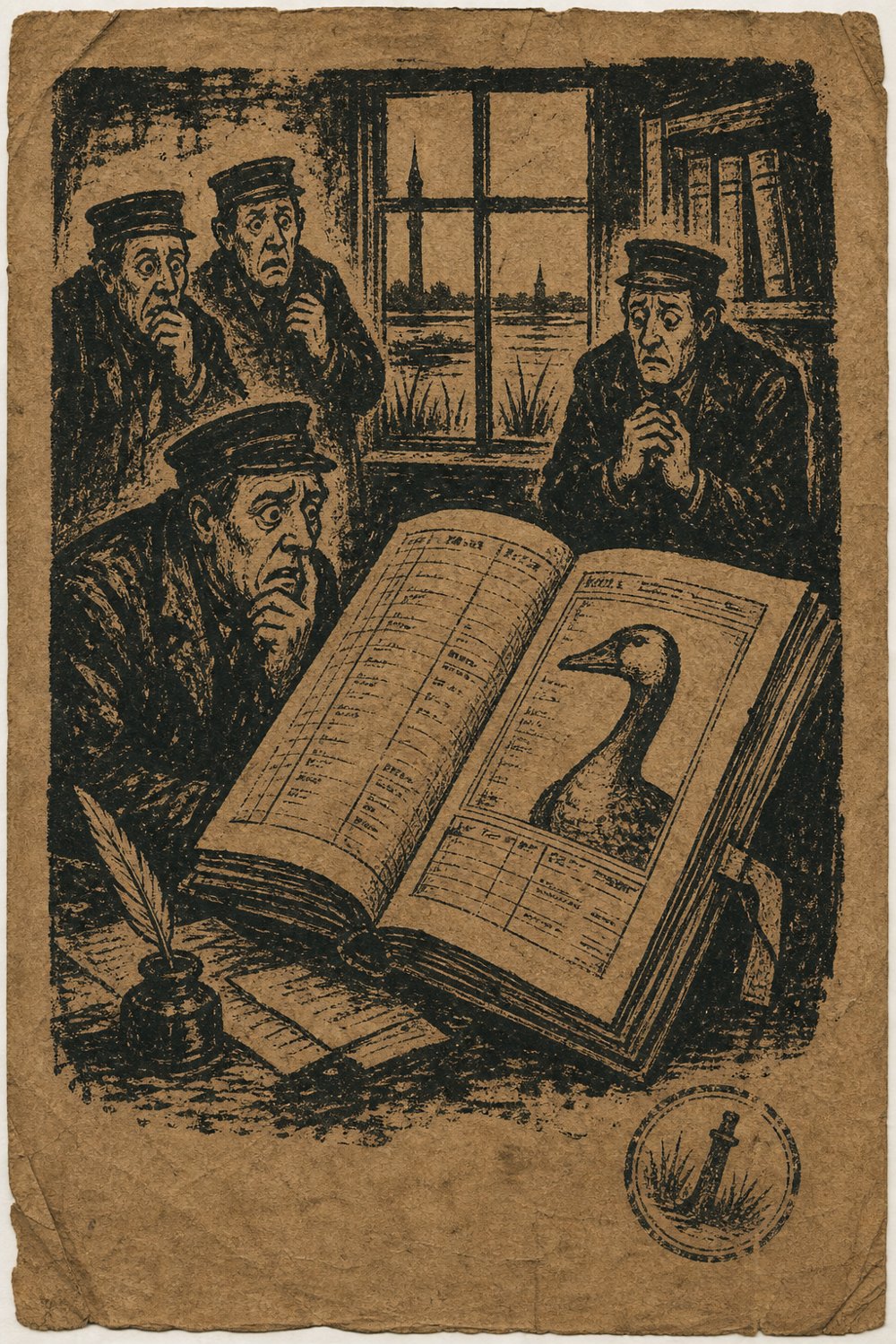
The Clerk sets this down because he is the Clerk, and because the alternative is that it goes unrecorded, and this office has quite enough of that.
There are two facts in the register which every soul in this realm knows separately and no soul has ever put beside the other, and the Clerk, having nothing better to do one wet winter and access to the older drawers, has put them beside each other, and wishes now that he had not.
Fact the first. The status of House Haver — that aristocratic family which declines to exist, in order to dodge the audit — is entered as PROBABLY HYPOTHETICAL, and has been, unaltered, since 1672.
Fact the second. The Haver Goose Tournament has been won, every year without exception, by the Goose, since 1672 — including on the celebrated occasion when it reached the final against itself, and won, and took the Perpetual Trophy, and did not acknowledge the committee.
The Clerk invites the reader to look at those two years for a moment. He looked at them for the better part of a fortnight.
Here is what is in the drawer, and the Clerk warns the reader that it is a great deal duller than they are hoping, and that this is the point of it.
In the autumn of 1672 a clerk of this parish — he is named in the margin and the Clerk will not repeat it, he has descendants and they are decent people — was working through the quarter's returns. It was a bad autumn. The register for that month is in a hand that starts square and ends like a man falling downstairs. He had, by his own note on the reverse of the third sheet, "been at the turnips three days" — the rotten count, which anyone who has done it will tell you does something to a person.
He had two papers on his desk.
The first was the Haver family's return — the annual declaration of persons, holdings and liabilities, which the Havers had submitted late, in a hand of enormous grandeur, and which is the document upon which their standing as a family is entered.
The second was the tournament result — the Goose, first; the field, nowhere — which comes in on a similar sheet, of a similar size, from a body with a similar seal, because in this realm nobody has ever seen the value in different paper.
He filed the tournament result under FAMILIES.
He filed the family return under FIXTURES.
Then he went home. He meant to correct it in the morning. He wrote himself a note about it, and the note is still there, at the foot of the sheet, in the falling-downstairs hand: "put right thurs."
He did not put it right on Thursday. The Clerk has looked. There is no evidence he ever came back to it at all, and the Clerk has formed his own view about the health of a man who wrote a hand like that at the end of that particular week, and will keep it to himself.
The consequences are as follows, and the Clerk sets them out in the order the office incurred them.
One. The FAMILIES register, consulted the following spring on the matter of House Haver, was found to contain — where the family's persons and holdings should have stood — a goose.
Two. The office, being an office, did not conclude that a mistake had been made. The office concluded that the return was defective, and wrote to the Havers requiring clarification.
Three. The Havers, who had submitted their return correctly and in a hand of enormous grandeur, and who had already grasped in a general way that being uncertain was cheaper than being taxed, replied — in the words which have gone into the language of this realm and which the Clerk records here as the load-bearing sentence of the entire affair:
Four. The office, having a defective return and a refusal to clarify, and having no column for we have lost your family in the fixtures, entered the only status available to it for a matter attested by everybody and evidenced by nobody, and entered it provisionally, pending resolution: PROBABLY HYPOTHETICAL.
Five. Meanwhile, in the FIXTURES register, the tournament committee found itself in possession of a document listing the persons, holdings and liabilities of an aristocratic family, and, being also an office, did not conclude that a mistake had been made either. It concluded that it had received an entry. It entered the Havers as a competitor, once, in 1672, and they have never withdrawn, because withdrawal requires a letter and the Havers have not written one since — and a competitor who does not attend forfeits, and a forfeit gives the walkover to the field, and the field, that year and every year since, has been the Goose.
Six. In 1672 the field consisted of the Goose and, owing to a further clerical matter the Clerk declines to go into, the Goose. It reached the final against itself. It won. It has retained the Perpetual Trophy ever since on the strength of a competitor who cannot withdraw because the office is not certain it exists, and does not acknowledge the committee, which the Clerk considers fair, since the committee has never acknowledged its own filing.
That is all. That is the whole of it. Three hundred and fifty-odd years of the realm's most cherished mystery and its most reliable sporting fixture, and underneath both of them there is no curse, no bargain, no old dark thing in the wing that appears on no survey — there is a man who had been at the turnips three days and put two papers in the wrong two drawers and wrote put right thurs and did not.
The Clerk knows what the reader wants. The reader wants it to be more than that. The reader has been raised, as we all have, on the notion that a thing which has stood for three hundred years must have something underneath it. The Clerk has spent his working life in the drawers of this office and can tell the reader, with the confidence of a man who has looked, that what is nearly always underneath a great standing mystery of this realm is a tired person, a bad week, and a note about Thursday.
The Clerk did, naturally, propose that it be corrected. He is the Clerk. It is a two-minute job: swap the sheets, amend the register, restore House Haver to the families and the Goose to the fixtures, and the error of 1672 is undone.
The reply came back from Murkminster in eleven days, and it is pinned above the Clerk's desk, and it reads:
So the sheets stay where they are. House Haver does not exist, and does not pay, and answers certainly not to all enquiries. The Goose wins in the spring. The register carries the error of 1672 in the same ink as everything else, and will carry it after the Clerk is dead, and after whoever reads this is dead, and it will still be the same two sheets in the same two drawers, and nobody will ever put right thurs.
The Clerk records the whole of it here, accurately, without hope, because that is his office.
Every unshakeable institution in this realm rests on something a tired person did wrong on a Thursday — and it stays standing not because nobody has noticed, but because by the time somebody does, the cost of being right has grown greater than the cost of being wrong, and it has grown that way one quiet year at a time.
Tale 45THE STANDING ACCOUNT
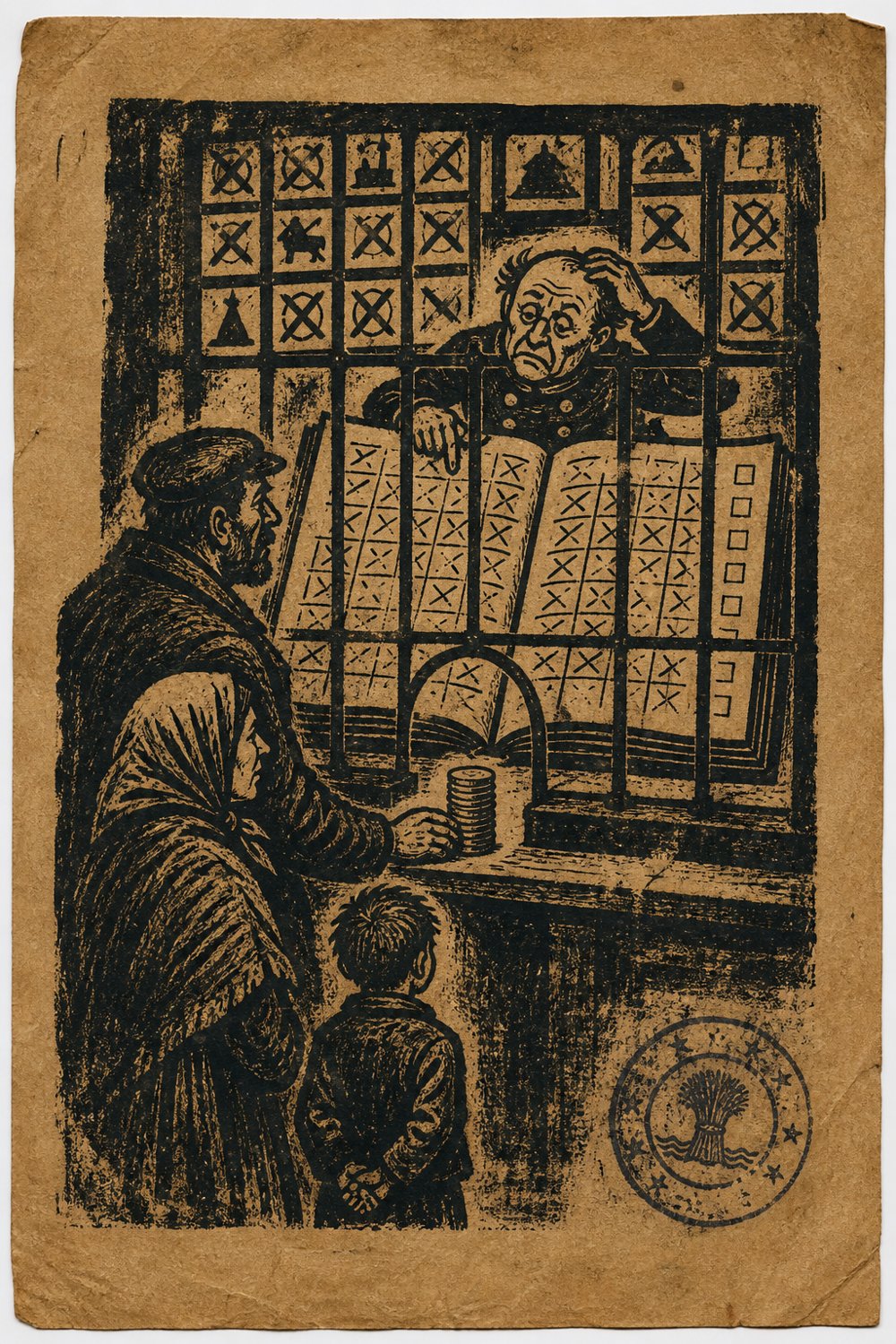
The Counting-House of Pennyworth keeps, among its ordinary business, a thing called the Standing Account.
It is explained to every family that comes under it, patiently, at the outset, and the explanation is always the same and is never a lie: this is a debt of long standing; the interest is modest; nothing is demanded that cannot be met; you will not be turned out; your children will not be turned out. Pennyworth is not a monster. Pennyworth has never once, in the whole recorded history of this realm, sent a man with a stick.
What Pennyworth does not explain, because nobody ever asks it in the right words, is that the Standing Account cannot be settled. Not will not. Cannot. To settle a thing is to have done with it, and the Counting-House has no business with things that are done with; it keeps positions, and a position is a thing that carries forward. The account is not a hole you are filling. It is a relationship you are in.
The Thrupp family did not know this, and spent three generations proving it.
Old Thrupp started it, out of temper, in the way of this realm. He had gone in to make his quarterly and had been treated perfectly civilly, and had come out into the rain and stood there and said the sentence that cost his family sixty-one years:
"I'll clear it."
His son took it up. His son's daughter finished it. And I want to be exact about what that meant, because it is easy to write three generations and hard to feel it: it meant sixty-one years of a family being slightly colder, slightly hungrier and slightly shabbier than their neighbours, on purpose, by agreement, across three sets of lives — a wedding done cheap, a roof mended twice instead of replaced, an education declined, a good coat not bought, ten thousand small refusals of ordinary comfort, all of it going into a tin under a board and out of the tin into the Counting-House, quarter after quarter, decade after decade, while the interest was modest and the account carried forward.
And in the sixty-first year, Sary Thrupp — the granddaughter, who had done the arithmetic since she was nine and had checked it more times than she would admit — walked into the Counting-House of Pennyworth with the last of it in a bag, and put it on the counter, and said:
"That's the whole. Every farthing, principal and interest, calculated to today, and I've done it three ways and they agree. That clears the Standing Account of the Thrupps."
The clerk counted it. It took some time; it was in coppers, mostly, because that is what sixty-one years of small refusals looks like when you finally pour it out.
He counted it twice, in fact, and the second count was not suspicion. The second count was a man buying himself a minute, because he had already understood the difficulty and did not know how to say it.
"It's right," he said at last. "It's — madam, it's exactly right."
"Then we're clear."
And the clerk looked down at his ledger, and turned the page, and turned it back, and Sary Thrupp watched a grown man in a warm office go slowly grey, and understood before he said it, because she was the sort who does the arithmetic.
There was no column for it.
There was a column for received, and he entered it. There was a column for balance, and he worked it, and it came to nothing, and he wrote the nothing in, and it looked wrong on the page in a way he could not account for. And then there was the next line, waiting, and the line after that, ruled and dated and going on down the page and over the page and into the next book — because the Standing Account is a standing account, it is ruled forward for ever, it has no last line, it was never designed with one, and there is no entry in the whole system of that Counting-House that means CLOSED.
He tried. He was a decent man and he tried for about a quarter of an hour. He wrote paid in full in the margin, and looked at it, and it changed nothing — the account still stood, ruled forward, waiting for the quarter. He went and found the ledger-master, who came and looked and said that paid in full was not a status, it was a remark, and that the account remained open because open is what an account is.
"Then close it," said Sary.
"I cannot close it, madam. There is no procedure for closing it."
"Then what happens next quarter?"
And the ledger-master, who was not being cruel, who was in fact by then rather distressed, said: "Next quarter the account carries forward, madam, at nil, and we shall write to you about it, because that is what the system does with a standing account, and I do not know how to make it not do that."
They wrote to her. Of course they did. Nine weeks later the Thrupps received their quarterly notice, on the good paper, correctly calculated, showing a balance of nothing, and requesting, in the usual terms, that the sum of nothing be remitted at her earliest convenience.
Sary Thrupp framed it.
She had been braced, on the walk home from the Counting-House, for grief or fury, and got neither. What she got — sitting at the table with her grandfather's tin empty in front of her for the first time in her life — was laughter, the helpless kind, on and on, until her husband came in and thought something dreadful had happened.
Because she had seen it. Sixty-one years, three generations, ten thousand small refusals — and the thing they had been paying off was not a debt at all. It was a shape in a book. A ruled line going forward for ever, in an office that has no way of writing finished, because the men who designed that book could not imagine a world in which anything concluded. Her family had spent three lifetimes fighting the arithmetic and the arithmetic had never once been the problem: she had beaten the arithmetic, comprehensively, to the farthing, three ways, and it had made no difference at all, because the account was never a sum. It was a column, and the column runs off the bottom of the page.
"Sixty-one years," she said, when she could speak. "Sixty-one years, and we could have been warm."
The Thrupps are still on the Standing Account. It stands at nothing, and has for eleven years, and every quarter the notice comes on the good paper and every quarter Sary writes nil, with compliments across it and sends it back, which the Counting-House files, and which the Counting-House regards — this is on record — as satisfactory conduct of the account.
They are, by any measure the realm keeps, the only family in the history of Pennyworth to have won.
And they are still in the book, and their children will be in the book, and the notice will come on the good paper for as long as there is a Counting-House and a Thrupp, and Sary has stopped explaining it to people because the explanation takes longer than the joke.
She has one piece of advice, and she gives it freely at Drudgeford market to anybody who asks about the tin, and it is this. Do not fight the number. The number is honest; the number can be beaten; the number is the only fair thing in that building. Look instead at the shape of the page — at what the book has a column for and what it has none for — because a house that cannot write finished will keep you until you are dead, not out of greed, and not out of malice, but because you are a line in a ledger that was ruled to go on for ever, and no one there has ever once been asked to imagine the bottom of it.
A debt is arithmetic and can be beaten; an account is a relationship and cannot — and the cruellest ledgers in this realm are not the ones that add up wrong, but the ones with no column for CLOSED, kept by perfectly decent people who have never been given a way to write the word.
Tale 52I TIED IT OFF MYSELF
This one is not funny. I have told it in taprooms where they wanted it to be and I have watched it not be, and I have stopped trying, and I would ask you to take it as it comes.
Assistant Surveyor Silas Kite went up in the Committee's observation balloon on a still morning in Rainmelt. He had twice applied to be excused, citing a fear of heights. Both applications were received. Both were filed.
He made the mooring fast himself. The Committee has inspected the remaining rope and finds the knot to have been correctly tied, and has minuted this, and has sent him a copy of the minute, and understands that he has not opened it.
He was carried east some considerable distance, alone, and came within sight of the Hem — which no surveyor of that office had done since 1893 and none has done since — before the wind turned and put him down in the Great Slough.
And the bog, which has drowned better men on foot, took him at forty feet and gave him back whole.
It is the only recorded kindness of the Great Slough. He has never mentioned it.
He has not been above the ground floor since. That is now nineteen years.
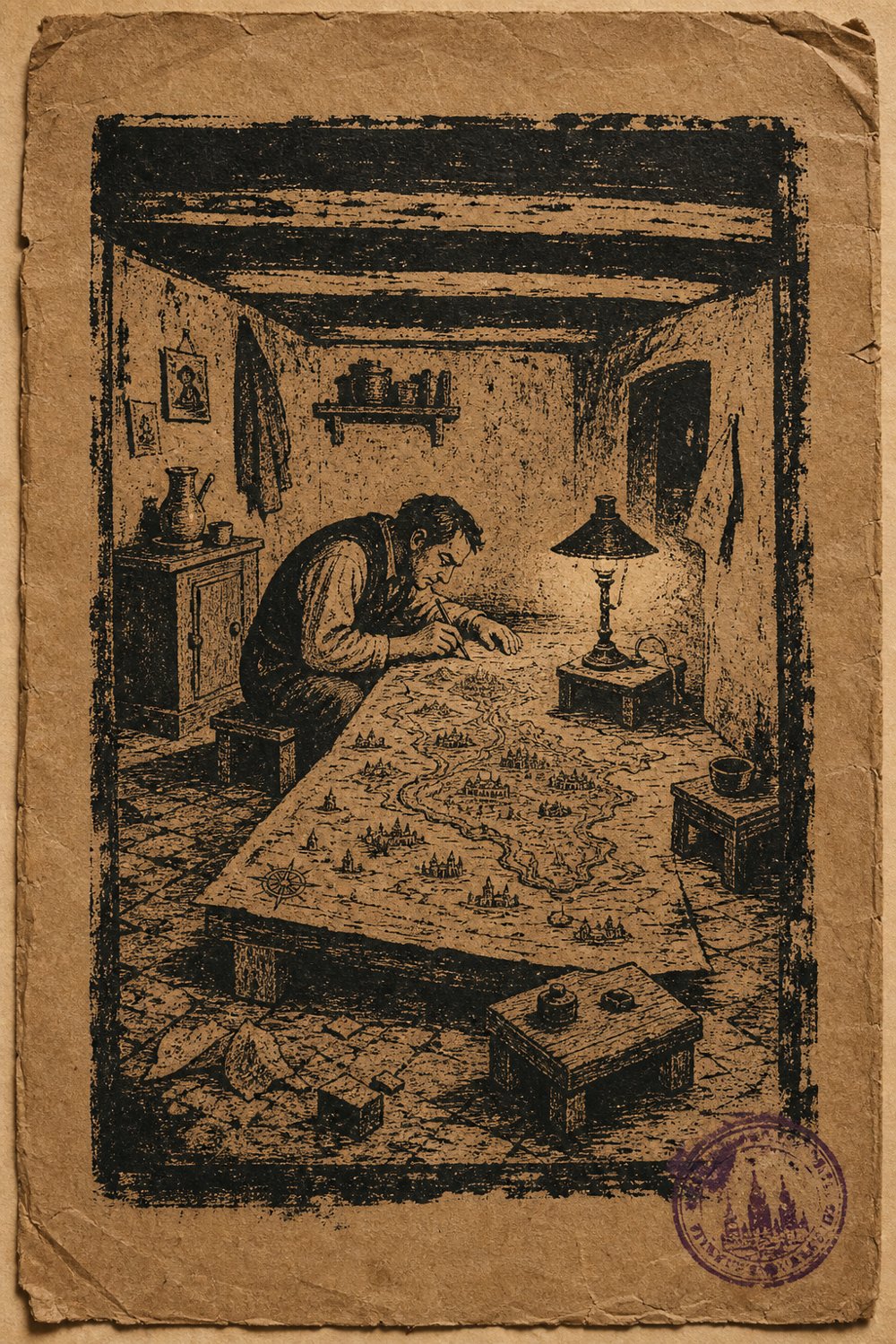
He does not go out. He has a low room with the shutters closed, at the back, off a yard, and he sits at a table in it, and he draws the realm from the air.
I want to be exact about what that means, because the pity in it is the wrong pity and people reach for it too fast: Silas Kite is the finest cartographer this realm has ever produced. Not sentimentally. Not "considering." His sheets are better than anything the Grand Cartographic Revision Committee has ever put its seal to, and every draughtsman in that office knows it, and two of them have said so in writing, and the Committee has never adopted a single one of his plates because he cannot certify a survey he did not conduct.
He saw it once. Entire, from above, in a single morning, at the one altitude nobody in this kingdom has ever had. And he remembers every inch of it, exactly, and cannot put it down.
So he puts it down instead, over and over, on paper.
There are four.
The first he drew the week he came out of the Slough. No compass, no border, no cartouche — nothing to hold it down. Just the thing itself as he saw it: the whole realm, the fen and the coast and the Sog going through it, and the eastern side going grey and stopping.
It is the truest of the four and everybody who has seen it says so. He will not have it in the room. It is kept, folded, at the Office, by a clerk who was told to burn it and did not.
The second has a compass rose. And a mileage note. And the smaller places named — Peatdike, Nettlewick, the withy stand — in a fine hand. Every mark of a proper survey, and not one of them measured. All of it off the inside of his own eye.
The third is the fortified copy: full cartouche, full key, a scale he knows to be a lie, arms, a dedication, and the Hem expedition dated 1895 — the year of the revision he happened to have to hand, the Committee having revised that report in 1894, 1895 and 1897 without once going back. It is the most official-looking map in the realm. He is not drawing what he saw any more, on that sheet. He is building a thing around it — because a map is official, and a map can be put in a drawer, and a memory cannot.
The fourth is the latest, and it is the one that frightens the draughtsmen. The key is gone. The apparatus is coming off. The arms, the dedication, the false scale — all gone. And the Hem expedition has moved back to 1893, the year it actually went, under Thaddeus Quill, before the Committee revised it three times.
The hand is finer than it has ever been. The scaffolding is falling away. And what is left underneath is more accurate than anything that office has ever filed.
Drudgeford has lost its middle. Nobody has corrected it. Nobody is going to.
The neighbours report muttering through the wall.
I have sat in that yard. It is not constant, and it is not raving, and it is not — this is the thing the taproom version always gets wrong, and it is why I stopped telling it there — it is not the muttering of a broken man. It is the ordinary undervoice of somebody working, the way a carpenter talks to a joint.
It is always the same sentence.
And here is the whole of this tale, and I will set it down plainly and then leave him alone:
Nobody has ever accused him.
Not one person. Not the Committee, which inspected the rope and minuted that the knot was correctly tied and sent him the minute. Not the men who fetched him out of the Slough. Not a single soul in nineteen years has suggested to Silas Kite that the fault was his — because it was not his, and the paperwork proves it, and the paperwork is on his own mantelpiece in an envelope he has never opened.
He is not defending himself against the office. The office agrees with him.
He is defending himself against the only accuser he has got, who is in the room with him, and who has heard the minute and does not accept it, and never will — and who is the same accuser most people are finally left alone with, and who is entirely deaf to evidence.
The Committee sends a boy round with paper and ink, quarterly. This is not charity and is not recorded as charity; it is on the establishment as materials, assistant surveyor, which is a small lie a kind clerk arranged in 1907 and which four subsequent clerks have declined to notice.
The boy is not to knock. He leaves it on the step.
Once, some years ago, a new boy knocked, not knowing, and the door opened — and Silas Kite stood there in a low room with the shutters closed, with the fourth sheet behind him on the table, and looked at the daylight for a moment, and then said, quite politely, that he had everything he needed, thank you, and shut the door.
The boy said afterwards that he had expected a wild man and found a tidy one, and that the room smelt of ink, and that over his shoulder he had seen, in the failing light, the most beautiful thing he had ever seen in his life.
Some people are given one great sight and then given nowhere to put it, and they will spend the rest of their lives setting it down beautifully, in a room with the shutters closed, arguing with the one accuser that no minute, no rope, no kind clerk and no evidence on earth has ever been able to acquit them in front of.