The Working World
The Working World
The Year
- A Roof Before the Rain — tale
- The Grinder's Round — tale
- The Year the Goose Didn't Come — tale
- The Silt Gate — comic
- The Lighting of Low Withern — tale
w01 · taleA Roof Before the Rain
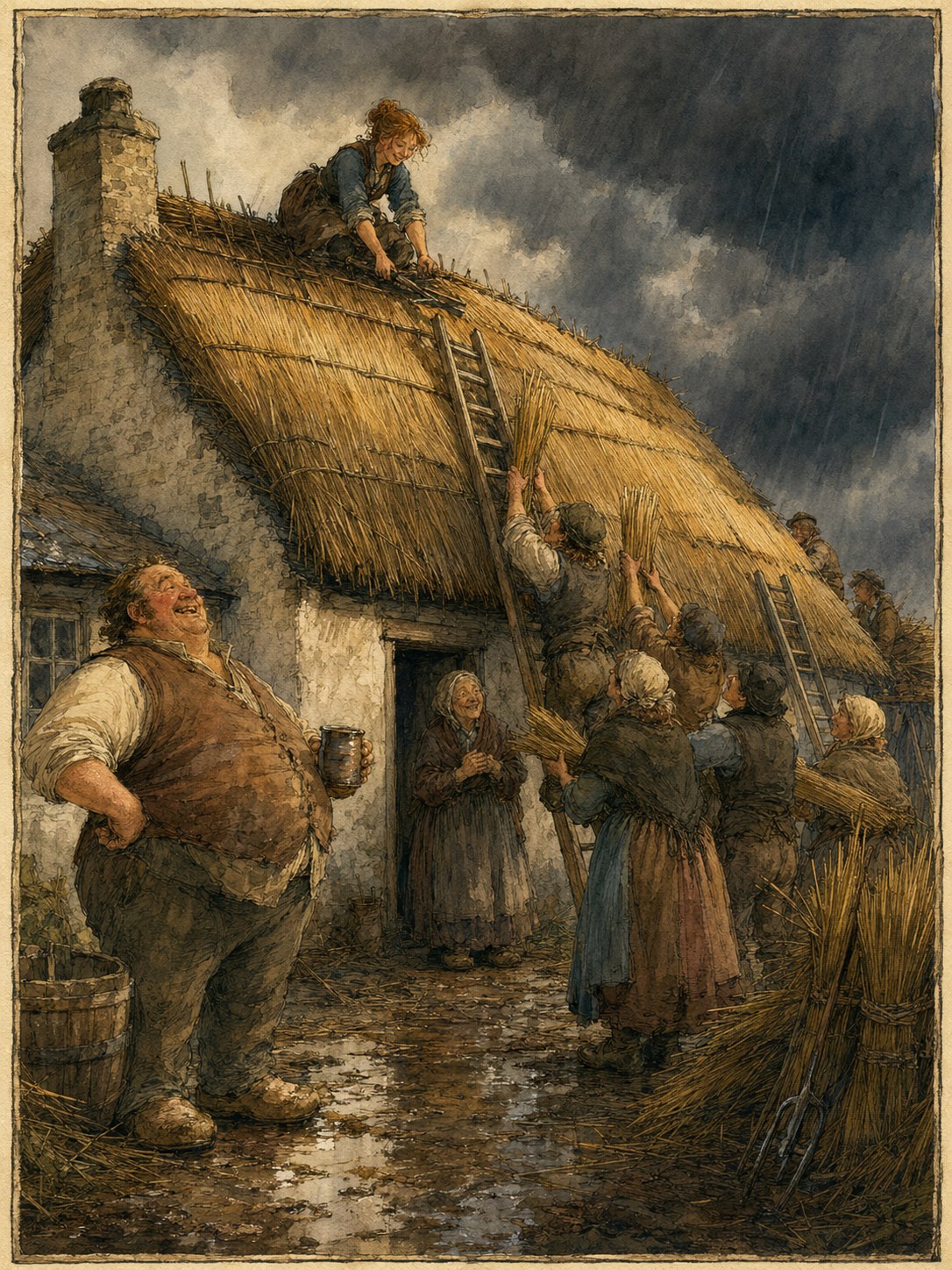
Hodge and Lettie were to be married at noon — in their own cottage, under their own roof, before the Loaf-priest and the whole reed-country — and in the small hours of that very morning the roof, which was old reed and had been old reed since Hodge's grandfather's day, gave up over the hearth, and let the night's rain in onto the very stone the two of them were to stand upon and be wed.
You cannot move a wedding in Sogmarsh. The priest is booked, the Loaf is baked, the guests are already poling and trudging in from three parishes, and the day is the day. Nor can you be wed in the wet, under a hole, with the rain coming down on your own hearth — not because it is unlucky, though it is, but because a couple who cannot keep the rain off their own heads on their wedding morning have made a start the reed-country will remember for forty years and mention at every christening after.
So the roof had to be re-reeded before noon. The sky — which the whole fen can read — said rain by mid-afternoon at the very latest. And the roofers of the reed-country were the Rennies; and there were three of them; and they had not agreed on how to lay a single course of reed since before the eldest of them was born.
They came at first light and went up on the ridge and looked at the roof, and did not lay one bundle, and began instead to argue.
"Butt down," said Gaffer Renny. "It's always been butt down. Butt down sheds the wet, and my father laid it butt down, and his father before—"
"Butt down holds the damp in the thatch, Gaffer," said Sim, who had learned the new way off a man from the coast. "Everyone past the Slough lays it tip down now."
"Everyone past the Slough," said Gaffer, "has a wet loft and a short life."
"You're both of you wrong," said Wat, "and if you'd let me dress the ridge my way—"
"We'll not have your way, Wat," said the other two, together, which was the only thing the three of them agreed on all morning.
And below, at the foot of the ladder, in her wedding dress, stood Lettie — watching three men argue on the bones of her roof with the sky greying behind them and not one course laid; and the first guests already arriving to find the bride so employed; and the reed itself sorted on the wet grass into its grades — roof reed, basket reed, and worthless stuffing reed — and a fresh argument breaking out over whether Wat had truly brought good roof-reed or fobbed them off with basket-reed and pocketed the difference, which is the argument the reed-country has with a reed-grader every day of the world.
The morning went. The guests gathered under the eaves out of the coming wet. The Loaf-priest came, and waited, and was given tea. The sky went from grey to slate. And still the three Rennies argued on the ridge, immovable, as men of a trade are immovable — while the wedding bore down on them from one side and the weather from the other, and the dry hour between shrank to nothing.
It was not the priest that ended it, nor the bride's face, nor the shrinking hour. It was a single fat drop of rain, which fell out of the slate sky and landed, precisely, on the back of Gaffer Renny's neck.
And the argument that no man could end ended in that one cold drop. The three Rennies looked up, and looked at each other, and said not one further word — and fell to it. And they laid that roof, all three, in the last stolen hour: Gaffer's butt-down at the eaves, Sim's tip-down up the long of the slope, Wat's own third way dressing the ridge — three men who could not agree on a single principle, thatching one roof together at a dead run because the rain was coming and the girl was in her dress; and it went up, course on course, far faster than any one of them could have laid it alone, and it was done — the last bundle pegged, the ridge dressed and combed — in the very moment the rain came down at last, in earnest, on a new roof that kept out every drop.
So Hodge and Lettie were wed at noon under the new reed, dry, with the rain drumming a benediction on it and the whole reed-country packed in below, and the three Rennies at the back with their tools still in their hands and the mud to their thighs, each of them privately and immovably certain that his own third of the roof was the only third that would not leak.
And here is the whole of it — the whole of Sogmarsh, in one roof. Where the three methods meet — where Gaffer's butt-down runs into Sim's tip-down, and both run up into Wat's ridge — that roof will always, a little, leak. Not much. A drip in a hard blow, into a pail Lettie will learn to set out without thinking, the way Mercy Crimp sets hers a hundred miles off. And every year Hodge will go up and patch the seam; and every year the three Rennies will come and argue whose third is failing; and it will be all three thirds and none of them; and the patching and the arguing will go on exactly as long as the roof does — which is to say as long as the marriage, which will be long.
Because a roof in Sogmarsh is never finished, and neither is a marriage, and neither is the realm. You do not get to lay it once and have done. You lay it; and it lets the wet in a little where the joins are; and you patch it, and you argue, and you keep each other dry one more year. That is the work. That is the whole of the work. And under it, if the reed is good and the company is better, you may yet be wed, and fed, and dry, and short of nothing at all at the turn.
w02 · taleThe Grinder's Round
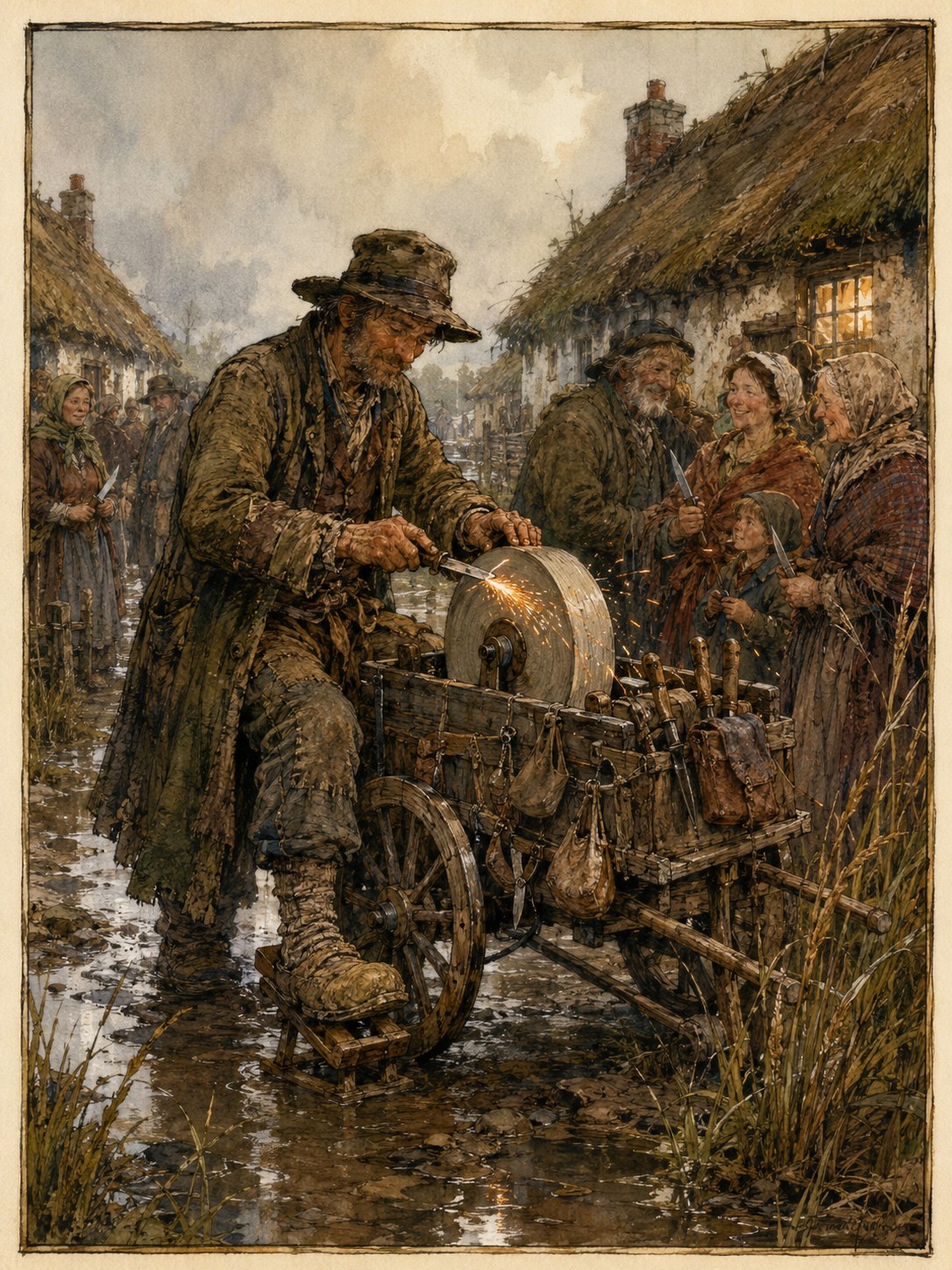
There is a man who belongs to no parish and is welcome in all of them, and his name, if he ever owned one, is long since worn down to his trade: Sparks the Grinder. He walks the whole circuit of the realm behind a barrow with a treadle-wheel on it, and where he stops he sets the wheel spinning and sharpens whatever the parish brings — knives, scythes, shears, eel-knives, the smokehouse blades, the boot-menders' awls — and while the wheel throws its little stars into the dusk, he takes in the news of that town and carries it on to the next.
In a realm with no roads worth the name and a Wireless made of string, he is one of the very few things that actually moves the whole length of Sogmarsh; and so he is its newspaper. He is not, however, an accurate one. For the grinder changes nothing he carries — he only carries it; and it is the towns that do the changing, each bending what he brings to the shape of its own dread, until a thing small and true at one end of his round is, by the other, a wonder.
Consider what became, over one turn of his wheel, of old Griggs and the quay.
At Saltgate, where it began, it was nothing much. Old Griggs — who weeps if you so much as move his boat to scrub it — stepped back off the quay at the Reckoning to admire it, and went straight in, and would have made a sorry end of eighty years had Marget Reek not put down her curing-knife and hooked him out of the harbour by the braces: alive, and streaming, and so furious at being saved that he did not speak to her for a week. Sparks sharpened the smokehouse blades that evening, had the whole of it from Marget herself, and carried it up the coast road.
By the time his wheel was turning in the yard of the Hand and Reed at Drudgeford, it had picked up a little weight, as things do on a road. "A man went in off Saltgate quay," Sparks reported, putting an edge on Mavis Grutch's carving-knife, "and was hauled out by his braces — and some say he'd have swum it, but for the ale." Mercy Crimp, mending by the fire, said only that a man of eighty had no business admiring anything he could fall off. Wren wrote it in the book under her loose board — which is the truest archive in Drudgeford, and already a little wrong.
At Mucklecombe, where Sparks ground the whole clan's scythes for the Long, the tale had grown a bone or two more. "A man drowned off the Cold Coast," Pa Muckle told it back to the grinder — having had it off the grinder not an hour before, and improved it in the telling — "clean drowned, and got back only by a hook through the heart. Lives yet, mind. But cannot abide the smell of a smokehouse since, for the memory of it." Sparks did not correct him. Sparks never corrects anyone. He sharpened the scythes, took his bread, and walked on into the wet.
And at Sodden Bottom, in the Drownings — where drowning is not a mishap but the dread, the oldest and nearest thing there is — the tale of old Griggs came at last into its full glory. Sparks set his wheel by the Skeel half-deck and sharpened the eel-knives, and Grandfer Skeel, from the warm corner, told the grinder the story the grinder had brought him, as gospel, as a thing everyone knew: "A man went under off Saltgate at the Reckoning. Went right under — and stopped. And walked out again on the far tide three days after, dry as a summer stone, and would not say one word of where he'd been. And they do say the smoke will not take to his fish." Dib and Dab believed every syllable, which is proper; they are children of the Drownings, and a man who walks out of the water is exactly the sort of thing they mean to grow up doing.
So the grinder carried old Griggs the length of the realm and turned him, mishap by mishap, into a miracle — and will carry the miracle round again next turn of the wheel, until it comes back at last to Saltgate as a stranger's marvel; and old Griggs, who is only wet and cross and eighty, will hear his own fall told back to him unrecognisable, and will not know it, and will shake his head, and say, "poor fellow," and mean it.
That is how the realm knows everything it knows: by the grinder, and by the string, and by each other — faithfully, and slowly, and wrong. Sparks grinds your knife true and your news false; and if you have understood Sogmarsh at all, you know that both of these are a kindness, and you pay him in bread, and you send him on.
w03 · taleThe Year the Goose Didn't Come
For as long as anyone could prove, the Goose Tournament had one certainty at its heart, and that was the Goose. You entered the Tournament — the running, the root-judging, the singing, the wrestling, the general contesting of a green in the Short — not to win, for you could not win; you entered to come second to the Goose. The Goose was undefeated. The Goose had always been undefeated. No soul in the memory of the realm had beaten the Goose at anything the Goose chose to be judged in, which was everything, for the Goose was entered by long custom in every event and placed first in all of them; and there was a rosette for the Goose, and a rosette for nobody, and nothing whatever in between. You went home second-best, and content — for to come second to the Goose was the natural and honourable condition of a person, and the Goose asked nothing of you but that you try, and fail, and try again next Short.
And then one year the Goose did not come.
Its coop, which was Mr Pottle's to keep — Pottle being the parish's most persistently employed incompetent, and Goosekeeper by the same logic that had made him a ferryman where there was no crossing — its coop, that Short, was simply empty. Nobody had seen the Goose die. Nobody had seen it leave. It was an old goose, granted, and geese do not last forever; but it was not there, and Pottle, who had fed it every day of his adult life and been bitten for his trouble, could only stand by the empty coop with the feed still in his hand and say that the Goose had, he supposed, gone. Whether it had died, or wandered, or simply won so completely and for so long that it had retired undefeated into legend, no one could say, and everyone, in the end, decided.
Here is what happened after.
Within a few short years the Goose was misremembered. The children were taught that the Goose had been enormous — ten feet at the shoulder, black-eyed, ferocious, a terror of the green. The old ones, who recalled a smallish, bad-tempered, entirely ordinary grey goose, said so, and were not believed; and the Goose grew in the telling, Short on Short, exactly as a man grows on the grinder's round, until the Goose the children feared and the Goose the elders remembered were plainly two different birds, and only one of them had ever existed.
It was commercialised, a little, as these things are: the press that prints the Frost Fair began to sell The Legendary Goose, fiercer and larger with each edition; and a man set up on the green selling rosettes to those who had come second to a Goose that was no longer there.
It was disputed by witnesses. For there is one man — everyone knows which — who holds, and has always held, that his grandfather once beat the Goose, at the singing, in a year he cannot quite fix; and he is universally disbelieved, and universally cherished, because a town needs exactly one man who claims the impossible thing, and defends him fiercely against the doubt of strangers while doubting him themselves.
And it was, in one respect, never repaired at all — which was the real trouble, and took the town a while to see. For without the Goose, the Tournament had no one to lose to. And that meant that the people of the green, for the first time in the memory of the realm, might have to compete with each other. And that the realm cannot bear. Because the whole quiet genius of the Goose had been this: the only one you ever competed with in Sogmarsh was yourself, and the Goose was the pleasant fiction that let you. You cannot beat the Goose; no one beats the Goose; therefore no one is beaten by his neighbour, and everyone is beaten only by the Goose — which is to say by the impossible, which is to say by no one at all — and goes home second, and fond of the whole green. Take the Goose away, and you are left with winners and losers, which is a Murkminster idea, and a cold one, and no way to spend a Short.
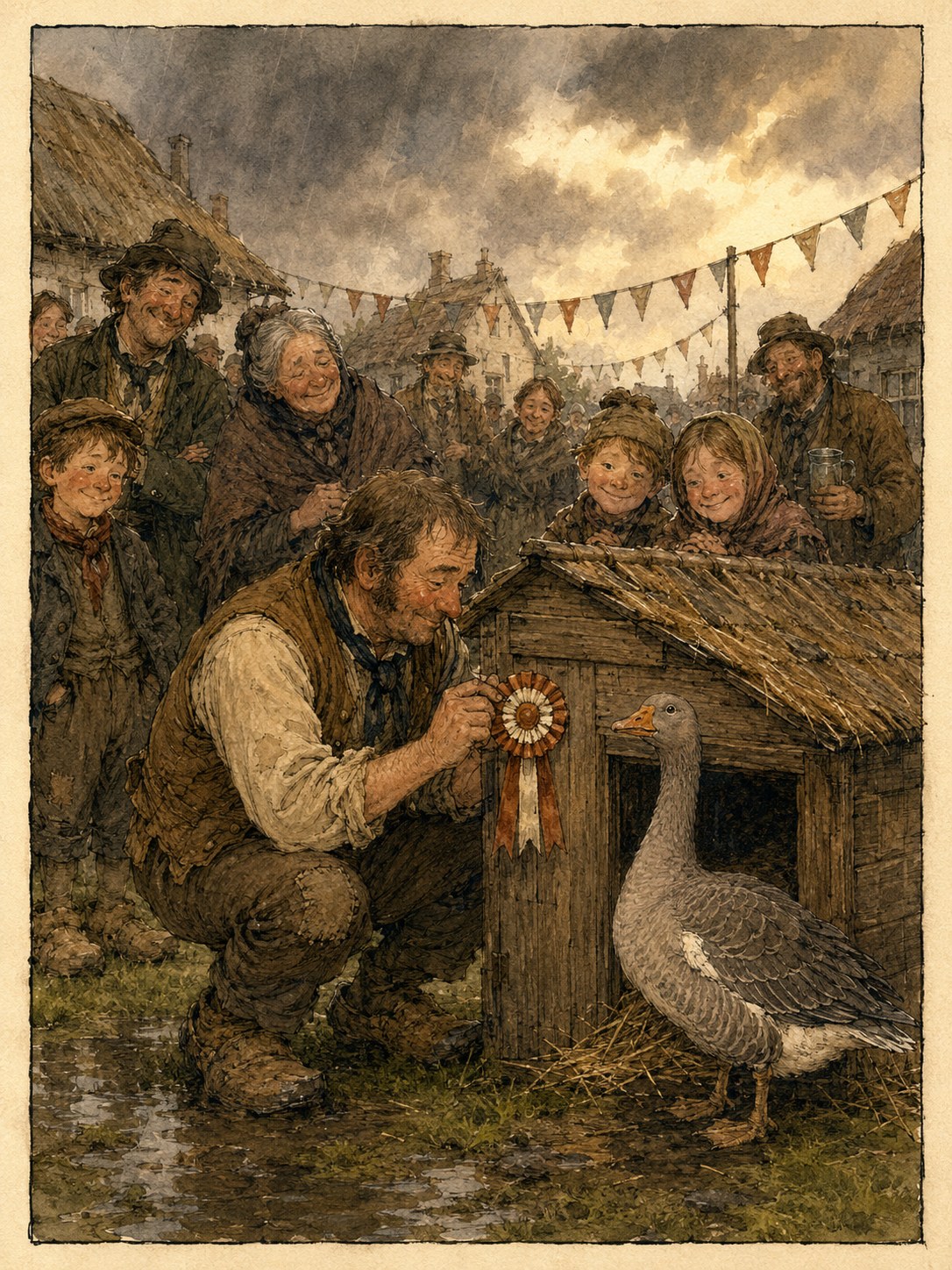
So the town did the only Sogmarsh thing. Without a meeting, without a vote, without a decision anyone could ever afterward point to, it kept the Goose. It was agreed — by no one, by everyone — that the Goose remained undefeated in perpetuity; that the first rosette was the Goose's forever; and that a new goose, a perfectly ordinary bad-tempered grey goose that somebody's aunt had going spare, would be quietly installed in Mr Pottle's coop as "the Goose." And no one — no one — admits it is a different goose. Because the Goose was never a goose. The Goose is a principle: the thing you cannot beat, that keeps you racing only against yourself; and it does not matter in the least which bad-tempered bird is standing in for the impossible this year.
And this Short, a small child ran the fastest a child has ever run on that green, and so nearly — so nearly — beat the Goose (the Goose being, after all, a goose, and slow) that Mr Pottle had to step it smartly across the line at the last; and the child was told, gravely, before the whole green, that they had come a magnificent second, the finest second in living memory — and given a rosette-for-nobody with the child's own name inked on the back, where the grown ones could not see — and went home glowing, and undefeated in spirit, and racing, ever after, against no one on earth but themselves.
Which is the whole of the point, and the whole of the kindness, and the whole of the realm. The Goose won for good, the year it didn't come — won by becoming, at last and openly, the principle it had always secretly been. The old man's grandfather still beat it once, in a year no one can fix. The prints grow fiercer. The children grow up racing themselves. And somewhere in Mr Pottle's coop a perfectly ordinary bad-tempered goose stands in for the impossible, and knows nothing of it, and bites the hand that feeds it; and Mr Pottle says "good Goose," and means it.
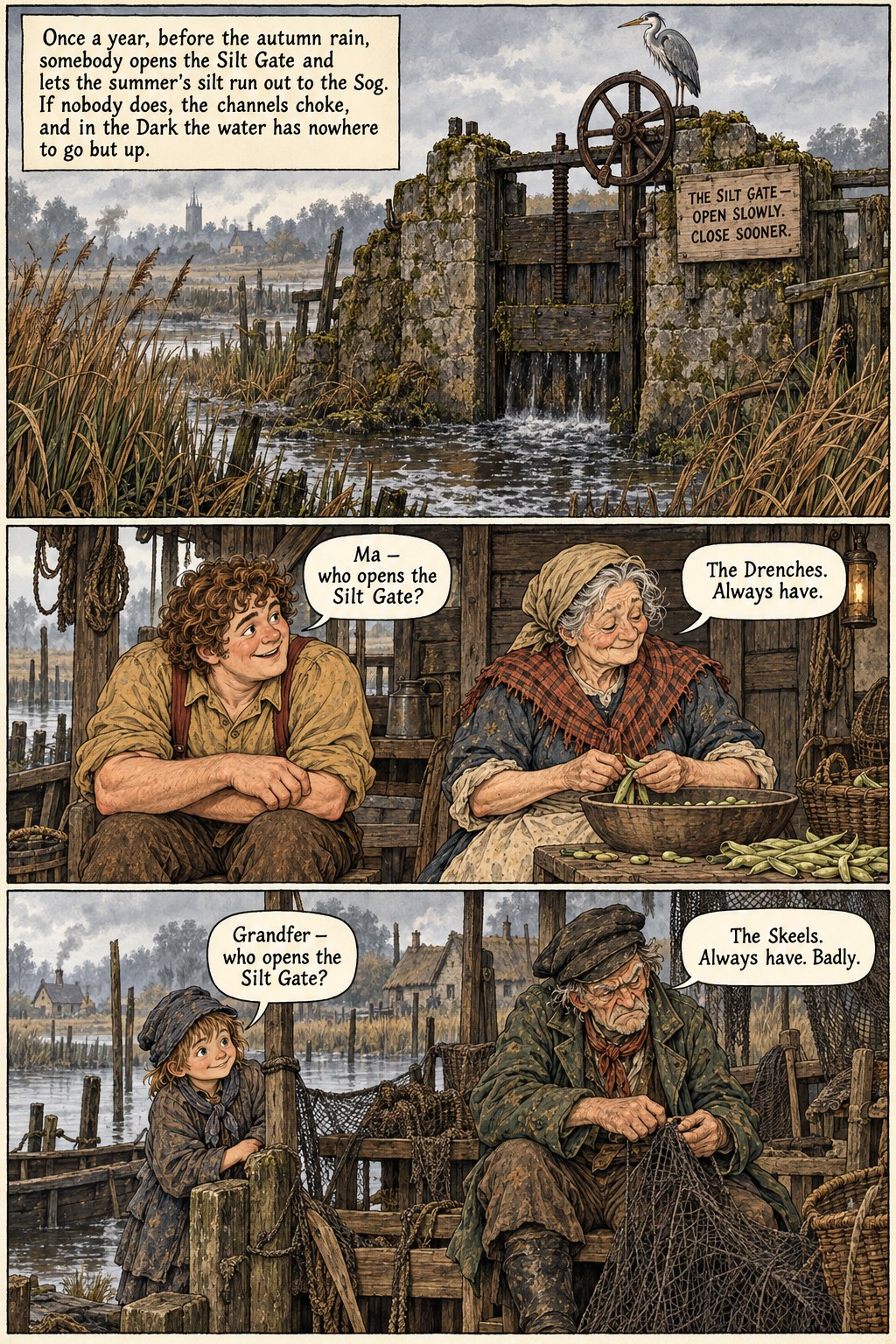
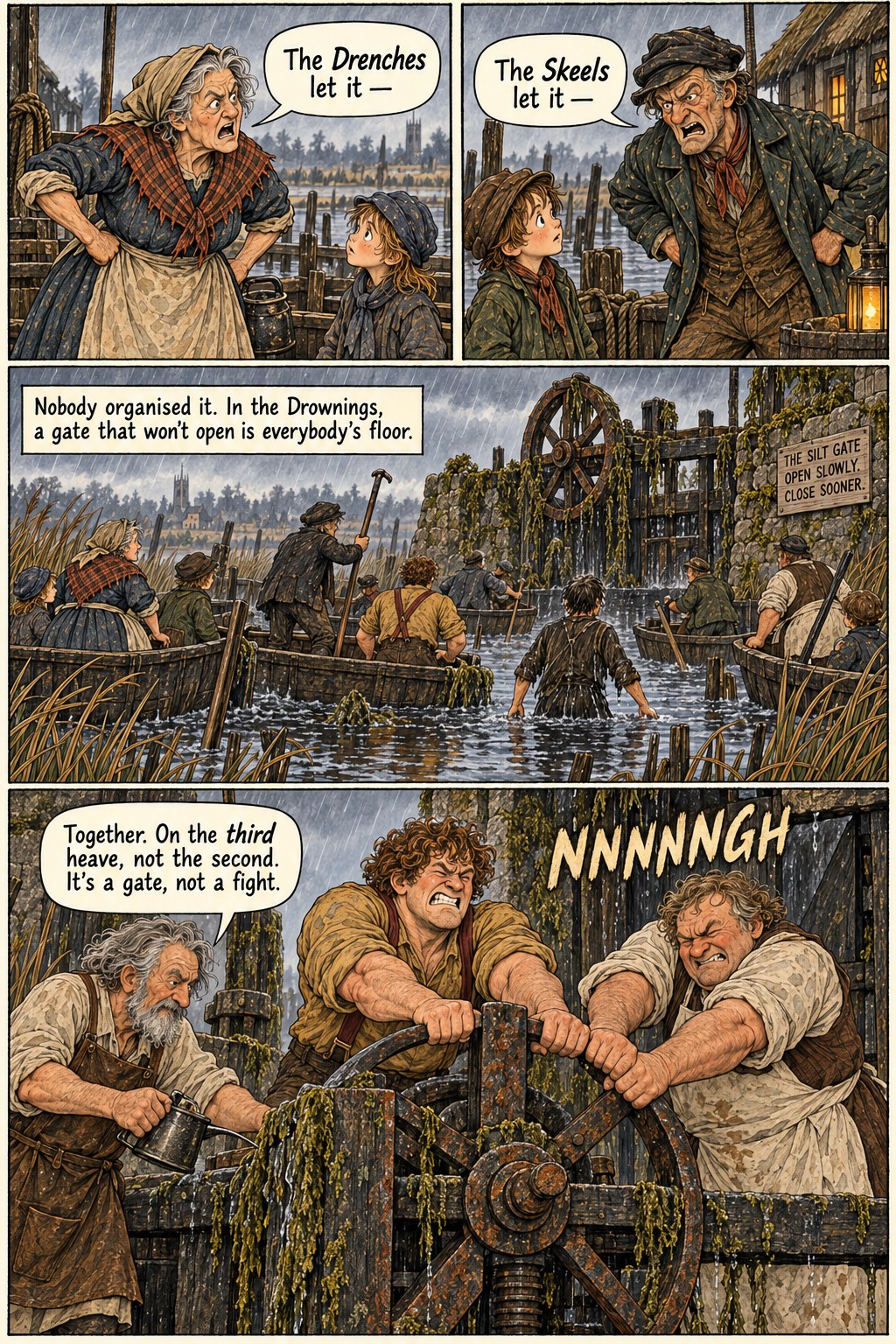
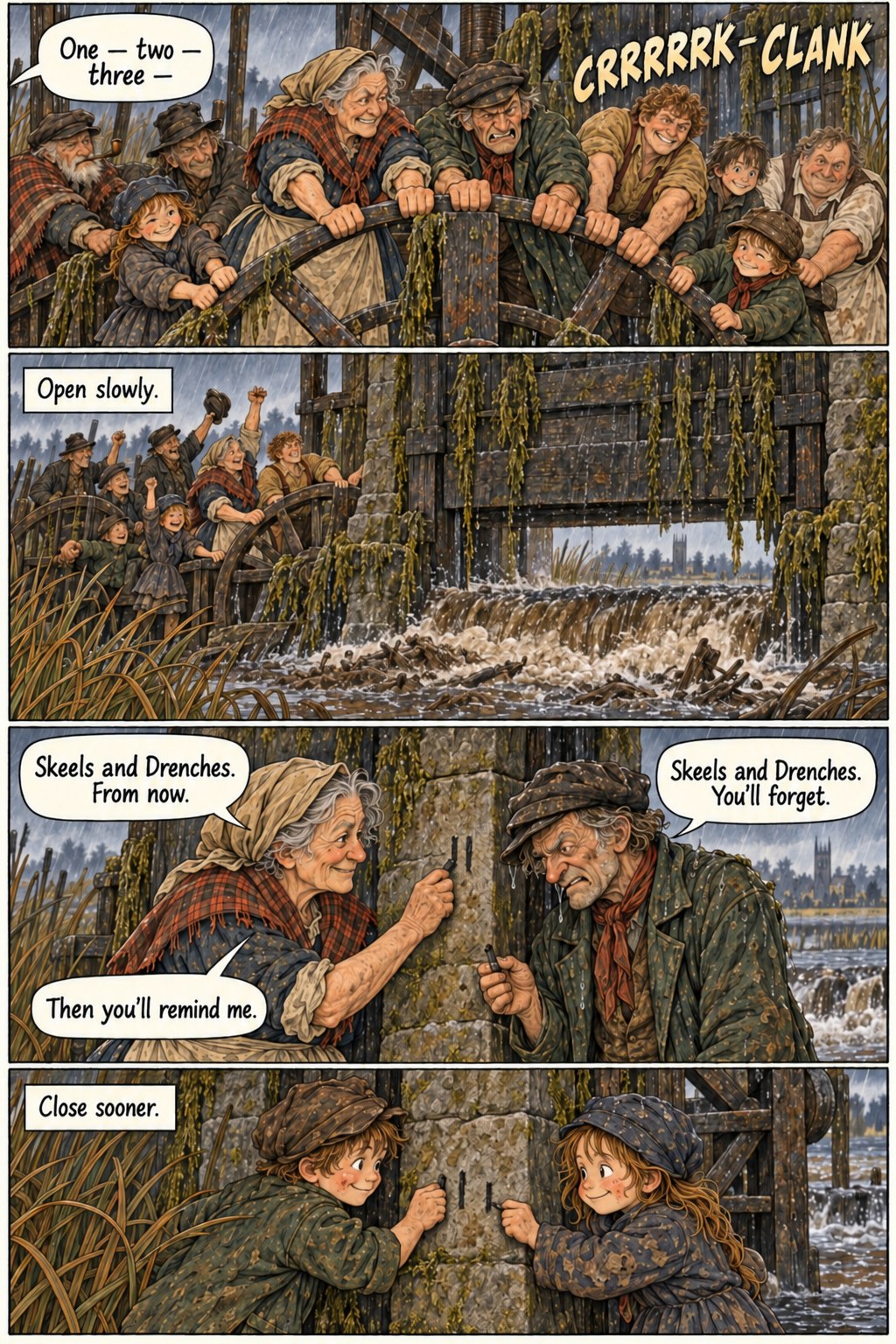
The Silt Gate


w05 · taleThe Lighting of Low Withern
Low Withern is the parish the realm goes to when it wants to know what really happened. Its people are the best witnesses in Sogmarsh — they notice everything, report it plainly, and add nothing — and it is from their accounts, taken down one winter and kept, that this is told.
What the parish saw first. A wheel.
Wat Sarn, the Drudgeford miller, keeps his mill on the Sog where the Low Withern lane comes down to the river, and lives in the mill-house over it. He had always had one waterwheel for his stones. That summer he built a second, smaller one, on the mill-race, and fixed to it a thing none of us had seen: a drum of copper wire as big as a cheese, in an iron case, with a short cord of wire run from it up through the floor into his own front room. We watched it being built for a month. Nobody asked what it was. You don't ask a miller his business; he'll only take a bigger toll off you for asking.
What the parish heard. That it was electric.
The word had come down the Sog from Murkminster, where there are said to be three or four such lamps in the great houses, and one in the Chancery, lit on feast days. There is one in Castle Bastable; everyone knows the story of that one and does not tell it at table. But there had never been one west of Drudgeford. And now there was to be one in Low Withern, in the miller's front window, because the miller had money — he takes his toll off every sack of grain in the parish, and has done for thirty years — and because the miller, it was generally agreed, wanted everybody to know it.
What happened on the night. The whole parish came.
Nobody was invited. The miller put up no notice. But on the evening of the first frost of the Short, when the lamp was to be lit, every soul in Low Withern happened to be passing the mill-house at dusk: the Fishers and the Coles, the smith and his boys, old Mother Pargeter carried in her chair, children on shoulders. It was cold. We stood in the lane with our breath going up and our hands in our sleeves and said we were only passing.
The miller came out on his step in his best coat. He did not make a speech. Wat Sarn is not a speech-making man; he is known to the parish for the miller's thumb and the miller's toll and the miller's grudge, and for not much else, and he stood on his step looking at us all with a face like a man who has been caught at something. Then he went in, and below, in the mill, his boy let the race run onto the little wheel, and we heard it begin to turn — a slow wet knocking, then faster — and a humming came up through the floor of the house, very faint, like bees in a wall.
What we saw. Light.
It came up in the miller's front window slowly, the colour of a coal going from dull to orange, and then it steadied, and it was light — not a candle's light, which moves, but a still, small, yellow, perfectly steady light, in a glass bulb no bigger than an egg, hung from the miller's ceiling on a cord. It lit the miller's front room: his table, his chair, his clock, a jug. It did not flicker. It did not smoke. The wind came down the lane and every candle-lantern in the crowd guttered, and the light in the miller's window did not so much as notice.
Mother Pargeter said, "Well." That is the whole of her account. Most of the parish's accounts are not much longer.
How long it lasted. Some while.
We stood and looked at it. Nobody said anything much. The children were lifted up to see. The smith, who understands iron, went to the window and looked for a long time at the glass egg and came back and said it was a very small fire in a very small bottle and he didn't see how it breathed. It was not bright. A good oil-lamp is brighter. But it was steady, and it was strange, and it was the first of its kind in the west of the realm, and we understood — all of us, without saying — that it was the miller's money we were looking at, made into light, and hung up in his window for us to see.
Then the frost came down harder, and the children began to cry with the cold, and one by one, the way a parish does, we went home.
What we did at home. Lit the candles.
That is all. We went home to our own houses along the dark lane and lit our own candles and our own rush-lights and our own fires, the way we always have; and the light was yellow and it moved and it smoked and it was ours. And from most of the houses in Low Withern, if you went upstairs, you could see down the lane to the mill-house window, and the little steady egg of light burning on in it, all night, and the miller sitting under it at his table on his own.
What the parish noticed next morning. That he had sat there till dawn.
The Coles' boy, who was up in the night with the colic, saw it. The miller sat under his light the whole night through, not reading, not working, just sitting at his table in the steady yellow, alone, in the only electric light for twenty miles, with his hands in front of him. And when the light went out at dawn — the race ran low, and the little wheel slowed — the Coles' boy saw him get up and put his head in his hands.
What the parish did. It is recorded here plainly, as it was done.
Nobody arranged it. That is the Low Withern way. But on the next evening, at dusk, the Fishers came down the lane to the mill carrying their supper in a pot, and knocked at the mill-house. And the Coles came after them with a loaf. And the smith brought his boys and a jug. And old Mother Pargeter was carried down in her chair with her knitting. And by dark the miller's front room, which had never had more than the miller in it, was full of Low Withern: eating its suppers off its knees, arguing, knitting, the children under the table, under the miller's electric light.
The miller stood in his own doorway for a long while with his mouth open.
Then he said — Mrs Fisher reports it word for word — "You'll want to mind the cord. It's hot."
And then he fetched the chairs.
What has happened since. The parish has continued to take its supper at the mill on the evenings of the Short.
Not every evening. You'd not want to take advantage. But often. The light is not bright to read by and it goes out when the race runs low, and the parish has not taken to electricity and has no plans to; we go home to our candles, and we like them. But the miller's toll, this last year, has been — it is noted in the Fishers' account, and in the Coles', and in the smith's — somewhat less than it was. Nobody has mentioned this to the miller. He has not mentioned it to anyone.
And the lamp in the mill window is, by general agreement, the finest thing in the west of the realm; not for the light, which is poor, but because it is the one place in Low Withern where, all through the Short, you can be sure of finding somebody in.
Witnessed. Set down plain. Nothing added.