A Year in the Drownings
A Year in the Drownings
The Year
- The Spring Rise — tale
- The Kindest Arithmetic — comic
- The Deepest Dark — tale
- The Day the Drowned Rat Ran Aground — comic
- The Quarantine Hut — tale
- The Lost Boat — tale
- An Hour Late — tale
e01 · taleThe Spring Rise
When the Light comes to the Drownings it comes as water. Up in the dry countries the Light is a lengthening of the days and a greening of the hedges; at Sodden Bottom it is the melt of the whole realm coming down at once, and the mark on the third stilt climbing, day on day, until the morning it stands a hand above the boards and Ma Skeel says, without turning from the fire, "Floor goes up today" — and the year has begun.
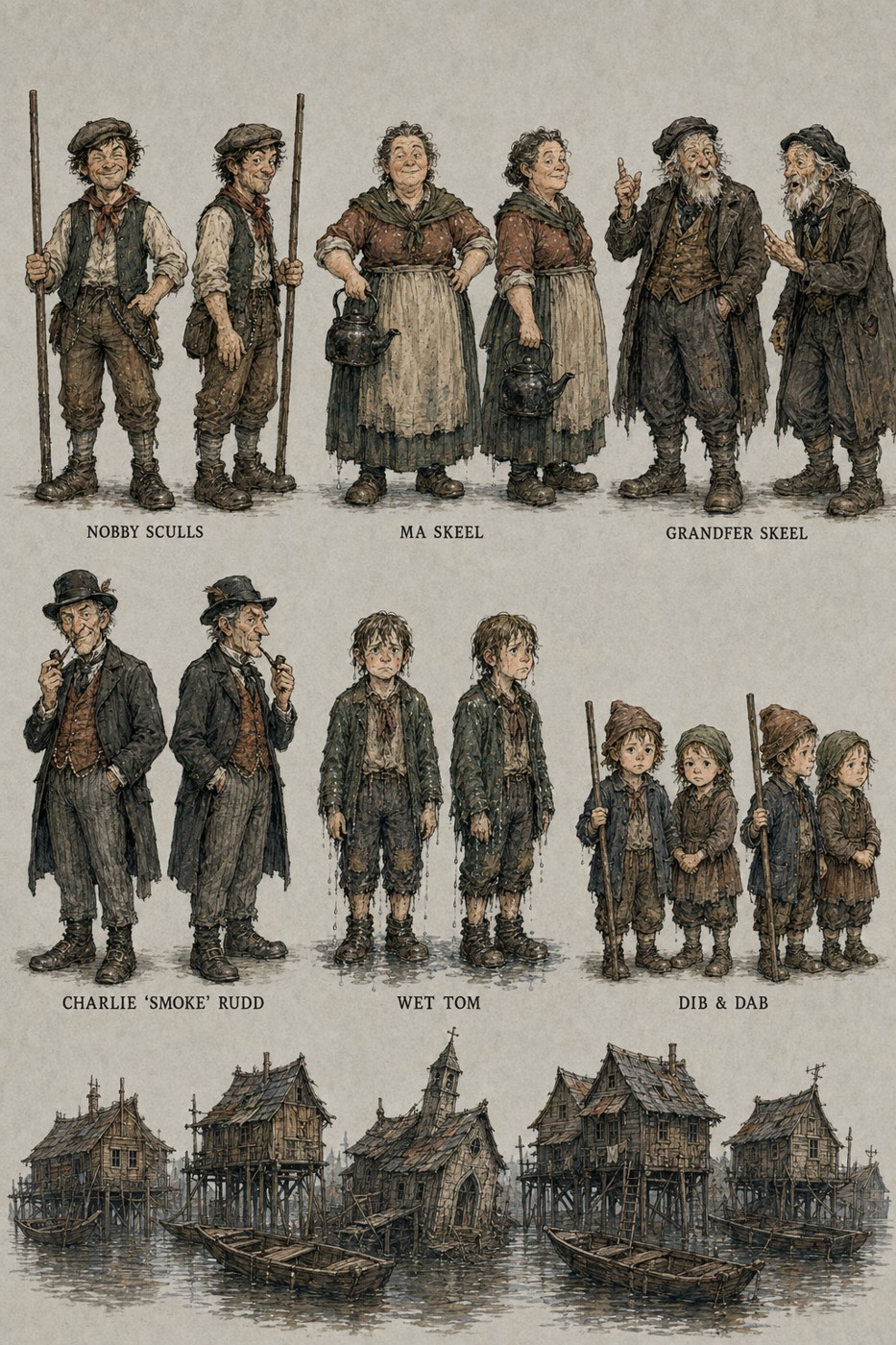
Grandfer Skeel, from the warm corner, declares that this will be the last time. The water has very nearly stopped; he can feel it in the stilt, he says, a slackening. He has felt it slacken every spring for sixty years. Smoke Rudd — who came up out of the city long enough ago that only his vowels still remember it — allows that in that case they had best raise the floor one final time, just to be sure, and heaves himself up off the bench with the groan of a man who has agreed to a great many final times.
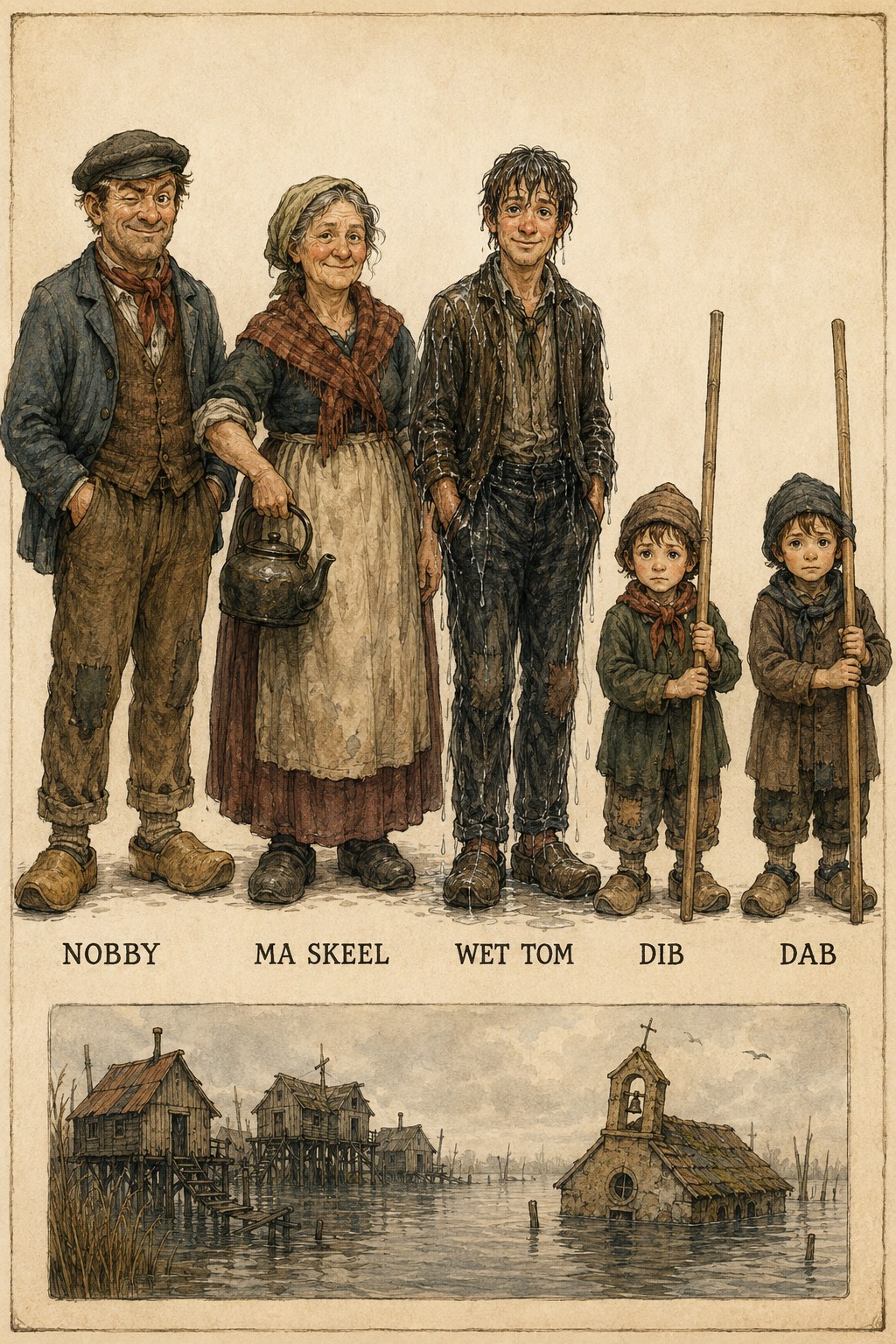
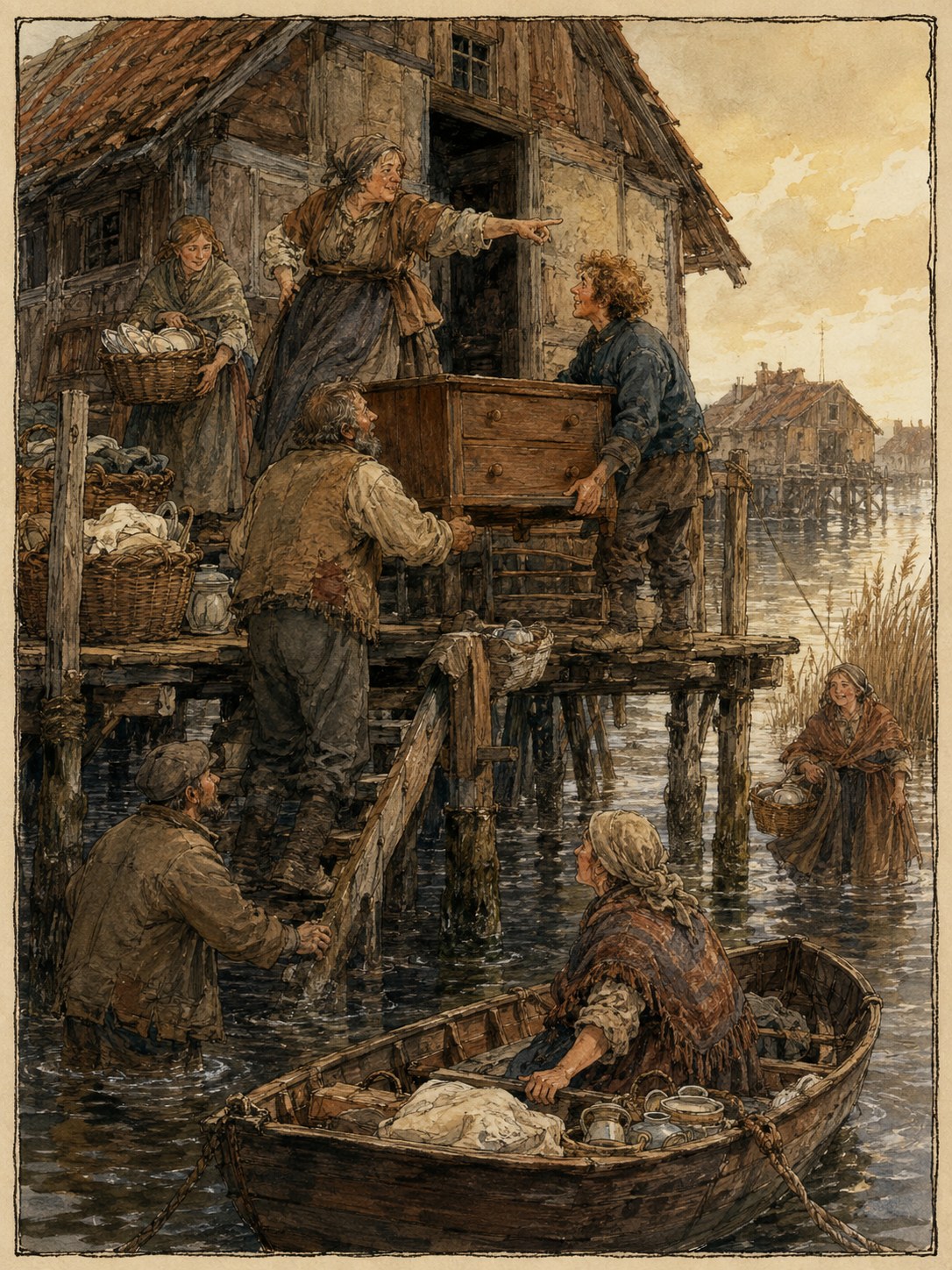
It is not a Skeel job. It is a village job, and no one is sent for. By the time Wet Tom has the trestles braced, boats are already poling in out of the murk — the neighbours, unasked, unthanked, poling over the flooded lane that is the only road they have — because in the Drownings no floor is short at the turn, the way at Saltgate no boat is short and at Drudgeford no tab uncleared: the same old creed, poled here from stilt to stilt. Curly and the men take the weight; Dib and Dab pass the pegs, poling between the stilts with the pegs held in their teeth, too small yet to lift and too Drownings to be idle. And the whole floor comes up, six inches, onto fresh blocks — the furniture walking up the room after it, the fire relaid higher, the good weather-glass rehung a hand nearer the sky.
Everyone raising that floor knows the mark will stand a hand higher next Light, and the Light after that, and that a village cannot out-raise a sea. Nobody says it. It is the plainest fact at Sodden Bottom and the one thing never spoken aloud, because to say it would be to make it a grief, and the Drownings has decided, collectively and without discussion, that it will go under without ever once making a grief of it.
Grandfer says the opposite, loudly, all the day long — she's stopping, I tell you, feel it, this is the last raising we'll ever do — and the young ones half believe him, and lift with light hearts, and that is exactly why he says it. A man of ninety spends his certainty on the children the way another man spends coin: so they may carry the pegs and laugh and not yet feel the weight of the water. Ma Skeel lets him spend it. Ma Skeel raised this floor the first time as a bride, and will raise it a last time as whatever it is she is now, and made her peace long ago with a home that goes down an inch a year and holds its head up the whole way.
The only fright of the day is a new neighbour's. Halfway through the lift the drowned-chapel bell tolls out over the water, and the young man — lately come to the parish, not yet broken in — hears it and goes white and lunges for his boat, certain it is a warning, a surge, the water coming to take them all; and he half tips the raised floor in his scramble. And the village, without hurry, sets him right: steady, lad. That's only the chapel. That bell's told the hour an hour wrong since before any of us, and always will. A bell you can trust to be wrong the same way every day is as good as one that's right. Now — lift. And the false alarm is folded into the work like everything else, and the floor goes up.
By dusk it stands. Life is exactly as it was, six inches nearer the sky. The neighbours pole home into the murk, called across by children who count them off the way children here count everything, and Ma Skeel sets the kettle on the new-high floor. Grandfer settles into the warm corner at its fresh height and looks out through the black window at the mark on the third stilt.
"There," he says, satisfied. "She'll stop now."
And the water, which will not stop, laps the third stilt in the dark, patient as it has always been. And the house above it is warm, and lit, and dry, and entirely unhurried — and that, not the winning, which was never on offer, is the whole art of the Drownings.
The Kindest Arithmetic
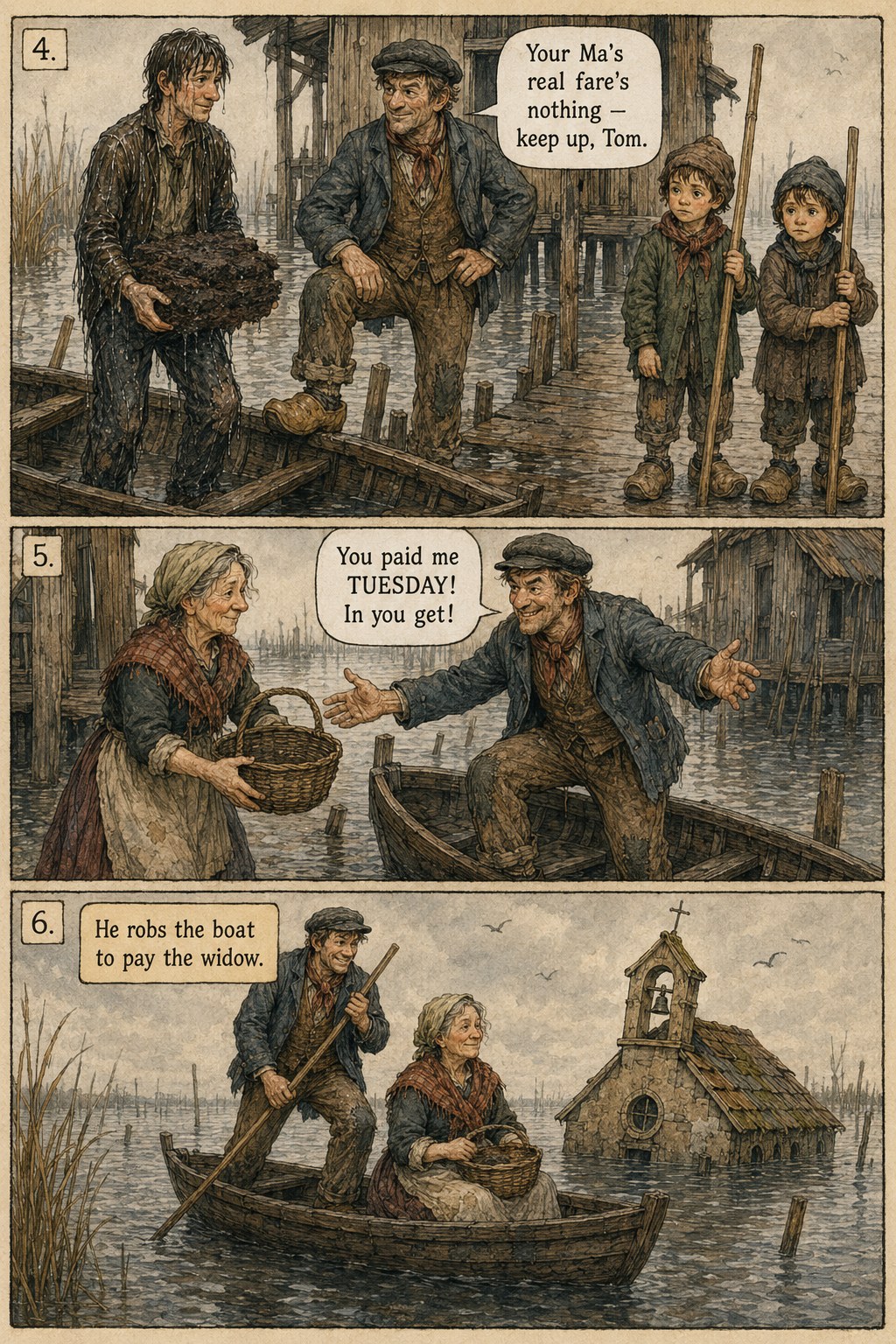
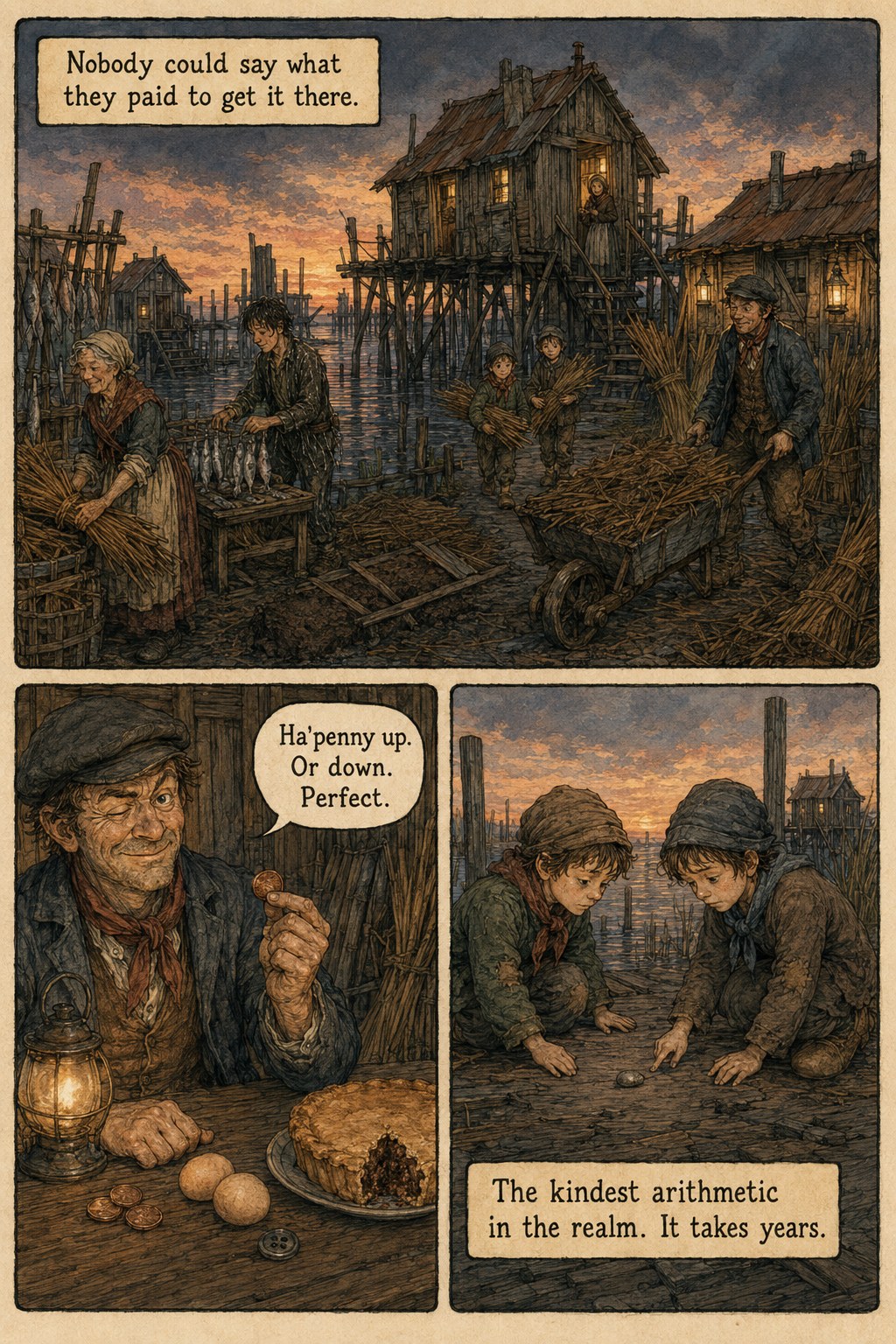
e03 · taleThe Deepest Dark
The Light had brought a hopeful flood — the melt, the first raising, Grandfer certain it would stop this time. The Dark brought the other kind. The rains came down off the whole realm at once and did not let up, and the mark on the third stilt, which climbs a hand in a year, climbed a hand in a night, and then another; and by the deep of the Dark it stood higher than any Skeel living had seen it — higher than the notch cut for Ma Skeel's own grandmother, higher than the worst bad year in the whole long slow argument between the village and the water.
Ma Skeel raised the floor a fifth time. She did it the way she does everything: without discussion, in the worst of it, by lamplight, the furniture walking up the room after the boards, the fire relaid higher, the good weather-glass rehung a hand nearer the roof than it had ever hung. And the village came — poling through the black in the driving wet, unasked — to raise it with her, because no floor is short at the turn, even now, especially now; and the Skeel house held.
But not every house held. The lowest house in Sodden Bottom was old Tobit Beake's, down at the drowned-chapel end, where the water always comes first and worst; and old Beake's floor had been raised as high as its stilts would bear, and could be raised no higher, and this Dark, at the last, the water came up over it and did not go back, and stayed, and the house was the water's.
Nobody made a fuss. That is the thing about the Drownings; that is the whole of the thing. They did not cry out that it was a tragedy, though it was. They did not rail at the water, which does not hear. They did what the village has always done when the water finally keeps a house: they poled to old Beake's in the worst of the night, and they took him — and his chair, and his kettle, and the tin of his few treasures, and the weather-glass his father had hung — and they poled him up through the flood to the Skeel house, where Ma had already, without being asked, without a word, set a place at the new-high fire and made up a bed on the raised floor. Because she had known, the way they all knew, the way nobody said, which house would go this Dark; and she had made it ready.
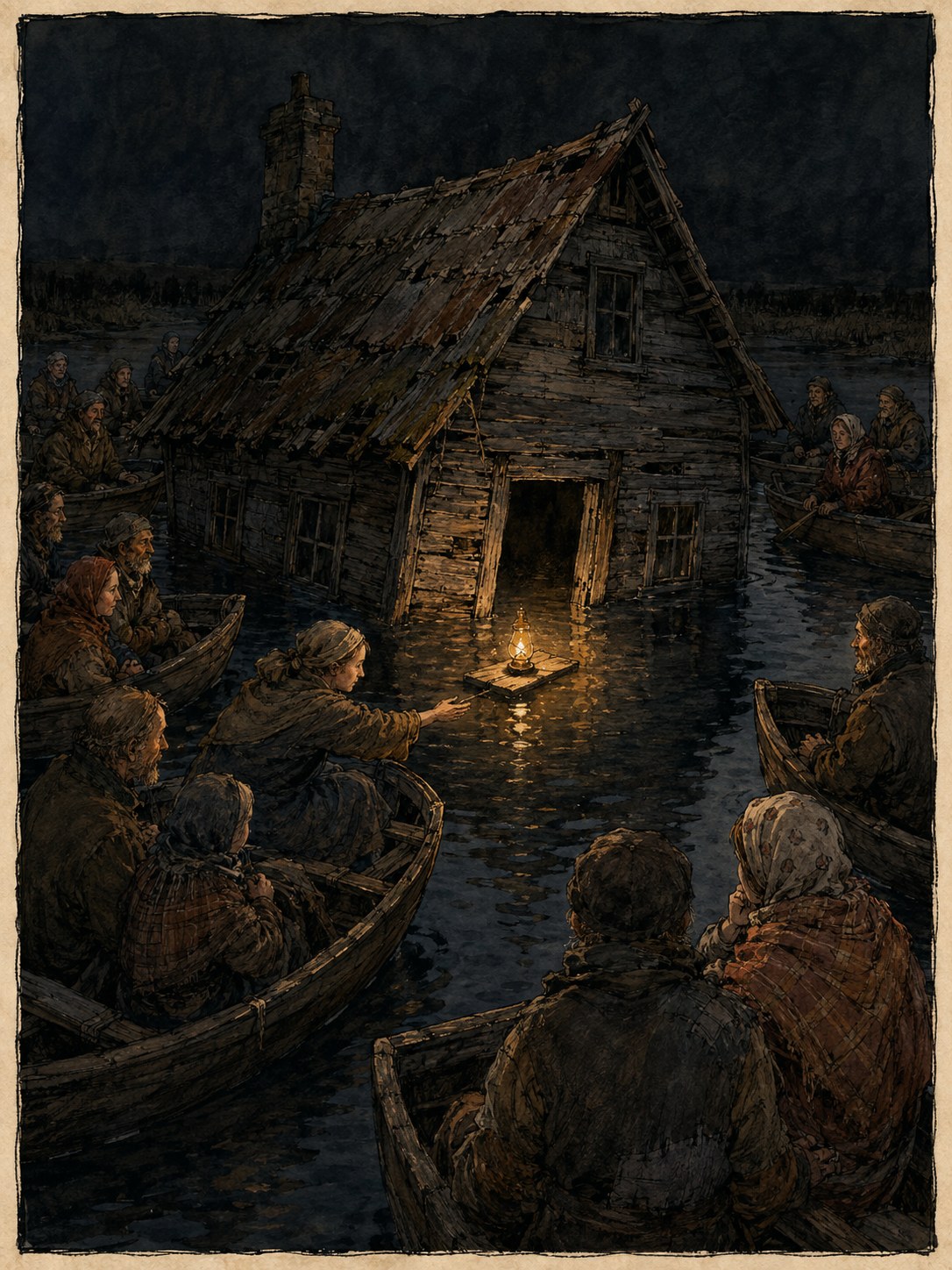
And old Beake sat by the Skeel fire, dry, and warm, and taken in, and looked back through the black window at his own house going under — the last lamp still lit in it. For they had left a lamp burning in it, the village had, on purpose: a lamp set in the window of the drowning house and let go, floating its small light on the rising water for as long as it would burn. It is the nearest thing the Drownings keeps to a funeral, and the kindest thing in the realm: you do not put a lost house out. You let its light go under still burning, so that the last of it the water takes is warm.
And through all of it the drowned-chapel bell tolled its wrong hour — an hour off, as it is always an hour off — and nobody corrected it; and its being so reliably, so faithfully wrong was, that night more than any other, a comfort: a thing that does not change, ringing steady over a village that is losing, an inch and a house at a time, everything that does.
Here is the thing they all knew, in that crowded warm room, and not one of them said. They knew what old Beake's house meant. They knew the water had taken a hand this Dark and would take another; that the notch climbs and does not fall; that a village cannot out-raise a sea; and that one Dark — not this one, not soon, but one — the water will come up over the last and highest floor in all of Sodden Bottom, and there will be no higher house left to pole to. They knew it the way a person knows their own death: certainly, and without saying so, and while putting the kettle on. Ma Skeel put the kettle on the new-high floor. There was tea.
It was Dab who asked — the way only the smallest can ask — watching old Beake's lamp go small and gold and finally out on the black water: whether their house would go under too, one day. And Ma Skeel, who does not lie to a child and does not frighten one either, gave the truest answer there is at Sodden Bottom. "One day," she said. "But not tonight. Tonight we're dry, and we're warm, and old Beake's got his own chair by our fire, and the kettle's on. We do tonight, child. And tomorrow, if it wants raising, we raise the floor again." And Dab was satisfied — because a child of the Drownings learns early that not tonight is the whole of the good news there is, and quite enough to be going on with — and went to sleep on the raised floor to the sound of the wrong bell and the right rain, with the whole warm crowded losing village breathing around her in the dark.
And the Deepest Dark went by the way the deepest dark always goes by at Sodden Bottom: a house the poorer, a hearth the fuller, a lamp let go under still lit, and the whole village keeping one another warm above a water that will, in the very end, have all of it — and cannot, for the life of it, have a single one of them tonight. That is the last thing the water teaches, and the first, and the whole art of the place: you cannot win. You can only go under warm, and together, and unhurried, with the kettle on, and refuse — to the very last floor, and past it — to make a grief of it.
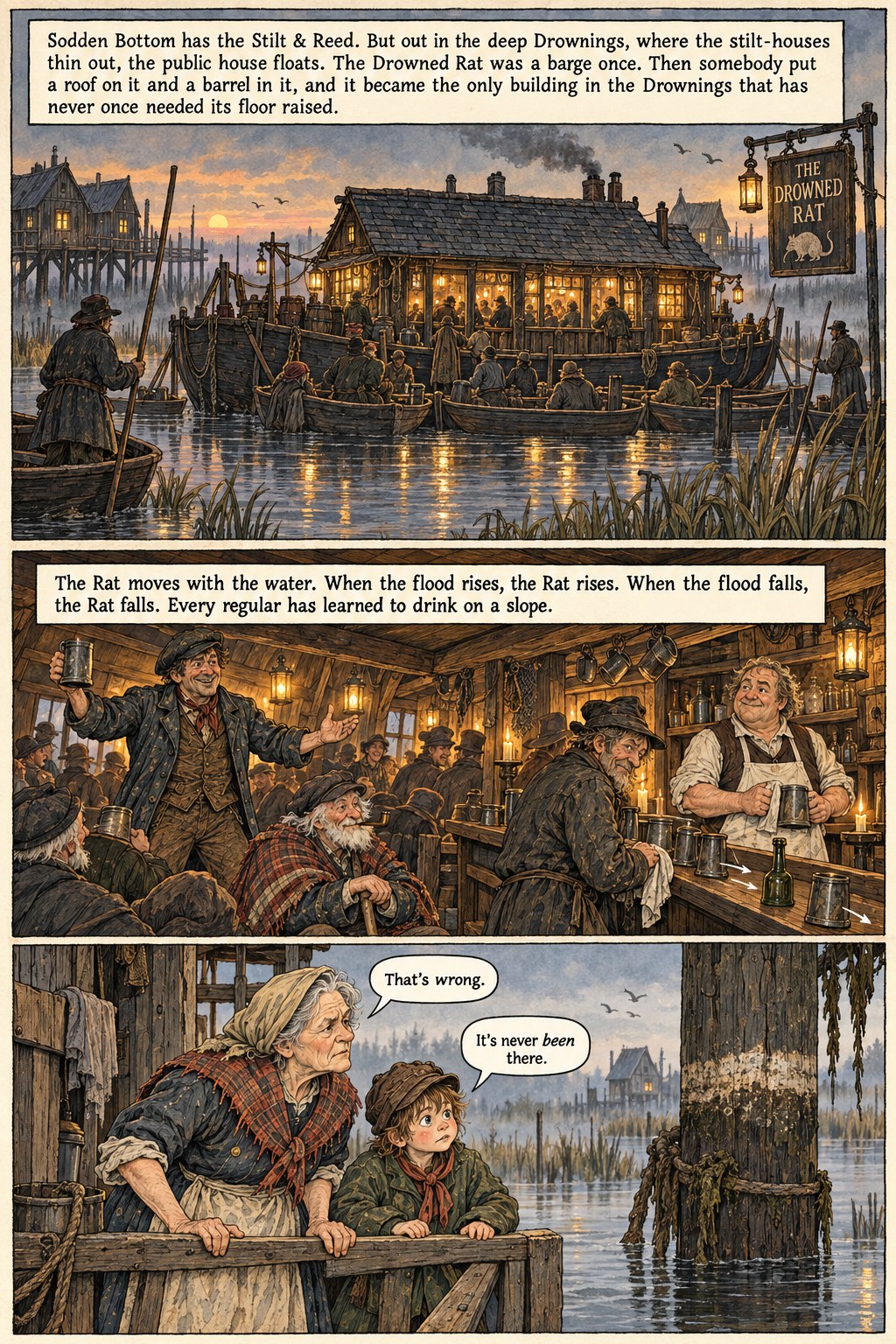
The Day the Drowned Rat Ran Aground
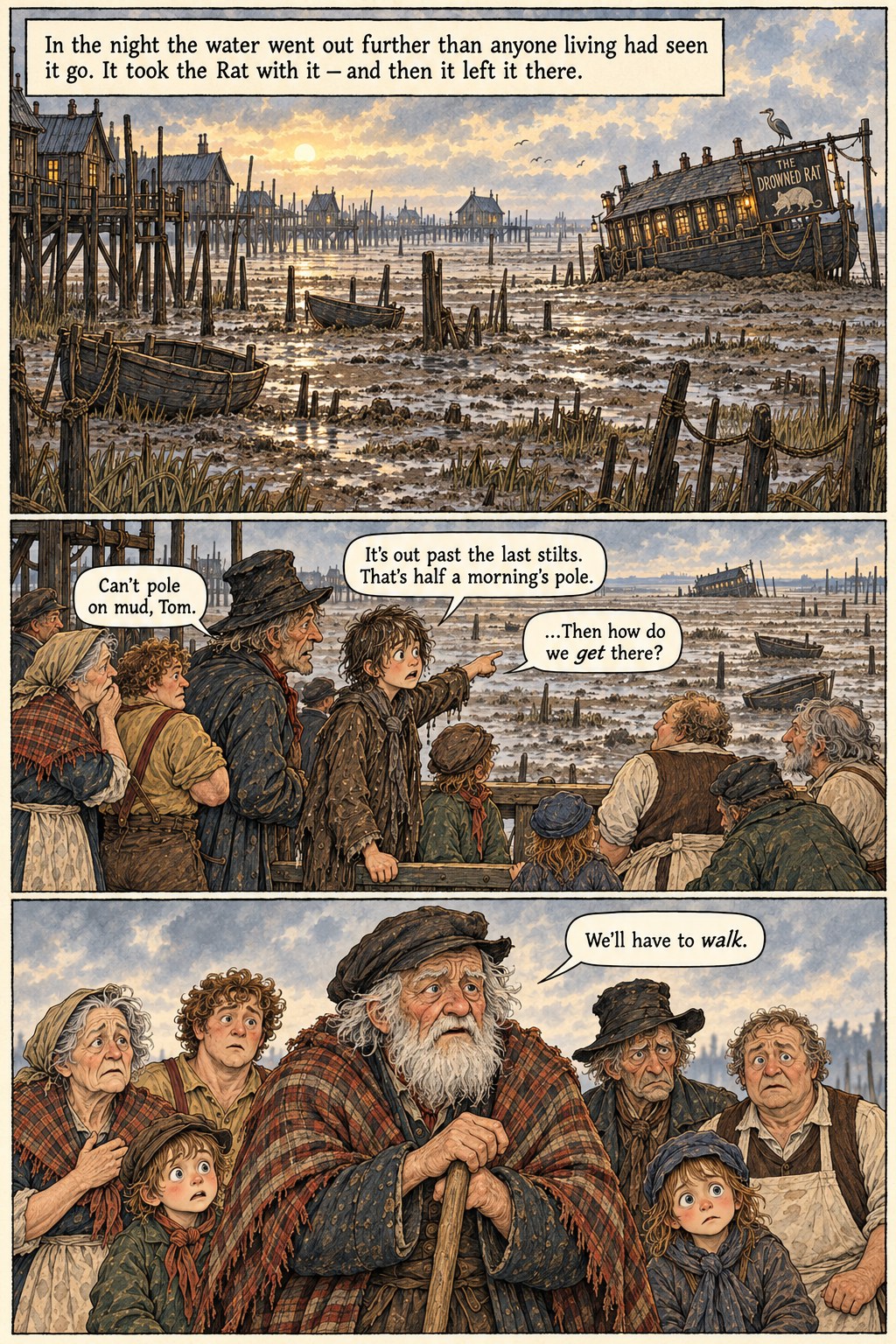
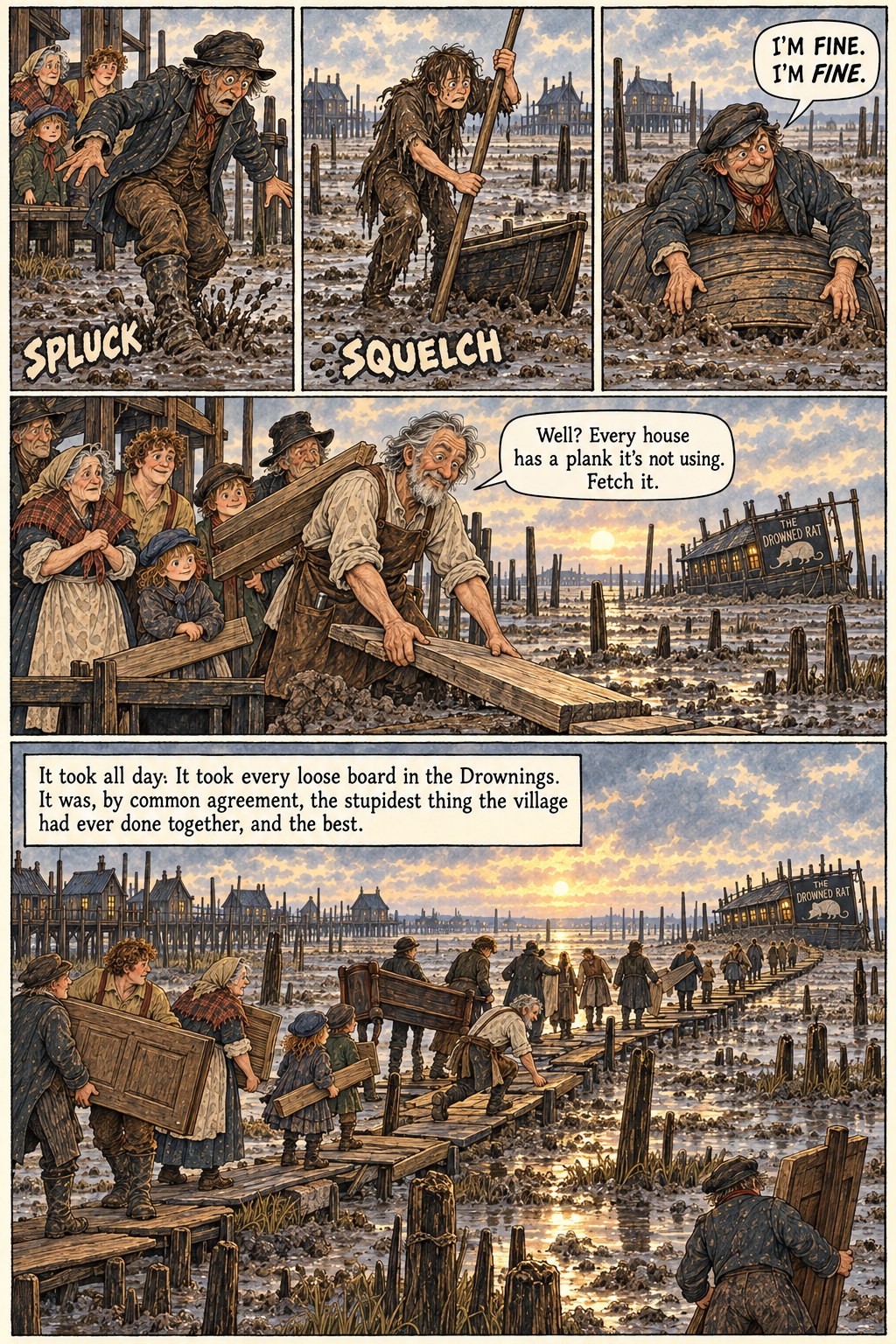
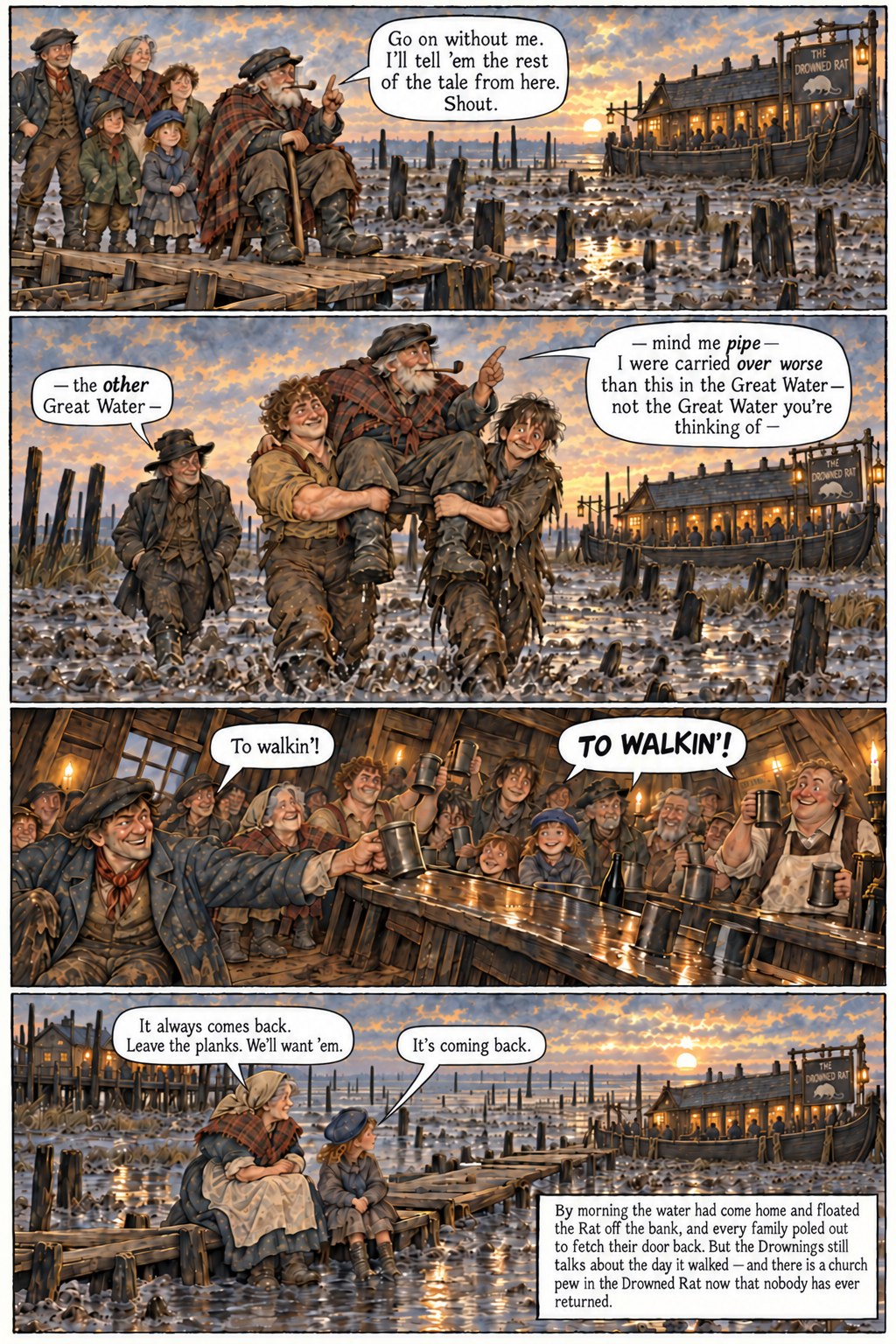
e05 · taleThe Quarantine Hut
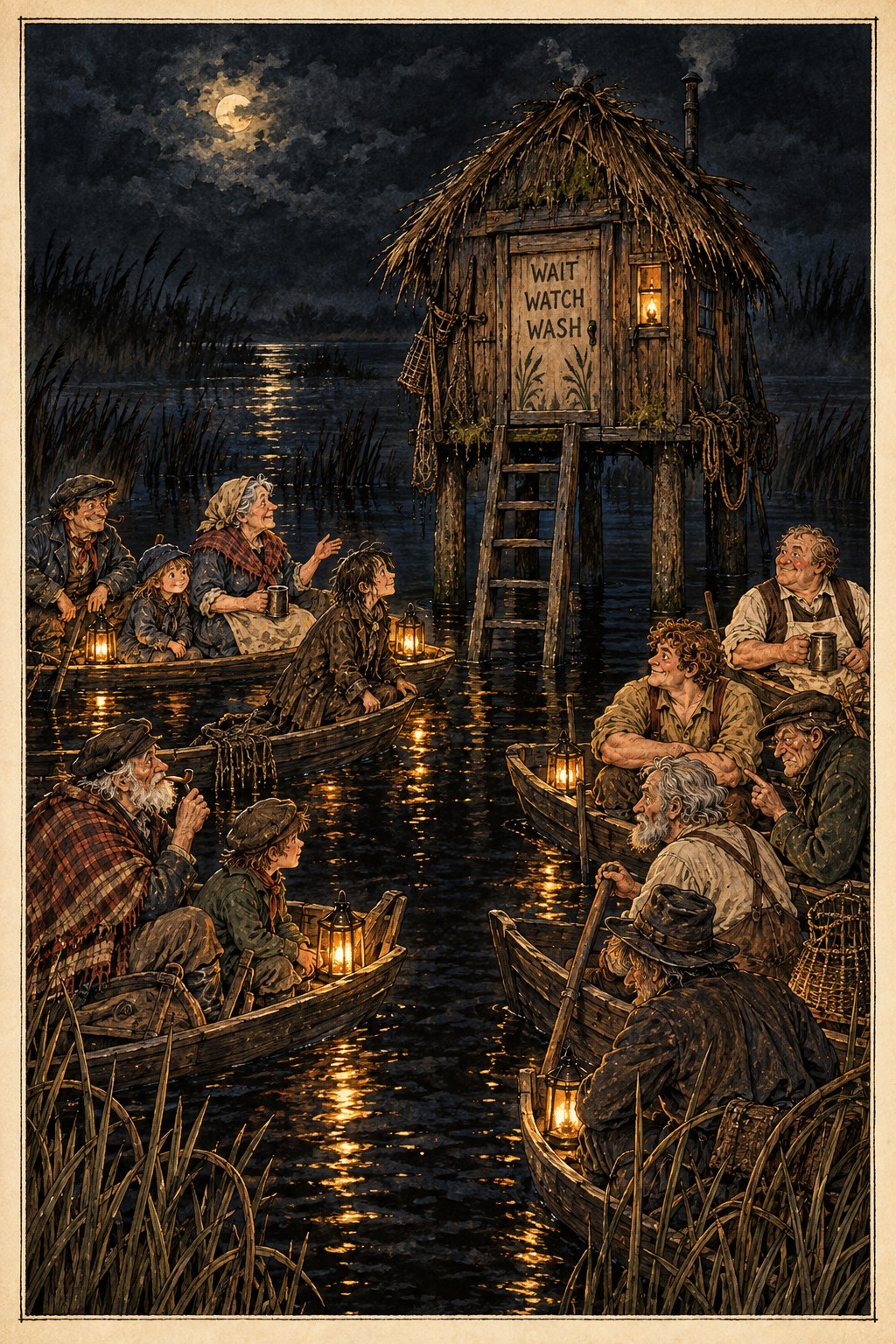
The Quarantine Hut stands on its own four stilts out in the open water, a long pole's reach from anything, with a painted board nailed to the door that says WAIT WATCH WASH, and under it, smaller, in a different hand, health first. welcome later. It is the loneliest building in the Drownings, and it is meant to be. When the ague comes into a stilt-village it goes house to house along the water faster than any boat, and the only thing that has ever stopped it is a person willing to be rowed out to the hut and left there until it passes, or they do.
That Dark, it was Ma Skeel.
She had it three days before she admitted it. Ma Skeel does not admit things. She raised the Skeel floor four times without discussion and has buried more than anyone should, and she went on keeping fire and family and roof above the water while the ague shook her, until the morning she dropped the kettle, and looked at it on the floor, and said to nobody in particular: "Well. That's that, then." And went and got her shawl.
Nobody argued. You don't, in the Drownings, when it's the ague; and you don't with Ma Skeel. Nobby Sculls poled her out himself in the grey of the morning, with her blankets and her tin cup and a pot of broth and the little lamp, and stood the boat off at a pole's length while she climbed the hut ladder, which he was not allowed to hold for her; and she went in, and shut the door on WAIT WATCH WASH, and called through it, "Mind you feed the fire, Tom's hopeless," and that was all.
The rule of the hut is that nobody goes in. Nobody touches the ladder. Food goes up on the end of a pole to the little shelf by the door; the pot comes back down the same way and is washed in boiling water before any hand in the village touches it. That is all. That is the whole rule. It has kept the Drownings alive through worse winters than anyone now remembers, and nobody breaks it.
But there is nothing in the rule about talking.
It was Dab who noticed that. Dab is the smallest Skeel, who poled a boat before she could walk and tells the time by the tide-mark on the third stilt. On the first night Ma was gone, Dab would not settle, and at the fourth bell Wet Tom found her missing from the bed she shared with Dib, and the little boat missing from the landing, and went out in the big boat in a fright — and found her sitting in her boat in the dark, tied off a careful pole's length from the Quarantine Hut, talking.
"— and Tom let the fire go out, and Grandfer said it were the damp, and it weren't the damp, it were Tom —"
And from inside the hut, through the boards, hoarse and shaking and perfectly unanswerable: "Course it were Tom."
Wet Tom sat in the big boat with his mouth open. Then he tied off beside his sister, at his own pole's length, and said, "It were not me," and his mother said, "It's always you, Tom," and he found that his eyes had gone wet, which is nothing new for Wet Tom, but this time was not the water.
By the second night, word had gone boat to boat, the way word does in the Drownings.
At the fifth bell there were three boats tied off in a ring around the Quarantine Hut, each at its own pole's length, lanterns low. By the sixth, there were seven. Nobody organised it. Nobody said it was anyone's turn. A boat simply came out of the dark and tied off in the ring, and a voice said, "Evening, Ma," and the hut said, "Who's that? Is that Smoke Rudd? What are you doing here, you've no business with sick folk, you'll catch your death," and Smoke Rudd said, "I came to see you catch yours first," and the hut laughed so hard it had to stop and cough, and everybody in the ring waited until it had.
They talked to her all night. That was the whole of it. Nobody went up the ladder; nobody touched the stilts; the pot went up on the pole and came down again and was boiled. But from dusk to first light, every night, there was a ring of boats around the Quarantine Hut and a voice in the dark close enough to hear her breathing — and the Drownings, which is scattered by water into a hundred separate little islands, was for once in its life all in one place, in a circle, round the loneliest building it owns.
And they said the things you say. Clem Wherry told her the new stilt was in on the Drench side and it was a good stilt, it would outlast them both, and she said it had better. Curly told her about the dry land up the fen he meant to go and see, one day, and she said he'd hate it, there's nothing to do on dry land, and he said he knew. Grandfer Skeel was rowed out by Smoke at the eighth bell and resumed, through the boards, the tale of the Pike of Sodden Bottom, and for once got a good deal further on than usual, because Smoke let him, and it was the kindest thing anyone had ever seen Smoke Rudd do.
And Ma Skeel, shaking, burning, alone inside four walls in the middle of the water, complained about every single one of them.
She said Nobby's voice kept her awake. She said Grandfer was telling it wrong. She said whoever had put onions in the broth wanted drowning, and the whole ring went quiet, and then a small voice from a boat on the far side said, "It were Tom," and the whole ring of boats in the dark broke out laughing.
That was how they knew. You can hear it, in the Drownings, when the ague's winning — the voice goes thin and polite, and starts thanking people. On the fourth night Ma Skeel told Nobby Sculls he was a disgrace to the water, and Nobby, bobbing in his boat at a pole's length, put his face in his hands and wept like a child, and everyone pretended not to see.
On the ninth morning, the door of the Quarantine Hut opened.
Ma Skeel stood in it, thinner, grey-faced, holding the door-frame, with her shawl over her head and her tin cup in her hand. She looked down at the ring of boats. The night's watch had fallen asleep in them, curled in the bottoms under blankets, lanterns burned out — Dab and Dib together in the little boat, Wet Tom sprawled in the big one with an oar for a pillow, Nobby Sculls snoring on his back with his hat over his face.
She looked at them for a long time.
Then she looked at the board on the door: WAIT WATCH WASH. health first. welcome later. And she took the charcoal stub out of her apron pocket that she uses to mark the tide on the third stilt, and underneath, in her own square hand, she wrote one more line.
Then she shouted for somebody to fetch a boat, because she had a floor to see to and her fire was out, and she'd lay money it was Tom.
What she wrote under the sign is still there. The weather has had most of it, but you can make it out, if you pole close enough — which nobody is supposed to, and everybody does:
talk anyway.
e06 · taleThe Lost Boat
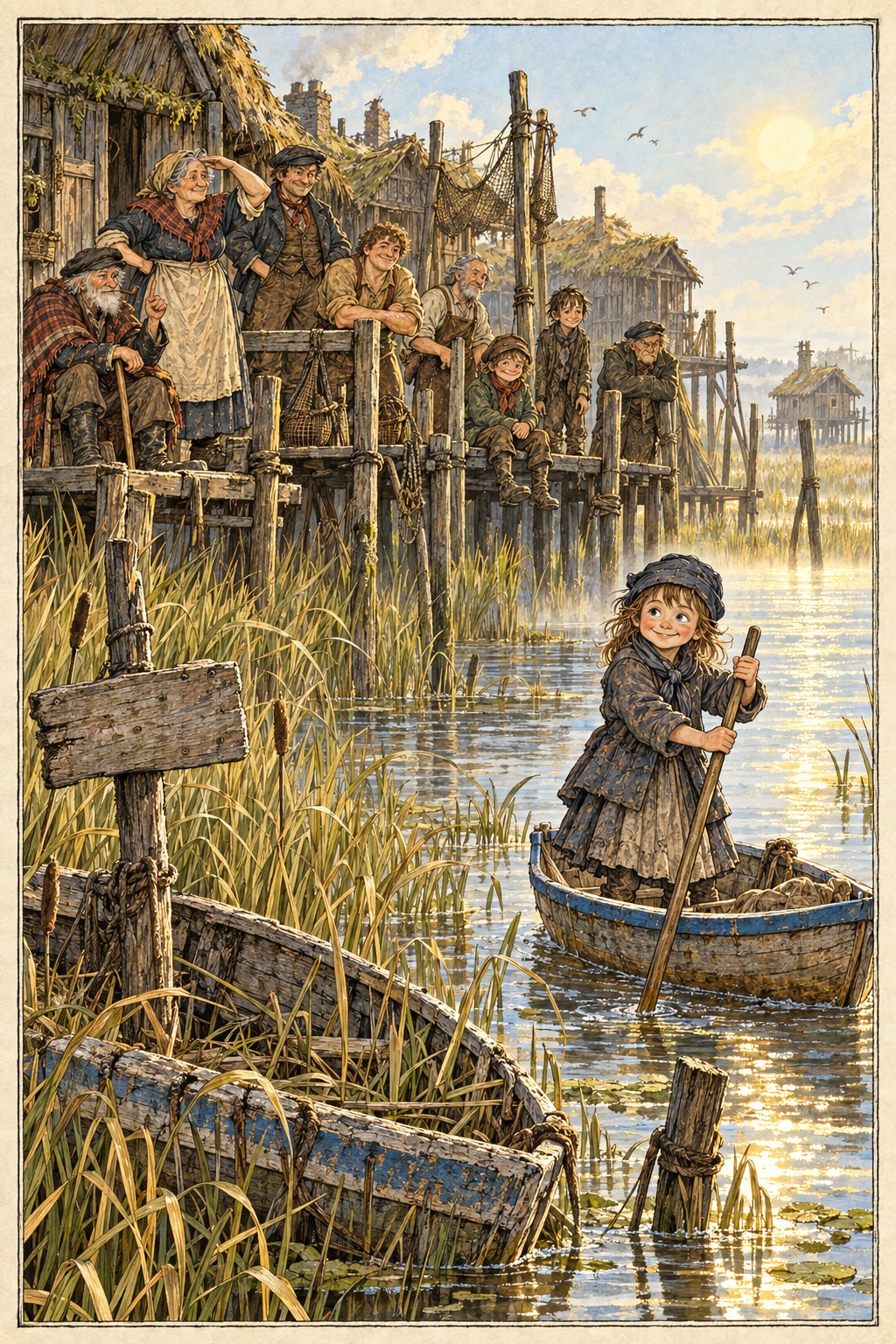
Out beyond the last of the stilt-houses, where the reed beds close in and the water goes brown and quiet, there is a boat that has grown into the reeds.
It has been there longer than anyone can say. The reeds have come up through its seams and its thwarts and its broken bottom boards, so that it floats in them rather than in the water, cradled, leaning a little, grey as driftwood, with a line of old blue paint still just visible along the gunwale. Children row out to look at it and are called back. Grown folk pole past it and do not look. Somebody long ago nailed a board to a post beside it, and the board says, in weathered letters, that was not found, and under that, in another hand, no one admits it was theirs.
That is all anyone in the Drownings will say about the Lost Boat. Whose it was. Who went out in it. Why it was left. There are a dozen stories and nobody tells any of them, because in a stilt-village every family has lost somebody to the water, and a boat nobody owns might be anybody's grief.
Dab Skeel wanted it.
Dab is the smallest Skeel. She poled a boat before she could walk, and in the spring of her eighth year she outgrew the little tub she shares with her brother Dib — outgrew it the way you outgrow a coat, all at once, one morning, so that her knees came up past the gunwale and the tub sat so low in the water that the ducks looked in. There was no other boat for her. The Skeels have the big boat, and the working boat, and the tub, and in the Drownings a boat is a house's hands and feet and nobody has one spare.
So Dab poled the tub out past the last stilts, with the water slopping in over her knees, and tied off at the Lost Boat, and sat looking at it for a whole morning. And then she poled home and went to Clem Wherry's boat-shed and stood in the door until he noticed her, which with Clem Wherry can take some time.
"I want the Lost Boat," said Dab.
Clem Wherry is the boatwright of the Drownings, and therefore its house-builder, its stilt-mender, its floor-raiser and its undertaker, and he does not frighten easily. He put down his adze.
"It's not yours to want," he said. "It's not mine to give. It's not anybody's."
"Then nobody'll mind."
"Everybody'll mind," said Clem. "That's the trouble with a thing that's nobody's, Dab. You don't bill a house for its grief. And you don't break up a boat that somebody might be missing."
Dab thought about that. "Is anybody missing it?"
"Nobody says."
"Then how do you know?"
And Clem Wherry, who has made more coffins than boats in his time and knows a great deal about what people don't say, found he had no answer, and sent her home.
But he could not stop thinking about it. That evening he poled out past the stilts himself and tied off by the Lost Boat and looked at it properly, for the first time in years, with a boatwright's eye. It was old, and it was rotten where the reeds had come through. But the keel was good. The keel was elm, and elm under water outlasts a man; and the stem-post was sound, and three of the planks along the top strakes were sound, and a boatwright could build a small new boat — a girl's boat — round that keel and that stem, if he had leave.
If he had leave. From whom?
Clem Wherry sat in his boat in the dusk and thought for a long time. And then he did the only thing you can do in a village where the thing is nobody's: he went round the Drownings, house by house, and asked everybody.
He did not ask is it yours. You can't ask that. He poled up to each landing and stood off and said, "I've a mind to take the keel out of the Lost Boat, for Dab Skeel, who's outgrown her tub. I thought I'd say."
And then he waited.
At the Drench house, old Wilf Drench — who has complained about every boat, stilt and weather in the Drownings for seventy years, and is the finest complainer in the realm — came to the landing and stood a while looking out toward the reed beds, and for once did not complain. "It weren't ours, Clem," he said. And then, after a moment, very low: "But if it had been — which it weren't — I'd want it on the water again. Not rotting in the reeds. I'd want a child in it." And went in.
At the Stilt & Reed, Tobit Beake said, "Nothing to do with us," quick and sharp, and shut the door. And opened it again a minute later, and came out with a coil of good tarred line, and put it in his boat, and said, "For the child. Nothing to do with the boat," and shut it again.
Nobby Sculls said, "Never saw that boat in my life," and then told Clem, without being asked, exactly how the stem-post had been fixed to the keel, and with what, and that there'd been a little carved fish on the inside of the bow under the paint, and to be careful of it. And then stood at his landing looking at the water with his hat in his hands, and did not say anything else at all.
At every landing in the Drownings it was the same. Nobody owned the Lost Boat. Nobody had ever owned it. And house after house, not owning it, gave leave — and something with it: a pot of pitch, an old oar cut down small, a scrap of blue paint in a jar; and at the Skeel house itself, Grandfer Skeel, who has never in sixty years let anybody finish a sentence about the water, heard Clem out in perfect silence, and said only, "Build it good."
Clem Wherry built Dab Skeel's boat that spring. He took the elm keel and the stem-post out of the Lost Boat as gently as you lift a sleeping child, and three sound planks off the top strake, and built round them a small, bright, sweet-sitting boat, just right for a girl of eight to pole. Dab worked beside him every day, and learned to caulk, and learned to steam a plank and bend it, and cut her hands and said nothing about it; which is how the Drownings takes an apprentice, though nobody calls it that.
And under the new paint, on the inside of the bow, he kept the little carved fish.
He put the rest of the Lost Boat back in the reeds where it had been, and left the board on its post: that was not found. no one admits it was theirs. Some things you don't mend.
Dab Skeel's boat went on the water at the first calm of the Long. It is painted blue along the gunwale, because that was the paint she was given. And on the morning she first poled it out past the last stilt-houses, every landing in the Drownings happened to have somebody standing on it, not watching, mending something, looking the other way — and more than one of them, as the little blue boat went by, put a hand up to their eyes against the light, which was bright that morning, very bright, off the water.

e07 · taleAn Hour Late
The bell of the drowned chapel at Sodden Bottom has rung the hour a full hour wrong for as long as anyone in the Drownings can remember, and nobody has ever minded.
The chapel went under long ago, when the water came up over that end of the parish and did not go down; its crooked spire still stands up out of the flood, and the bell still hangs in it, and somebody still climbs up from a boat, by a ladder nailed to the spire, to ring it. And it rings wrong. When the sun says noon, the drowned bell is still insisting on the hour before. When the fires are banked for the night, it is still an hour behind them. It has done so through floods and frosts and more generations of Skeels than Grandfer can count on one telling — and the Drownings sets its whole day by it, because a bell you can trust to be wrong the same way every single day is every bit as good as a bell that is right.
Then, in the Short of a bad year, the bell cracked.
It went in a frost. The ringer climbed up at what the bell called dawn, and pulled, and instead of the long wrong note there was a dull flat clack like a dropped pan, and a split ran up the bronze from the lip like a crack across ice. And the Drownings, which has lost houses and boats and people to the water without once raising its voice, went very quiet indeed.
A cracked bell cannot be mended. It must be broken up and melted down and cast again. And nobody in the Drownings can cast a bell, because casting a bell needs dry ground, a great deal of it, and a deep pit, and a fire that does not go out — and there is not a yard of dry ground in the Drownings from one end of the Dark to the other.
So they took it up the fen. It took four boats lashed together, and the whole of a week, and Clem Wherry swearing, and at the end of it the cracked bell of the drowned chapel came up out of the water onto the Bogmoor, to the old field on the Mucklecombe side of the moor, beside the Bell Without a Church — the parish bell that belongs to no chapel, that the Bogmoor rings for meetings, funerals, warnings and the like — because that was where the bell-founder was.
The bell-founder was a travelling man, as bell-founders are, who went from parish to parish digging his pit and building his furnace wherever a bell was wanted, and he was the proudest man in his trade on the whole of the moor. He was proud of his metal, and his moulds, and his pit; but above all things he was proud of his tuning. A bell of his, he said, did not merely ring. It told the truth. It rang the note it was meant to, clean and whole, and when it was hung in a tower and set to the hours, it rang the right hour, and it went on ringing the right hour for three hundred years, and there was not a bell of his anywhere on the Bogmoor that had ever once been wrong.
So when the Drownings people told him — standing uneasily in his field, a long way from water, with their boots sinking in the unaccustomed ground — what their old bell had done, he was horrified.
"An hour out?" he said. "For a hundred years? My dear good people. You have been living wrong. No wonder the water came up. I shall cast you a bell you can set your lives by."
The Drownings people looked at each other, and said nothing, because it was his field and his pit and they could not have done it themselves; and they went home down the fen in their boats to wait.
He did it beautifully. Everybody who saw the casting said so. He dug his pit in the Bogmoor field and built the mould of clay and dung and hair, and broke up the old cracked bell and melted it in the furnace with new metal, and poured it glowing into the ground under a clear frosty night, with half of Mucklecombe come out to watch and Deaf Tolley, the weather-ringer, standing with his hand flat on the Bell Without a Church to feel the pour through the bronze. And when the new bell came up out of the pit and was cleaned and struck, it rang a note so pure and so true that Tolley, who has not heard a sound since he was a boy, took his hand off the old bell and put it on his own chest and wept.
They took it back down the fen in four boats lashed together, and hung it in the crooked spire of the drowned chapel, and the ringer climbed up the ladder at noon, and pulled.
And it rang noon.
It was a disaster.
Nobody could say quite why. It was only an hour. But the Drownings, it turned out, had built its entire life on that hour. The boats that went out at the drowned bell's noon to catch the eels on the turn now went out at the right hour and missed the turn. Nobby Sculls, who times every crossing of the day to the drowned bell, arrived everywhere an hour early and found nobody on any landing, and had to pole round and round the stilts like a lost duck. Ma Skeel banked the fire at the right hour and the house was cold by the morning. Grandfer Skeel, who begins the Midsummer telling at the bell and has done so for sixty years, began it an hour too soon, in broad daylight, and half the village was still at work, and he had to stop and start again, which he has never once done in his life and has not got over. Every child in the Drownings was late for everything, by being on time.
And worst of all — nobody could say this, but everybody felt it — the new bell sounded wrong. Too clean. Too sure of itself. It rang out over the flood as if the flood were a mistake that it, personally, had come to correct. It did not sound like the Drownings. It sounded like somewhere drier, telling them off.
After a fortnight, Wilf Drench — who has complained about everything in the Drownings for seventy years and has never, until then, been listened to — poled all the way up the fen to the bell-founder's field on his own, in the rain, and complained.
The bell-founder did not understand it. He was angry. He was insulted. He explained to Wilf Drench, at length, that his bell was correct, that it rang the true hour, that it was the finest casting he had made in years, and that the Drownings should be grateful to be put right after a century of error.
And Wilf Drench, standing in the unaccustomed dry field with his boots sinking in it, said the one uncomplaining thing he had ever said in his life.
"We don't want putting right," he said. "We want our bell."
The bell-founder looked at him for a long time.
Then he said, in the voice of a man who has been proud of one thing all his life and has just been asked to let go of it, "I can't cast a bell wrong. It's not in me."
"You don't have to cast it wrong," said Wilf. "The old one weren't cast wrong. It were only ever rung an hour late. Nobody ever set it right, that's all. Nobody wanted to."
The bell-founder came down to the Drownings himself, that Dark. It was the first time he had ever been in a boat and he did not enjoy it. He climbed the ladder up the crooked spire of the drowned chapel, holding on very tightly, and he did not touch his beautiful bell at all. He only sat in the belfry through a whole day and a night with the ringer, and a candle, and the Drownings' own tide-mark on the third stilt of the Skeel house to go by, and he taught the ringer — patiently, correctly, with his whole trade's care — how to ring the true bell an exact, reliable, unvarying hour late.
It is the only wrong thing he has ever taught anyone. He never speaks of it on the Bogmoor.
And the drowned bell of Sodden Bottom rings wrong again, clean and true and an hour behind, over the water, as it always has. The eels are caught on the turn, and Nobby Sculls finds folk waiting on the landings, and Grandfer Skeel begins the telling at the proper wrong time; and the Drownings says that the new bell sounds very like the old one now — it has learned, they say, and settled, and grown damp in its ways.
The bell-founder's name is cast into its lip in fine raised letters, the way all his bells are signed. And underneath it, scratched in very small with a nail by somebody who went up the ladder without asking, are two words the founder has never seen and nobody in the Drownings will ever tell him about:
an hour late.