A Year at Sump Lane
A Year at Sump Lane
The Year
- Midsummer Rent — tale
- The Circle of the Lane — comic
- The Longest Night on Sump Lane — tale
a01 · taleMidsummer Rent
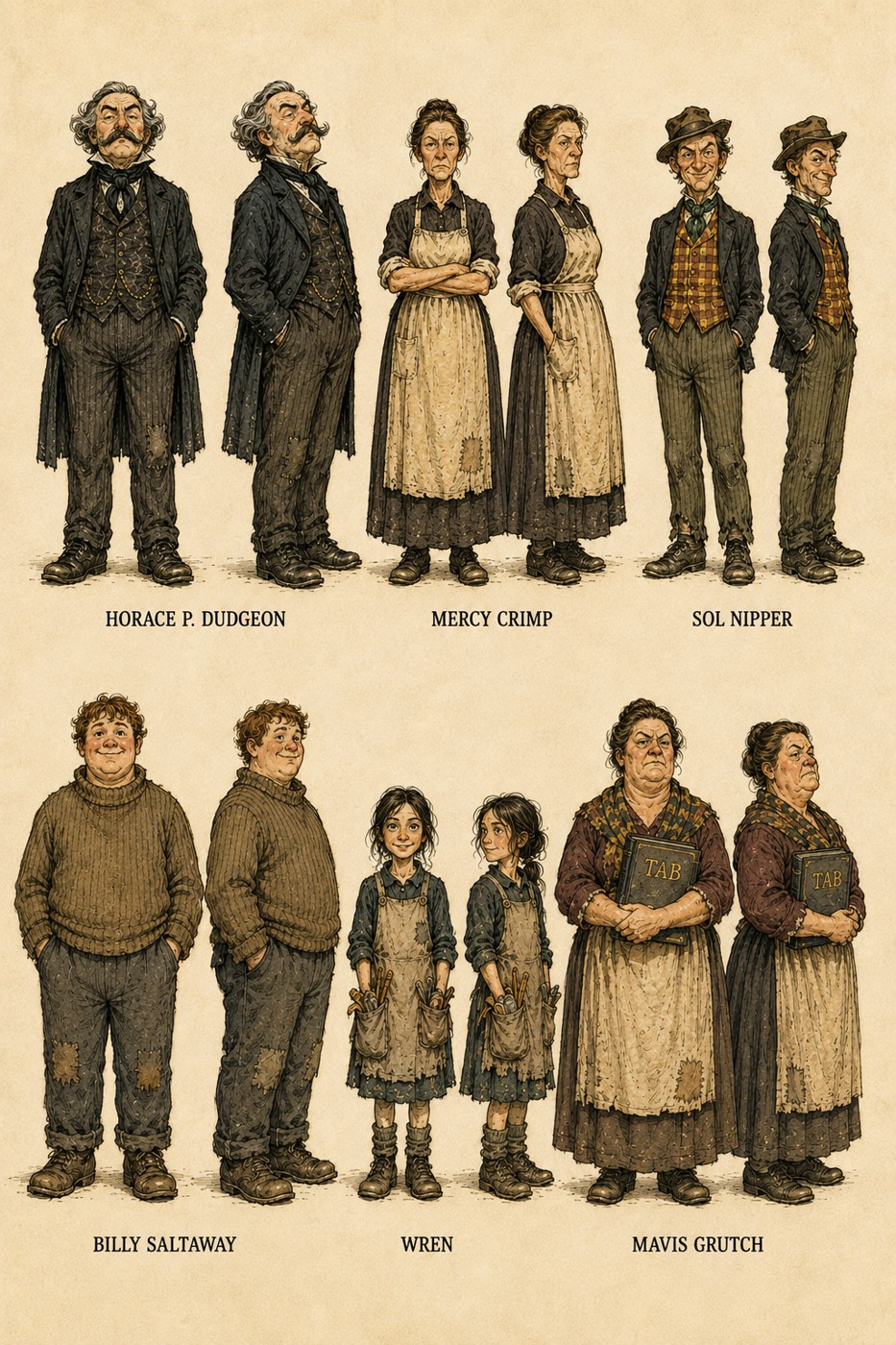
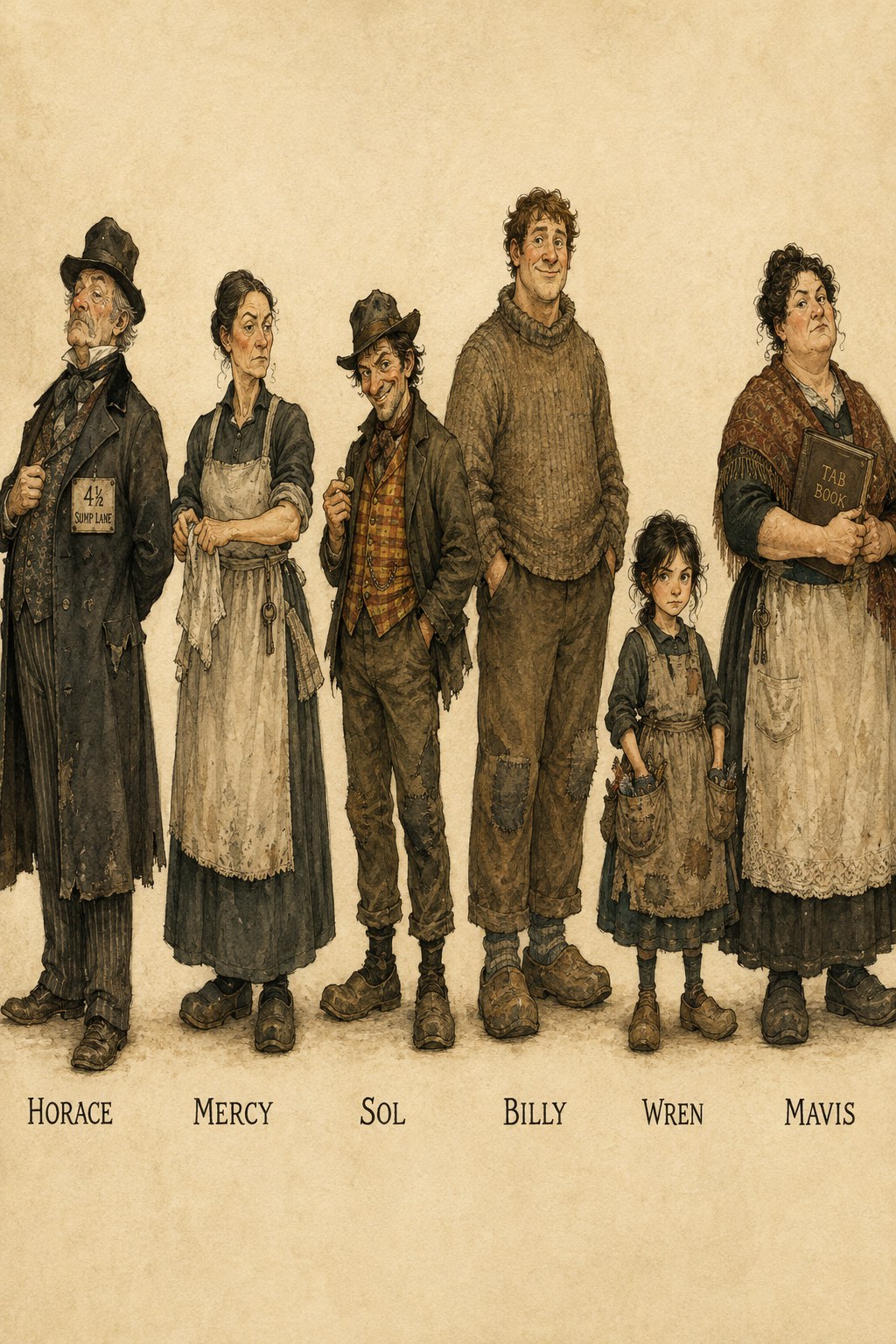
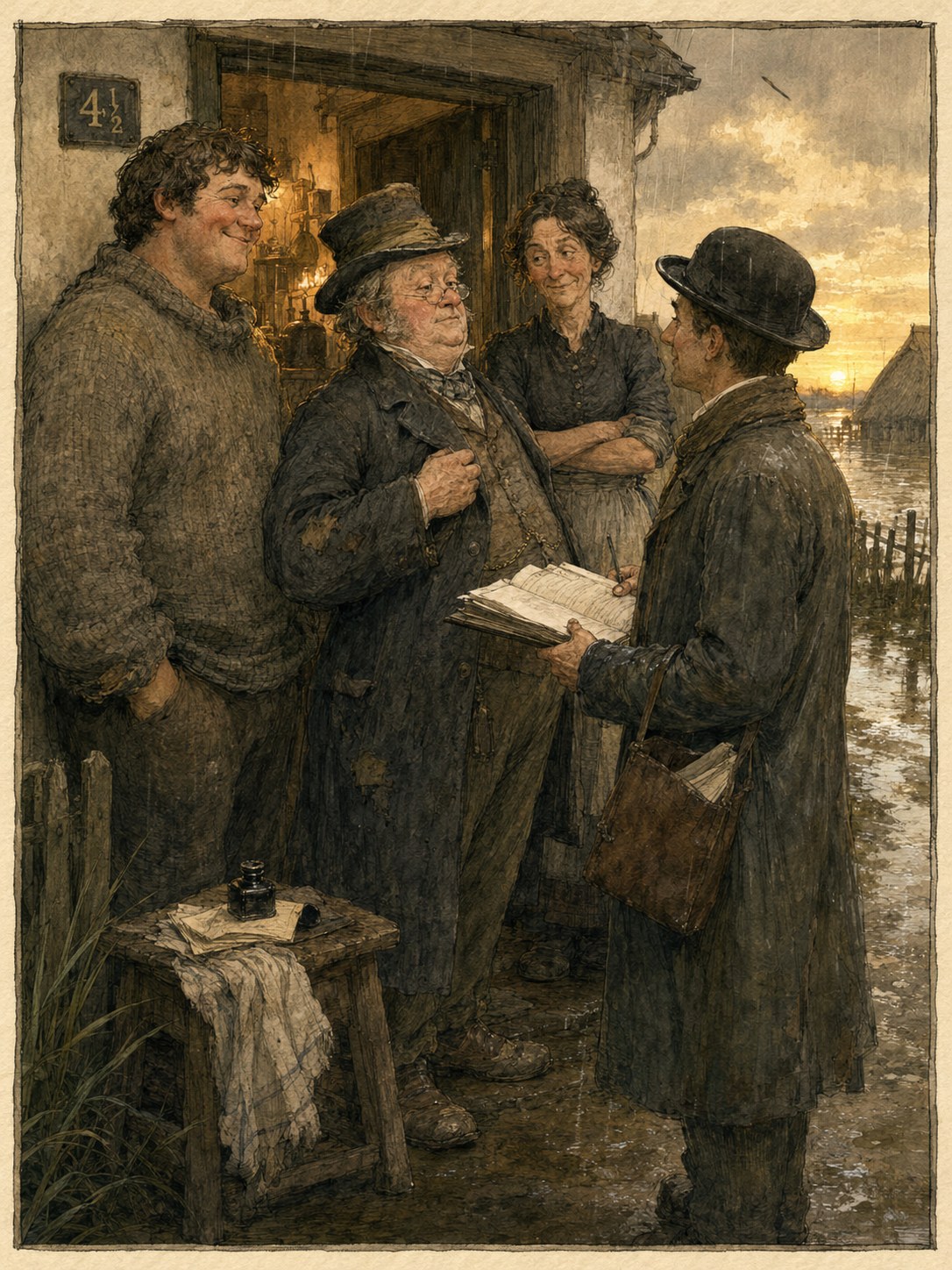
The ground beneath Sump Lane belongs to Aunt Euphemia Bastable, who owns the earth under half of Drudgeford and most of the parish besides; and the rent for the patch under No. 4½ falls due, as it has fallen due since before anyone can prove, at Midsummer. Horace P. Dudgeon has never once paid it. This is not, whatever Horace believes, on account of his genius.
Each Midsummer Horace mounts what he calls the Grand Deferral — a pageant whose entire and secret purpose is to arrive at the very moment of payment and, by sheer weight of occasion, sail straight past it. There is bunting. There is Billy Saltaway in a sash, blowing a whistle he has been trusted with against his history. There is a procession the length of the lane to the door of the great cold Bastable house, and there, upon the step, Horace delivers his oration — On the Ancient and Cordial Relations Between the Independent Literary Republic of Dudgeon and the Noble House of Bastable — building, and building, to the ceremonial presentation of a single folded paper: a Voucher, drawn upon a treasury of nothing, redeemable never, and signed with a flourish that has taken him a week to practise.
And Aunt Euphemia — ancient, upright, immensely rich, and not fooled for the smallest part of a second — receives the whole absurd business every year with exactly the gravity it does not deserve. She accepts the Voucher in two gloved fingers. She files it, so she says, "with the others" — and there are four hundred others, in a drawer, in order. And she defers the rent one further year, "in recognition of the Republic's continued goodwill," and Horace marches his procession home down the lane magnificent, certain he has out-generalled his landlord once more.
Here is the first thing nobody says. Euphemia Bastable could have the rent any Midsummer she liked. She could have the house. She could have Horace in a debtor's cell by the following bell and never feel the loss of him. She chooses the pageant instead — chooses it, and keeps the rent forever unpaid, because paid rent ends the pageant. She is old, and she is rich, and she is alone in a house with too many rooms, and once a year a ragged, beloved, ridiculous procession comes down her lane with a homemade sash and a whistle and a fat man who treats her doorstep as a state occasion — and it is the only day in her year that anyone comes to her door for any reason at all but money. So she pays, quietly and very dearly, in the one coin that keeps them coming: she keeps the debt owed. The unpaid rent is the last thread by which the warmth of the parish still reaches the great cold house, and she will not, for anything, let it be cut by so vulgar a thing as settlement.
And here is the second thing nobody says. The rent is paid — only not by Horace, and not in coin, and not on the day of the pageant. The morning before it, every Midsummer, Mercy Crimp walks up to the Bastable house with a basket on her arm. Mercy takes in the parish's mending; it is the real income of No. 4½ and it is never discussed; and up at the great house she spends the whole long light of that morning at it — darning Euphemia's stockings, turning her worn collars, mending the linen of a woman with money enough to buy a hundred new and no one, any longer, to sit and sew with. She takes no coin for it. The two women do not call it rent. It is rent, near enough — paid hand to hand, in thread, by the one person in either house who knows precisely what is owed, and to whom, and why. They do not speak of that either. They speak of collars, and of the weather, and of a wedding thirty years gone that Mercy will not discuss with Mavis Grutch but will, it seems, discuss with Euphemia Bastable; and the morning goes, and the basket empties, and the rent is paid in the only currency that was ever really at stake, which was company.
So it holds, the whole daft and tender machinery of it: Mercy lets Horace keep his pageant and his genius; Euphemia lets Horace keep his victory; and between them, over a basket of mending in the long Midsummer light, the two women quietly keep an old woman warm and a rented half-house standing, and let the man of the house go on believing to his bones that he did it all himself, with a Voucher, by the bold policy of not paying.
On the day itself the procession forms, and Billy blows his whistle, and the bunting sags in the heat, and Horace clears his throat upon the step for the four-hundred-and-somethingth reading of the Ancient and Cordial Relations. And Euphemia Bastable opens her own door — she always opens it herself, on this one day, having sent the girl away so as not to share it — and for just a moment, before the gravity comes down over her face like a lid, there is something on it, at the sight of them all coming, that no rent in the realm could buy and no Voucher could ever be drawn against; and then it is gone, and she is the landlord again, and the pageant begins.
The rent went unpaid that Midsummer, as it has gone unpaid four hundred years, and will, if the parish is kind, go unpaid four hundred more.
The Circle of the Lane
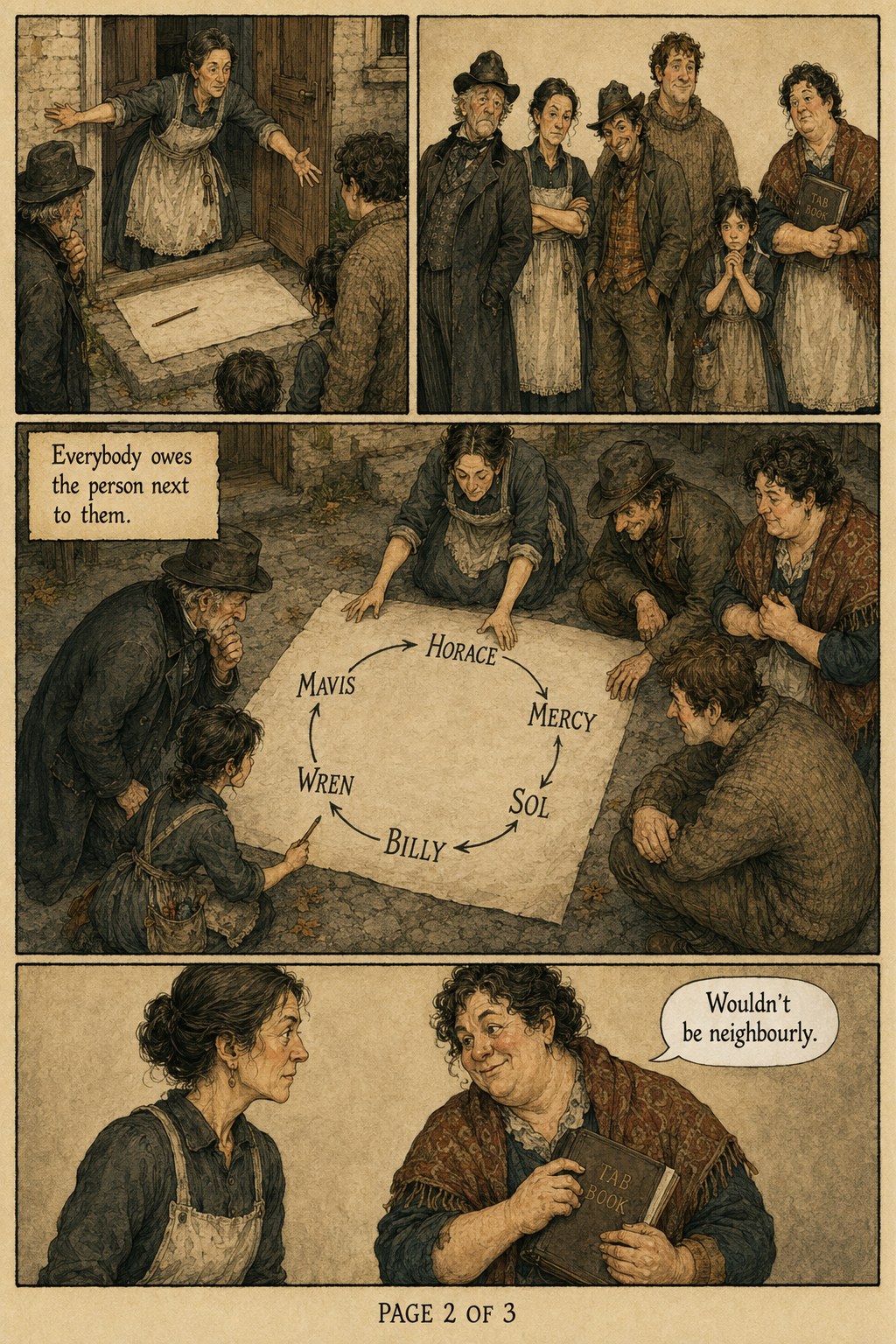
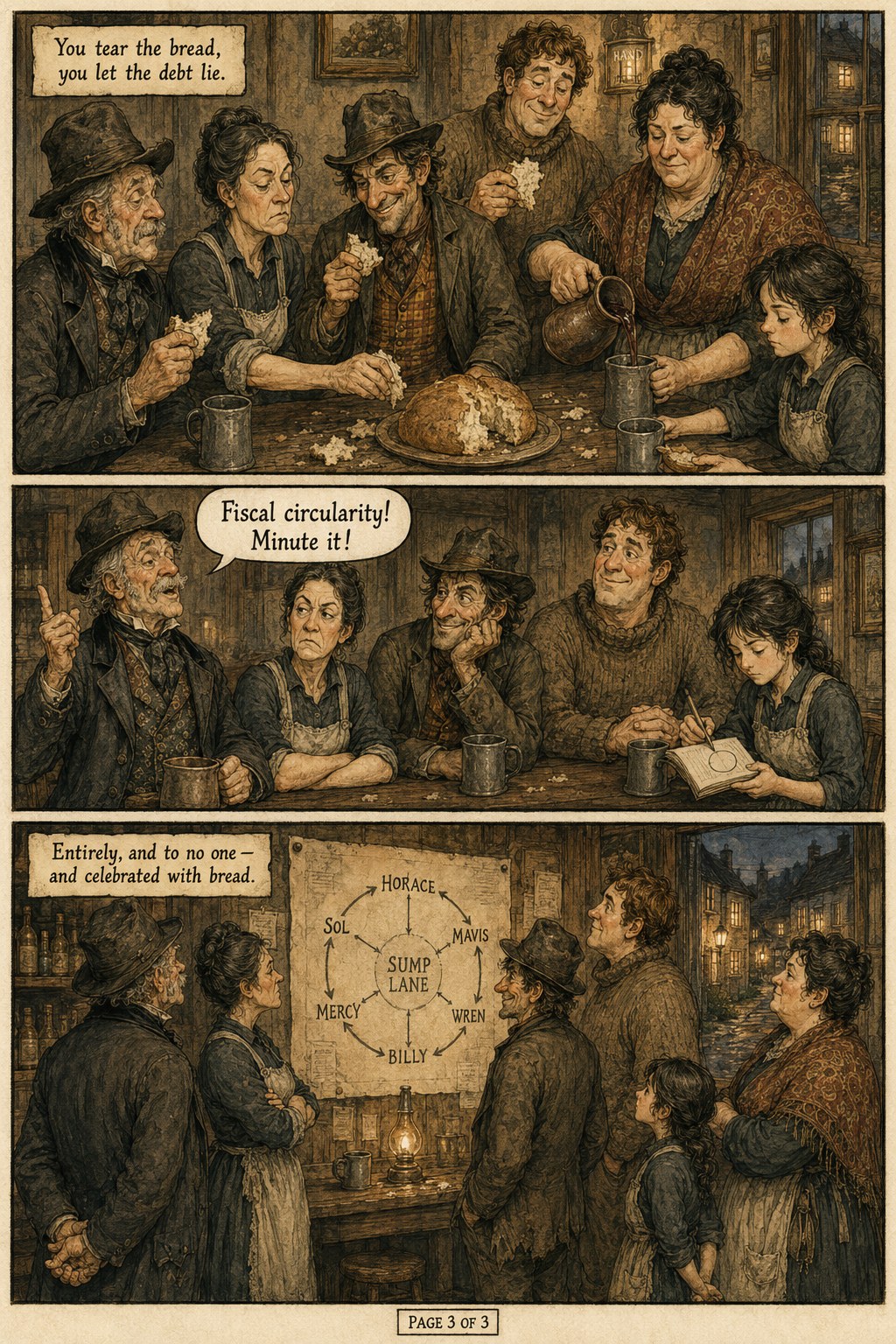
a03 · taleThe Longest Night on Sump Lane
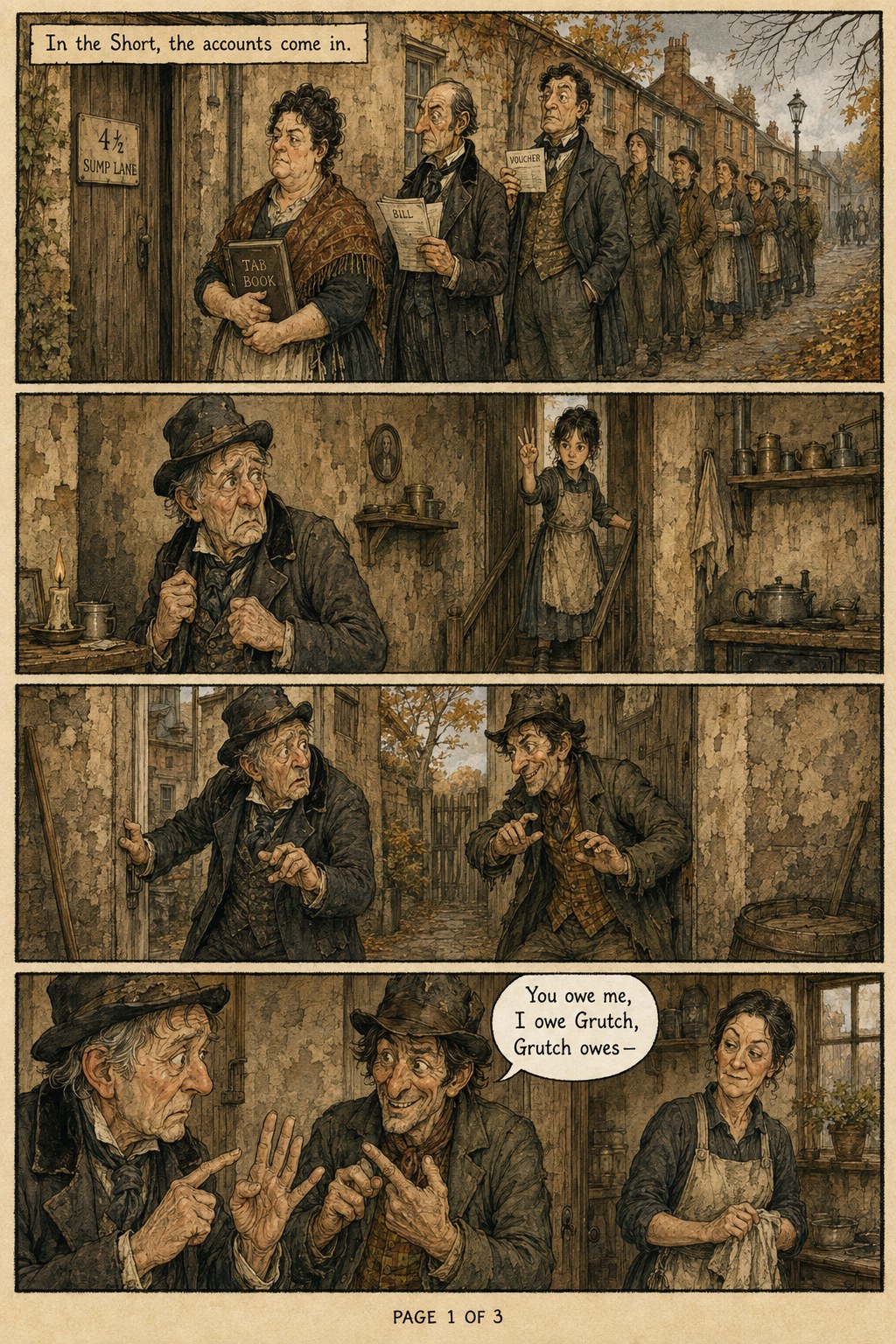
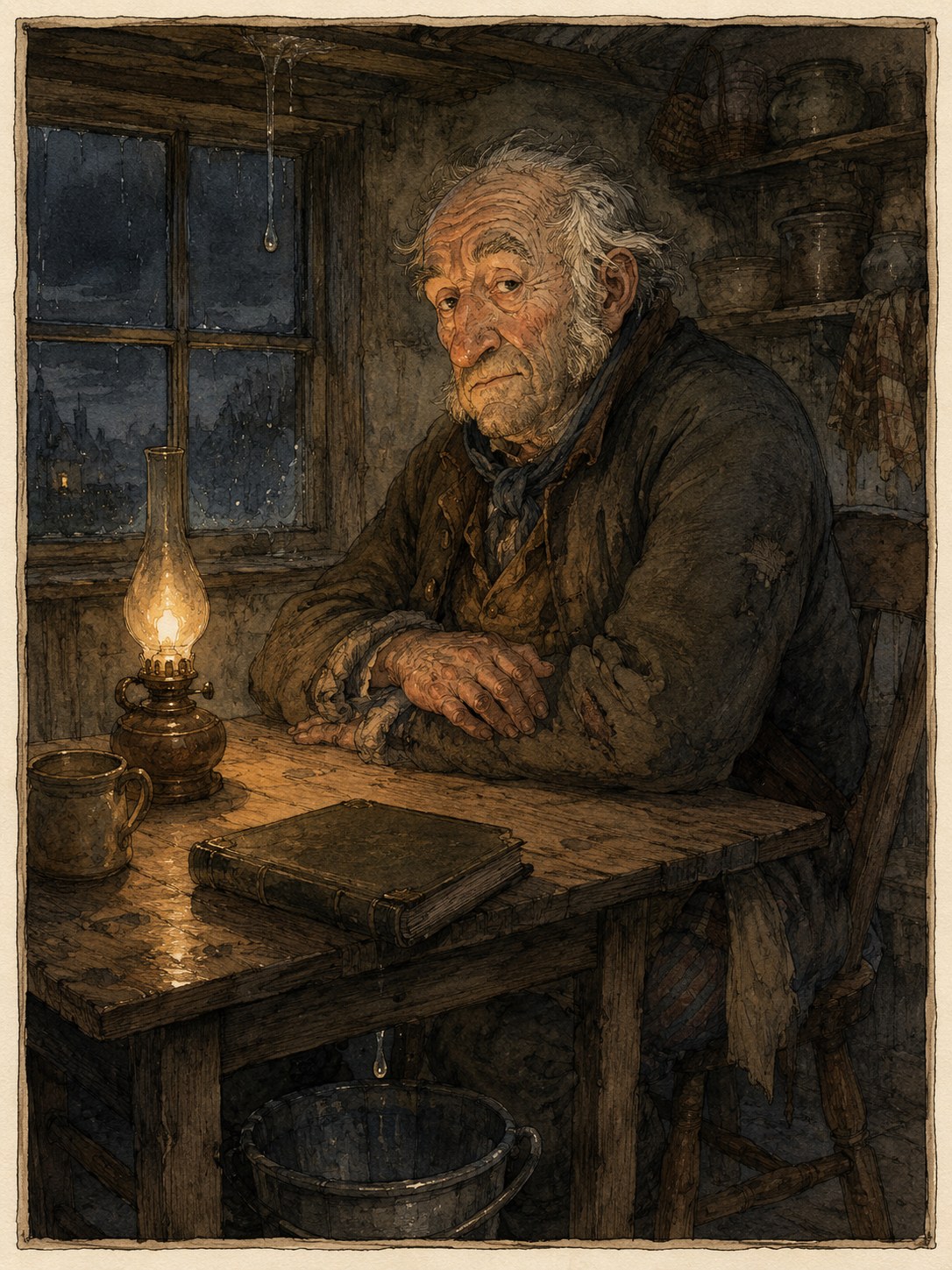
Amos Crimp had mended boots for sixty years, and it was not the cold of the Dark that grieved him now but the fact that his hands would no longer close, and a hand that will not close cannot hold an awl, nor a last, nor a child, nor much of anything a man spends a life learning to hold. He sat by Mercy's range on the longest night of the year and said his one true thing — "It'll turn now," he said, of the dark, which from tonight would shorten — and then he went back to the fire, because a man is allowed one true thing a day and Amos was careful not to spend more.
It was Frost Night, and on Frost Night a Sump Lane house takes the cold in. You do not bar the door against the Dark; you open it, and let the lane come through, and the more bodies in the kitchen the less room there is for the year's longest night to sit down among you. So they came. Grutch came, who does not speak to Mercy and would walk into the Slough for her; she came with a pie and put it down without a word and the two of them stood either side of the range not speaking to each other with tremendous warmth. Dolly Quick came, and Billy, and Eddie Tupp, who was made to sit far from anything that could be knocked over. Horace came downstairs in his good coat and announced that the Republic observed Frost Night as a state occasion, and was told to fetch coal, and did, which was the truest act of statesmanship he performed all year.
Mercy laid the long table. And at the end of it, at the turn of the stair, she laid one place more — a cup, a plate, a chair pulled a little out — for the top-floor lodger who might be in and might not, and either way was owed his place. Nobody remarked on it. The house had learned, without ever deciding to, that you set a place for the ones you cannot quite see; and if you asked Mercy why, she would say the draught came down those stairs and the chair kept it off her neck, and she would go on slicing the pie, and you would let her have it.
The wall in the back plot was bare. In the Light — Billy had done it at dawn, before the Ministry of Agriculture was so much as awake to flood a sleeping man — he had put the peas in along that wall, low, where a man in a chair by the window could watch them come; and all through the Long, Amos had watched them, the whole slow green business of it, day on day, the one crop in Drudgeford grown for no reason but that an old man's eyes could reach it. Now it was the Dark and the wall was frost and there was nothing on it to watch, and Amos looked at it once through the black window and then did not look again, and the house saw him not-look, and the house said nothing, because there are things that if you say them aloud you make true, and this was one.
It was Wren who crossed the kitchen to him. Wren was nine, and kept a collection under a loose board that no one was supposed to know about and everyone did, and she came to Amos's chair and put into his lap — carefully, into the lap and not the hands, because she was the only one small and quick enough to have noticed that the hands were the grief and the lap was the mercy — a small clay pot. In the pot was earth, and in the earth, just breaking, pale and certain and weeks too early for any sane gardener, three green threads of pea.
"I started 'em on my sill," she said. "In the warm. From the ones off your wall — I kept some back, they were under the board. So you'd have some to watch." She considered the arithmetic of it, frowning. "They'll be slow, being winter. But they'll come. You can watch 'em come from the fire."
Amos Crimp looked at the three green threads. He did not try to hold the pot, and Wren did not offer it to his hands, and that not-offering was the kindest thing done in Drudgeford that year. He looked at the peas a long time. Then he said his one true thing, though he had already spent it, and nobody in that kitchen was fool enough to point out that he owed the day nothing further.
"It'll turn now," said Amos, and this time he was not talking about the dark.
And the longest night of the year went by the way the longest night always goes by on Sump Lane — too many people in too small a room, the feud conducted in perfect silence over a shared pie, the President fetching coal, a place kept warm at the stair for a lodger who came, or did not, and left his cup somehow empty by morning — and from that night the light began, a minute at a time, the long climb back toward a wall of peas that a boy would plant again at dawn, low, where an old man could watch them; and whether Amos would be in the chair to watch them was the one thing the whole house was thinking and the one thing not a soul would say, and so it stayed where it belonged, which was unsaid, which was here, which is why this is a tale and not a half-hour.