A Year at Saltgate
A Year at Saltgate
The Year
- Fitting Out the Fleet (That Won't Sail) — comic
- The Long Days' Catch — tale
- The Salt-Factor Can't Sleep — tale
- The Crane That Lifts Nothing — comic
- The Windward Path — tale

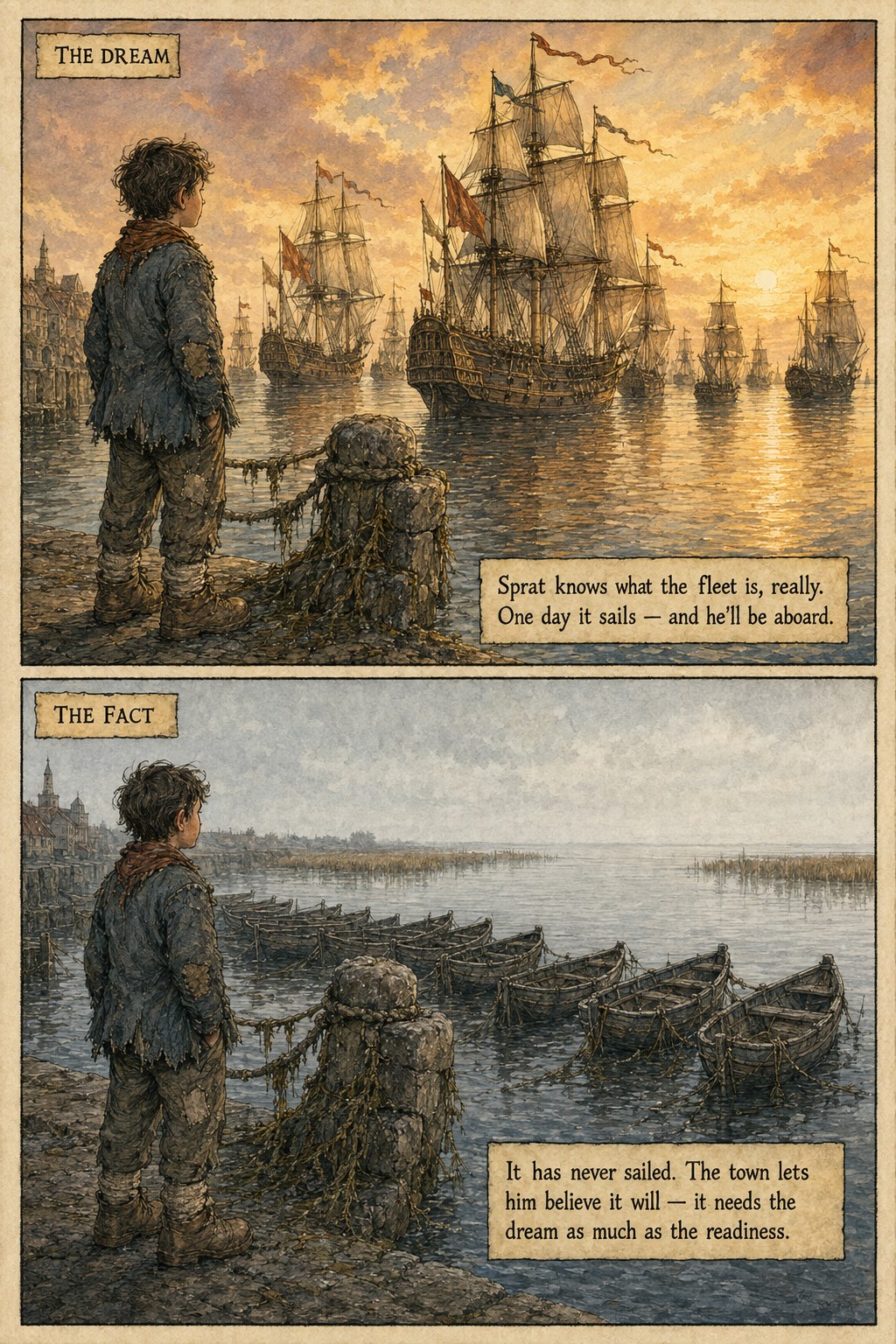
Fitting Out the Fleet (That Won't Sail)
d02 · taleThe Long Days' Catch
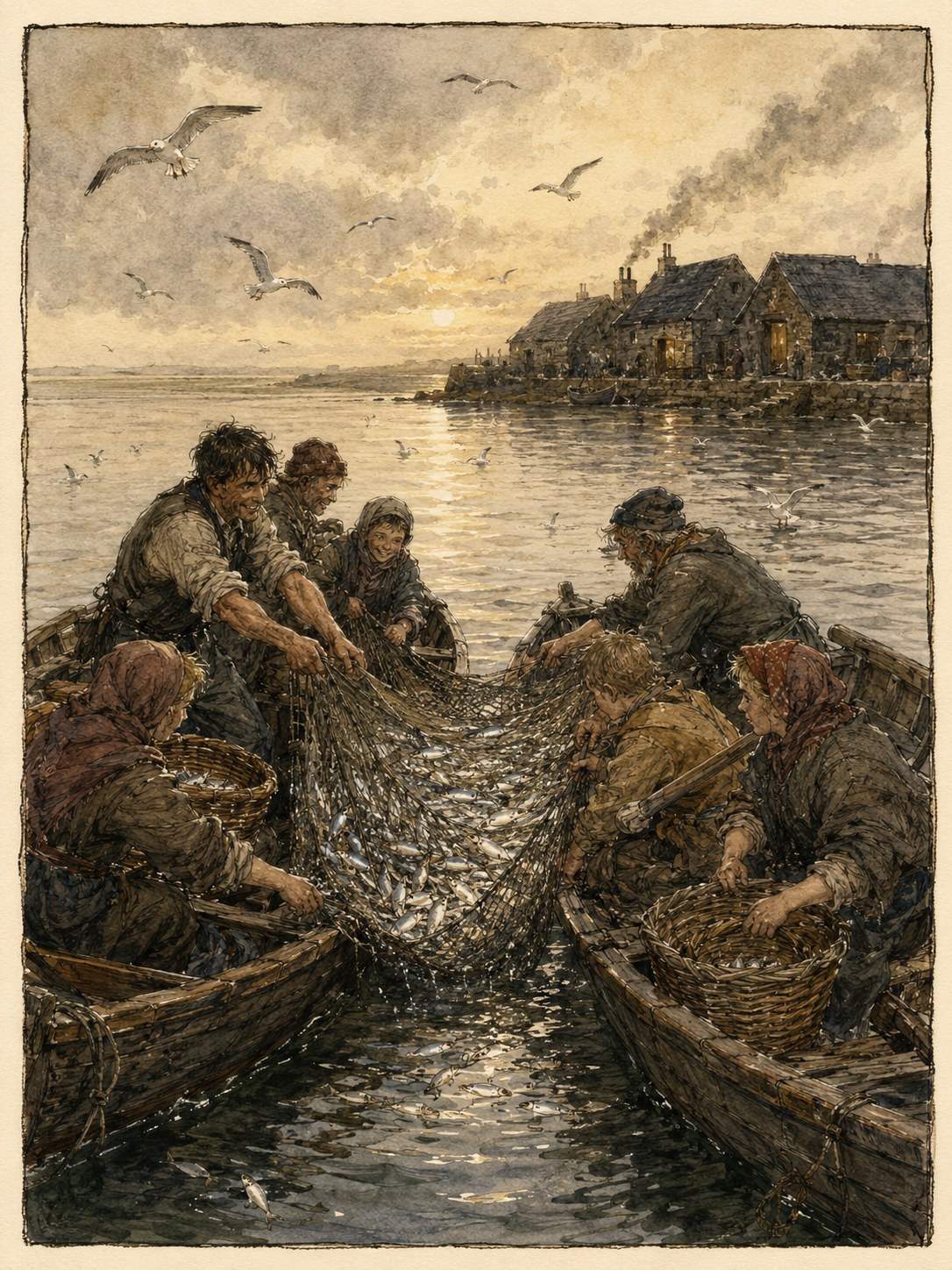
There are three or four nights in the Long — the shortest nights of the year, when the light barely leaves the water before it comes back — when the near shoal runs into Saltgate's own bay, silver and vast and brief, and the whole harbour lives or goes thin on the taking of it. And on one of those nights, the greatest of them, the shoal is too great for any one boat-family to net alone; and so, once a year, in the pale small hours of the Long, the two boat-families of Saltgate — the Sacketts and the Pells, a hundred years of racing and feuding and marrying across the same grey harbour — put down the feud where it stands on the quay, and go out, and fish it as one crew.
Nobody calls it a truce. Loveday Sackett would not use the word, nor Goodwife Pell's kin, nor any of them. It is simply that the shoal does not care whose grandmother wronged whose over a herring in a year nobody now remembers, and the fish will not wait for a feud to be settled, and a family that let the great catch pass for the sake of an old grievance would be a family too proud to eat — and no one on the Cold Coast is that. So the boats go out together, Sackett and Pell, gunwale to gunwale in the half-dark, and the two crews become, for the one night, the single crew the harbour has always secretly been.
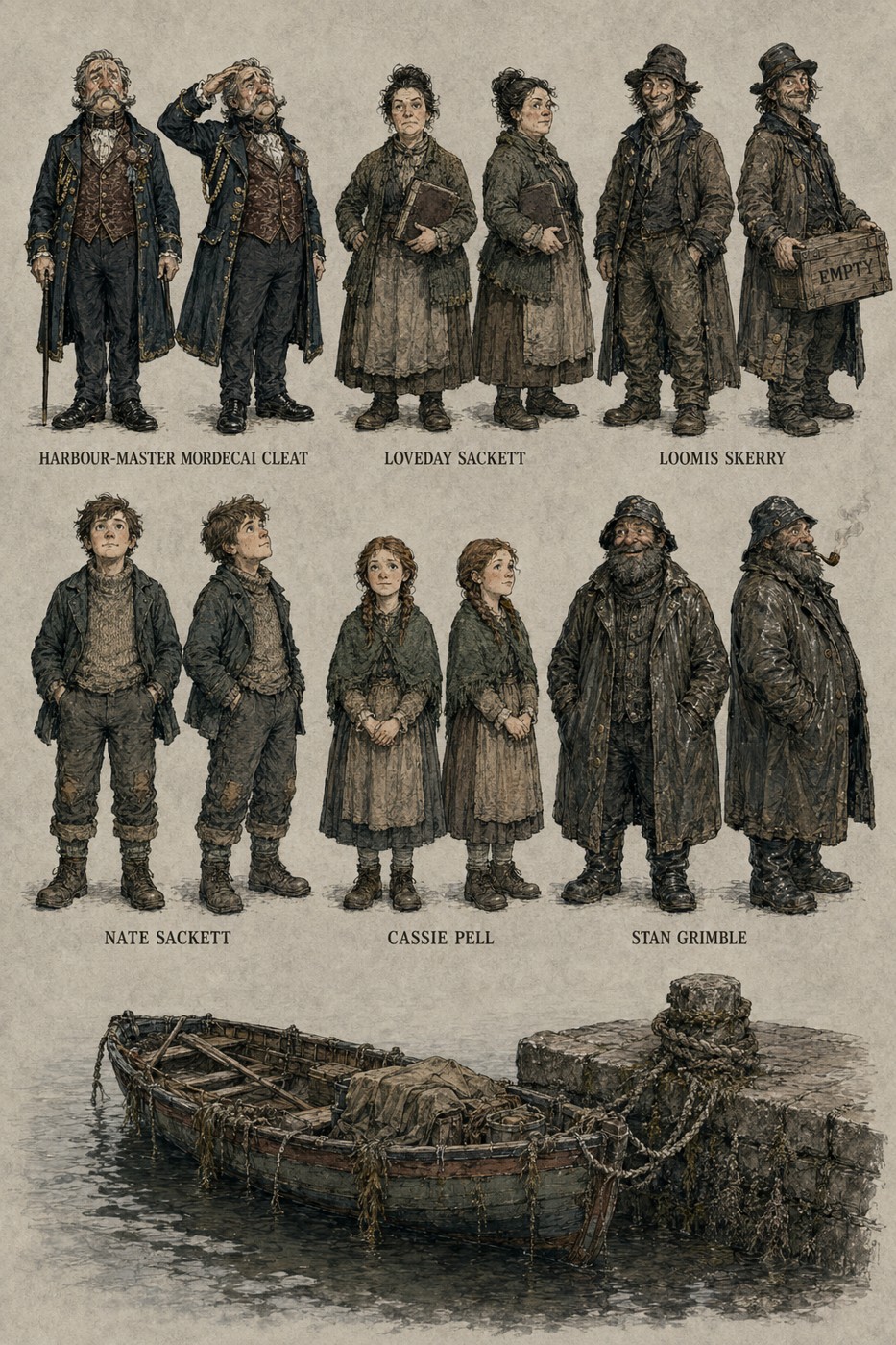
Nate Sackett fished that night at the near net with Cassie Pell at the other end of it, and the whole silver weight of the Long between them, and did not speak to her, because you do not, across the feud, in front of the families; and hauled, and hauled, the shoal coming up out of the black water like a spill of moonlight into the boat, more than the Sacketts had taken in a season, more than the Pells; and it was, by any reckoning the town keeps, the best catch of the year, and the best of many years, and Nate Sackett stood in the middle of it up to his knees in silver and looked, as he always looks, past all of it, out through the harbour mouth, to the far water.
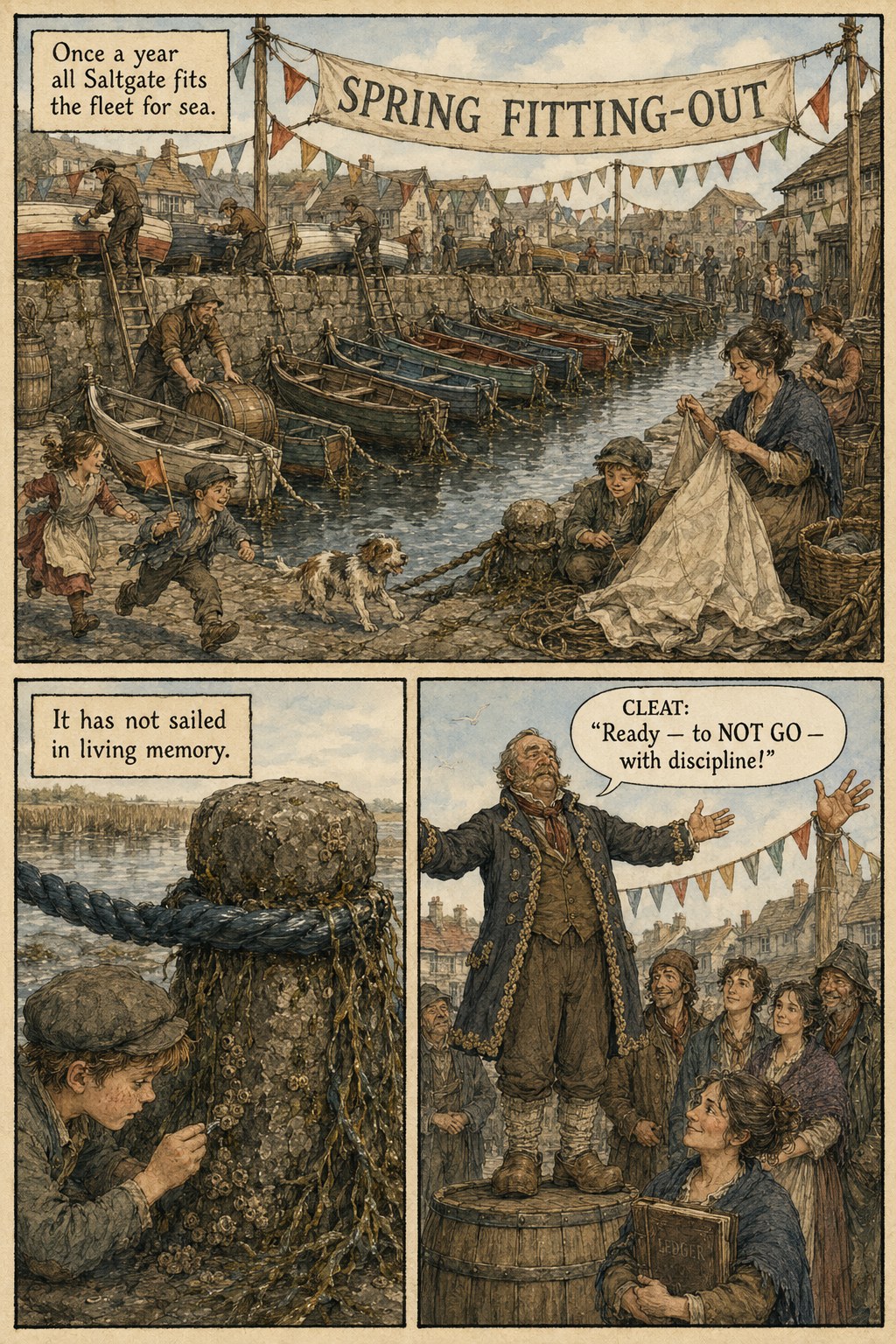
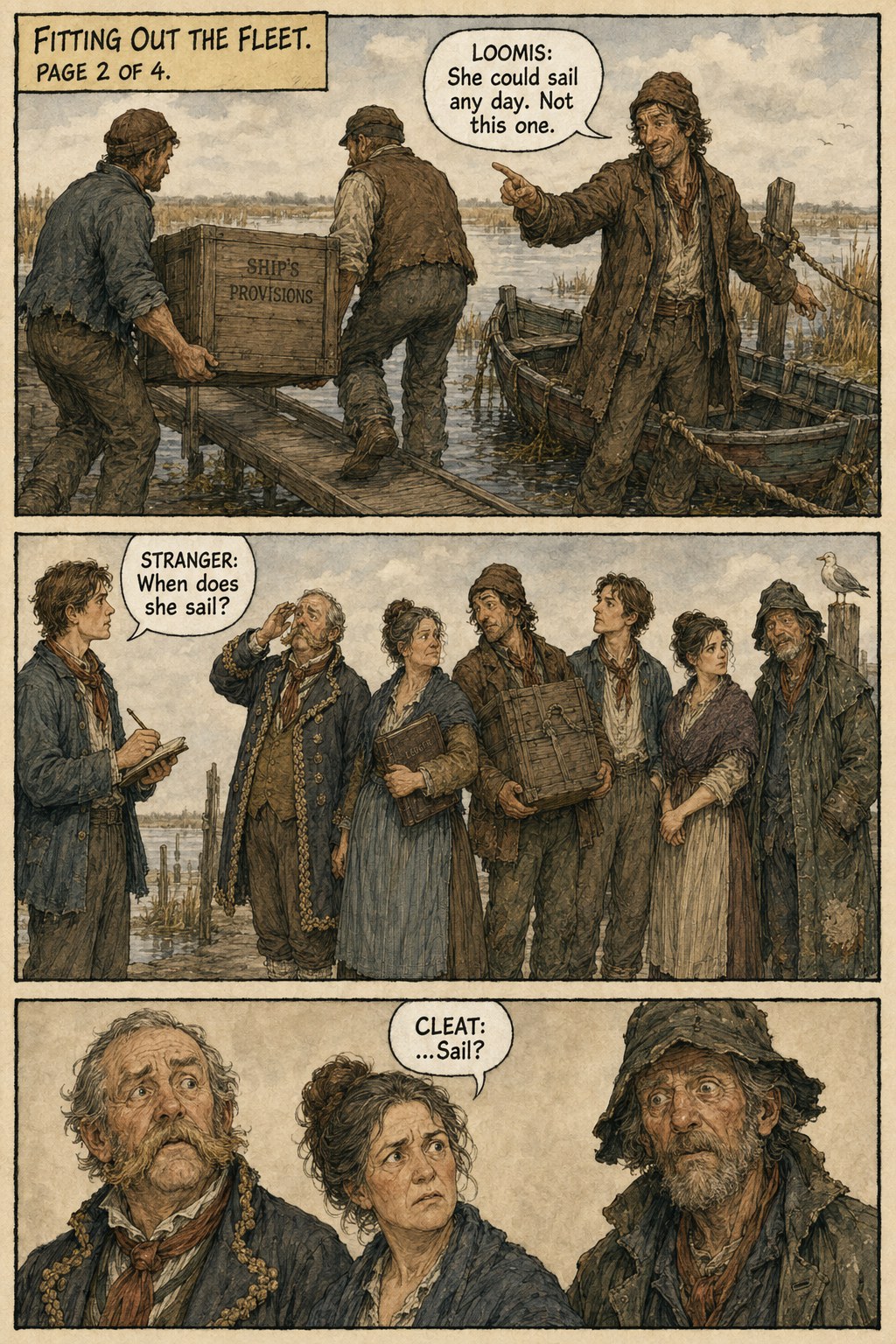
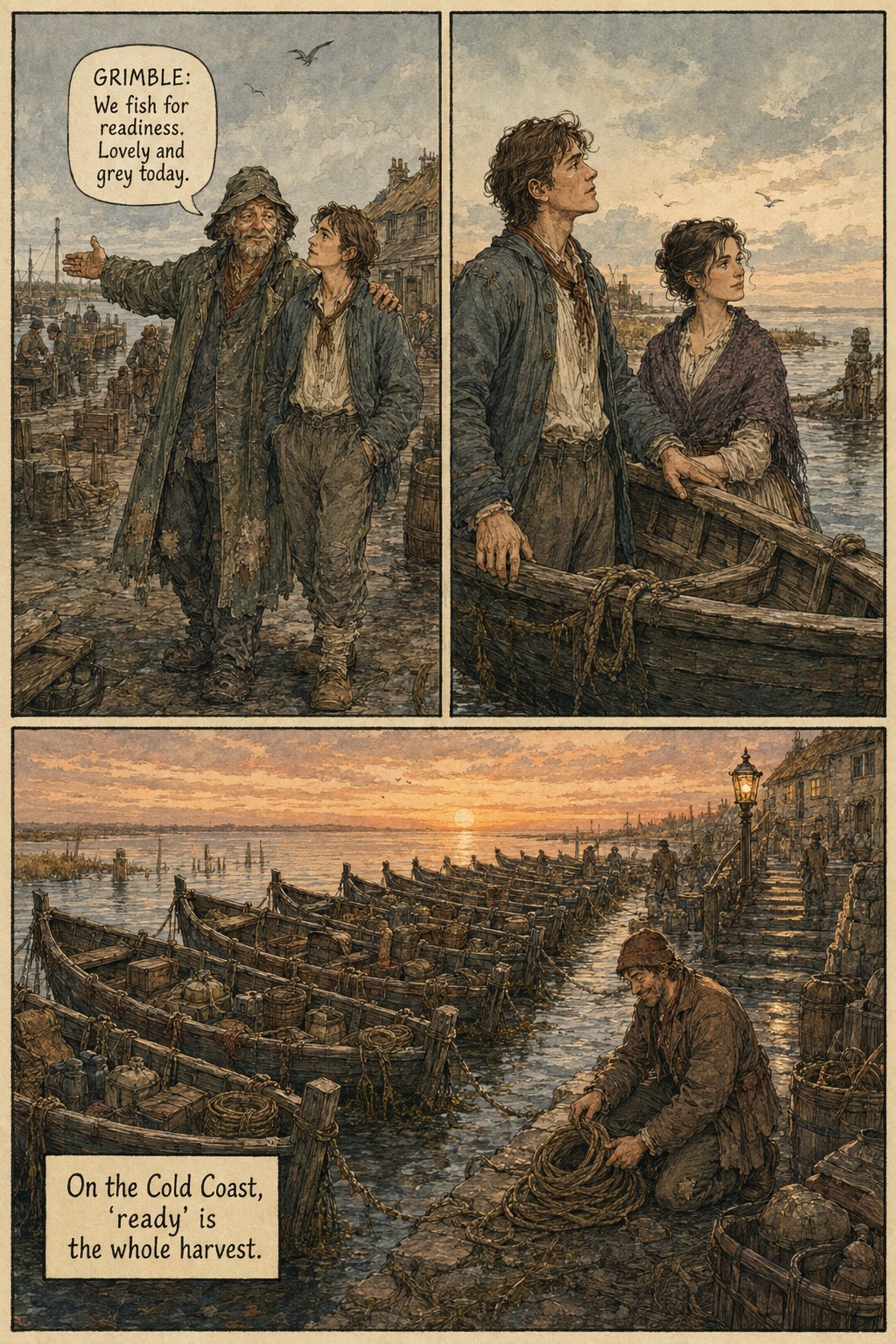
For that is where Nate's eye goes and has always gone. Not to the near shoal, which feeds them; not to the harbour, which holds them; but out, through the gap in the wall, to the open sea beyond, the far water no Saltgate boat has crossed in living memory — the sea the whole magnificent idle fleet is kept forever ready and forever unwilling to sail. Nate fishes the near water like the good son he is, and never once, in all his life, has cleared the harbour mouth, and never will; and everyone in the town knows it, the way they know the tide, and no one says it, because to a young man who aches for the far water there is nothing crueller you can say than that he is right to stay.
But in the dark, at the turn of the tide, when the net was in and the great catch taken and the two crews rested a moment gunwale to gunwale before the long pull home, Cassie Pell — from the rival boat, the wrong family, the other end of the net — reached across the little gap of black water between the two boats, quick, where the families couldn't see, and took Nate Sackett's cold hand in hers, and held it, and looked with him out through the harbour mouth at the far water, and did not tell him to stop wanting it. That was all. She held his hand and looked where he looked. And Nate Sackett, who will never in his life sail past the wall, understood in that moment that there are two far waters a man can ache for, and that one of them was sitting in the next boat holding his hand, and that this one, at least, the feud might yet let him cross.
They said nothing. You say nothing. The families hauled for home in the first grey of the returning light, Sackett and Pell together, the year's great catch shared out on the quay before the sun was properly up — so many baskets to the Sacketts, so many to the Pells, and not a fish nor a cross word between them, because for one night there had been no between. And by full morning the feud was back where it belonged, on the quay, exactly as it had been, both families swearing they'd raced the harder and taken the bigger share; and Loveday Sackett and old Goodwife Pell's people cut each other dead across the fish-market as they have for forty years, and would walk into the sea for one another, and know it, and never say.
And the far water lay beyond the harbour mouth, uncrossed, as it always lies. But Nate Sackett fished the near water more gladly that Long than he ever had — because a man can bear a sea he'll never sail, it turns out, a great deal better with a warm hand to hold while he looks at it; and because the deepest thing the Long taught him that year was that the harbour he'd spent his life longing to leave had, in it, at the other end of a net, the one crossing worth staying for.
d03 · taleThe Salt-Factor Can't Sleep
Every year, when the Short comes in and the herring must be cured before the Dark, a stone-grey boat comes up out of the west to Saltgate with salt in her, and a woman in her who does not like you.
She is the salt-factor of Cragholm. Nobody in Saltgate has ever called her anything else, and she has never offered. She is tall and dry and upright as a gatepost, with a face the wind has been at for fifty years and found nothing soft to take, and she steps off her boat onto the Saltgate quay the way a cat steps into a wet yard: with one foot, slowly, and a look of having been personally insulted by the ground.
Because the ground is wet. That is the trouble. On Cragholm there is no standing water — the rock holds none, and what little they catch in the cisterns they keep outside, covered, and do not think about, because standing water on the Hard Isle is a thing for the dead. And Saltgate is nothing but standing water: puddles on the quay, water in the boats, water in the ruts of Anchor Steps, a harbour full of it, a sky full of it. The salt-factor walks up the quay each year with her skirts held clear and her mouth shut tight, and the children follow at a distance to watch her not breathe.
She comes for Marget Reek. Marget Reek's smokehouses cannot cure a single fish without Cragholm salt, and the salt-factor knows it; and Cragholm cannot get a single thing that grows without going through Saltgate, and Marget Reek knows it; and so every Short the two of them sit down in the back of the smokehouse, among the hanging gold of the herring, and bargain like two old dogs over one bone. It takes all afternoon. The salt-factor names a price that would make a stone weep. Marget Reek laughs, once, like a door slamming. The salt-factor says the Soft Isle is offering more. Marget Reek says the Soft Isle couldn't pan salt if you gave them the sea and a spoon. And by dusk, as it always does, the bargain lands where Marget Reek meant it to land, a little lower than the salt-factor meant it to, and the two women do not shake hands, because on Cragholm you do not touch another person's hand over money, and in Saltgate you do not touch Marget Reek.
Then the salt-factor must sleep somewhere, and there is only one place that will have her: the Saltmarsh Haven, down the coastal path south of the town, where the hearth is kept lit all night so its smoke will warn boats off the rocks.
And that is where the real trouble starts.
The Haven is a good inn. It is warm, and the beds are dry, as dry as anything is on the Cold Coast. But it is still. It sits in the lee of the headland, out of the weather, and on a quiet night in the Short there is not a breath of wind about it — only the hearth breathing up the chimney, and the sea breathing on the rocks, and somewhere in the walls the tick of water finding its way down. And on Cragholm, the wind never stops. Not for an hour. Not in anyone's life. A Cragholmer is born into it and lives in it and is buried in it, and a Cragholmer in a still room lies awake all night, stiff as a plank, listening to the silence the way you or I would listen to a footstep on the stair.
The first night, the salt-factor did not sleep. The second night she did not sleep either, and in the morning she bargained so badly over the second load that Marget Reek looked at her with something close to alarm, and asked if she was unwell, and was told to mind her own fish.
It was Sprat who worked it out. Sprat is the hired boy over the Saltgate store and misses nothing, because missing nothing is how a boy with no family of his own gets fed. He had been sent down to the Haven with a basket and had seen the salt-factor at the window at first light, grey as her own salt, staring out at the dead calm water as if it had done her a wrong. And Sprat, who reads the water better than boys twice his age, understood — the way you understand a boat that won't sit right — that the woman was not ill. She was homesick for a noise.
He told Cassie Pell. Cassie Pell is the best hand in the harbour and does not waste words, so she said only, "The net-loft," and went.
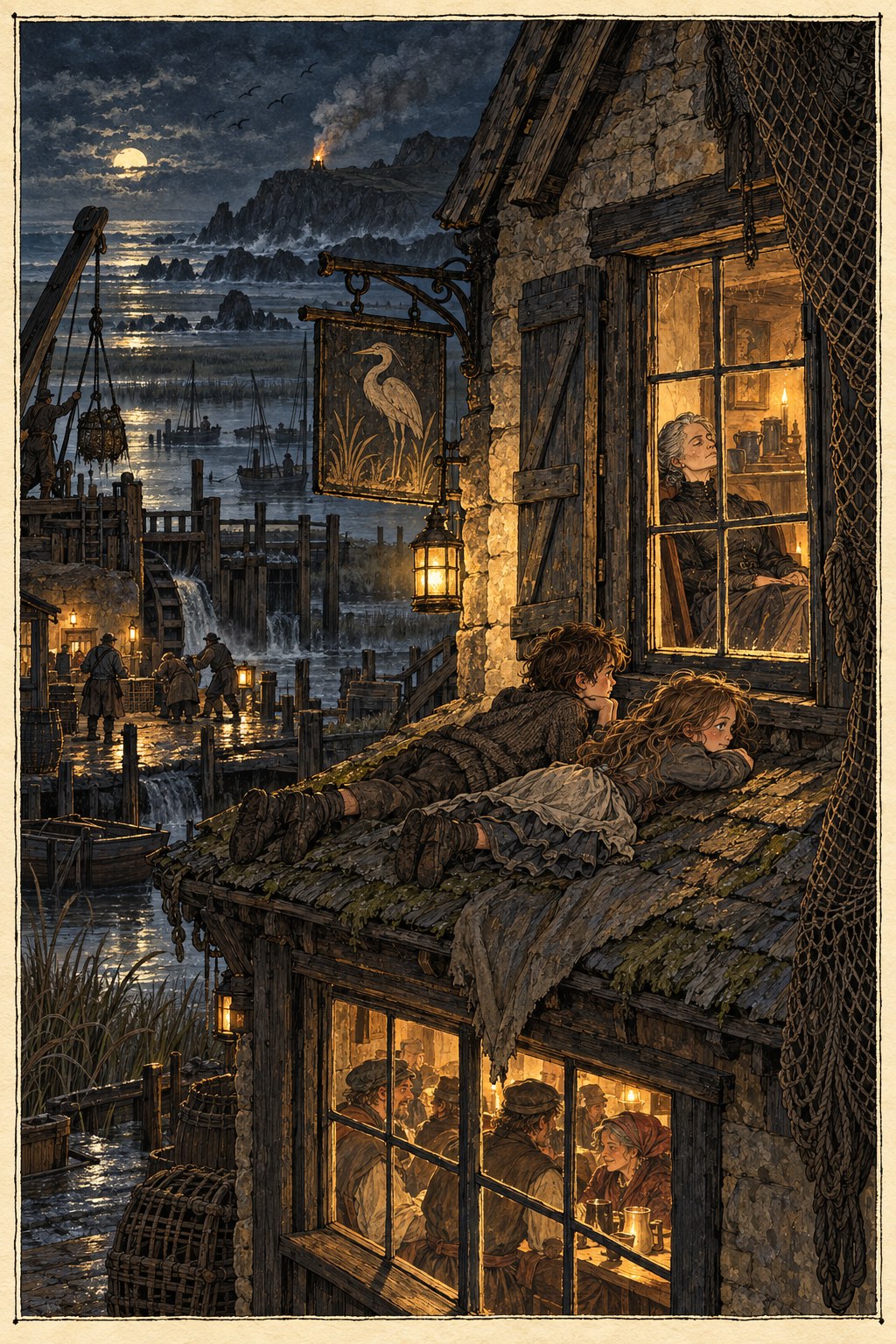
The net-loft over the Pell sheds has shutters on all four sides, for drying, and in a wind those shutters sing — every child in Saltgate knows it; it is where the tale of the Whistling Sailor comes from, and why nobody courts in the Pell loft on a blowy night. But there was no wind. So Cassie and Sprat and three children who were supposed to be in bed carried the Pell loft's spare shutters, and a coil of old net, and a great deal of borrowed twine, down the coastal path in the dark to the Saltmarsh Haven, and up onto the lean-to roof under the salt-factor's window, and set to work.
They could not make a wind. Nobody can make a wind. But you can make a draught, if you know how a chimney pulls; and the Haven's hearth, lit all night to warn the boats, pulls a great deal of air. Cassie opened the lean-to's gable end and propped the shutters in it at angles, and strung the old net across the gap tight as a fiddle, and the air the hearth dragged in across the rocks came through the shutters and over the strung net — and began, very quietly, to hum.
Not loud. Not a gale. A thin, steady, rising and falling breath of a sound, like wind round a crag. Sprat lay on the lean-to roof in the cold with his ear to the slates until he was sure it would hold, and then the children went home, and said nothing, because you say nothing.
In the morning the salt-factor came down to breakfast with colour in her face, and ate two eggs, and did not look out of the window once.
She bargained over the third load like a woman restored — so well, in fact, that for the first time in living memory Marget Reek came off the worse by a penny, and was delighted, and would not say why. And that afternoon, before she went down to her grey boat, the salt-factor walked out along the coastal path alone, and stood below the Haven for a long while looking up at the lean-to roof, at the propped shutters and the strung net, humming in the draught.
She did not thank anybody. On Cragholm you do not thank people warmly; it is taken as an insult, a suggestion that the kindness was more than a person owes. She did not smile. She did not ask who had done it, though she had seen the children watching her all week and could have counted them.
But when the stone-grey boat had gone back out into the west, and the smokehouses had the last of the season's salt, Marget Reek went to open the final sack and found, pressed down into the top of it, a second sack, small and tied tight with Cragholm cord, with no mark on it and no note. It was the finest, whitest salt anyone in Saltgate had ever seen — table salt, the Hard Isle's own best, the kind they do not sell — and there was a great deal more of it than a smokehouse needs.
Marget Reek divided it without a word. A bowl to the Pells. A bowl to the Sacketts, which went down badly with both. A bowl to the Saltmarsh Haven. And the last bowl, the biggest, up to the store eaves, where Sprat keeps his hoard of sea-glass and cork floats and the coin from a place that can't be reached; and Sprat found it there that night, and knew who it was from, and knew better than to say.
The salt-factor of Cragholm will come again next Short, holding her skirts clear of the wet and her mouth shut tight, and she will not like you. But the net is still strung under the Haven's lean-to, and nobody has taken it down, and on still nights in the Short the whole of the coastal path hums, very quietly, like wind round a rock — and the fisherfolk walking home say it is the Whistling Sailor, and the children say nothing at all.
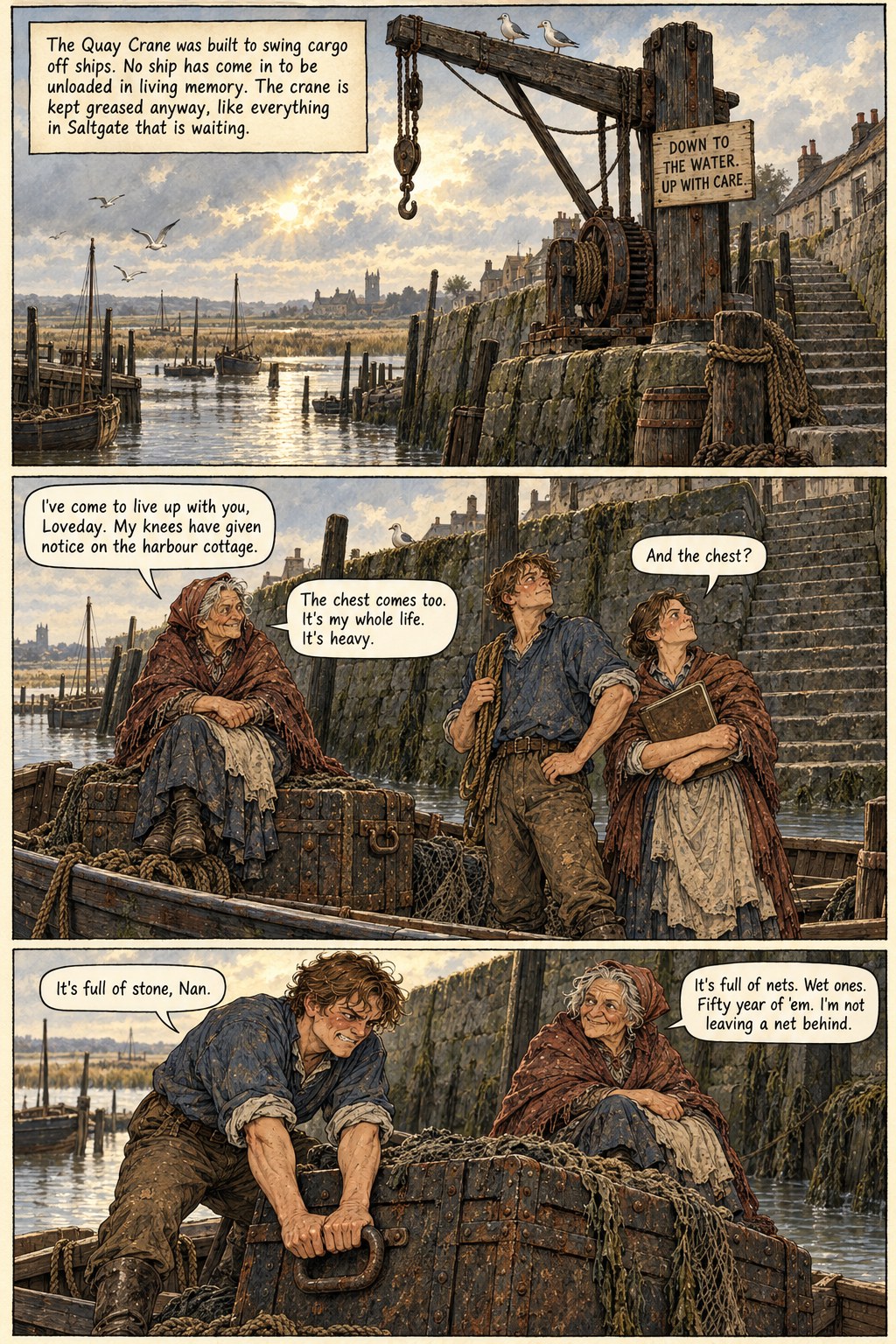
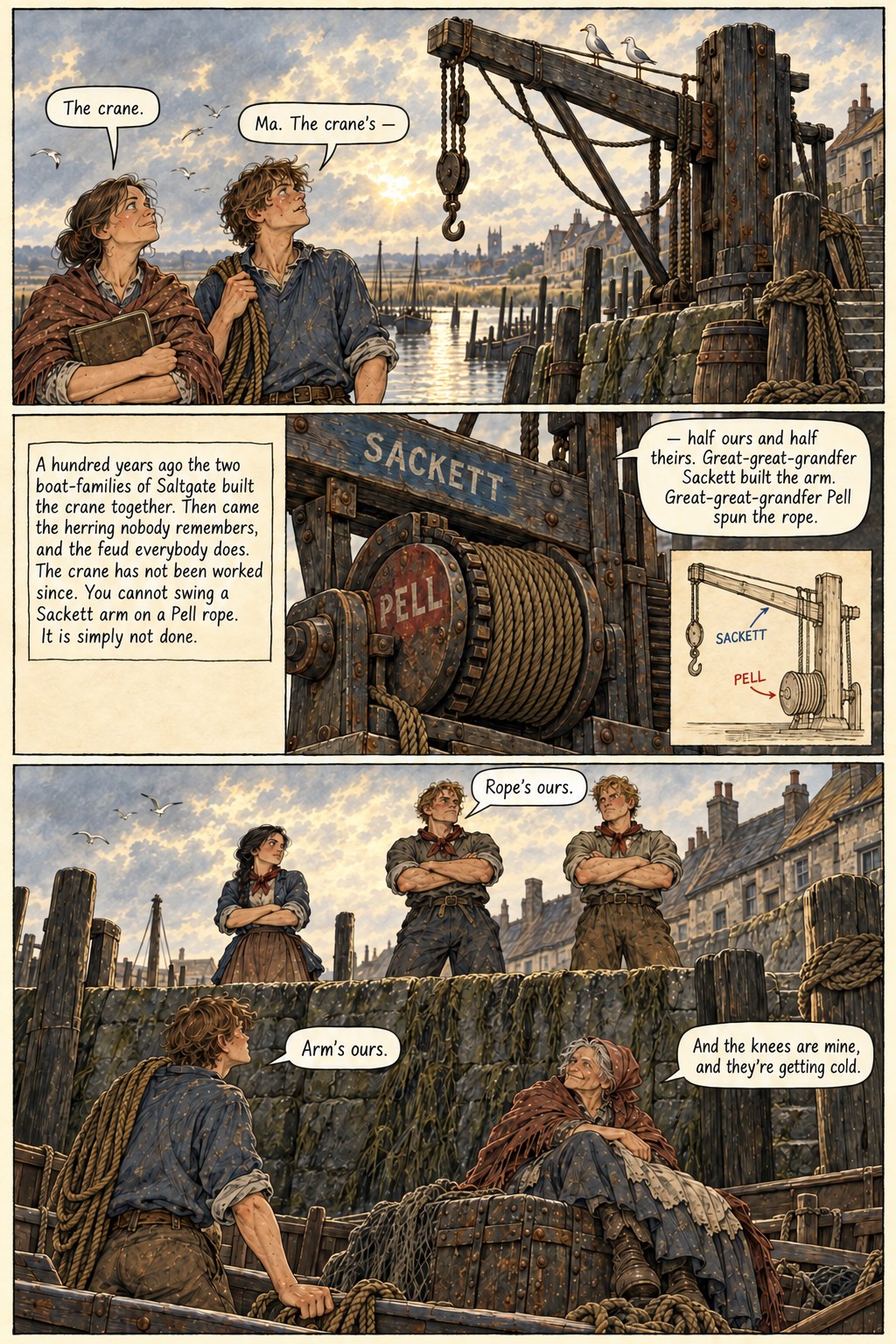
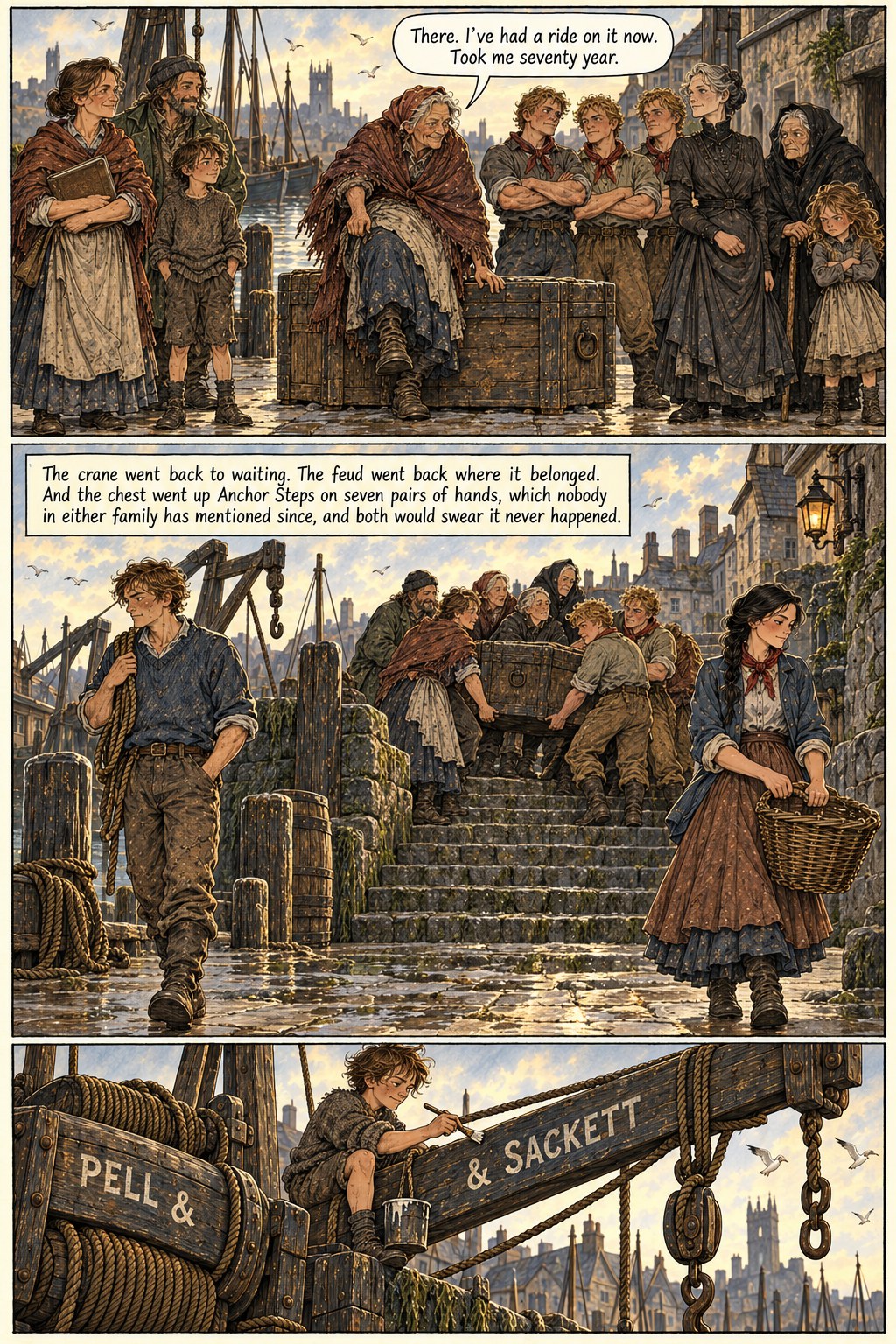
The Crane That Lifts Nothing

d05 · taleThe Windward Path
Loomis Skerry keeps the Kittiwake, the boat that is officially empty, and it is officially empty a great deal of the year, both ways, between Saltgate and the two Isles. That spring it was officially empty of reed.
A whole boatload of it: good Muckle reed, roof-grade, come down the fen in bundles and stacked on the Saltgate quay in the rain, with a certificate from the grader swearing to its quality, which nobody believed, because the grader was also the cutter. The harbour stood round it and wondered. Nobody on the Cold Coast had ever heard of anybody taking reed to Cragholm. Cragholm is rock. Cragholm buys nothing that grows, because nothing it buys will grow there; it takes Vinholm's wine and Saltgate's cured fish and the fen's timber for its boats, and it sends back salt and lime and stone, and it has no use for reed at all.
"Who wants reed," said Marget Reek, "on a rock?"
"A widow," said Loomis Skerry, and would not say more.
Nate Sackett helped him load it. Nate fishes the near water and has never once in his life cleared the harbour mouth, and everybody in Saltgate knows it, and nobody says it; and he carried reed down the quay all morning, bundle after bundle, into a boat that was going where he never would, and did not complain once, and Loomis watched him do it.
When the Kittiwake was low in the water and the tide was on the turn, Nate stood on the quay steps with his cut hands in his pockets and looked past Loomis, past the boat, out through the gap in the harbour wall at the grey water beyond — the way he always looks.
"What's it like?" he said. "Out there."
"Wet," said Loomis. "Then dry. Then wet again coming home." And cast off, unhurried as a calm tide, and did not look back; but he had seen Nate's face, and it went with him out of the harbour mouth, the way a stone goes with you in a pocket.
The Hard Isle came up out of the sea at noon: a long grey back of rock, no green on it anywhere, stone jetties on the windward side and a town of drystone houses huddled low in the lee of the crag. And the wind came across the jetty as he tied up and did not let go of him for three days. The wind on Cragholm never stops. Loomis has been going there all his working life and has never once got used to it; it was in his ears and his sleeves and his bread; it leaned on him at the corners of streets; it sang in the drystone walls, which are built with gaps on purpose so they will not blow down.
The widow's house was up the hill, at the top of the town, where the last houses give out and there is only stone and sky. On the harbour-master's chart the way up was the leeward road: a proper, marked, sheltered road that went the long way round the back of the crag, out of the wind. So Loomis loaded the reed onto a hand-cart and went that way, because he is never in a hurry, and the road went round, and round, and gave out at a quarry face with a sign on it that said, in the careful letters of the Salt-Reckoning, CLOSED FOR WEIGHING.
He went back down. A quarryman at the bottom watched him come with no expression at all, and when Loomis asked the way to the widow's, he pointed straight up the steep face of the hill, into the full teeth of the wind, at a path of worn steps nobody had put on any chart.
"Windward path," the quarryman said. "Everybody goes windward. The chart's for visitors."
"Why's the chart wrong?"
"It isn't wrong," said the quarryman. "It's sheltered. Nobody's ever wanted to go that way. It was drawn by a man who didn't like wind." And he went back to his stone, and did not offer to help, and then — when the cart stuck on the third step with Loomis's whole weight behind it — came up without a word and put his shoulder to the other side, and pushed it to the top, and went back down, and did not look round once to be thanked.
The widow was very old and very straight. Her husband had been a quarry-master and had died in the winter, and she lived now with her granddaughter, a small fierce girl of seven or so who looked at Loomis's wet coat as if it were both disgusting and the most interesting thing she had ever seen.
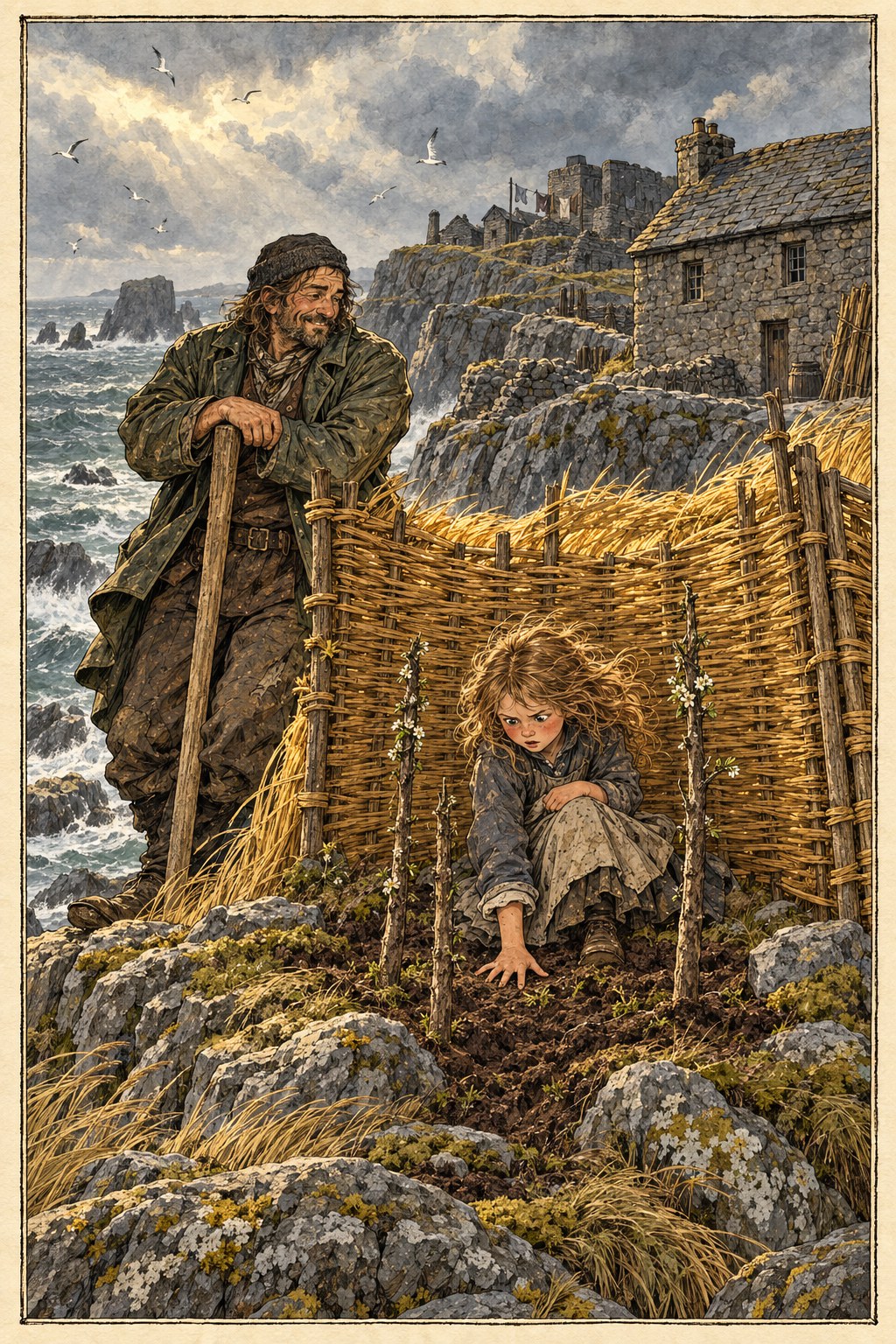
Behind the house, on the windward side, there was a scrap of ground walled round with drystone — and in it, in a trench, in soil that must have been carried up the windward path a basket at a time, there were six little sticks.
"Hawthorn," the widow said. "From the fen. My husband had them off you, last year. He wanted the child to have a hedge. Something green that isn't a Vinholm grape." She looked at the sticks. "They'll not live, of course. The wind takes them."
It did. The six sticks were bent flat to the ground, three of them already dead, the soil round them scoured to the stones.
"You don't grow a hedge on a rock," said Loomis, as if it were obvious. "You grow a hedge behind a reed fence, and you keep the wind off it for three years till it's tall enough to keep the wind off itself. Every child in the Bogmoor knows that. Nobody on Cragholm does, because nobody on Cragholm has ever had reed to try it with."
So he built it. It took two days, and the whole of the good Muckle reed: a thick woven fence of fen reed, bound in bundles, staked deep into the drystone on the windward side of the little trench, curved round the hawthorns like a cupped hand. The granddaughter carried stakes and gave orders. Neighbours came to the wall to watch and said nothing, and then, one by one, as Cragholmers do, climbed over it without a word and helped, and went home again without a word, and were not thanked, because you do not.
On the last evening the wind came round the crag as it always does, and hit the reed fence, and the reed fence sang — a soft, dry, rushing sound, a sound from somewhere else — and behind it, in the still air, for the first time since they were planted, the three living hawthorn sticks stood upright.
The granddaughter sat down in the lee of the fence among them, where there was no wind at all, and put her hand flat on the soil, and looked up at Loomis with her face gone entirely astonished.
"It's quiet," she said. "In here it's quiet."
"That's what it sounds like in a fen," said Loomis. "All the time."
She thought about that. "I'd not like it," she decided. "Not all the time." And then, after a while, lower: "Just here."
He sailed the next morning. The widow came down the windward path to the jetty, which she did not have to do, and stood on the stones as the Kittiwake pulled away, and did not wave, because on the Hard Isle you do not. But she had put a sack in the bottom of the boat while he was busy, and when Loomis opened it halfway home it was salt — Cragholm's best table salt, which they do not sell — and a small stone, flat and grey, with a single word scratched into it in the careful letters of the island.
He knew who that ought to go to. He had known since the quay.
The Kittiwake came home into Saltgate on the evening tide, past the harbour wall, into the grey water, where the fleet sat ready and unsailed along the quay exactly as it had when he left. Nate Sackett was on the quay steps. Nate is often on the quay steps at that tide.
Loomis tied off, and climbed up, unhurried, and put the flat grey stone into Nate's cut hand without a word, and went off to the Arms.
Nate turned it to the last of the light. "Windward," he read. "What's that mean?"
"It's the way up," said Loomis, over his shoulder. "On Cragholm. The one that's not on the chart. They go the hard way, into the wind, because it's the way that gets there." He paused at the door of the Arms. "Your reed's keeping a little girl's hedge alive on the top of a rock, Nate. It sings when the wind hits it. Thought you ought to know you'd been."
And he went in.
Nate Sackett sat on the quay steps until it was dark, turning the stone over in his hands. He did not look out through the harbour mouth quite as long as usual that night. Some of him had been past it now — only as far as the near water, only as far as a fence round six sticks for a child he would never see — and he found, holding the grey stone, that it had been enough to know the wall was not the end of the world. And that when Cassie Pell sat down beside him on the step, quick, where the families couldn't see, and asked what he'd got there, he had, for the first time in his life, a far-water story of his own to tell her.