A Year at Mucklecombe
A Year at Mucklecombe
The Year
- Planting Day at Mucklecombe — tale
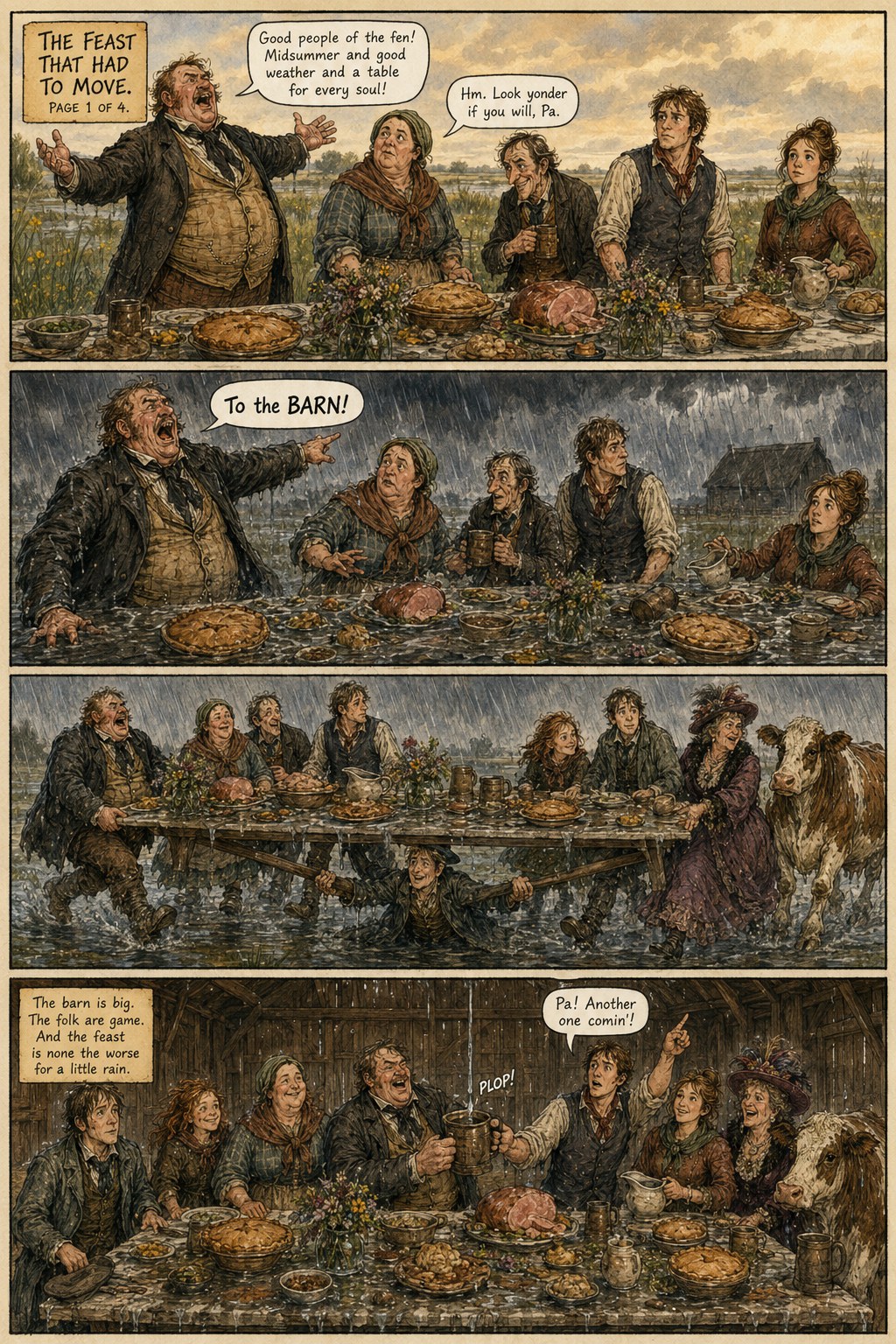
- The Feast That Had to Move — comic
- The Undeclared Harvest — tale
c01 · talePlanting Day at Mucklecombe
Planting day at Mucklecombe began, as it always began, with Pa Muckle standing in the yard at first light telling the weather what it was going to do.
"Fair," said Pa, to the sky, which was not listening. "Fair and drying, with a warm wind up from the Griddle by noon. It says so in the book." He held up the book. The book was Podd's Compleat Kalendar for the Turnip Country, three years old, and it did indeed say fair and drying, because Pa was holding his thumb over the word unless.
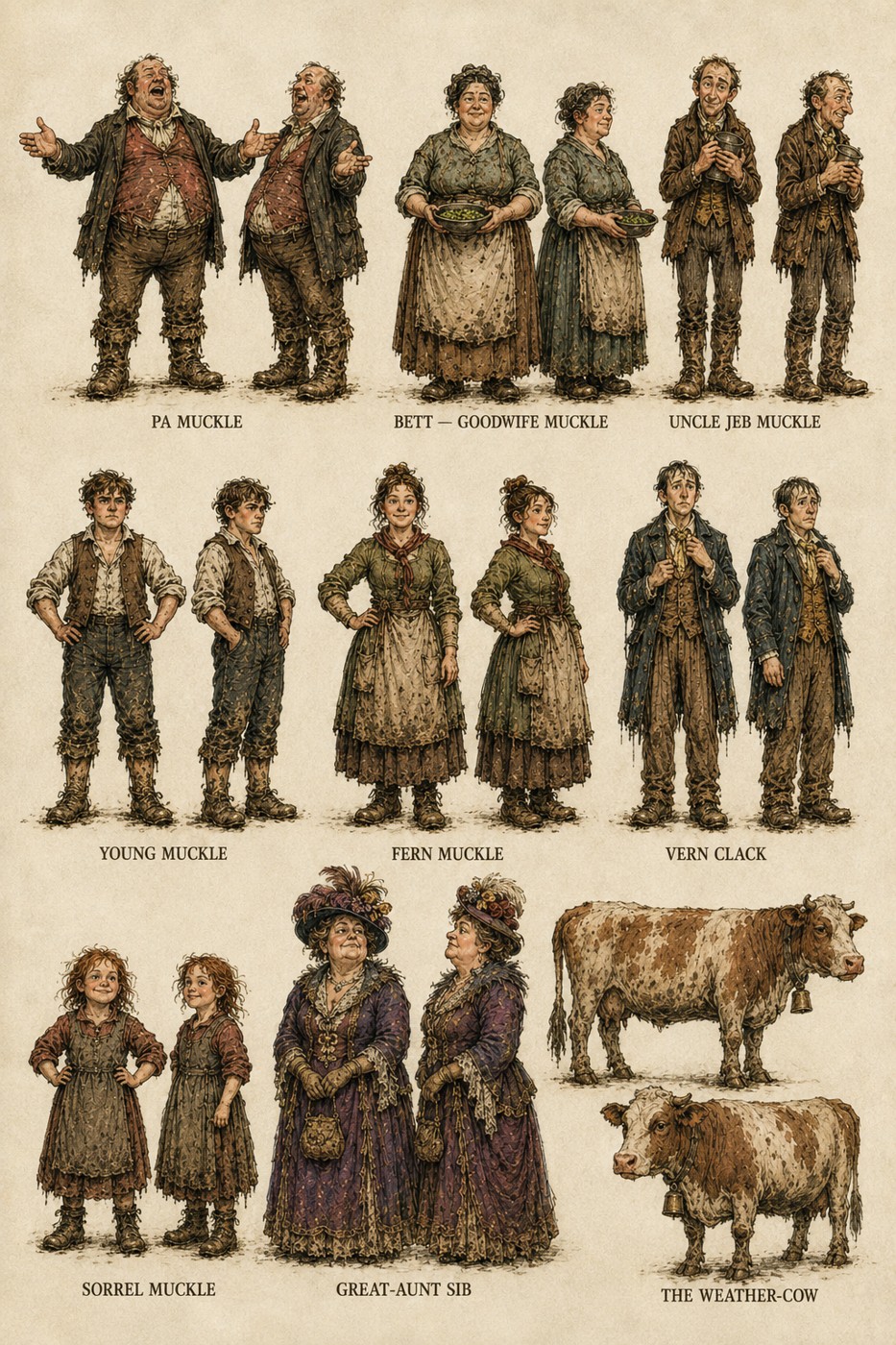
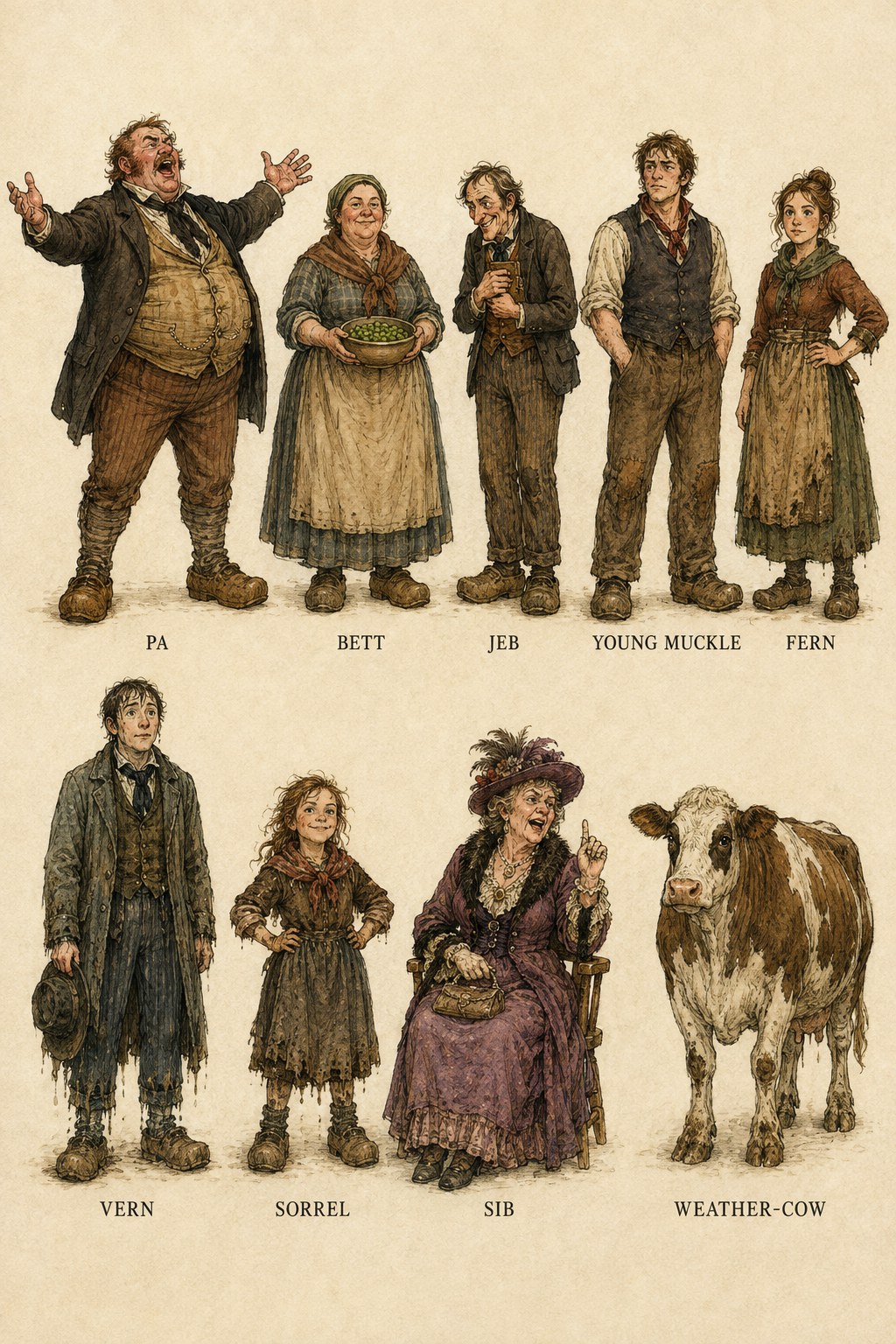
Bett came out with his breakfast and read the sky in the time it took her to hand him the bowl. "It'll rain by the dinner bell," she said, "and the low field's a bog to the knee, and if you plant Jeb's good corn in it you'll grow nothing but a fine crop of ducks." Bett was Goodwife Muckle on the green and at church, where she ran the parish; she was Bett in her own yard, where she ran everything else. "But you'll not be told, so I've told you, and now my conscience is clear and my porridge is going cold indoors."
"The book, Bett," said Pa, wounded.
"The book's three years dead and never once been wet," said Bett, and went in.
Now, the seed-corn. Here was the first thing the almanac had not thought to mention, which was Uncle Jeb.
Uncle Jeb had, over the winter, and entirely for the good of the family, moved the best of the seed-corn to a place of safety. The place of safety was known only to Jeb, and the reason for it was that a thing put somewhere safe could not be borrowed, spent, eaten, gambled, lent to a Tussock, or planted before Jeb had satisfied himself, over a long and reluctant morning, that planting it was truly necessary and there was no cheaper way. When Young Muckle came for the seed, Jeb met him at the barn with the particular pained expression of a man being asked for a kidney.
"The good corn," said Jeb, as though Young Muckle had proposed something coarse. "You'd not want the good corn, boy, not on a day like — " he looked at the fair, drying sky " — a day like this. No. What you want," and here his voice went soft and warm as a spread of butter, "is the thrifty corn. I've a sack of the thrifty corn put by special."
The thrifty corn was last year's sweepings, and three mice.
This might have been the whole disaster, except for the second thing the almanac had not foreseen, which was Vern Clack, trying to help.
Vern Clack had been a Murkminster clerk. He was, this Light, some months into being a Muckle instead, and he was trying so hard and so visibly to be useful that the entire holding had quietly agreed to love him for it and never, ever, let him near anything that mattered. But Fern had said, at breakfast, without looking up, that a man could learn to plant, and Vern had heard in it a commission from on high, and so when he found Young Muckle carrying two sacks and cursing, he seized the heavier one — the good corn, the real corn, the corn Jeb had at last surrendered with the air of a man watching his own funeral — and he strode off to be helpful with it, at speed, in entirely the wrong direction, toward the low field.
The low field. The bog to the knee.
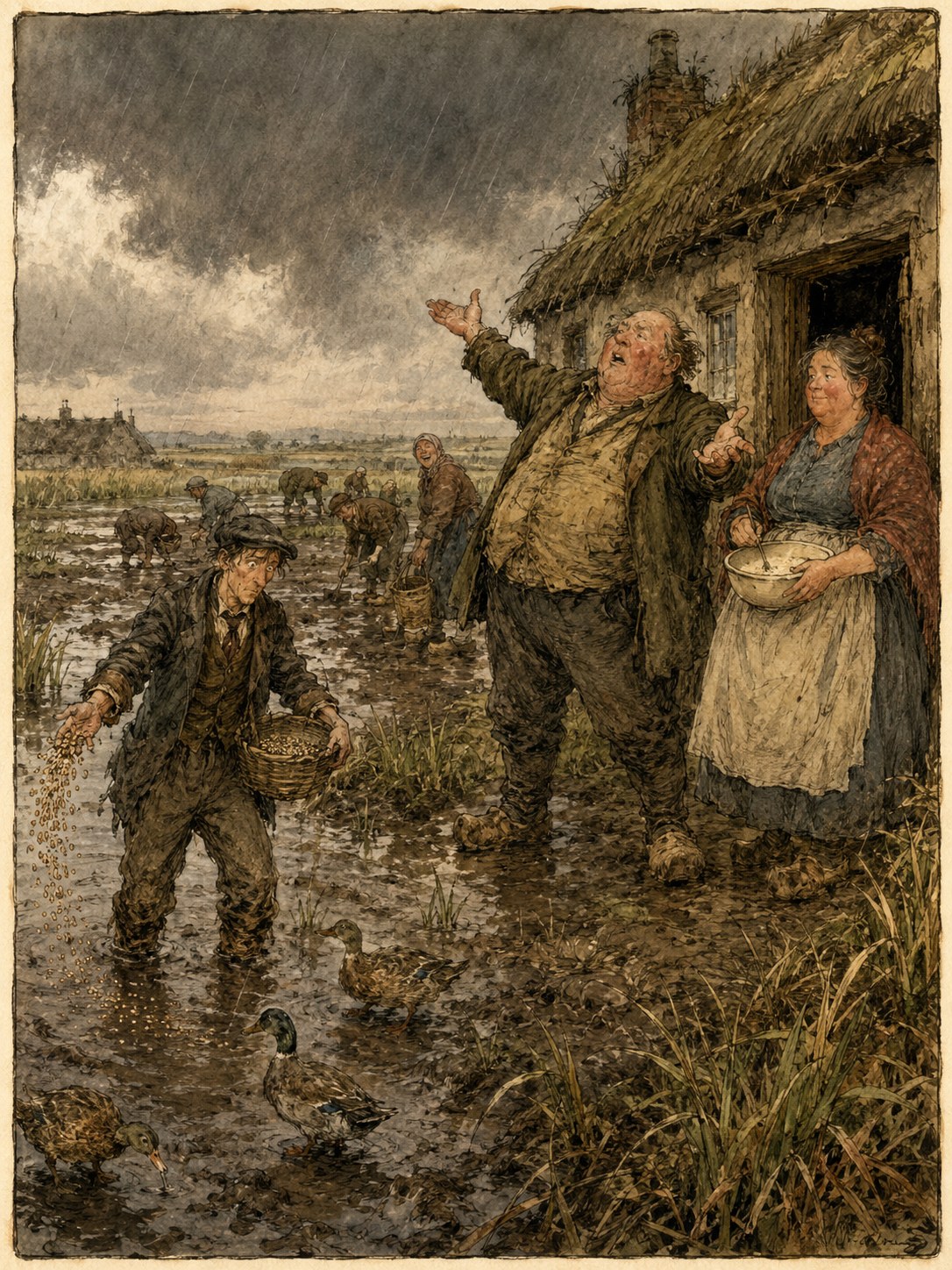
By the time they caught him he had, with tremendous energy and the very best intentions, broadcast a third of the good seed-corn across the one stretch of Mucklecombe where nothing but ducks would grow, and he was standing in it to the shins, beaming, calling back, "It's marvellous soil down here! Ever so soft!"
And then, on cue, and precisely as the book had promised it would not, it began to rain.
There is a way a farm can go, at a moment like that. Pa going purple over his book; Jeb keening over his corn like a widow; Young Muckle laughing so hard he sat down in the wet; the rain coming on; the year's whole gamble sinking, seed by seed, into a duck-bog — and somewhere at the back of all of it, if you let yourself feel it, the true cold fact underneath the comedy: that this one day, got wrong, is a thin winter eight months off, and a thin winter is not funny at all to anyone who has had one.
Fern felt it. Fern always felt the cold fact under the warm day; it was why the house turned to her without ever deciding to. She came across the yard wiping her hands, took one look at the low field, one look at Vern standing hopeful and soaked and ruinous in the middle of it, and did three things.
She sent Dib and the little ones down the bank with baskets, because seed broadcast on wet ground sits on top a while before it drowns, and small quick hands can lift a deal of it back before it does. She sent Young Muckle running for the Tussocks — the Tussocks, the rival house, the hundred-year feud — because the Tussocks' high field was already turned and drilled and they had the drill and the daylight to spare, and a feud is a fine thing but nobody at Mucklecombe was going to be short at the turn for the sake of it. And she took Vern by his wet sleeve and did not scold him, which he had braced for, and would almost have preferred.
"You've a clerk's hands and a clerk's eyes," she said. "You can't plant. But you can count, and there's not a soul on this holding can tell me true how much good corn we've truly got left, because Jeb's hidden it, and Pa's guessed it, and you're the one man here who's never once lied about a number in his life."
Vern looked at her. Something went straight in him that had been bent since Murkminster.
"I can count," he said.
"I know," said Fern. "Go and be the only honest ledger in Bogmoor. It's the most useful thing you'll do all year."
So he did. And it was the strangest sight of that whole strange day: the ex-clerk of the capital, up to his shins in the Bogmoor bog, kneeling in the rain with a slate, gravely counting recovered seed-corn back into the sack grain by grain while the children fed it to him basket by basket and Jeb hovered at his shoulder weeping with relief at every full count — because a thing that is counted, to Jeb, is nearly as safe as a thing that is hidden, and here at last was a man making his corn safe in a way Jeb could understand.
The Tussocks came, and brought their drill, and their scowls, and stayed, without anyone remarking on it, until the light was gone. The good corn, most of it, went into the high field where it should have gone at first light, before the book and the thrift and the helpfulness. The low field they left to the ducks, and the ducks were very pleased. Bett fed thirty people at a table meant for twelve, and never said I told you, which everyone understood to be the loudest I told you in the history of the fen.
And the year's gamble went into the ground after all, a day muddier and a house fuller than the almanac had drawn it — because the almanac had reckoned on the weather, and the seed, and the soil, and had left out, as almanacs always leave out, the only things that ever actually got a crop into a Sogmarsh field: a girl who felt the cold fact early, a feud set down for an evening, an honest man given the one job he could do, and a great damp sprawl of people who would not, on any account, be short at the turn.
Pa stood in the yard at dusk, soaked to the skin, watching the last of the Tussocks cart away up the drove.
"Went well, I thought," said Pa. "Went very well. It says here it would." He held up the book. His thumb had slipped. It now covered the word fair, and left showing, in Podd's small determined print, the one honest word the whole day had been organised around: unless.
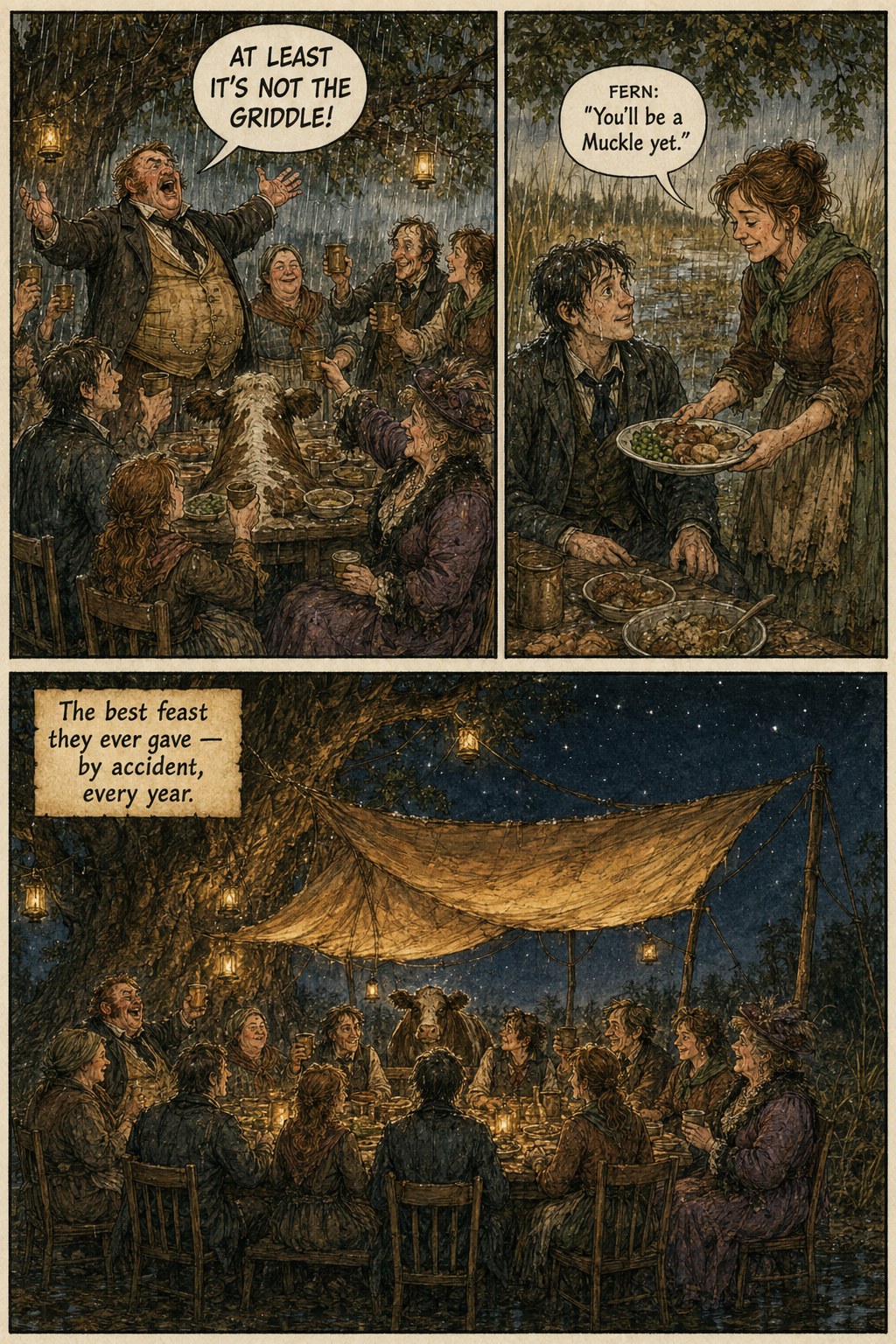
The Feast That Had to Move


c03 · taleThe Undeclared Harvest
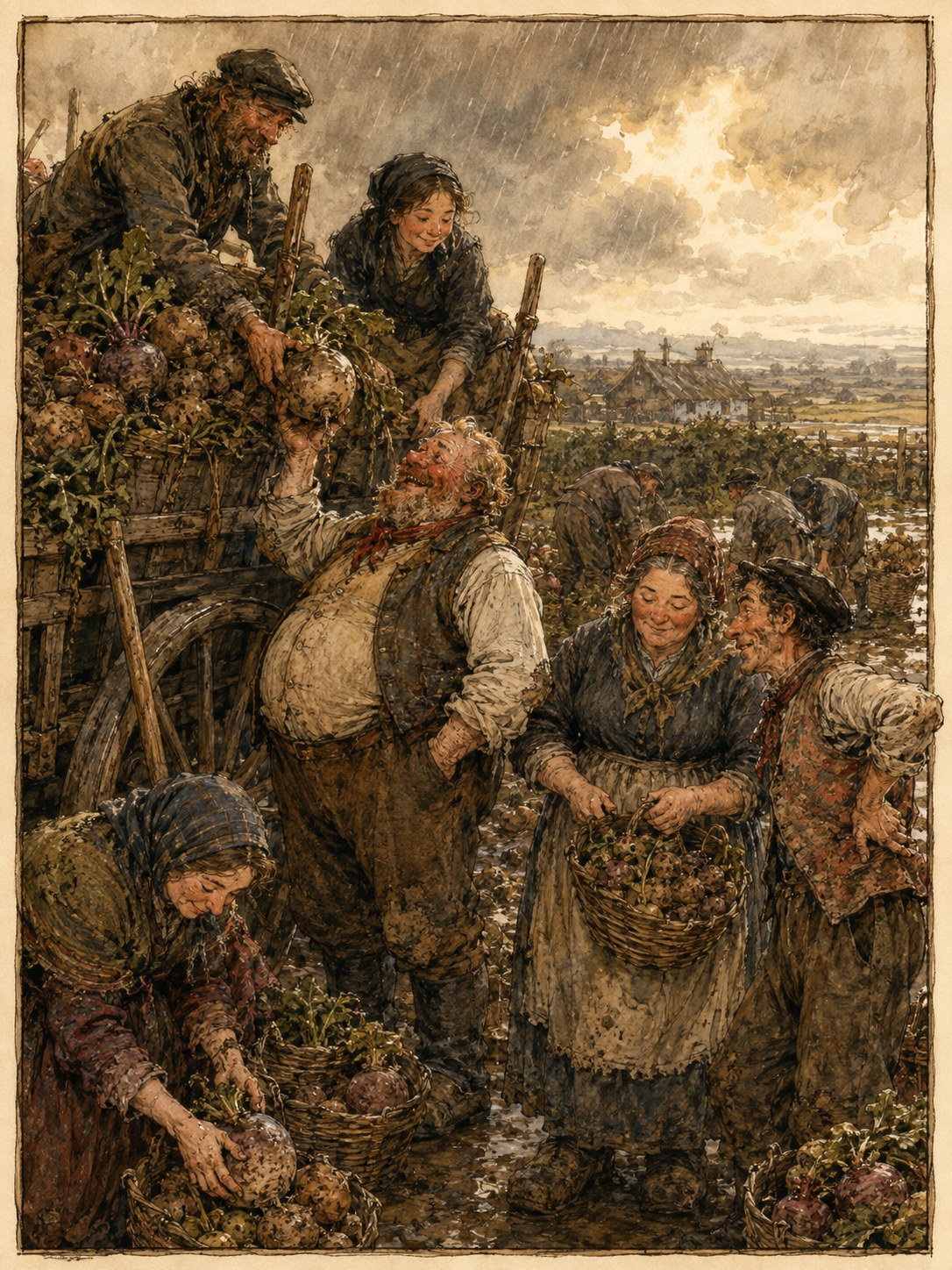
It was a good harvest that Short — the barns full, the lofts full, the ale-fruit heavy, the turnip country doing, for once, the one thing it is named for — and that was precisely the trouble, because a good harvest at Mucklecombe is a dangerous thing to be caught having.
The danger came up the Nettlewick road on the appointed morning in the shape of Mr Sallow the Tithe-Man: dry, courteous, dressed in the grey of a man whose whole office is subtraction, come to assess the yield of the holding and set against it what the holding owed. And what a holding owes, in the realm, is reckoned off what it is seen to have.
Uncle Jeb had of course been at work for a week. The best of the harvest had gone quietly to the places Jeb keeps things: the undeclared produce, the off-ledger side, the barter-heap, the two-tier economy that is the whole secret art of feeding a damp farm through a hard year. On the day, the visible barn had been arranged to look like the barn of an honest, modest, faintly unlucky family who would be very glad of the Tithe-Man's understanding. Jeb met him at the gate already grieving, already poor, already three sacks lighter than the truth.
And here was the new thing that Short, the thing that had not happened in any year before: there was, now, at Mucklecombe, a man who could not lie about a number.
Vern Clack had been a Murkminster clerk. Numbers were his mother tongue; a false figure showed to him the way a wrong note shows to a musician, and he could no more write forty sacks over sixty than he could sing flat on purpose. Mr Sallow, who knew a clerk's hands when he saw them, went straight to Vern with his ledger, smelling an honest man, and asked him — pleasantly, professionally, one paper-man to another — for the true count.
And Vern stood in the barn door with the whole warm groaning truth of the harvest behind him and the Tithe-Man's pencil poised, and felt the old Murkminster rectitude come up in him like water in a boot, and opened his mouth to give the honest number — because that is what a number is, he had always known, a number is the truth and you do not bend it —
— and then he saw Fern across the yard, not watching him, trusting him, up to her elbows in the last of the apples; and he saw Bett in her chair by the door, who had fed him when he was a debt come to collect a debt; and he saw old Sib, and young Sorrel, and the whole vast sprawl of the clan who had, without once discussing it, decided to love him — and he did the arithmetic he had never in his Murkminster life been taught to do. He worked out what the honest number cost.
For the honest number was not the truth. That was the thing no clerk in the capital had ever told him. The honest number — sixty sacks, written plain — was a family taxed to the bone off a good year, with nothing put by, so that the next year, the thin one that always comes, would find them with an empty loft and a full tithe and a winter no one lived easily through. And the "false" number — the modest number, the Bogmoor number — was not a lie about the harvest. It was the truth about survival. The undeclared produce was not hidden income; it was the margin between a family and hunger. The barter was not trade; it was the parish keeping itself alive off the books because the books, kept honest, would kill it.
So Vern Clack, who could not lie about a number, did not. He did something a Murkminster clerk would have called worse and Bogmoor called sense: he found the honest way to render the true thing. He showed Mr Sallow, in the man's own language, in columns the Tithe-Man could not fault, that the yield and the surplus were not the same figure — that a wet holding's true assessable surplus, after seed held back, after the barter that was not income, after the margin any sane man keeps against the fen, was modest indeed. Every number he wrote was true. The picture they made together was mercy. It is the hardest sum in the realm, and Vern, who had crossed a whole country to learn it, did it in an afternoon and never once bent a figure.
Mr Sallow read the columns. Mr Sallow was not a fool, and knew, more or less, what he was looking at, the way every Tithe-Man in the realm knows and every Tithe-Man in the realm decides, holding by holding, how hard to look. He looked at the modest columns, and at the immodest smell of the barn, and at Bett Muckle watching him from her chair, and he was given — as every visitor to the Muckles is given — a very great deal to eat, and a place at the fire, and an afternoon of being, for once, not a subtraction but a guest. And he assessed the holding as modest, and took his modest tithe, and went back down the Nettlewick road fed, and warmer than he came, and a little absorbed, the way they all are.
That evening Jeb moved a third of the good harvest quietly on again — not to his hoard this time, but out, in the dark, by cart: to the Rennies down the wet road, whose own harvest had failed that Short, and who would have gone into the Dark short but for a load of turnips that arrived at their door from nobody, with no word, and no bill, and no chance ever of being declared on any ledger in the world.
That is the undeclared harvest. Half of it is hidden from the Tithe-Man; the other half is hidden from the people it feeds, so they need never know they were carried. And Vern Clack lay awake that night not with a clerk's guilt but with something new and enormous, which was the understanding that he had spent his whole honest life adding up the wrong thing — and that the truest ledger in Bogmoor was the one that would never, on any account, be allowed to balance.