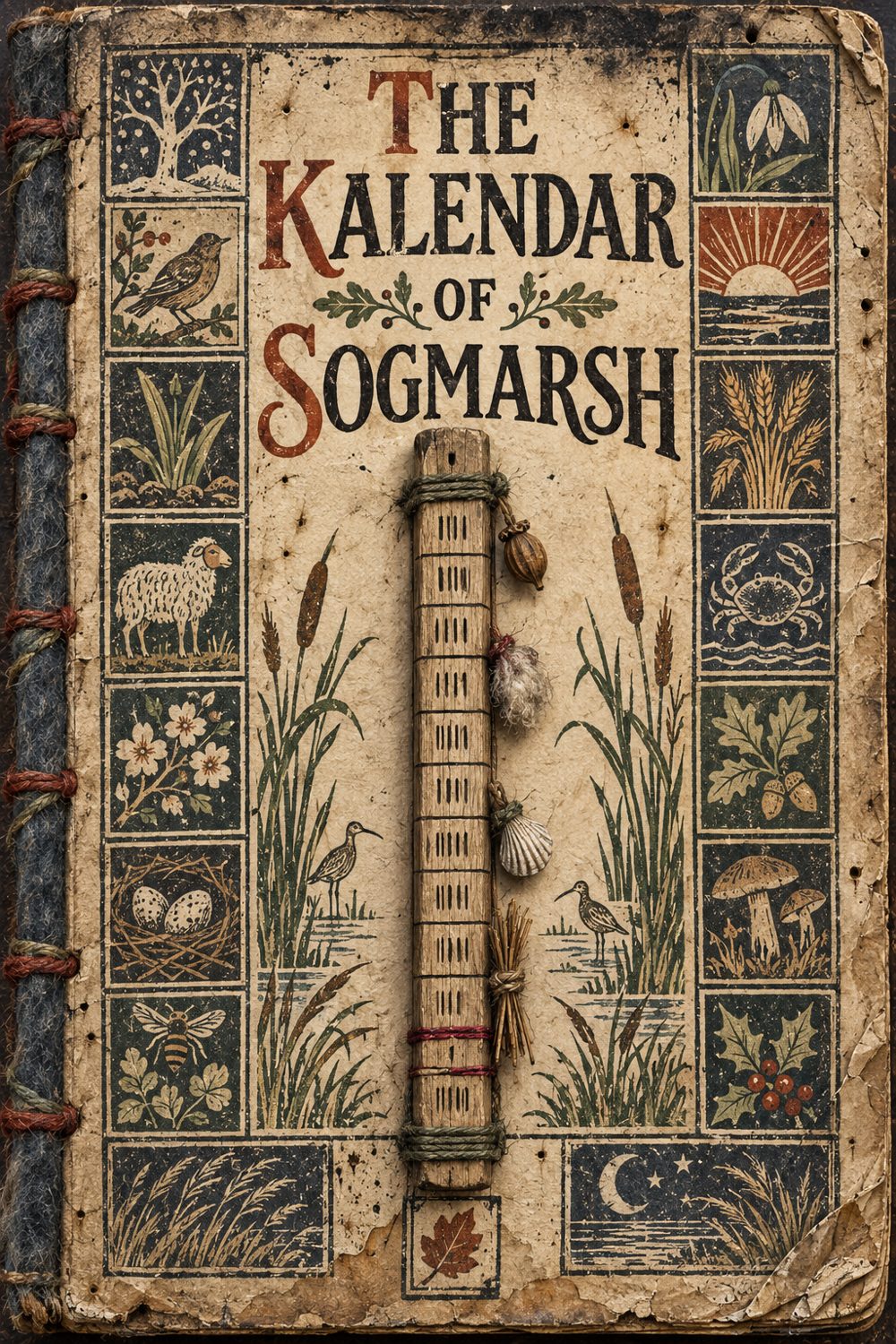
THE KALENDAR OF SOGMARSH
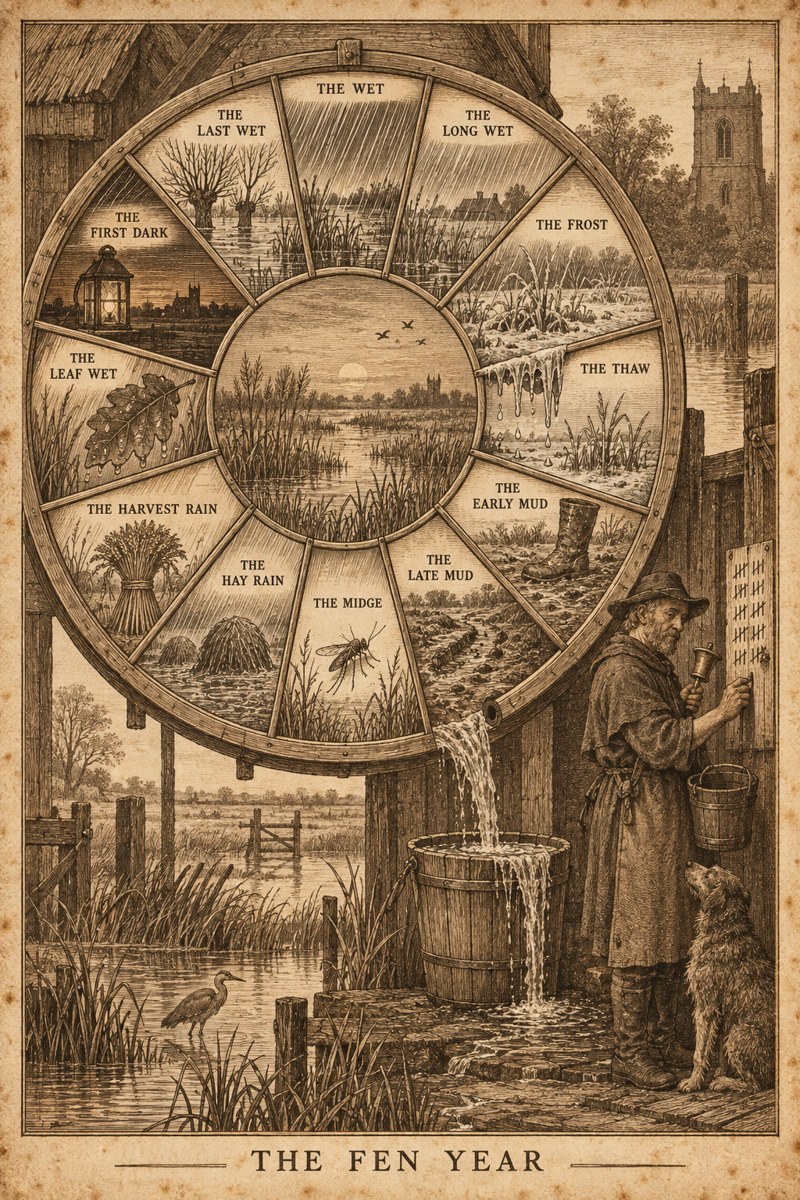
JANUARY, locally "the Wet." The year opens when the first bucket overflows, which the Castle observes with a short ceremony and a long argument about whose bucket it was. Taxed this month: optimism regarding firewood. Forbidden: predicting the weather aloud, as the weather is easily encouraged.
FEBRUARY, "the Going's Month." The pink slips go out thickest now, and the black moped may be heard at all hours, coughing across the mire like a polite apocalypse. The Sexton respectfully asks parishioners to be packed and ground-floor. Taxed: nothing, out of decency. Forbidden: dying in an upstairs room with a narrow staircase; it is inconsiderate.
MARCH, "the Re-Survey." The Grand Cartographic Revision Committee sets out to measure the realm, which rearranges itself to greet them. One theodolite is lost annually; it is in the budget. Persons finding a theodolite are asked to keep it, as returning them only encourages the Committee.
APRIL, "the Rising." The Church of the Blessed Loaf holds its Feast of the Rising, at which the faithful stand very still in a warm room until they feel improved. Souls are weighed against flour, in flour, for flour. Taxed: crumbs. Forbidden: punching down.
MAY, "the Weir-Month." The eel-weir opens, and with it the courting season, it being agreed that a person seen untangling eels is a person of prospects. Betrothals are declared by the exchange of insults regarding one another's potatoes; the fonder the couple, the worse the insult. Weddings follow, weather permitting. The weather does not permit; weddings follow anyway.
JUNE, "Goose-tide." The annual Haver Goose Tournament does not take place, as it has not taken place every June since 1672, without interruption. The East Wing is unavailable. Persons hearing honking, cheering, or the presentation of a perpetual trophy are mistaken, and should say so.
JULY, "the Drought." For up to three weeks it may not rain. The mud firms to the consistency of pudding, two ponds are formally downgraded, and the realm grows uneasy, as a fish grows uneasy in a lowering bucket. Taxed: shade. Forbidden: enjoying it.
AUGUST, "the Weeping Season." Old Mother Stilton's larder is sealed for the month, and the footmen are counted going in and counted coming out. What weeps in there, and why the scrapings must be guarded, is dairy business and none of yours. Taxed: appetite. Forbidden: toast within forty feet of the fourth shelf.
SEPTEMBER, "the Audit." The Great Potato Audit, high holy month of House Pennyworth. Every King Edward in the realm is counted, entered, taxed, mislaid, and counted again. The Great Hall smells of soil and arithmetic. Forbidden: eating the evidence.
OCTOBER, "Wondering-Month." Culminates in Wondering Night, when the children of the realm are permitted to ask, aloud and unpunished, the year's stock of questions their elders have been not answering. Classified by the Castle as Sedition, Mild. Chairs are turned to face the door. Nobody will say why. That is a Wondering for next year.
NOVEMBER, "the Tarrying." Saint Tarry's Day, patron of the about-to-be-served. The feast is laid, the queue is formed, and the whole parish stands in it together, in the drizzle, contentedly, for the feast that is at all times just about to begin. It is considered the most honest day of the year.
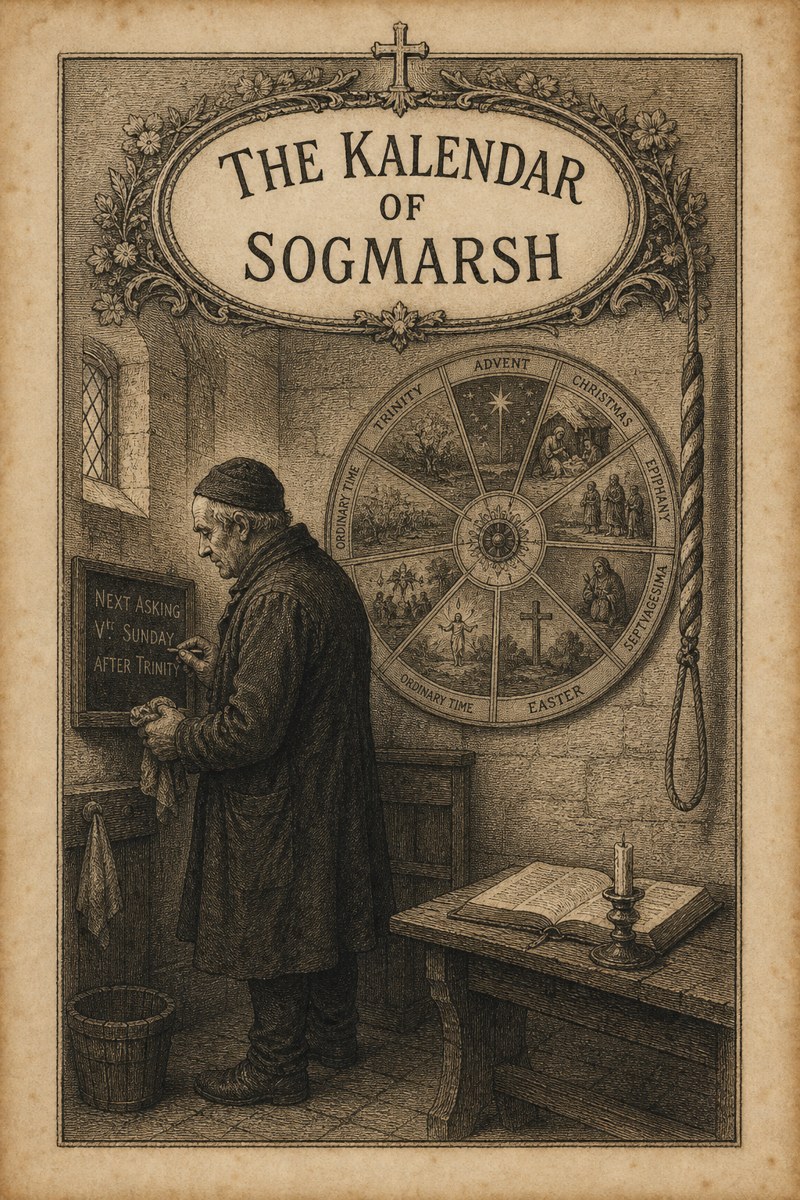
DECEMBER, "the Asking." On the last night, the Sexton goes out to the gate and formally asks the year to finish. The year declines. The bell that would mark it is oiled, raised, and not rung. The Sexton notes "carried forward" in the register, as his predecessors have noted since the register began, and goes in to his supper, and the Wet begins again.
Small print: corrections to this Kalendar may be submitted in writing to the parish, where they will be weathered until legible as agreement. The Feast of the Found Spoon remains movable, the spoon having not been located since 1731. In the event of the year finishing, consult a fresher almanac.
## APPENDIX: THE COMMITTEE'S CALENDAR (Added by the Sexton, under protest, at the insistence of the Grand Cartographic Revision Committee.)
The Committee does not use this Kalendar. The Committee keeps its own, in which the months are named for what the weather is doing to the instruments rather than for what it is doing to the people — so that our March, "the Re-Survey," is their Rainmelt; our January is their Sog; our July is their Dust; and our December, the Asking, is their Arrears.
The Committee further dates its papers not from the founding, of which there is no record, but from the Year of Our Confusion — a reckoning which begins, as far as the parish can establish, on the first day somebody tried to measure the castle and found it had already moved.
The Sexton records both. The Sexton records both because the two calendars, laid side by side, differ by between four and eleven days depending on the year, and nobody has ever been able to say which of them is wrong. The Sexton has a private opinion. The Sexton is not paid to have it.
Small print: parishioners are advised that a summons dated in Rainmelt is still a summons, and that arguing the calendar has never once worked, though it remains a popular hobby.